#Innovation

World Mobile Stratospheric Could Disrupt Starlink and Transform Global Connectivity
World Mobile Stratospheric Could Disrupt Starlink and Transform the Future of Global Connectivity
A new wave of high-altitude connectivity is beginning to emerge, and it could challenge everything we thought we knew about satellite internet. World Mobile Stratospheric, an initiative within the World Mobile ecosystem, is developing stratospheric aircraft and airships that beam internet and mobile service from the sky. These platforms could deliver lower latency, broader coverage, and cheaper deployment than satellite networks, including SpaceX’s Starlink. World Mobile Stratospheric say they are on the verge of making internet-beaming from the stratosphere, the layer of Earth's atmosphere roughly 6 miles to 31 miles above the planet, a reality. They also claim their approach will be better and more affordable than satellite megaconstellations in low Earth orbit, and another huge step forward towards their goal of connecting the world’s unconnected.
If successful, this approach may not only compete with Starlink, it could outperform it in many real-world scenarios and reshape the future of global connectivity.
What World Mobile Stratospheric Is Building
World Mobile Stratospheric is a program built around high-altitude aircraft and drones designed to operate around 60,000 feet. At this altitude, the aircraft can cover enormous geographic areas, potentially up to 15,000 square kilometers per platform, using steerable radio beams that deliver 5G, broadband, and mobile connectivity directly to user devices.
This aerial layer connects to the World Mobile Chain, a decentralized network that uses a combination of ground nodes, community-run AirNodes, and blockchain-based incentives. By combining telecom infrastructure with decentralized economics, World Mobile offers a model where communities and individuals participate in coverage and receive rewards for contributing bandwidth and infrastructure.
In simple terms, the system blends high-altitude platforms with a decentralized telecom economy to create a flexible, cost-effective connectivity network.
Why Stratospheric Aircraft Could Outperform Starlink
Starlink remains a powerful solution for fixed broadband and rural homes, but it has limitations that World Mobile’s architecture directly addresses.
Lower Latency and Faster Response
Stratospheric aircraft are far closer to Earth than low-Earth-orbit satellites. That shorter distance means lower latency, faster speeds, and a better experience for latency-sensitive applications. While LEO satellites perform better than traditional satellite internet, they still cannot match the physics of a platform tens of thousands of feet away instead of hundreds of miles.
Cheaper Deployment and Greater Flexibility
Launching satellites is extremely expensive, and updating or repairing them is even more costly. Stratospheric aircraft can land, undergo maintenance, be repositioned, or even be replaced at a fraction of that cost. This allows for rapid deployment, rapid scaling, and easy optimization when coverage needs change.
Better for Emerging Markets and Rural Regions
Remote and underserved regions are expensive to cover with ground towers or satellite networks. World Mobile Stratospheric has a stronger economic case for developing countries because it requires less capital than building tower networks and does not need a massive satellite constellation.
Mobile-Friendly, Not Just Broadband
While Starlink focuses primarily on fixed broadband, World Mobile’s airborne platforms are designed to integrate directly with mobile networks. They can deliver 5G or LTE signals straight to phones, something Starlink cannot currently do without additional hardware or specialized spectrum agreements.
Stratospheric platforms may not fully replace satellite networks in every case, but they have a strong chance to outperform them in several mass-market use cases, especially where mobile connectivity is essential.
If WMS scales globally, Starlink may lose dominance in the mobility and emerging-market segments of the connectivity economy.
The Role of World Mobile Chain and Decentralized Infrastructure
A major differentiator for World Mobile is its decentralized model. Instead of relying solely on a centralized operator, World Mobile distributes infrastructure across community operators. AirNodes, EarthNodes, and third-party operators help run the system while earning rewards through the World Mobile Chain.
This makes the network more resilient, more economically inclusive, and more scalable. It turns connectivity into a shared community resource rather than a top-down service offered only by large corporations.
This model pairs naturally with stratospheric platforms, which serve as ultra-high-coverage layers that tie all ground infrastructure together.
Key Milestones and Industry Signals
World Mobile Stratospheric is gaining momentum with several important developments:
-
Multiple test flights and trials have demonstrated high-altitude connectivity performance and long-range coverage.
-
A partnership with Protelindo positions World Mobile to serve Indonesia, one of the world’s most challenging geographies for telecom infrastructure.
-
Flight tests scheduled with Britten-Norman aircraft aim to validate 5G connectivity, multi-beam broadcasting, and integration with local mobile networks.
-
Reports indicate the system may support more than half a million simultaneous mobile connections per platform.
These milestones reflect growing confidence that stratospheric platforms can operate at scale.
Challenges That Still Need to Be Solved
While the promise is enormous, World Mobile Stratospheric must address important challenges:
-
Aviation and spectrum regulations require coordination with multiple authorities.
-
Long-duration high-altitude flight must be validated for safety and reliability.
-
Ground integration must be seamless across different regions and mobile operators.
-
Large-scale manufacturing and aircraft deployment must reach commercial feasibility.
-
Competition from other high-altitude platform providers, as well as Starlink’s future upgrades, will remain intense.
The technology must prove itself not only in isolated trials, but in real-world, long-term commercial deployment.
Final Thoughts
World Mobile Stratospheric represents one of the most innovative connectivity models in the world. By combining high-altitude aircraft, decentralized telecom infrastructure, and blockchain-powered economics, WMS is aiming to reshape how the world connects.
Starlink changed the satellite industry. World Mobile now wants to change the entire connectivity ecosystem.
If high-altitude platforms can deliver the performance, cost efficiency, and flexibility promised, they could disrupt satellite broadband and become the preferred solution for mobile coverage, rural connectivity, and rapid deployment around the globe.
The future of the internet may not be in orbit. It may be floating quietly above the clouds, bringing fast and affordable connectivity to the entire world, allowing the world to reclaim power over their connectivity.
Stay Connected
You can stay up to date on all News, Events, and Marketing of Rare Network, including Rare Evo: America’s Premier Blockchain Conference, happening July 28th-31st, 2026 at The ARIA Resort & Casino, by following our socials on X, LinkedIn, and YouTube.
Coinbase and Morpho Launch Up to $1 Million Crypto-Backed Loans
Coinbase and Morpho Team Up: Borrow Up to $1 Million Against ETH
Coinbase has launched a major upgrade to its crypto-lending services, enabling U.S. users (excluding New York residents) to borrow up to $1 million in USDC using their Ethereum as collateral. This capability is powered by Morpho Labs’ on-chain lending infrastructure, and it represents an important step toward mainstream access to decentralized finance (DeFi) via a trusted exchange.
The initiative ties together four critical trends: demand for liquidity without selling crypto, institutional-grade DeFi infrastructure, user-friendly platforms, and evolving regulatory comfort around crypto-backed loans.
How the Offering Works
-
Borrowers pledge Etherum (ETH) which is converted into Coinbase Wrapped Ethereum (cbETH) on Base, Coinbase’s layer-2 blockchain. The cbETH is then deposited into a Morpho smart contract as collateral.
-
In exchange, users receive USDC in their Coinbase account almost instantly. The loan product is integrated directly into the Coinbase mobile app, removing the user-experience friction common in traditional DeFi protocols.
-
The maximum borrowing amount stands at $1 million USDC per user, depending on collateral value and eligibility.
-
There are no fixed repayment schedules or deadlines—borrowers can repay any time. The key constraint is maintaining a healthy loan-to-value (LTV) ratio. If the outstanding loan amount including interest reaches approximately 86% of the collateral’s value, the position can be liquidated.
-
Rates are variable and determined by the open lending market on Morpho, and as part of Coinbase’s interface the process is designed to feel familiar to users of mainstream financial apps.
Strategic Significance
Unlocking Liquidity Without Selling
A major advantage of this offering is that users retain exposure to their underlying crypto holdings while accessing cash liquidity. This can help avoid tax-triggering events that might come from selling crypto assets, while still unlocking value for things like down payments, major purchases, or diversifying other investments.
DeFi Infrastructure Meets Mainstream Exchange
Coinbase is leveraging Morpho’s protocol layer so that the decentralized lending infrastructure handles execution and risk, while Coinbase manages the user interface, onboarding, and regulatory overlay. This model blends DeFi innovation with the user experience and brand trust of a regulated exchange.
Regulatory Evolution and Risk Management
Crypto-backed loans have a checkered history, with industry failures in recent years (for example, centralized lenders filing for bankruptcy). This time, Coinbase and Morpho appear to be building with lessons learned: a trusted exchange interface, modern risk controls, transparent collateral mechanics, and clear liquidation thresholds. The exclusion of New York is a nod to continuing regulatory variations across jurisdictions but demonstrates broader U.S. availability.
What the Data and Context Reveal
-
Morpho reports that its protocol supports billions in locked liquidity and has enabled institutions and exchanges to offer lending services in a modular, compliant way.
-
One source places the collective crypto-backed loan market at over $1 billion already in a short period, driven by this Coinbase-Morpho product and similar initiatives.
-
Earlier versions of Coinbase’s lending offering were closed suddenly amid regulatory issues, so this relaunch signals renewed confidence in design, oversight, and market timing.
-
The Base blockchain integration gives the service lower cost, faster transactions and more seamless experience compared to older DeFi on-ramps, improving accessibility for mainstream users.
Risks and Considerations
-
Volatility risk: If Ethereum’s price drops significantly, borrowers may face liquidation if the collateral value falls and the loan-to-value ratio breaches thresholds.
-
Liquidity and contract risk: While Morpho is audited and established, smart contract protocols always carry some risk of bugs, hacks or operational failure.
-
Regulatory change: Although the product is live, evolving regulation in the U.S. could alter lending terms, disclosure obligations or tax treatments tied to crypto-backed loans.
-
Cost of borrowing: Rates are variable and market-driven; high demand or collateral stress could increase borrowing costs unexpectedly.
-
User experience vs. risk exposure: The seamless interface may mask underlying complexity; users still need to monitor LTV, collateral status and market conditions.
Implications for Crypto and Finance
-
The introduction of high-limit crypto-backed loans via a mainstream exchange opens the door for wealthy and institutional crypto holders to access large liquidity without asset sales, blurring lines between traditional finance and DeFi.
-
This offering may accelerate use cases where holding crypto is strategic (for tax or value appreciation reasons) while accessing fiat liquidity for spending, investing or diversification.
-
If this model succeeds, more exchanges may follow, and lending protocols may become core infrastructure rather than niche DeFi tools—potentially reshaping the financial profile of crypto markets.
Final Thoughts
Coinbase’s collaboration with Morpho to offer up to $1 million in USDC loans backed by Ethereum is more than a product launch. It is a signal that crypto infrastructure is maturing from experimental protocols to user-friendly, high-scale financial services.
For crypto holders, it offers a new pathway to liquidity without sacrificing exposure. For the broader market, it shows that DeFi protocols and mainstream exchanges can integrate to deliver real-world services.
The key will be execution, risk control, user adoption and regulatory acceptance. If all elements align, this could mark a pivotal moment where crypto-native finance moves into mainstream modes and the borrowing-against-assets model becomes widely accessible.
Stay tuned as this space evolves, products like this may become standard components in how we finance, borrow and invest in the crypto age.
Stay Connected
You can stay up to date on all News, Events, and Marketing of Rare Network, including Rare Evo: America’s Premier Blockchain Conference, happening July 28th-31st, 2026 at The ARIA Resort & Casino, by following our socials on X, LinkedIn, and YouTube.
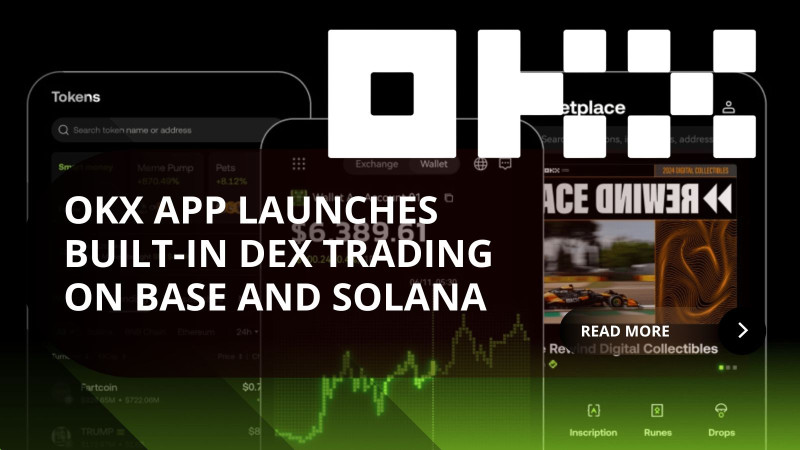
OKX Launches Built-In DEX Trading Across Base, Solana and X Layer
OKX Launches Unified DEX Trading for Base, Solana and X Layer
The global crypto exchange OKX has introduced a major upgrade to its app that integrates decentralized exchange (DEX) trading across multiple chains: Base, Solana and its own X Layer network. Users can now execute decentralized trades inside the OKX mobile application, enabling both centralized and decentralized trading from a single interface.
This move signals a new phase of centralized exchanges embracing DeFi liquidity rather than competing against it.
Unified interface for CEX and DEX
OKX’s update allows users to shift seamlessly between centralized order-books and on-chain markets. The wallet automatically sets up a self-custody passkey wallet when DEX mode is activated, ensuring users retain control of private keys while trading decentralized liquidity.
Liquidity is aggregated from more than 100 pools across supported chains, enabling the app to route orders toward the best available price.
Multi-chain support: Base, Solana and X Layer
-
On Base the integration taps into the growing ecosystem of Web3 apps building on its Ethereum-compatible roll-up.
-
On Solana the feature connects to high-performance on-chain DEXs that specialize in ultra-low fees and high throughput.
-
On X Layer OKX’s own modular Layer-2 supports EVM equivalence, throughput of several thousand transactions per second and is positioned to be a key part of OKX’s future modular infrastructure.
Self-custody meets exchange convenience
OKX emphasizes that users retain full self-custody of the DEX trades while benefiting from the liquidity and user-experience of a large exchange. For many retail users this removes the friction of switching between wallet apps, bridges and trading venues.
Lowering friction between CEX and DeFi
Historically traders faced two worlds: centralized exchanges (fast, liquid, custodial) and decentralized exchanges (non-custodial, self-sovereign, often clunkier). OKX’s integration helps bridge that divide. By offering both modes in one app it reduces switching cost and increases accessibility to on-chain markets.
Supporting multi-chain adoption
By including Base, Solana and X Layer networks OKX is betting that multi-chain strategies will dominate Web3. Users can access tokens, swaps and liquidity beyond a single network and participate in ecosystems that specialize in performance, low cost and innovation.
Strategic advantage for OKX
For OKX this feature furthers differentiation. Many exchanges now support wallet-apps, but fewer integrate full DEX trading across major chains inside their main app. OKX’s move could drive retention, user growth and stronger positioning in both CEX and DeFi sectors.
The broader context in DeFi evolution
Decentralized exchange volumes recently reached record highs with monthly totals exceeding $600 billion. The early DeFi wave emphasized pure open protocols while the current phase is more about unified UX, interoperability and ease of on-chain access from mass-market portals. OKX’s upgrade is consistent with this maturation trend.
At the same time, other major platforms are pursuing similar strategies. For example Coinbase recently added DEX access for Base network tokens and Binance has integrated wallet-native DEX routing on its app. OKX’s multi-chain DEX rollout therefore represents an escalation.
Potential risks and challenges
-
Liquidity fragmentation: Even though OKX aggregates over 100 pools, liquidity on some chains and tokens may still be shallow, increasing slippage for large trades.
-
Smart-contract and chain risk: Trading on-chain introduces protocol risks like bridge failures, network downtime or contract exploits which are less common on centralized markets.
-
Centralization criticism: While the feature offers non-custodial trading, critics may argue that routing via a centralized app reintroduces centralization trade-offs under the guise of decentralization.
-
User education: Retail users may assume the same protections apply across CEX and DEX modes; mismatches in custody, recovery or regulation awareness could lead to errors.
What to watch next
-
Adoption metrics: How many users enable the DEX mode and how much trading volume flows through the integrated system on each of the three chains.
-
Token listings: Will OKX prioritize new token launches or cross-chain assets via DEX mode, and how quickly will additional chains be added?
-
Development of X Layer: As OKX’s proprietary roll-up matures, liquidity and user activity on that network will be a key strategic indicator.
-
User experience and security feedback: Reports of slippage, wallet setup issues or custody concerns could influence how successful the rollout is.
-
Competitive responses: How other major exchanges respond with similar features, and whether this becomes standard across the industry.
Final thoughts
OKX’s rollout of built-in DEX trading across Base, Solana and X Layer marks a meaningful evolution in the convergence of centralized exchanges and decentralized finance. By enabling users to access on-chain liquidity from within a trusted exchange app, OKX is making DeFi more accessible, multi-chain, and user-friendly.
For traders and DeFi enthusiasts this is a powerful tool: multi-chain access, self-custody trading and deep-liquidity routing in a single environment. For OKX it is a strategic differentiation as the industry moves into its next phase of scale and adoption.
That said, execution will matter: how smoothly the feature works, how security is upheld and how users adopt it will determine whether this raises the bar for exchange-DeFi integration or remains a headline feature.
If OKX nails it, the result could be a clearer path for the average user to interact with DeFi fully, from wallet to swap to multi-chain strategy...all inside one seamless interface.
Stay Connected
You can stay up to date on all News, Events, and Marketing of Rare Network, including Rare Evo: America’s Premier Blockchain Conference, happening July 28th-31st, 2026 at The ARIA Resort & Casino, by following our socials on X, LinkedIn, and YouTube.
Coinbase Launches Regulated Token Sale Platform to Revive Public Offerings
Coinbase Launches Token-Sale Platform with Guardrails to Avoid ICO Chaos
Coinbase has rolled out a new token-sale platform designed to provide retail investors with access to early-stage crypto projects under a regulated framework. The initiative aims to revive public token offerings in a safer, more transparent manner while restoring trust in token sales.
According to the company’s announcement the platform will host roughly one token sale per month. The first offering featured Monad, a high-performance blockchain startup.
Participants will use USD Coin (USDC) to purchase tokens. Token allocations are determined via an algorithm rather than a first-come, first-serve mechanism. Project teams and affiliated insiders will be prohibited from selling their tokens for six months after the public sale in order to reduce speculative flipping.
Key Features of the New Platform
Algorithmic Allocation
Unlike many of the chaotic ICOs of the past the platform will compile purchase requests during a one-week submission window. After that the algorithm will determine allocations with the goal of broad and equitable participation. Small investors will be given a fair chance rather than being crowded out by big players.
Payments must be made using USDC and participants must complete identity verification and compliance checks in good standing with Coinbase.
Token Issuer Restrictions
Project teams, founders and affiliated parties will be barred from selling any tokens—whether private or publicly traded—for at least six months following the public sale on Coinbase. This lock-up provision is intended to align incentives between founders and public investors and avoid immediate dump scenarios.
Disclosure and Pricing Transparency
Issuers will be required to submit detailed disclosures covering tokenomics, vesting schedules and distribution mechanics. These documents will be publicly available providing prospective buyers clarity on what they’re purchasing and how the project is structured. The platform also plans to further develop features like limit orders, automatic reinvestment options and issuer-specific eligibility criteria.
Strategic Context and Rationale
Learning from the 2017-2018 ICO Boom
During the 2017 ICO surge thousands of projects raised capital via token sales with minimal oversight. Many lacked product roadmaps, operated without regulatory compliance and ended in large losses or scams. This new Coinbase platform seeks to avoid that history by embedding regulatory controls and design features to reduce speculative excess.
The algorithmic allocations, lock-up periods and rigorous issuer criteria reflect this change.
Retail Access Meets Institutional Standards
Previously early-stage token participation was largely reserved for venture capital and accredited investors. Coinbase’s platform opens this market to retail investors under a regulated process tied to its existing infrastructure and compliance regime. In addition Coinbase has made strategic acquisitions including token issuance platform Liquifi and capital-formation platform Echo which strengthen its ability to manage token launches, compliance and cap-table operations.
Diversification of Business Model
For Coinbase the token-sale platform represents a growth avenue beyond trading fees. By hosting early-stage token launches and integrating token issuers earlier in their lifecycle the exchange can deepen user engagement, expand its product suite and capture new revenue models as the crypto capital-formation market evolves.
Potential Benefits and Market Implications
-
Increased participation and democratization: Retail users gain more equitable access to early token launches.
-
Improved token quality and credibility: Issuers undergo vetting and lock-ups promoting longer-term alignment.
-
Competitive pressure on other exchanges: Coinbase may set a new standard for token launches under regulatory guardrails.
-
Boost to on-chain fundraising: The platform could catalyze a revival of public token offerings with better structure and oversight.
-
Enhanced secondary market liquidity: With tokens launching via Coinbase’s funnel, listings and liquidity may improve for projects post-sale.
Risks, Challenges and Watch-Points
-
Volume vs quality trade-off: If offerings are too restrictive it may limit deal flow or cause frustration among issuers seeking speed and capital.
-
Regulatory land-mines: Token sales remain subject to securities laws classification and regulatory enforcement. Any misstep on issuer vetting or investor protections could prompt scrutiny.
-
Scalability of governance and infrastructure: As the platform hosts more sales maintaining the rigor of disclosures, lock-up enforcement and user fairness will be operationally demanding.
-
Market sentiment and speculation: Even with guardrails speculative behavior could still dominate new token launches, possibly recreating volatile market dynamics.
-
Issuer reputation risk: Early failures or token launches that under-perform could damage the platform’s credibility and the broader token-sale model.
What to Watch Next
-
The performance and user-feedback of the first offering from Monad and how secondary trading unfolds.
-
Timeline for subsequent sales and how frequently the platform opens slots.
-
Additional features announced such as limit orders, reinvestment tools and issuer custom-allocations.
-
Regulatory responses—whether U.S. agencies view the platform model as compliant or require additional oversight.
-
Impact on the broader token-launch ecosystem—whether rivals adopt similar models or the industry shifts toward more regulated public sales.
Final Thoughts
Coinbase’s token-sale platform represents a meaningful step toward the institutionalization of crypto capital-formation. By introducing algorithmic allocations, issuer lock-ups and strong disclosure standards the exchange is attempting to reboot public token launches in a way that avoids the chaos of the ICO boom.
For retail investors it offers a structured opportunity to access early-stage crypto projects. For issuers it provides regulated access to a large investor base under Coinbase’s brand and infrastructure.
Ultimately the success of this initiative will depend on execution, project quality and market reception. If Coinbase can maintain disciplined rollout while delivering compelling token offerings this could set a new paradigm for how tokens are issued, sold and listed in the next phase of crypto.
The next few token sale cycles will tell whether this is merely a novelty or a foundational shift in how crypto projects raise capital and engage with the public.
Stay Connected
You can stay up to date on all News, Events, and Marketing of Rare Network, including Rare Evo: America’s Premier Blockchain Conference, happening July 28th-31st, 2026 at The ARIA Resort & Casino, by following our socials on X, LinkedIn, and YouTube.
CFTC Prepares to Approve Leveraged Spot Crypto Trading in the U.S.
CFTC Eyes First Leveraged Spot Crypto Products by Next Month
The Commodity Futures Trading Commission (CFTC) is reportedly preparing to allow leveraged spot crypto asset products to launch as early as next month. These products would enable retail and institutional traders to buy and sell cryptocurrencies like Bitcoin and Ether on a spot basis with margin or leverage, similar to traditional commodity trading instruments.
This initiative marks a major shift in U.S. crypto regulation. For years, regulators treated spot crypto as largely unregulated or under-enforced. Now, the CFTC is using its existing authority under the Commodity Exchange Act to extend oversight to spot crypto trading, especially trades involving leverage, margin, or financing.
What the Proposal Means
Leveraged spot crypto products would work like this: A designated contract market (DCM) or registered futures exchange would list spot crypto contracts that are backed by actual delivery of crypto or tracked via underlying assets. Traders could engage in margin trades on the spot market rather than relying solely on futures or derivatives.
This means platforms regulated under the CFTC could list inventory of crypto assets, allow participants to borrow or finance positions, and require clearing, custody, and risk-management frameworks similar to those in commodities markets.
The CFTC recently launched a “listed spot crypto trading initiative,” inviting comment on how to list these products, including how to handle clearinghouses, custodian arrangements, and whether crypto assets are commodities or securities. That initiative referenced Section 2(c)(2)(D) of the Commodity Exchange Act, which specifically governs retail commodity transactions offered on a leveraged, margined, or financed basis.
The CFTC and the Securities and Exchange Commission (SEC) have also issued a joint staff statement affirming that current law does not prohibit regulated exchanges from listing certain spot crypto asset products, including those with leverage. Together, these regulatory moves signal a clear shift toward opening margin and leverage trading of spot crypto in the U.S.
Why It’s Significant for Crypto Markets
-
Regulatory clarity and scale
For years, one of the key obstacles in the U.S. crypto market was uncertainty over how spot trading with leverage could function under existing law. By establishing a path for leveraged spot crypto trading under CFTC authority, the industry gains a bridge to larger-scale, regulated activity. -
Margin and leverage could bring more liquidity
Allowing spot crypto trading with margin may attract more participants, both retail and institutional, because they can use less capital to gain exposure. That could increase market depth and volatility. -
Domestic competition with offshore exchanges
Many existing leveraged crypto products are offered by overseas exchanges that lack full U.S. oversight. A regulated domestic pathway could shift volume from offshore platforms to U.S. venues, improving transparency and investor protection. -
Integration with futures and derivatives markets
Because these spot leveraged products could be listed on futures exchanges, the ecosystem of trading, hedging, and settlement may become more integrated. This could bring spot, futures, and options markets into closer alignment for crypto assets.
The Regulatory Mechanics and Timeline
The key regulatory anchor is Section 2(c)(2)(D) of the Commodity Exchange Act (CEA), which states that retail commodity transactions offered on a leveraged, margined, or financed basis must be conducted on a DCM or foreign board of trade (FBOT). Historically, this applied to futures and certain commodities. The CFTC is now interpreting this to apply to spot crypto if leverage or financing is involved.
On August 4, 2025, the CFTC launched its listed spot crypto trading initiative. Regulators invited public comments on how to implement listing spot crypto asset contracts on designated contract markets. Meanwhile, the CFTC’s acting chair has engaged with regulated exchanges and clearing organizations to prepare the framework.
Separately, the SEC-CFTC joint staff statement issued in early September affirmed that regulated U.S. exchanges may list spot crypto asset products and that margin and leverage are within scope, provided proper registration and oversight exist.
According to multiple reports, the CFTC is in active discussions with major exchanges, including futures venues such as CME, Cboe, and ICE, as well as crypto-native platforms, to list these leveraged spot products possibly by next month. That timeline positions the rollout sooner than many expected, though final approvals and exchange rule submissions remain necessary.
Potential Risks and Industry Implications
While this development could scale regulated crypto markets, several risks remain:
-
Clearing and custody risk: Spot leveraged contracts require robust clearinghouses and custodians. Any weakness in settlement or collateral arrangements could create systemic stress.
-
Market risk: Leverage amplifies both gains and losses. If leveraged retail positions grow without sufficient risk controls, it could increase volatility or trigger sharp liquidations.
-
Regulatory arbitrage: As U.S. venues expand these offerings, overseas platforms may still offer different terms. Fragmentation could persist unless the domestic offering is competitive on cost and efficiency.
-
Securities law overlap: The CFTC’s effort applies to “commodity” crypto assets. If tokens are deemed securities, the SEC retains oversight. Platforms must ensure proper asset classification and compliance.
What to Watch Next
-
Exchange rule filings: Watch for futures exchanges or DCMs submitting rule changes or product proposals for leveraged spot crypto contracts.
-
Clearinghouse partnerships: Expect new collaborations between clearing organizations and crypto custodians, which are essential for safe margin and settlement operations.
-
Public feedback: The CFTC’s open comment process will reveal where industry stakeholders align or disagree on the proposal’s structure.
-
Asset inclusion: Bitcoin and Ether are expected to be first, but whether other tokens join early will indicate how broad the regulatory green light truly is.
-
Margin parameters: The permitted leverage levels, such as 2x, 5x, or 10x, will determine the potential scale of new trading activity.
Final Thoughts
The CFTC’s push to approve leveraged spot crypto products marks a pivotal moment in U.S. digital asset regulation. It moves the market closer to a structure where spot trading of crypto under margin and leverage is not only possible but also regulated in line with traditional commodities.
For the crypto industry, this means deeper liquidity, greater institutional involvement, and a more secure trading environment. Yet it also raises the stakes. Leverage and margin create opportunity but also amplify risk. The success of this initiative will depend on how carefully exchanges, clearinghouses, and regulators manage execution and oversight.
If the launch proceeds as early as next month, it could accelerate crypto’s integration into mainstream financial markets and bring a new era of regulated spot trading to the U.S. The next few weeks may determine whether leveraged spot crypto becomes a lasting cornerstone of the industry or remains a tightly controlled experiment.
Stay Connected
You can stay up to date on all News, Events, and Marketing of Rare Network, including Rare Evo: America’s Premier Blockchain Conference, happening July 28th-31st, 2026 at The ARIA Resort & Casino, by following our socials on X, LinkedIn, and YouTube.
U.S. Senate and State AGs Unveil Landmark Crypto Market Structure Legislation
U.S. Senate and State AGs Unveil Landmark Crypto Market Structure Legislation
After months of build-up the U.S. Senate along with state attorneys general have released a landmark draft of crypto market-structure legislation intended to create a comprehensive regulatory framework for the digital asset industry. The bill seeks to establish clearer rules for exchanges, custodians, stablecoins, and token issuers, signalling a major step in integrating crypto markets into the broader financial-regulatory system.
Key provisions of the legislation
Exchange registration and custody oversight
One of the bill’s cornerstone features is the requirement that platforms offering token trading register as exchanges or alternative trading systems under federal law. Custodial service providers will face enhanced capital, segregation, and reporting standards similar to traditional securities and futures firms. This aims to reduce counterparty risk and improve investor protections.
Stablecoin regulation and redemption guarantees
Stablecoins are addressed explicitly in the legislation. Issuers must maintain redemption rights at par value, hold reserves in approved categories, and submit to regular audits. This creates a regulated pathway for stablecoins to operate under federal oversight rather than piecemeal state rules.
Token classification and issuance protocols
The bill also introduces a clearer set of rules distinguishing when a token is treated as a security versus when it remains a commodity or other asset. Token issuers will face registration or exemption requirements depending on utility, liquidity and decentralization factors. This aims to reduce legal ambiguity for projects and improve market integrity.
Inter-agency coordination and enforcement
The legislation mandates cooperation among the U.S. Securities and Exchange Commission (SEC), Commodity Futures Trading Commission (CFTC) and state regulators. A new federal-state crypto oversight council is proposed to harmonize enforcement, share data and coordinate cross-border investigations.
Investor protection and disclosures
Exchanges and token issuers will be required to disclose meaningful risk information, liquidity metrics and relationship with affiliated entities. Retail investors would gain clearer visibility into where their assets are held, how trades are processed and what rights they possess in the case of insolvency or cyber-attack.
Why this matters for crypto markets
Path to legitimacy
For years the crypto industry has operated across fragmented regulatory regimes with varying standards. This legislation offers the possibility of a unified federal framework that could increase trust, lower friction and bring institutional capital to the space.
Institutional onboarding
Clearer rules for custody, trading and stablecoin issuance reduce operational risk for large players. Institutional funds, fiduciaries and corporates may be more willing to enter crypto markets if they can rely on regulated entities rather than offshore or lightly supervised platforms.
Token projects and innovation
While increased regulation introduces burden the bill simultaneously provides clarity. Projects now have clearer paths to token issuance, less fear of regulatory surprise and improved access to U.S. markets. The transparency could foster broader crypto ecosystem growth, especially for high-quality protocols.
Risks and criticisms
-
Regulatory burden & cost Many smaller projects argue that compliance costs may favour large incumbents and stifle innovation in early-stage ecosystems.
-
Securities law crossover If tokens are treated as securities many projects may face retroactive registration or litigation risk. The timing and grandfathering provisions will matter.
-
Implementation complexity Coordinating federal and state regulators, aligning rules across 50 states and dealing with cross-border issues will be operationally intense.
-
Risk of over-regulation Some stakeholders worry the legislation may push innovation offshore or drive it underground if U.S. rules become too restrictive compared to global peers.
What to watch next
-
Senate floor votes and committee mark-ups The timeline for passing the legislation will influence market sentiment and business planning.
-
Rule-making phases Exchanges, custodians and token issuers will monitor how the SEC, CFTC and new oversight council implement the rules.
-
Stablecoin ecosystem response Will major stablecoin issuers adjust to the new reserve and audit standards and maintain parity?
-
Token classification outcomes How many tokens will be reclassified as securities and how quickly issuers will respond?
-
Global regulatory spill-over Other jurisdictions may adopt similar frameworks or respond to U.S. leadership in crypto regulation.
Final thoughts
The release of this crypto market-structure legislation marks a milestone in the maturation of the digital asset industry. By creating clearer rules for exchanges, custodians and issuers the U.S. is signalling that crypto is not outside the financial system—it is increasingly part of it.
For markets this means the potential for deeper liquidity, institutional participation and broader adoption—but also higher expectations around compliance, governance and transparency. The next phase of crypto may well depend less on token hype and more on regulated infrastructure, institutional trust and sustainable business models.
As this framework moves through Congress regulators and the industry alike will be watching closely. The outcome will shape not just the next bull market, but how crypto fits into global finance for years to come.
Stay Connected
You can stay up to date on all News, Events, and Marketing of Rare Network, including Rare Evo: America’s Premier Blockchain Conference, happening July 28th-31st, 2026 at The ARIA Resort & Casino, by following our socials on X, LinkedIn, and YouTube.
Uniswap Proposes UNIfication With UNI Burn, Protocol Fee Activation, and Governance Overhaul
Uniswap (UNIfication) Plan: UNI Burn, Fee Overhaul and Ecosystem Reset
A New Chapter for Uniswap and UNI
The protocol behind the leading decentralized exchange, Uniswap Labs, has introduced a sweeping governance proposal named “UNIfication”. The plan would activate protocol fees, burn large volumes of its native governance token UNI, and consolidate the protocol’s leadership and development teams.
At its heart the proposal is designed to align incentives, sharpen focus on growth and position Uniswap as the default exchange for tokenized assets. It marks a significant evolution for a protocol that has been dominant in DeFi but long-standing questions have remained about its tokenomics and monetization model.
Key Elements of the Proposal
UNI Token Burn
A major feature of the proposal is the retroactive burn of 100 million UNI tokens from the treasury. The team has stated that this amount represents what might have been burned had protocol fees been active since launch.
Additionally a portion of future trading fees—including fees from Uniswap’s new layer-2 network, Unichain—would be redirected into the burn process. This creates deflationary pressure on the token supply and promises enhanced value capture for long-term holders.
Protocol Fee Activation and Discount Auctions
Under the proposal trading fees on the protocol would be switched on. A new mechanism called Protocol Fee Discount Auctions (PFDA) would allow traders to bid for fee discounts while also internalizing MEV (maximal extractable value) capture. The revenue generated through these mechanisms would further fuel the UNI token burn.
Team and Governance Restructuring
Uniswap Labs and the separate entity Uniswap Foundation would merge their ecosystem and product teams under a unified leadership structure. A five-member board, including founders like Hayden Adams and others, would oversee growth strategy. Product offerings such as the Uniswap interface, wallet and API would pivot from independent monetization to zero-fee access so that future monetization aligns directly with holders of the UNI token.
Expansion of Uniswap v4 and Aggregator Model
Uniswap v4 is envisioned to function as an on-chain aggregator that hooks into external liquidity sources via new “hooks” architecture. The proposal emphasizes that Uniswap will capture trading fees from external protocols, not just its own AMM pools. This broadened revenue base underpins the fee and burn mechanics.
Why This Matters for UNI Holders and DeFi
For UNI token holders this proposal offers a clearer path to value capture. The token had long been perceived primarily as a governance token with limited economic upside. By activating fees and burning tokens, Uniswap is offering a mechanism for UNI holders to benefit from protocol performance.
From a market perspective the plan signals that the protocol is moving beyond being a pure AMM to becoming comprehensive infrastructure for tokenized assets, multi-chain liquidity and on-chain aggregators. In an ecosystem where protocol revenue and tokenomics matter more than ever, the timing appears aligned with broader DeFi maturation.
What to Watch Next
-
The Snapshot-vote timeline in the Uniswap DAO for the UNIfication proposal.
-
Detailed specifications of fee activation, discount auction parameters and burn schedule.
-
Metrics on swap volume, fees generated and UNI token burn rate once changes are enacted.
-
How Uniswap v4 and Unichain adoption evolve across chains and whether liquidity aggregation materializes.
-
Price action of the UNI token as markets digests the economic redesign and tokenomics shift.
Final Thoughts
The UNIfication proposal from Uniswap marks a pivotal moment for the protocol and its governance token. By activating fees, deploying a structured burn mechanism and consolidating leadership, Uniswap is offering UNI holders a more direct link between protocol growth and value capture.
If successful, the changes could redefine how decentralized exchanges monetize and distribute value in the DeFi era. UNI could shift from a governance play to a value-bearing asset aligned with ecosystem growth. For DeFi at large it suggests that leading protocols are evolving from infrastructure into autonomous economic engines.
That said, execution is key. Merging teams, introducing fees and reorganizing tokenomics demand precision. Unlocking the full potential of UNIfication will require discipline, community support and sustained trading activity. If Uniswap pulls it off, UNI’s role and value proposition could be significantly elevated.
Stay Connected
You can stay up to date on all News, Events, and Marketing of Rare Network, including Rare Evo: America’s Premier Blockchain Conference, happening July 28th-31st, 2026 at The ARIA Resort & Casino, by following our socials on X, LinkedIn, and YouTube.
Anchorage Digital Brings Institutional Credibility to Bitcoin DeFi
Anchorage Digital Brings Institutional Credibility to Bitcoin DeFi
Institutional infrastructure is beginning to enter one of crypto’s most promising frontiers: decentralized finance built on Bitcoin. The latest signal comes from Anchorage Digital, which announced it will provide regulated custody services for institutional clients engaging with emerging Bitcoin DeFi platforms such as BOB Finance.
This partnership marks a turning point for the industry. It signals that Bitcoin’s role in decentralized finance is no longer theoretical. It is becoming a regulated, investable reality for institutions that demand compliance, security, and transparency.
Understanding Bitcoin DeFi
For years, DeFi was synonymous with Ethereum and other smart contract platforms. Users could lend, borrow, and trade without intermediaries, while Bitcoin largely remained a store of value. Now, a new wave of developers is extending DeFi’s reach to Bitcoin.
Bitcoin DeFi refers to financial applications built on or around Bitcoin, where users can earn yield, provide liquidity, and interact with decentralized systems while still relying on Bitcoin’s robust network for security. The challenge has always been technical: Bitcoin’s scripting language is limited, so most of these innovations rely on Layer 2 solutions, sidechains, or bridging frameworks that connect Bitcoin to programmable networks.
Anchorage’s move brings something that has been missing: institutional-grade custody and compliance. For funds and corporate investors, this is what transforms experimentation into adoption.
Anchorage’s Institutional Advantage
Anchorage Digital is a U.S. federally chartered digital asset bank, one of the few with the regulatory approval to custody digital assets for institutional clients. Its entrance into the Bitcoin DeFi arena changes the calculus for institutional investors who have been hesitant to participate due to security and compliance concerns.
By offering custody and secure access to protocols like BOB Finance, Anchorage provides the backbone institutions need to engage with on-chain Bitcoin yield opportunities. This development not only reduces custody risk but also strengthens confidence that Bitcoin-based DeFi can scale under proper oversight.
For DeFi protocols, institutional custody means more than safety. It opens the door to deeper liquidity pools, regulated capital, and integration with traditional financial systems. The involvement of Anchorage suggests that institutional investors can now treat Bitcoin DeFi as a legitimate extension of their crypto strategy rather than an unregulated niche.
The Growth of Institutional Bitcoin DeFi
While the total value locked in Bitcoin DeFi remains small compared to Ethereum’s vast DeFi ecosystem, it is growing steadily. Platforms such as BOB Finance are exploring hybrid models that use Bitcoin as collateral while leveraging programmable infrastructure on other chains.
This design lets users access yield and lending opportunities tied directly to Bitcoin without giving up self-custody or transparency. The institutional entry point that Anchorage provides could unlock a wave of new participation from funds and treasuries that were previously sidelined.
Bitcoin’s reputation as the most secure network in the world gives it a natural advantage. If its liquidity and market cap can be mobilized through DeFi infrastructure, Bitcoin could become a productive financial asset, not just a passive store of value.
Bridging Bitcoin and DeFi
Bitcoin DeFi’s growth depends on interoperability — the ability to bridge Bitcoin’s stability and security with the flexibility of programmable ecosystems. The emerging solutions often use cross-chain infrastructure to connect Bitcoin to Ethereum-compatible networks, enabling lending, borrowing, and yield generation without losing Bitcoin exposure.
Anchorage’s involvement provides the compliance and governance layer necessary for that interoperability to appeal to institutions. It helps bridge two worlds that have long been siloed: traditional capital markets and decentralized protocols.
Challenges and Risks
Despite growing optimism, Bitcoin DeFi faces clear challenges. The technology remains young, and the bridges connecting Bitcoin to other networks carry smart contract and security risks. Regulatory clarity is also still evolving, especially as global watchdogs evaluate the role of tokenized assets, wrapped tokens, and decentralized lending systems.
However, Anchorage’s move indicates that progress is being made. Institutions are now demanding solutions that balance innovation with accountability, and that demand will accelerate the creation of safer, more transparent systems.
Final Thoughts
Anchorage Digital’s entry into Bitcoin DeFi represents a significant milestone for both Bitcoin and decentralized finance. It proves that institutions are ready to move beyond Bitcoin as merely a “store of value” and begin using it as a productive, yield-generating asset.
This evolution could redefine how capital flows across the crypto ecosystem. With secure custody, regulatory oversight, and growing cross-chain infrastructure, Bitcoin DeFi is emerging as the next major chapter in the asset’s story — one where Bitcoin becomes not only a symbol of digital sovereignty, but also a cornerstone of decentralized finance itself.
Stay Connected
You can stay up to date on all News, Events, and Marketing of Rare Network, including Rare Evo: America’s Premier Blockchain Conference, happening July 28th-31st, 2026 at The ARIA Resort & Casino, by following our socials on X, LinkedIn, and YouTube.
Bybit Expands Into Real-World Assets with Backed Finance Partnership for Tokenized Stocks
Bybit Expands Into Real-World Assets with Backed Finance Partnership for Tokenized
A new wave of tokenized equity products is reshaping how investors access global markets, and xStocks is leading the charge. Created by Backed Finance in partnership with Bybit and Mantle, xStocks allows tokenized versions of major U.S. company shares such as Nvidia (NVDA), Apple (AAPL), and MicroStrategy (MSTR) to be traded on-chain in a regulated, transparent, and globally accessible format.
Each xStock token is backed one-to-one by the underlying equity, which is held in custody by regulated third-party custodians. This approach ensures full backing while enabling the shares to move seamlessly within decentralized finance (DeFi) ecosystems.
How xStocks Works
For every xStock minted, a real-world share of the corresponding company is held by the issuer in custody. These tokens can then be traded 24/7 on platforms such as Bybit and used within DeFi protocols for lending, borrowing, or liquidity provision.
Bybit supports deposits and withdrawals of xStocks through the Mantle Network, which acts as the blockchain infrastructure layer connecting centralized and decentralized platforms. Mantle’s low fees and high performance make it an ideal environment for on-chain trading of real-world assets.
This structure allows investors to gain global exposure to leading U.S. equities without the limitations of traditional brokerage systems or market hours. Tokenized stocks can also be composed into smart contracts, collateral systems, and decentralized trading strategies, creating new opportunities for both traders and developers.
Why Tokenized Stocks Matter
The launch of xStocks marks a major step toward convergence between traditional finance (TradFi) and decentralized finance. By tokenizing shares of publicly traded companies and making them available on-chain, the project introduces a host of benefits:
-
Global access: Investors from almost any region can gain exposure to U.S. stocks without relying on traditional brokerages.
-
Composability: Tokenized stocks can integrate with DeFi platforms, enabling creative use cases such as yield farming or collateralized lending.
-
Continuous trading: Unlike traditional markets, xStocks can trade around the clock, while still tracking underlying asset prices through custodial backing and oracle feeds.
-
Fractional ownership: Smaller investors can gain access to high-value stocks through fractionalized token units.
This level of accessibility and flexibility represents a meaningful expansion of the global financial system into blockchain-based environments.
Key Partnerships Driving xStocks
-
Backed Finance serves as the issuer and compliance manager for xStocks, ensuring that each token is fully backed by a corresponding equity share and held under regulated custody.
-
Bybit, one of the world’s top crypto exchanges, provides the liquidity, infrastructure, and user base to make tokenized stock trading seamless.
-
Mantle Network delivers the blockchain infrastructure that underpins the system, offering a modular Layer 2 framework with high throughput and low transaction costs.
Together, these partners form a complete pipeline for bringing traditional assets onto the blockchain. Shares are securely held, tokenized, and then made accessible through regulated on-chain channels.
Use Cases and Early Listings
The initial lineup for xStocks includes a mix of technology and finance leaders such as Nvidia, Apple, Tesla, Coinbase, and MicroStrategy. Each stock is represented by a corresponding xStock token (for example, NV DAX for Nvidia and MSTRX for MicroStrategy).
Holders can store these tokens in self-custody wallets, trade them directly on Bybit, or integrate them into DeFi applications across the Mantle ecosystem. Over time, more equities and potentially ETFs may be added to expand the offering.
Regulatory and Market Considerations
While the concept is groundbreaking, tokenized securities carry some caveats:
-
No voting or dividend rights: Token holders typically gain economic exposure but not shareholder privileges like voting or direct dividend collection.
-
Jurisdictional restrictions: Residents of certain countries, including the United States, may be restricted from purchasing or holding xStocks until further licensing is obtained.
-
Price variance risk: During off-market hours, token prices can deviate from the underlying asset price, creating both arbitrage opportunities and liquidity risks.
-
Regulatory evolution: The treatment of tokenized stocks varies across jurisdictions, and projects like xStocks will likely face ongoing regulatory review as adoption grows.
Even with these considerations, the model represents a significant advancement toward a future where on-chain representations of real-world assets can coexist with traditional financial infrastructure.
A New Era for Real-World Assets
Tokenization of assets like equities, bonds, and commodities has long been viewed as the next frontier for blockchain adoption. Projects such as xStocks demonstrate that this vision is now moving from concept to implementation.
By combining regulatory compliance, on-chain transparency, and cross-border accessibility, xStocks delivers a clear example of how tokenized finance could evolve. The initiative also highlights the growing appetite for real-world assets (RWAs) among DeFi participants, who are increasingly seeking stable, yield-bearing alternatives to purely speculative tokens.
Final Thoughts
The xStocks launch represents more than a new trading product. It is part of a broader transformation of financial infrastructure — one that connects traditional equity markets to the programmable, borderless nature of blockchain.
Bybit, Mantle, and Backed Finance are positioning themselves at the intersection of these two worlds. If xStocks succeeds, it could pave the way for widespread tokenization of major assets, potentially redefining how investors trade, store, and leverage real-world value in the digital age.
As more institutions explore on-chain settlement, custodial bridges, and tokenized asset offerings, xStocks may be remembered as one of the early milestones that made Wall Street truly interoperable with Web3.
Stay Connected
You can stay up to date on all News, Events, and Marketing of Rare Network, including Rare Evo: America’s Premier Blockchain Conference, happening July 28th-31st, 2026 at The ARIA Resort & Casino, by following our socials on X, LinkedIn, and YouTube.

Alchemix v3 Upgrade Sparks ALCX 200% Surge as DeFi Eyes Revolutionary Self-Repaying Loans
Alchemix v3 and the Surge of ALCX: Is This Just the Beginning?
The ALCX token is soaring, up as high as 200% in the last two days, and traders are wondering if this is the start of something much bigger. The rally coincides with mounting anticipation for Alchemix v3, the protocol’s most ambitious upgrade yet, which promises to revolutionize how self-repaying loans and decentralized yield work across DeFi.
With new features, ongoing audits, and a community buzzing with excitement, Alchemix v3 is positioning itself as one of the most transformative developments in decentralized finance this year.
What Makes Alchemix v3 So Important
Alchemix built its reputation around a simple but powerful idea: self-repaying loans. Users deposit yield-bearing collateral, mint synthetic alAssets such as alUSD or alETH, and let yield progressively extinguish your debt. v3 keeps that core idea, but it changes where and how redemption pressure is handled in order to stabilize alAssets and improve fairness between borrowers, LPs, and arbitrageurs.
Version 3 retains that core innovation but introduces a completely new architecture designed for stability, efficiency, and growth.
1. A Stronger Foundation for Self-Repaying Loans
In previous versions, Alchemix loans depended heavily on fluctuating yields. With v3, the system gains predictability and balance through fixed-duration redemption periods. When users deposit stablecoins like USDC to mint synthetic assets such as alUSD or alETH, they will now have the option to redeem them one-to-one for their underlying collateral after a set time window.
This approach strengthens price pegs and prevents instability that can arise from volatile yield inflows. It also creates a more transparent redemption process, giving users clear expectations for how and when they can reclaim their collateral.
2. The Meta-Yield Token: A New Core Mechanism
Alchemix v3 introduces the Meta-Yield Token (MYT), a DAO-managed system that aggregates yield from multiple strategies across chains. Instead of forcing users to pick individual strategies, MYT automatically balances yield opportunities, optimizing for safety and return. The MYT is a composite of yield strategies integrated into one token, built on Morpho V2.
This design allows the Alchemix DAO to allocate capital dynamically, ensuring that collateral continues earning yield efficiently. The composition of the Meta-Yield Token (MYT) will differ across various chains, offering users a diverse mix of strategies tailored to their preferred risk levels...from conservative, low-yield options to more aggressive, high-return approaches. This design simplifies the yield-generation process, giving users a seamless and powerful experience that balances flexibility with accessibility.
3. Higher Capital Efficiency and Smarter Borrowing
One of the biggest changes in v3 is the increase in loan-to-value (LTV) ratios, allowing users to borrow up to 90% of their collateral in some pools. This boosts capital efficiency and makes the protocol more competitive with leading lending platforms. High loan-to-value borrowing of up to 90% requires strong protections.
As with any DeFi platform, there are inherent risks such as smart contract bugs, economic exploits, or poor strategy management that could lead to losses. Because the Meta-Yield Token (MYT) draws from multiple yield strategies, any underperforming strategy could affect the overall collateral base.
To address this, Alchemix v3 includes a transparent and well-defined liquidation framework that activates only if the MYT’s backing falls short. Liquidations are guided by fundamental oracles measuring real collateral value rather than volatile market prices, helping the system remain solvent and stable even under stress.
4. Security and the Audit Process
Before Alchemix v3 launches publicly, it is undergoing a public audit competition on Immunefi. Developers, researchers, and security specialists are reviewing every part of the new system, with a reward structure to incentivize discovery of vulnerabilities.
In addition to the audit competition, the team has hosted a technical walkthrough of the codebase, emphasizing transparency and security readiness. Alchemix’s reputation for careful, deliberate development continues to build trust among long-term holders and new investors alike.
The Market’s Reaction: ALCX Is on Fire
The excitement around v3 has spilled over into markets. Over the past 48 hours, ALCX surged as much as 200%, climbing from the low single digits to over $20 in major trading pairs. The spike in price coincides with growing speculation that the v3 upgrade could trigger renewed activity and liquidity in the protocol’s ecosystem.
This is not just a speculative rally. The token’s movement reflects a combination of fundamental optimism and investor enthusiasm for Alchemix’s evolution into a fully integrated, multi-chain DeFi platform. The market is reacting not just to hype, but to real, measurable progress in protocol design and governance.
Why People Are Paying Attention
-
Fundamentals Over Hype: Alchemix v3 introduces tangible, mechanical improvements that directly address issues of efficiency, yield consistency, and peg stability.
-
Proven Innovation: Alchemix pioneered the concept of self-repaying loans, and v3 builds on that legacy with a more sustainable model.
-
DAO Empowerment: The new Meta-Yield Token design increases transparency in how capital is deployed, appealing to both DeFi veterans and institutional watchers.
-
Upcoming Catalyst: The completion of the public audit and mainnet launch could represent major short-term catalysts for price and total value locked (TVL).
Looking Ahead: Is This the Start of a New Chapter for DeFi?
If Alchemix v3 delivers on its promises, it could set a new standard for decentralized lending. The upgrade’s combination of high capital efficiency, predictable redemptions, and streamlined user experience positions it as a next-generation alternative to traditional lending and yield protocols.
The surge in ALCX’s price may be more than a short-term pump — it could be an early signal that the market is recognizing the potential of self-repaying DeFi loans at scale. With the audit nearing completion and excitement building across the ecosystem, Alchemix v3 might represent the start of a broader wave of innovation in on-chain credit systems.
Final Thoughts
The ALCX rally tells a story that extends beyond price charts. It reflects renewed confidence in DeFi’s ability to evolve, adapt, and solve its own structural challenges.
With v3 introducing fixed-duration redemptions, a DAO-managed yield layer, and dramatically improved borrowing efficiency, Alchemix is making one of the most meaningful leaps in decentralized lending since its inception.
If markets are any indication, investors are already taking notice. Whether the price stabilizes or continues upward, one thing is clear — Alchemix v3 has reignited momentum in DeFi, and ALCX’s explosive rise may just be the opening chapter of what’s to come for this innovative team.
Stay Connected
You can stay up to date on all News, Events, and Marketing of Rare Network, including Rare Evo: America’s Premier Blockchain Conference, happening July 28th-31st, 2026 at The ARIA Resort & Casino, by following our socials on X, LinkedIn, and YouTube.
TRON Integrates LayerEdge for Bitcoin-Anchored Zero-Knowledge Verification
LayerEdge Brings Zero-Knowledge Verification and Bitcoin Security to the TRON Network
The TRON blockchain is taking a major step toward stronger verification and interoperability through its new integration with LayerEdge, a decentralized verification protocol that combines zero-knowledge (ZK) technology with Bitcoin-anchored security.
The partnership introduces a new layer of trust and scalability to TRON, allowing applications across its network to benefit from ZK verification, Bitcoin-backed immutability, and cross-chain interoperability. Together, these tools could reshape how TRON-based systems prove and secure their data.
What LayerEdge Does
LayerEdge is not a typical blockchain or rollup. Instead, it acts as a verification layer that uses zero-knowledge proofs to validate computations and state transitions across multiple blockchains and off-chain environments.
Its key innovation is anchoring verification data on Bitcoin, meaning every verified proof ultimately inherits Bitcoin’s unparalleled security and immutability. In practice, LayerEdge aggregates many individual proofs, such as those from TRON smart contracts or DeFi applications, compresses them into one compact ZK proof, and then records that proof’s hash on Bitcoin’s blockchain.
This gives the TRON ecosystem an independent and tamper-proof method of confirming that its transactions, smart contracts, or data proofs are valid, without relying solely on centralized validators or internal consensus mechanisms.
Why the TRON Integration Matters
TRON has rapidly grown into one of the most active blockchains for stablecoins, DeFi applications, and global payment infrastructure. With millions of daily users and over $50 billion in total value transferred across the network, scalability and trust are critical priorities.
By integrating LayerEdge’s ZK verification and Bitcoin anchoring, TRON gains several key advantages:
-
Enhanced security: Transactions and proofs on TRON can now be independently verified against Bitcoin’s immutable ledger, adding another layer of protection.
-
Cross-chain interoperability: TRON-based apps can interact with other LayerEdge-supported chains through shared verification layers, improving composability.
-
Reduced verification costs: Aggregating proofs minimizes on-chain computation, improving efficiency and transaction throughput.
-
Improved transparency: Developers and auditors can trace TRON proofs anchored on Bitcoin, ensuring end-to-end accountability.
This integration bridges two major blockchain pillars: TRON’s scalable performance and Bitcoin’s proven security. It also introduces the possibility of ZK-verified smart contracts and multi-chain DeFi ecosystems backed by Bitcoin trust.
How It Works
-
Proof Generation:
When TRON smart contracts execute, LayerEdge creates zero-knowledge proofs confirming the correctness of those transactions or computations. -
Proof Aggregation:
Multiple proofs from across the TRON ecosystem, including DeFi apps, stablecoin transactions, or staking programs, are aggregated into one compressed proof. -
Bitcoin Anchoring:
That single proof’s hash is then written to the Bitcoin blockchain. This process anchors the proof, meaning even if TRON were compromised, the verified data remains verifiable through Bitcoin’s immutable ledger. -
Verification and Auditing:
Anyone, including TRON developers, auditors, or users, can confirm proof validity via LayerEdge’s verification tools, ensuring trustless validation across networks.
A New Kind of Cross-Chain Security
This integration also positions TRON as part of a broader cross-chain verification ecosystem. LayerEdge’s architecture allows it to connect with any blockchain that supports proof submission, effectively making Bitcoin the shared “trust anchor” for multiple ecosystems.
For TRON, this opens new doors:
-
Bitcoin-anchored stablecoin security: Proof of reserves, transactions, and liquidity data can be verified across both networks.
-
TRON-based DeFi with external verification: Lending, staking, and liquidity protocols on TRON can now provide provable security assurances to cross-chain users.
-
Regulatory-grade transparency: Proofs of activity anchored to Bitcoin can be shared as immutable records for compliance or auditing, without revealing user data, thanks to zero-knowledge proofs.
Broader Context: ZK and Bitcoin Together
LayerEdge’s model of ZK verification anchored on Bitcoin is part of a larger movement to bring modern scalability and privacy tools to Bitcoin’s foundational security. While most ZK ecosystems have evolved on chains like Ethereum or Polygon, anchoring them to Bitcoin has been rare due to the network’s limited scripting capabilities.
LayerEdge overcomes this by using recursive proof aggregation and off-chain data availability layers to store and compress verification data, with only a minimal commitment recorded on Bitcoin. This approach preserves Bitcoin’s block space and keeps transaction costs low.
In TRON’s case, it effectively gives the network access to Bitcoin-level finality and trust, without compromising TRON’s high-speed, low-cost transaction model.
Historical Significance for TRON
For years, TRON has focused on scaling usability, transaction throughput, and global adoption. With this integration, the network now adds a verification layer comparable to institutional-grade auditing.
Founder Justin Sun has previously emphasized TRON’s commitment to decentralization, security, and interoperability. Partnering with LayerEdge extends that mission by connecting TRON’s ecosystem to Bitcoin, the original symbol of blockchain immutability, through the most advanced verification technology available.
This alignment places TRON among the first major smart contract platforms to incorporate Bitcoin-anchored ZK verification, positioning it ahead of competitors in transparency and cross-chain security.
Challenges and Next Steps
As with any major innovation, integration brings both opportunity and risk. Anchoring proofs on Bitcoin increases transparency and trust, but also introduces dependencies such as Bitcoin network fees and anchoring cadence, which determines how often proofs are written.
Still, TRON’s integration is a milestone. Future updates may include:
-
Broader cross-chain integration beyond Bitcoin anchoring.
-
Expansion of TRON DeFi protocols to use ZK verification for compliance and insurance.
-
Enhanced developer tooling for building ZK-verified TRON dApps.
Final Thoughts
LayerEdge’s integration with TRON marks a turning point for both ecosystems. For TRON, it brings Bitcoin-level security and zero-knowledge transparency to one of the world’s fastest and most active blockchains. For LayerEdge, it demonstrates how Bitcoin’s proof-of-work finality can underpin scalable, privacy-preserving systems across multiple chains.
The collaboration represents more than just a technical upgrade. It is a philosophical bridge that unites the speed and accessibility of TRON with the security and permanence of Bitcoin, powered by the mathematics of zero-knowledge cryptography.
If successful, this model could set a new precedent for Web3: where verification, privacy, and finality coexist seamlessly, and where Bitcoin serves as the ultimate foundation of truth for the decentralized world.
Stay Connected
You can stay up to date on all News, Events, and Marketing of Rare Network, including Rare Evo: America’s Premier Blockchain Conference, happening July 28th-31st, 2026 at The ARIA Resort & Casino, by following our socials on X, LinkedIn, and YouTube.

Romania Blacklists Polymarket for Unlicensed Crypto Betting
Romania Blacklists Polymarket in Crackdown on Unlicensed Crypto Betting
Romania’s National Office for Gambling (ONJN) has placed Polymarket, a popular blockchain-based prediction market, on its national blacklist for operating without a local gambling license. The move marks one of the first times a European regulator has explicitly targeted a decentralized crypto-betting platform.
What Happened
According to reports confirmed by Yahoo Finance and Gambling Insider, the ONJN issued an updated list of banned gambling and betting sites, adding Polymarket to the roster. The regulator said it would “not allow the transformation of blockchain into a screen for illegal betting.”
The blacklist directs internet service providers in Romania to block access to the listed sites. Operators without a license are considered unregulated gambling entities, regardless of whether they use crypto or fiat currencies.
Polymarket users in Romania have since reported difficulty accessing the platform, which runs on the Ethereum and Polygon networks and allows people to bet on outcomes of political events, sports, and social trends using stablecoins.
Why Polymarket Was Targeted
Under Romanian law, all gambling or betting platforms that serve local users must register with and obtain authorization from the ONJN. This includes online platforms that use cryptocurrencies.
Polymarket, which positions itself as a “decentralized prediction market,” does not hold a gambling license in Romania. The ONJN therefore treated it as an unlicensed operator, grouping it with dozens of other offshore betting sites that have been banned from local access in recent months.
Romania’s approach reflects a wider regulatory push across Europe to enforce licensing requirements even for decentralized or crypto-based services. Authorities argue that while blockchain can improve transparency, it cannot be used to bypass national gambling regulations.
A Growing Global Trend
Polymarket is no stranger to regulatory scrutiny. In 2022, the company paid a civil penalty to the U.S. Commodity Futures Trading Commission (CFTC) for operating unregistered event-based markets. Since then, it has implemented geo-blocking to limit access from certain jurisdictions.
Romania’s action follows similar moves by other countries tightening oversight of crypto-gambling platforms. Regulators in the United Kingdom, Italy, and the Netherlands have all increased enforcement against unlicensed or offshore betting operators, many of which use cryptocurrencies for wagers and payouts.
These measures form part of a global effort to bring crypto-related gambling into existing regulatory frameworks, focusing on consumer protection, anti-money-laundering compliance, and tax reporting.
What It Means for Users
For Romanian residents, access to Polymarket is now restricted. Users attempting to visit the site are redirected or blocked by local ISPs. Engaging with unlicensed gambling services can also expose users to penalties under national law.
Globally, the move underscores a clear message from regulators: using blockchain does not exempt a platform from traditional licensing requirements. While crypto-based betting platforms promote transparency and open participation, they remain subject to the same laws as conventional gambling operators.
Polymarket’s Position
Polymarket has not publicly commented on the Romanian blacklist, but the platform’s documentation already lists Romania among its “restricted jurisdictions.” The company has previously stated that it aims to operate responsibly within local regulations and continues to expand in markets where prediction markets are permitted.
Industry observers note that Polymarket’s technology itself is not illegal; the challenge lies in regulatory definitions. Many jurisdictions classify markets that allow users to profit from event outcomes as a form of gambling, regardless of how the bets are structured or settled on-chain.
A Broader Message
Romania’s decision is part of a larger balancing act between innovation and oversight. Regulators are increasingly recognizing the potential of blockchain technology, but they are also drawing firm lines around activities that resemble gambling or financial speculation.
For crypto-prediction markets, the key challenge ahead will be finding ways to remain open and decentralized while still complying with regional laws.
The ONJN’s statement summed up the sentiment clearly: blockchain cannot be used as a shield for unlicensed betting.
The Bottom Line
The blacklisting of Polymarket in Romania highlights a new phase in the global conversation about crypto regulation. As blockchain applications expand into areas like prediction markets and decentralized finance, governments are working to ensure these innovations operate under existing legal structures.
For Polymarket, the ban may limit its reach in one European market, but it also reinforces the growing need for dialogue between blockchain innovators and traditional regulators. Transparency and accountability, it seems, will remain central to the next chapter of crypto’s evolution.
Stay Connected
You can stay up to date on all News, Events, and Marketing of Rare Network, including Rare Evo: America’s Premier Blockchain Conference, happening July 28th-31st, 2026 at The ARIA Resort & Casino, by following our socials on X, LinkedIn, and YouTube.