#Telecom
World Mobile Network Builder Auction 2 Launches with Rapid Momentum

World Mobile kicked off Network Builder Auction 2 at full speed, officially going live on January 15, 2026. Within the first 12 hours, more than half of the 50 available hexes were claimed, signaling strong demand and growing confidence in the Network Builder franchise model. The auction immediately delivered a mix of major metropolitan markets, rural regions, and high-traffic vacation destinations.
Notable early markets included Fairbanks, Alaska, Seattle, Washington, St. Louis, Missouri, Topeka, Kansas, and Salt Lake City, Utah. Pittsburgh, Pennsylvania emerged as a particularly strong contender, with eight additional hexes purchased and a total of twelve hexes sold across the greater Pittsburgh metropolitan area. The Steel City appears poised to represent World Mobile prominently, complete with its iconic black and yellow.
Florida also saw continued expansion. Coral Bay joined its Gulf Coast neighbor Tampa from the previous auction, while North Key Largo extended World Mobile’s footprint from the southern tip of the Sunshine State. Two hexes along the southern New Jersey coast also entered the auction mix, further expanding coastal coverage.
Rural expansion remained a central theme throughout Auction 2. Continued growth was seen across Iowa, New Mexico, Texas, and the North Carolina coast. Notable additions included Bald Head Island and Sunset Beach in North Carolina, Carlsbad, New Mexico, and San Antonio’s greater south side. These markets highlight World Mobile’s continued focus on areas historically underserved by traditional telecom providers.
Auction 2 also introduced a new dynamic not previously seen on auction day. The Roanoke and Salem, Virginia area made a strong debut, with two hexes purchased instantly using the “buy now” feature at $900 each. In total, six connected hexes were secured in the area, putting the region firmly on the World Mobile map.
Vacation destinations played a major role in this round as well. Nantucket Island, Massachusetts, often considered the summer playground of East Coast elites, appeared on the board and brought much-needed connectivity attention to the island. Located roughly 30 miles south of Cape Cod, Nantucket is a seasonal hotspot that large telecom companies have long treated as expendable due to fluctuating demand. This has often resulted in outdated infrastructure being deployed for some of their wealthiest customers. The hope is that a local Network Builder identified this gap, aiming to both improve service and capitalize on the opportunity.
Additional underserved vacation areas joined the network, including one hex claimed in the Hawaiian Islands on Kauai. Texas vacation country continued to expand with Breckinridge, a lake market nestled in the Texas Hill Country. This region is frequently overlooked by major telecom providers due to geographic challenges. Rugged terrain, extreme elevation changes, dense mesquite growth, briar patches, creeks, lakes, boulders, and rock slides make infrastructure deployment and maintenance difficult. Combined with a roughly two-hour drive from the Dallas–Fort Worth metroplex, Breckinridge has remained unattractive to big telecom operators, creating an ideal opening for World Mobile Network Builders.
Several notable bids stood out during Auction 2. Salt Lake City’s Sandy suburb closed at $3,898.46. Pittsburgh’s Emworth neighborhood followed closely at $3,449.26. San Antonio’s south side Elmendorf neighborhood sold for $811.17. Seattle’s Keyport neighborhood closed at $698.82, while St. Louis’ East Carondelet neighborhood sold for $669.03. Carlsbad, New Mexico came in at $525.32, making it one of the more expensive low-population markets on the map. By comparison, Nantucket Island listed at $229.86.
Investors in larger metropolitan areas will be looking to capitalize on higher customer density and bandwidth demand. World Mobile coverage in these markets is expected to provide relief to users who frequently experience throttling from major telecom providers during peak hours and large events. Population density combined with bandwidth limitations remains a key revenue driver in urban markets.
Rural markets, however, offer a different value proposition. In these areas, users are likely to roam onto World Mobile’s network simply because traditional carriers often fail to provide reliable service at all. By delivering infrastructure that large telecom companies have neglected for decades, Network Builders are expected to bring meaningful connectivity improvements to rural communities. This approach aligns closely with World Mobile’s mission to deliver a cheaper, better, and more private cellular experience, while earning strong local support.
This continued expansion reflects World Mobile’s community fully embracing the mission to “connect the unconnected,” as outlined by founder and CEO Micky Watkins. In just over a week, 100 franchises have been sold across 18 states, spanning coast to coast and extending to the islands. With this level of momentum, World Mobile storefront openings appear imminent.
If Auction 3 launches next week as expected, another 50 franchises will enter the market. Questions remain around whether every state will eventually adopt World Mobile, or if some regions will resist, similar to patterns seen in fast food franchise adoption. There are also open questions about long-term profitability across states with varying tax laws. Despite these uncertainties, early Network Builders are not hesitating.
Some investors have committed heavily to large markets, betting on demand and scale. Others are building networks in rural communities, aiming to improve local infrastructure while earning returns for their efforts. Auction 2 closed faster than Auction 1, wrapping up in just 20 hours compared to 22 hours during the first week. This occurred during the same week a Verizon outage impacted large portions of the country, further fueling investor confidence as weaknesses in traditional telecoms became more visible.
Within 36 hours, all sales will finalize, further reshaping the U.S. telecommunications landscape into something more decentralized and user-friendly. Announcements are expected in many of these markets, including half-off discounts for the first month of service and potential storefront openings. Given the level of early investment and anticipation surrounding the World Mobile User Network, it is increasingly clear that at least one Network Builder is ready to open shop.
Auction 2 has now wrapped, closing out the second auction recap. To stay informed on Auction 3, follow the World Mobile Discord and Telegram channels, and check back with Rare News for the next recap if you are enjoying these updates.
World Mobile Launches Network Builder Platform in the United States
World Mobile’s Network Builder Launch Signals a New Era for Community-Owned Telecom
World Mobile officially brought its long-anticipated Network Builder platform online on January 8, 2026, marking the next major phase of its decentralized sharing network. The rollout, led by World Mobile CEO and Founder, Micky Watkins, launched with 50 Hexes, telecom franchise NFTs, available for auction across the United States.
Interest was immediate. Within 12 hours of launch, half of the 50 hexes already had opening bids. Some of the largest early markets included Pittsburgh, Pennsylvania, Kansas City, and Tampa, Florida. Smaller markets also saw fast activity, stretching from Kodiak Island, Alaska, down to rural Alabama, Iowa, Minnesota, Missouri, New Mexico, and the North Carolina coast.
One of the more notable early bidding areas was Lake Travis outside Austin, Texas. Seven hexes covering the entire popular vacation area were bid on early and aggressively. Anyone familiar with Lake Travis knows cell service there is almost nonexistent. South Lake Tahoe also appeared on the auction board, another high-end vacation destination with notoriously poor coverage. In both cases, the issue is not demand, but infrastructure. Large telecom companies have little incentive to invest in difficult or geographically challenging areas when existing profits are already strong elsewhere.
Within 22 hours of the auction launch, all 50 hexes were claimed. Just 26 hours later, those sales were set to finalize, effectively laying the groundwork for a new nationwide mobile network option. The real-world functionality is what stands out. Individuals in smaller markets can start their own telecom franchise with opening bids as low as $90. Larger markets commanded higher prices, with Pittsburgh reaching $16,775 and Tampa closing at $2,535.
Network Builders begin at level one. After selling 1,000 phone plans, they advance to level two, unlocking the ability to buy, sell, and install hardware such as transmitters. Local Network Builders are responsible for onboarding customers, opening storefronts, running advertising, and expanding hardware coverage within their purchased hex. Owning land inside a hex is an advantage, as it allows builders to host transmitters directly on their own property.
Telecommunications deserts are just as real as food deserts, and World Mobile’s platform is designed to address that gap. By lowering the cost of entry and decentralizing ownership, the company is aiming to bring lasting infrastructure to underserved areas that traditional telecoms have ignored.
Mainstream crypto adoption suddenly feels closer. World Mobile storefronts are expected to open within weeks in several major U.S. markets, offering a real-world product that consumers will use without needing to understand crypto at all. Everyone needs a phone. The question is whether American consumers are ready for a new cellular provider opening in their neighborhood.
Given the current state of the U.S. telecom industry, the answer may be yes. Network Builders, the investors who purchased these franchises, will be offering half-off discount on the first month of service to customers who switch to World Mobile. In the current economy, saving money matters. So does the idea of switching to a service built locally, not by a massive corporation, but by a neighbor operating a local franchise of what aims to become a major telecom player.
From a business perspective, Network Builder resembles opening a fast-food franchise, but at a far more accessible price point for entrepreneurs. It represents a blockchain powered alternative for small town America, where large telecom companies have long prioritized profit over infrastructure, often charging full price for poor service while offering perks like bundled streaming subscriptions to mask the underlying issues.
Instead of that model, World Mobile positions itself as a community-built network with real accountability and improved service. It will be worth watching how the first group of Network Builders performs and where the next World Mobile franchises open across the United States. If Network Builder delivers at scale, World Mobile will have done more than launch a new cell service. It will have shown that blockchain-backed, community-owned infrastructure can compete where legacy telecom has stalled.
The second auction of 50 hexes is expected to begin soon. Those interested in future launches and auction updates should stay connected through the World Mobile Discord and Telegram groups.
World Mobile Stratospheric Could Disrupt Starlink and Transform Global Connectivity
World Mobile Stratospheric Could Disrupt Starlink and Transform the Future of Global Connectivity
A new wave of high-altitude connectivity is beginning to emerge, and it could challenge everything we thought we knew about satellite internet. World Mobile Stratospheric, an initiative within the World Mobile ecosystem, is developing stratospheric aircraft and airships that beam internet and mobile service from the sky. These platforms could deliver lower latency, broader coverage, and cheaper deployment than satellite networks, including SpaceX’s Starlink. World Mobile Stratospheric say they are on the verge of making internet-beaming from the stratosphere, the layer of Earth's atmosphere roughly 6 miles to 31 miles above the planet, a reality. They also claim their approach will be better and more affordable than satellite megaconstellations in low Earth orbit, and another huge step forward towards their goal of connecting the world’s unconnected.
If successful, this approach may not only compete with Starlink, it could outperform it in many real-world scenarios and reshape the future of global connectivity.
What World Mobile Stratospheric Is Building
World Mobile Stratospheric is a program built around high-altitude aircraft and drones designed to operate around 60,000 feet. At this altitude, the aircraft can cover enormous geographic areas, potentially up to 15,000 square kilometers per platform, using steerable radio beams that deliver 5G, broadband, and mobile connectivity directly to user devices.
This aerial layer connects to the World Mobile Chain, a decentralized network that uses a combination of ground nodes, community-run AirNodes, and blockchain-based incentives. By combining telecom infrastructure with decentralized economics, World Mobile offers a model where communities and individuals participate in coverage and receive rewards for contributing bandwidth and infrastructure.
In simple terms, the system blends high-altitude platforms with a decentralized telecom economy to create a flexible, cost-effective connectivity network.
Why Stratospheric Aircraft Could Outperform Starlink
Starlink remains a powerful solution for fixed broadband and rural homes, but it has limitations that World Mobile’s architecture directly addresses.
Lower Latency and Faster Response
Stratospheric aircraft are far closer to Earth than low-Earth-orbit satellites. That shorter distance means lower latency, faster speeds, and a better experience for latency-sensitive applications. While LEO satellites perform better than traditional satellite internet, they still cannot match the physics of a platform tens of thousands of feet away instead of hundreds of miles.
Cheaper Deployment and Greater Flexibility
Launching satellites is extremely expensive, and updating or repairing them is even more costly. Stratospheric aircraft can land, undergo maintenance, be repositioned, or even be replaced at a fraction of that cost. This allows for rapid deployment, rapid scaling, and easy optimization when coverage needs change.
Better for Emerging Markets and Rural Regions
Remote and underserved regions are expensive to cover with ground towers or satellite networks. World Mobile Stratospheric has a stronger economic case for developing countries because it requires less capital than building tower networks and does not need a massive satellite constellation.
Mobile-Friendly, Not Just Broadband
While Starlink focuses primarily on fixed broadband, World Mobile’s airborne platforms are designed to integrate directly with mobile networks. They can deliver 5G or LTE signals straight to phones, something Starlink cannot currently do without additional hardware or specialized spectrum agreements.
Stratospheric platforms may not fully replace satellite networks in every case, but they have a strong chance to outperform them in several mass-market use cases, especially where mobile connectivity is essential.
If WMS scales globally, Starlink may lose dominance in the mobility and emerging-market segments of the connectivity economy.
The Role of World Mobile Chain and Decentralized Infrastructure
A major differentiator for World Mobile is its decentralized model. Instead of relying solely on a centralized operator, World Mobile distributes infrastructure across community operators. AirNodes, EarthNodes, and third-party operators help run the system while earning rewards through the World Mobile Chain.
This makes the network more resilient, more economically inclusive, and more scalable. It turns connectivity into a shared community resource rather than a top-down service offered only by large corporations.
This model pairs naturally with stratospheric platforms, which serve as ultra-high-coverage layers that tie all ground infrastructure together.
Key Milestones and Industry Signals
World Mobile Stratospheric is gaining momentum with several important developments:
-
Multiple test flights and trials have demonstrated high-altitude connectivity performance and long-range coverage.
-
A partnership with Protelindo positions World Mobile to serve Indonesia, one of the world’s most challenging geographies for telecom infrastructure.
-
Flight tests scheduled with Britten-Norman aircraft aim to validate 5G connectivity, multi-beam broadcasting, and integration with local mobile networks.
-
Reports indicate the system may support more than half a million simultaneous mobile connections per platform.
These milestones reflect growing confidence that stratospheric platforms can operate at scale.
Challenges That Still Need to Be Solved
While the promise is enormous, World Mobile Stratospheric must address important challenges:
-
Aviation and spectrum regulations require coordination with multiple authorities.
-
Long-duration high-altitude flight must be validated for safety and reliability.
-
Ground integration must be seamless across different regions and mobile operators.
-
Large-scale manufacturing and aircraft deployment must reach commercial feasibility.
-
Competition from other high-altitude platform providers, as well as Starlink’s future upgrades, will remain intense.
The technology must prove itself not only in isolated trials, but in real-world, long-term commercial deployment.
Final Thoughts
World Mobile Stratospheric represents one of the most innovative connectivity models in the world. By combining high-altitude aircraft, decentralized telecom infrastructure, and blockchain-powered economics, WMS is aiming to reshape how the world connects.
Starlink changed the satellite industry. World Mobile now wants to change the entire connectivity ecosystem.
If high-altitude platforms can deliver the performance, cost efficiency, and flexibility promised, they could disrupt satellite broadband and become the preferred solution for mobile coverage, rural connectivity, and rapid deployment around the globe.
The future of the internet may not be in orbit. It may be floating quietly above the clouds, bringing fast and affordable connectivity to the entire world, allowing the world to reclaim power over their connectivity.
Stay Connected
You can stay up to date on all News, Events, and Marketing of Rare Network, including Rare Evo: America’s Premier Blockchain Conference, happening July 28th-31st, 2026 at The ARIA Resort & Casino, by following our socials on X, LinkedIn, and YouTube.
World Mobile - A Community Driven Revolution

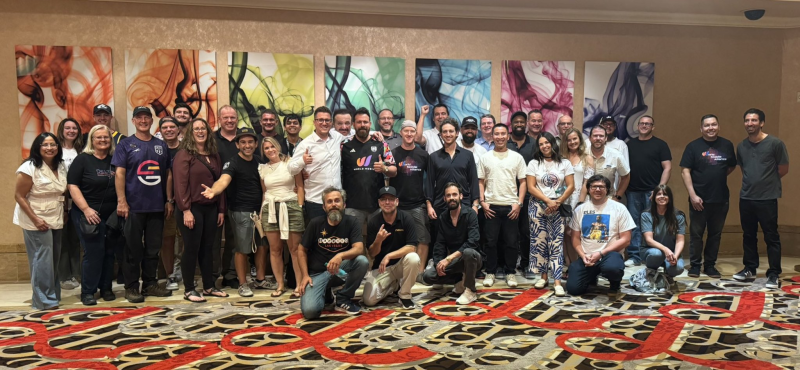
The World Mobile Alliance (WMA) has grown from a small community gathering into a major force within the World Mobile Network ecosystem. What started as a chance meeting at Rare Evo in Denver in 2022 has now transformed into an organized movement that actively supports and promotes World Mobile’s mission of decentralizing telecom infrastructure through blockchain technology.
We had the privilege to sit down with Rob and Clover Nodes of WMA to learn about the roots of the alliance and how community is the driving force of this ever-growing business. Here’s what we got:
The Birth of the World Mobile Alliance
The World Mobile Alliance came to life when a handful of passionate individuals discovered that Will Reid, a World Mobile team member, would be attending Rare Evo in Denver in 2022. Seeing this as an opportunity, a group of enthusiasts—including Clover, Rob, and others—organized an impromptu meetup by a waterfall, drawing 13 attendees who mostly held Earth Node reservations.
This was the first in-person gathering of community members planning to operate within the World Mobile Network. At the time, engagement with World Mobile was limited to occasional AMAs and promotional videos, leaving the community craving more interaction. The WMA quickly took matters into their own hands, organizing weekly Twitter Spaces and live streams, which became the backbone of a vibrant, growing community.
Expanding the Alliance
Encouraged by their initial success, the WMA pushed for greater involvement at Rare Evo 2023 in Denver. They lobbied the World Mobile team, securing a booth and a main-stage speech by Micky Watkins, World Mobile CEO. Their relentless advocacy ensured that the community had a place at the table, hosting dedicated meetups for Earth Node operators and fostering a deeper connection among supporters.
By Rare Evo 2024 in Las Vegas, the Alliance had cemented itself as a key player, running a booth gifted by the Rare Evo team. Recognizing their commitment and influence, World Mobile decided to hand over booth operations entirely to the Alliance, placing their trust in the community to represent the brand. The success of this collaboration has set the stage for an even bigger presence at Rare Evo 2025, marking the fourth consecutive year of WMA’s involvement.
Unprecedented Growth and Global Reach
The Alliance has experienced exponential growth, with attendance at meetups doubling or tripling each year. From the original 13 attendees, the numbers have skyrocketed, with projections indicating another doubling in 2025 as members from Europe, South America, and beyond join the movement.
A testament to World Mobile’s commitment to decentralization, the company has consistently empowered the community. Micky Watkins once observed Alliance members engaging attendees at a booth and later remarked, “You guys get it; we don’t even need to be here.” This confidence led to the WMA’s official role in hosting booths at major events, showcasing the depth of community expertise and dedication.
How the Community Can Get Involved
Participation in the World Mobile ecosystem extends beyond running booths. The Alliance is spearheading initiatives such as World Mobile Day at Rare Evo 2025, which will feature:
- Educational seminars
- Meetups for Earth Node operators, Air Node operators, and Hex Guardians
- Collaborations with projects like Minutes Network
- Networking opportunities to enhance adoption
Additionally, WMA continues to host weekly X Spaces and bi-weekly YouTube live streams, providing platforms for project discussions, discussing blockchain-based ventures, and the launch of the World Mobile Chain.
Understanding World Mobile’s Technology
World Mobile operates on a sharing economy model, incentivizing individuals to participate in telecom infrastructure rather than just subscribing to it. Here’s how:
- Earth Nodes: The blockchain backbone of the network, responsible for processing and storing data securely on-chain. Operators are rewarded in WTMX, the World Mobile cryptocurrency.
- Air Nodes: Physical broadcast devices that transmit the World Mobile network signal. Owners can host them locally or remotely, earning a share of network revenue.
- Hexes and Scanning: The world is divided into hexagonal coverage zones, and users can scan and map network availability using a mobile app, earning rewards while providing critical data for deployment.
By leveraging these technologies, World Mobile is building a decentralized, community-powered telecom network, rewarding those who contribute to its expansion.
The Road Ahead: Rare Evo 2025 and Beyond
As the Alliance prepares for Rare Evo 2025, they plan to make an even greater impact. The vision includes:
- World Mobile Day with panels, workshops, and networking events
- Expanding educational efforts on blockchain-based telecom solutions
- Engaging new markets and international communities
- Organizing social and networking events, ensuring strong community bonds
From just 13 individuals in 2022 to potentially over 200 dedicated members in 2025, the World Mobile Alliance has transformed from a grassroots initiative into an influential decentralized movement. As they say, “We’re here because of each other, and we’re bringing more people into the vision of a truly decentralized, community-run mobile network.”
For those looking to join the movement, follow @WorldMobilers on X for updates and engagement opportunities.