#DEX
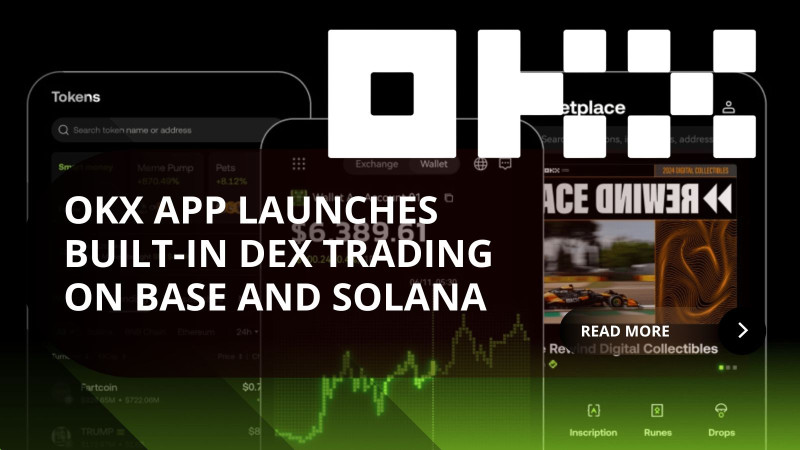
OKX Launches Built-In DEX Trading Across Base, Solana and X Layer
OKX Launches Unified DEX Trading for Base, Solana and X Layer
The global crypto exchange OKX has introduced a major upgrade to its app that integrates decentralized exchange (DEX) trading across multiple chains: Base, Solana and its own X Layer network. Users can now execute decentralized trades inside the OKX mobile application, enabling both centralized and decentralized trading from a single interface.
This move signals a new phase of centralized exchanges embracing DeFi liquidity rather than competing against it.
Unified interface for CEX and DEX
OKX’s update allows users to shift seamlessly between centralized order-books and on-chain markets. The wallet automatically sets up a self-custody passkey wallet when DEX mode is activated, ensuring users retain control of private keys while trading decentralized liquidity.
Liquidity is aggregated from more than 100 pools across supported chains, enabling the app to route orders toward the best available price.
Multi-chain support: Base, Solana and X Layer
-
On Base the integration taps into the growing ecosystem of Web3 apps building on its Ethereum-compatible roll-up.
-
On Solana the feature connects to high-performance on-chain DEXs that specialize in ultra-low fees and high throughput.
-
On X Layer OKX’s own modular Layer-2 supports EVM equivalence, throughput of several thousand transactions per second and is positioned to be a key part of OKX’s future modular infrastructure.
Self-custody meets exchange convenience
OKX emphasizes that users retain full self-custody of the DEX trades while benefiting from the liquidity and user-experience of a large exchange. For many retail users this removes the friction of switching between wallet apps, bridges and trading venues.
Lowering friction between CEX and DeFi
Historically traders faced two worlds: centralized exchanges (fast, liquid, custodial) and decentralized exchanges (non-custodial, self-sovereign, often clunkier). OKX’s integration helps bridge that divide. By offering both modes in one app it reduces switching cost and increases accessibility to on-chain markets.
Supporting multi-chain adoption
By including Base, Solana and X Layer networks OKX is betting that multi-chain strategies will dominate Web3. Users can access tokens, swaps and liquidity beyond a single network and participate in ecosystems that specialize in performance, low cost and innovation.
Strategic advantage for OKX
For OKX this feature furthers differentiation. Many exchanges now support wallet-apps, but fewer integrate full DEX trading across major chains inside their main app. OKX’s move could drive retention, user growth and stronger positioning in both CEX and DeFi sectors.
The broader context in DeFi evolution
Decentralized exchange volumes recently reached record highs with monthly totals exceeding $600 billion. The early DeFi wave emphasized pure open protocols while the current phase is more about unified UX, interoperability and ease of on-chain access from mass-market portals. OKX’s upgrade is consistent with this maturation trend.
At the same time, other major platforms are pursuing similar strategies. For example Coinbase recently added DEX access for Base network tokens and Binance has integrated wallet-native DEX routing on its app. OKX’s multi-chain DEX rollout therefore represents an escalation.
Potential risks and challenges
-
Liquidity fragmentation: Even though OKX aggregates over 100 pools, liquidity on some chains and tokens may still be shallow, increasing slippage for large trades.
-
Smart-contract and chain risk: Trading on-chain introduces protocol risks like bridge failures, network downtime or contract exploits which are less common on centralized markets.
-
Centralization criticism: While the feature offers non-custodial trading, critics may argue that routing via a centralized app reintroduces centralization trade-offs under the guise of decentralization.
-
User education: Retail users may assume the same protections apply across CEX and DEX modes; mismatches in custody, recovery or regulation awareness could lead to errors.
What to watch next
-
Adoption metrics: How many users enable the DEX mode and how much trading volume flows through the integrated system on each of the three chains.
-
Token listings: Will OKX prioritize new token launches or cross-chain assets via DEX mode, and how quickly will additional chains be added?
-
Development of X Layer: As OKX’s proprietary roll-up matures, liquidity and user activity on that network will be a key strategic indicator.
-
User experience and security feedback: Reports of slippage, wallet setup issues or custody concerns could influence how successful the rollout is.
-
Competitive responses: How other major exchanges respond with similar features, and whether this becomes standard across the industry.
Final thoughts
OKX’s rollout of built-in DEX trading across Base, Solana and X Layer marks a meaningful evolution in the convergence of centralized exchanges and decentralized finance. By enabling users to access on-chain liquidity from within a trusted exchange app, OKX is making DeFi more accessible, multi-chain, and user-friendly.
For traders and DeFi enthusiasts this is a powerful tool: multi-chain access, self-custody trading and deep-liquidity routing in a single environment. For OKX it is a strategic differentiation as the industry moves into its next phase of scale and adoption.
That said, execution will matter: how smoothly the feature works, how security is upheld and how users adopt it will determine whether this raises the bar for exchange-DeFi integration or remains a headline feature.
If OKX nails it, the result could be a clearer path for the average user to interact with DeFi fully, from wallet to swap to multi-chain strategy...all inside one seamless interface.
Stay Connected
You can stay up to date on all News, Events, and Marketing of Rare Network, including Rare Evo: America’s Premier Blockchain Conference, happening July 28th-31st, 2026 at The ARIA Resort & Casino, by following our socials on X, LinkedIn, and YouTube.
DeFi Surges Ahead as Decentralized Exchanges Top $1 Trillion in Monthly Volume
DeFi Surges Ahead as Decentralized Exchanges Top $1 Trillion in Monthly Volume
A turning point for decentralized finance and the next wave of blockchain innovation
Decentralized finance just hit another major milestone. For the first time ever, decentralized exchanges (DEXs) recorded more than $1 trillion in monthly trading volume. This achievement highlights how DeFi has evolved from a niche experiment into a core pillar of the global crypto economy.
The surge reflects a growing appetite for permissionless trading, better infrastructure, and a new level of confidence in decentralized platforms.
A Record Month for DeFi
Throughout September 2025, decentralized exchanges saw explosive growth in both spot and derivatives trading. Platforms specializing in perpetual futures, often called “perp DEXs,” led the way by crossing the $1 trillion mark in total monthly activity.
Trading volume soared as market volatility increased, drawing in traders looking for liquidity and flexibility. What makes this especially significant is that decentralized exchanges achieved volumes once thought possible only on centralized platforms.
This moment signals that DeFi is no longer a secondary market. It is becoming the main arena for digital asset trading.
What’s Behind the Surge
Several key factors are driving this wave of adoption:
1. Mature Infrastructure and Seamless User Experience
DEX platforms have come a long way. Today’s decentralized exchanges offer the speed, stability, and intuitive interfaces that rival traditional trading venues. Many now feature lightning-fast transaction times, deep liquidity pools, and cross-chain functionality that lets users trade assets from multiple blockchains.
2. Empowered Traders and True Ownership
At the heart of DeFi is freedom. By using non-custodial wallets, traders maintain full control of their funds. This removes the risks associated with centralized intermediaries and custodians, putting ownership directly in the hands of users.
3. Rising Popularity of Perpetual Futures
Perpetual futures contracts have become one of the most traded instruments in the DeFi space. They allow traders to hold leveraged positions indefinitely, without expiration dates. This flexibility, combined with on-chain transparency, is attracting both retail users and professional traders who value autonomy and liquidity.
4. Global Accessibility and Open Participation
Unlike centralized exchanges that may impose restrictions based on geography or account type, decentralized platforms are open to anyone with a crypto wallet. This global accessibility is driving adoption in regions where traditional finance and centralized platforms have limited reach.
A New Era of Market Confidence
The $1 trillion milestone represents more than just trading volume. It is a reflection of trust.
As users increasingly seek transparency, fairness, and control, decentralized systems are proving their value. The fact that billions of dollars move daily through smart contracts shows how far blockchain infrastructure has advanced.
Institutional interest in DeFi is also growing. Hedge funds, liquidity providers, and professional traders are now entering decentralized markets for their efficiency and risk diversification potential.
For many, this shift marks a fundamental change in how digital markets operate — from opaque and centralized to open and community-driven.
Challenges and Opportunities
While the DeFi ecosystem is thriving, its next phase of growth will depend on how it handles several key challenges:
-
Sustainability: Can DEXs maintain these record volumes once volatility stabilizes? Continued innovation in liquidity management will be key.
-
Security: Smart contract audits, insurance solutions, and responsible code development will strengthen user confidence.
-
Education: As new users enter DeFi, accessible resources and clear guidance will ensure safer participation.
-
Regulatory Clarity: Engagement with policymakers will help shape frameworks that allow innovation to flourish while protecting users.
Each of these challenges is also an opportunity for DeFi to evolve further and prove that decentralized systems can be both powerful and responsible.
The Future of Decentralized Trading
Crossing the $1 trillion threshold is more than a headline moment. It is a signal that DeFi has arrived.
The ecosystem now supports traders of all sizes, powers new financial models, and fosters innovation across chains. Projects are integrating real-world assets, DeFi-native derivatives, and decentralized governance — creating a truly borderless financial system.
As developers and users continue to refine these platforms, the next frontier of DeFi will likely combine performance, interoperability, and strong community-driven ecosystems.
Final Thoughts
The rise of decentralized exchanges marks one of the most inspiring success stories in crypto. It proves that transparent, trustless, and user-controlled finance can scale globally without sacrificing efficiency.
With over $1 trillion traded in a single month, DeFi has firmly established itself as a cornerstone of the modern digital economy. The path forward is clear: innovation will continue, user empowerment will expand, and decentralized systems will keep reshaping the way the world interacts with finance.
DeFi’s momentum is unstoppable, and this milestone is just the beginning.
Stay Connected
You can stay up to date on all News, Events, and Marketing of Rare Network, including Rare Evo: America’s Premier Blockchain Conference, happening July 28th-31st, 2026 at The ARIA Resort & Casino, by following our socials on X, LinkedIn, and YouTube.
Jupiter Ultra V3 Sets a New Standard for Trading on Solana
Jupiter, Solana’s leading DEX aggregator, has just raised the bar with the launch of Ultra V3, a next-generation upgrade that promises the fastest, most reliable, and most secure trade execution on Solana to date.
This isn’t just an update. It’s a statement: Jupiter wants to redefine what’s possible for on-chain trading.
What Makes Ultra V3 Different
-
Iris Router: At the core is Iris, a “meta-aggregator” that combines routes from JupiterZ, DFlow, Hashflow, OKX and more, ensuring traders get the absolute best possible price every time.
-
Guaranteed Execution: Every quote is live-simulated before execution, so traders get what they see — not unexpected slippage.
-
Lightning Speed: With ShadowLane, Jupiter’s private execution layer, trades confirm in as little as 50-400 ms. That’s institutional-grade speed in a decentralized environment.
-
Gasless Swaps: Users can trade without worrying about holding SOL for fees. The system seamlessly covers costs from the trade itself.
-
Unmatched Protection: With ~34× stronger sandwich-attack protection than competitors, Jupiter is putting MEV bots on notice.
Why This Matters
Jupiter Ultra V3 is more than an upgrade... it’s an inflection point for DeFi on Solana. Faster, safer, and more transparent execution doesn’t just benefit power users; it makes decentralized trading viable for mainstream adoption.
For institutions, it means confidence in execution. For everyday users, it means no more frustrating failed swaps or hidden costs. For Solana, it’s a signal that the ecosystem is maturing into the fastest, most efficient layer for real DeFi innovation.
The Bigger Picture
DeFi is competitive, and execution quality is now the battleground. With Ultra V3, Jupiter has positioned itself not just as Solana’s go-to aggregator, but as a global leader in on-chain trading infrastructure.
This release could spark a wave of new activity on Solana with deeper liquidity, higher volumes, and more confidence from both retail traders and institutions looking for an edge.
Bottom Line
Ultra V3 isn’t just an upgrade. It’s Jupiter declaring that Solana trading can be faster, cheaper, and safer than ever before.
For anyone trading on Solana, from casual swappers to high-volume desks, this could be the moment to take a second look at Jupiter.