#SEC

Bitcoin Options Are Coming to NASDAQ

The SEC just greenlighted cash-settled Bitcoin iindex options on NASDAQ.
On May 22, the U.S. Securities and Exchange Commission published a 34-page order clearing Nasdaq PHLX to list cash-settled bitcoin index options under the ticker QBTC. The order hands everyday brokerage account holders a direct path to trade bitcoin volatility right alongside their Apple and Nvidia shares, no separate accounts, no crypto wallets, no extra steps.
The approval came on an accelerated basis under SEC Chairman Paul Atkins, and it is conditional. Before a single QBTC contract can trade, the Commodity Futures Trading Commission still needs to grant exemptive relief. Bitcoin is legally classified as a commodity in the U.S., so the CFTC gets a say. No timeline has been announced for that step. But the direction things are moving is pretty hard to misread at this point.
What QBTC Actually Is
QBTC options are European-style and cash-settled. There is no physical delivery of bitcoin at expiration. When a contract expires, the exchange credits or debits the dollar difference between the strike price and the final index value. No bitcoin wallet. No custody headaches. The contracts track the Nasdaq Bitcoin Index, which represents one one-hundredth of the CME CF Bitcoin Real Time Index, a benchmark pulling aggregated order book data from eight regulated venues roughly every 200 milliseconds.
Unlike options tied to individual spot bitcoin ETFs (say, BlackRock's IBIT), these contracts reference the broader bitcoin market directly. That gives institutional managers a cleaner hedge against general bitcoin price exposure without fund-specific tracking differences bleeding into their positions. It is a subtle but meaningful difference for anyone running a real book.
Size Is the Real Story Here
This is where retail traders should actually pay attention. Each QBTC contract delivers exposure equal to exactly one bitcoin, using a 1/100th index scaling factor with a standard $100 multiplier. CME's standard bitcoin options are sized at five bitcoin per contract. At current prices, one CME contract can represent several hundred thousand dollars in notional exposure. Fine for a large hedge fund, not so practical for smaller shops or individual investors trying to manage a position with any precision.
CME's bitcoin options also require a dedicated derivatives account, which is another layer of friction before anyone can even place a trade. QBTC options will sit on the same Nasdaq platform as the technology stocks most investors already own. Your existing brokerage account should work. That is a real accessibility improvement, not just a marketing claim.
For the record: the per-side position limit is set at 24,000 contracts, which the SEC noted works out to roughly 0.12% of bitcoin's outstanding supply. Minimum price increment is $0.01. The mechanics are deliberately designed to feel familiar to anyone who has ever traded index options.
The Regulatory Picture Is Messy, but Getting Better
The road to approval was not totally smooth. CME Group submitted a comment letter last October arguing these contracts fall under the CFTC's exclusive jurisdiction. The SEC pushed back, leaning on Section 717 of the Dodd-Frank Act to argue that shared jurisdiction is permissible when the CFTC provides exemptive relief. That jurisdictional tension is still technically unresolved, which is exactly why CFTC sign-off remains the final hurdle.
The SEC approval itself came nine months after Nasdaq PHLX originally filed back in September 2025, following multiple rounds of public commentary and extension periods. Nine months is actually fast by historical standards for a novel derivative product. The original spot bitcoin ETF approvals took something like four years from first filing to clearance, under the Gensler administration's much more skeptical posture toward crypto.
People following this space closely see QBTC as part of a broader shift that started taking shape in early 2025. The Atkins-led SEC has dropped numerous enforcement actions against crypto firms and moved toward more permissive regulatory frameworks. Add in the ongoing CLARITY Act discussions in Congress, and it feels less like a string of isolated approvals and more like a deliberate effort to build out the full institutional crypto stack inside traditional market infrastructure.
What Happens Next
A realistic launch window is probably the second half of 2026, assuming CFTC exemptive relief comes through on a normal timeline. Once trading begins, any U.S. options broker supporting index options should be able to facilitate QBTC trades without any special setup required on the user end.
The longer-term picture is worth thinking about. Crypto options volume has grown sharply over the past two years, driven by institutional demand for hedging tools and yield strategies. With QBTC in the mix, investors would have access to spot bitcoin ETFs, ETF-specific options, CME futures, and now broad index-linked options, all sitting within traditional exchange infrastructure. The institutional crypto derivatives stack is starting to look, piece by piece, a lot like what already exists for gold and oil.
How quickly the CFTC moves on exemptive relief will say a lot about whether the two agencies are genuinely coordinated on crypto or just moving in parallel. The market is watching that closely. And given everything that has happened over the past 18 months, it would be surprising if this one got stuck for long.
Prediction Market ETFs May Launch Next Week

Bloomberg ETF analyst James Seyffart has revealed in an X post that we may be seeing the first set of prediction market exchange-traded funds (ETFs) hitting the market next week, following a recent SEC filing by New York-based issuer, Roundhill Investment.
On the 29th of last month, Roundhill Investment filed a post-effective amendment under Rule 485(b) with the U.S. Securities and Exchange Commission (SEC), setting a new date of May 5 for its previously filed registration statement (Form N1A).

Image credit: sec.gov
With this late April filing, Roundhill sets May 5 as the new effective date for the six prediction exchange-traded funds (ETFs) it had initially filed with the SEC on February 13, when it filed for six binary-style ETFs tied to the outcome of U.S. elections.
These ETFs included the Democratic President ETF (BLUP) and Republican President ETF (REDP), which are tied to the outcomes of the 2028 U.S. presidential election, the Democratic and Republican Senate ETFs (BLUS and REDS) tied to the 2026 midterms Senate elections, and the Democratic and Republican House ETFs (BLUH and REDH) tied to the 2026 midterms House of Representatives elections.
By launching these ETFs tied to the outcome of U.S. elections, Roundhill allows investors to buy shares of these ETFs without having to interact with cryptocurrencies or create accounts with prediction market platforms. However, like other exchange-traded funds, these ETFs are highly risky, with investors potentially benefiting significantly if a target party wins and suffering near total losses if they lose.
Other Companies Gear Up for Similar Launch
Roundhill is not the only company to have filed for a prediction market exchange-traded fund. In the same month it made its initial filing, global investment managers Bitwise and GraniteShares also filed for similar exchange-traded funds tied to the outcome of the upcoming United States midterm elections and the 2028 presidential election.
Although none of these companies have filed for a post-effective amendment, like Roundhill, Bloomberg analyst James Seyffart said in a post on X that we should expect Bitwise and GraniteShares to make similar filings in the coming days or hours.

SEC Kills $25K Day Trading Rule

For more than two decades, the $25,000 minimum equity requirement loomed over retail like a barrier to the VIP section of the presitgious Day Traders Club. You either had the cash or you didn't get in. On April, 2026, the SEC quietly pulled that barrier down. The club is now open to all, but with some risks to entry.
The commission approved FINRA's sweeping overhaul of Rule 4210, formally eliminating the Pattern Day Trader (PDT) designation that has governed margin accounts since 2001. Under the old framework, any trader who executed four or more same-day round-trips within a rolling five-business-day window got slapped with the PDT label, and with it, a mandatory $25,000 account minimum. Miss that threshold and your broker locked you out until your balance recovered. It was deeply unpopular among smaller retail participants.
A Relic From the Dot-Com Era
The rule traces its origins to the wreckage of the dot-com bust. In 2001, regulators watched retail traders pile into overvalued tech stocks on margin, and when the bubble popped, the losses were severe. The $25,000 requirement was meant as a capital buffer, a way of ensuring that anyone placing rapid, leveraged bets had enough cushion to absorb the blowback. And the logic made some sense.
What it didn't account for was what markets would look like 25 years later. Commission-free trading arrived. Fractional shares went mainstream. Zero-day-to-expiration options exploded in popularity. According to Cboe Global Markets, 0DTE SPX options averaged 2.3 million contracts daily in 2025 and accounted for 59% of total S&P 500 index options volume, a fivefold jump in three years. Retail traders now represent roughly 50 to 60% of that activity. The old PDT rule wasn't built for any of this. The market has evolved and the rules need to evolve with it.
What Replaces It
The new framework ditches the trade-counting approach entirely and moves to a risk-based intraday margin model. Rather than flagging accounts based on how many trades they execute, brokers will now be required to maintain real-time margin calculations tied to a trader's actual position exposure. The SEC has essentially acknowledged what critics argued for years: a trader with $5,000 taking modest, well-hedged positions isn't necessarily more dangerous than one with $50,000 swinging leveraged concentrated bets.
FINRA's updated standards mandate that member firms implement algorithmic circuit breakers capable of blocking or liquidating trades the moment an account's margin deficit exceeds its available collateral. It's a more sophisticated system, arguably better calibrated to modern risk than a fixed dollar threshold written when broadband internet was still a luxury.
Full rollout across all brokerage platforms is expected to take time, with industry observers projecting implementation timelines stretching from mid-2026 into 2028 for some firms. That said, several retail-focused platforms have already signaled plans to debut PDT-free account structures as early as May 2026. Robinhood shares jumped roughly 7.8% and Webull climbed around 8.9% in the immediate aftermath of the SEC's announcement.
The Bitcoin Angle
The PDT rule never technically applied to crypto markets. Bitcoin trades 24/7 on venues that operate outside the traditional brokerage framework, which is why many retail crypto traders have never encountered it. But the practical implications of this regulatory shift for digital assets are hard to ignore.
The same retail cohort that speculates in 0DTE options and meme stocks is also the crowd most active in Bitcoin. With the $25,000 barrier removed from traditional markets, that capital doesn't necessarily stay put. Traders newly freed to day trade equities aggressively might also rotate liquidity into crypto, particularly during periods when Bitcoin's intraday swings regularly exceed 3 to 5%. The asset currently trades around $74,500 and commands roughly 59% dominance across a $2.54 trillion crypto market cap.
There's also a broader structural point. The PDT elimination signals a new regulatory positioning that favors market access over capital gatekeeping. That's a big shift that is worth watching, particularly as the SEC and other agencies continue to shape how crypto products, broker-dealers, and retail custody arrangements get regulated in the years ahead.
Risks Haven't Gone Away
Critics of the rule change aren't hard to find. Consumer protection advocates point out that the $25,000 threshold, whatever its flaws, did filter out inexperienced traders who might otherwise blow up small accounts on leveraged intraday positions. The dynamic margining model is more nuanced, but it also places more responsibility on brokers to enforce risk controls in real time, and on traders to understand what they're actually doing.
For firms with institutional-grade margin infrastructure already in place, this is a competitive advantage. For consumer apps that bolted on trading features as an afterthought, meeting the new real-time risk monitoring requirements is going to require meaningful investment. Not every platform is going to get this right immediately.
But for retail traders themselves, the opportunity is real, but so is the downside. The PDT rule never stopped people from losing money. It just slowed down how fast some of them could do it. The new framework removes a structural barrier, not the underlying risk of trading frequently in volatile markets with leverage.

Bitwise HYPE ETF Near Launch as SEC Filing Advances

Bitwise Asset Management is inching toward what could be a landmark moment for decentralized finance: the first U.S.-listed spot ETF tied to Hyperliquid's HYPE token. Bitwise filed a second amendment to its registration statement with the Securities and Exchange Commission, finalizing two key details: a ticker symbol, $BHYP, and a management fee set at 0.67%.
For people who watch the ETF market closely, these are typically the last things to be done before an ETF goes live. Bloomberg senior ETF analyst Eric Balchunas said on social media that the addition of a ticker and fee often means a launch could be coming soon, with the amended filing adding to signs the firm is preparing to go live. And when Balchunas speaks on ETF timelines, the market pays attention. He made similar calls ahead of the Bitcoin ETF approvals in early 2024.
The trust's stated goal is to give investors exposure to the value of Hyperliquid held by the fund, with staking rewards as a secondary objective. That staking component is extremely interesting. The fund includes a staking component with roughly 85% of staking rewards retained after fees, and custody will be handled by Anchorage Digital. Bitwise amended its earlier filing to include staking, while 21Shares signaled similar plans in its own proposal, suggesting issuers view staking as a way to improve investor returns beyond simple price exposure.
If approved, shares of the Bitwise Hyperliquid ETF are anticipated to list on NYSE Arca.
The competitive landscape of Hyperliquid ETFs is getting crowded fast. Bitwise was the first of the major issuers to submit a Hyperliquid ETF filing with the SEC, doing so back in September. 21Shares followed a month later with its own, while Grayscale submitted its filing in late March. VanEck, under proposed ticker VHYP, has also confirmed plans to pursue a similar product, bringing the total number of competing HYPE ETF applications to four. If any one of these gets approved first, it will be a precedent-setting moment, the first spot ETF approval for a DeFi-native token built around a decentralized exchange. A huge moment for DeFi.
One day before the latest U.S. filing update, Bitwise Europe launched the Bitwise Hyperliquid Staking ETP on Deutsche Boerse Xetra under the same BHYP ticker. The dual-market play suggests Bitwise is building out a coordinated global product strategy around HYPE.
HYPE is up roughly 65% since the start of 2026, trading around $41.96, despite a tough start to the year for the broader crypto market. Over the past 12 months, the price is also up about 182%. Balchunas noted Bitwise was likely "trying to strike while the iron was hot", a good read given where Bitcoin and Ethereum have traded in the same window.
The protocol's fundamentals have kept pace with that price action. A BitMEX research report published in early April revealed that Hyperliquid captured nearly 30% of the traditional finance perpetual swaps market in Q1 2026, posting 953% quarterly volume growth, driven heavily by commodities like gold and silver. Weekly derivatives trading volume on the platform has topped $50 billion, and the chain has dominated in on-chain revenue relative to other major networks.
The 0.67% fee sits above the 0.20-0.25% range common among Bitcoin spot ETFs, though that premium is a bit justified when you consider the staking yield component and the additional complexity of holding a DeFi-native asset in a regulated wrapper.
The regulatory backdrop has also shifted in a way that's helping all of these filings move faster. Under SEC Chair Paul Atkins, the commission has approved generic listing standards for crypto-based exchange-traded products, eliminating the need for asset-specific Section 19(b) rule change filings in many cases and opening the door for a broader wave of altcoin ETF applications.
The SEC has not yet approved the fund. But between the amended filings, the European product launch, and the queue of competing issuers pushing from behind, Bitwise has every incentive to get this across the finish line sooner rather than later. It will be interesting to watch the growing number of products beyond BTC and ETH to see what area of the crypto sector may be interesting to ETF issuers and the investors that use them.

Morgan Stanley Fires Up Bitcoin ETF Race
On March 27, Morgan Stanley filed Amendment No. 3 to its S-1 registration with the SEC, and buried inside was a number that caught the entire industry off guard: 14 basis points. That's 0.14% annually, the lowest management fee of any spot Bitcoin ETF currently available in the United States, Morgan Stanley is coming in hot with plans to dominate the crypto ETF field.
The Morgan Stanley Bitcoin Trust, set to trade under the ticker MSBT, will track Bitcoin's price using the CoinDesk Bitcoin Benchmark 4PM NY Settlement Rate. It holds Bitcoin directly, with no leverage, no derivatives, and no structural complexity. Coinbase will serve as the prime broker and custodian, while BNY Mellon handles cash and administrative functions. The product looks almost identical to what BlackRock, Fidelity, and others already offer. The only thing really different here is the price.
Why Basis Points Matter
To understand why this is a big deal, you need to look at what's already out there. BlackRock's iShares Bitcoin Trust (IBIT), the dominant product in the space with roughly $54 billion in assets and about 785,000 BTC under management, charges 0.25%. Grayscale's Bitcoin Mini Trust is currently the cheapest option at 0.15%. Morgan Stanley's proposed fee undercuts even that by a single basis point, putting the firm at the absolute bottom of the cost stack. Bloomberg ETF analyst Eric Balchunas called it a "semi-shock" on X, noting that the pricing means none of Morgan Stanley's 16,000 financial advisors would face any conflict of interest recommending the product to clients.
His colleague James Seyffart was even more blunt, writing that Morgan Stanley is "not messing around" and projecting a potential launch in early April 2026, pending final SEC sign-off. That timeline is looking increasingly credible. The New York Stock Exchange has already issued a listing notice for MSBT on NYSE Arca, which is one of the procedural steps that typically signals a fund is close to going live.
The Distribution Advantage
Here's where Morgan Stanley's play becomes something more than just a fee war. The bank's wealth management division oversees roughly $8 to $9.3 trillion in client assets, depending on who you ask. That advisor network of around 16,000 professionals is massive and, until now, has largely been directing clients toward third-party Bitcoin ETFs when they wanted crypto exposure. A proprietary fund, priced cheaper than everything else on the market, removes that friction entirely.
Phong Le, president and CEO of Strategy, laid out the math plainly: if just 2% of Morgan Stanley's wealth management assets rotate into MSBT, that's roughly $160 billion in potential demand. To put that in context, IBIT, the largest spot Bitcoin ETF on earth, currently holds about $54 billion. Even a fraction of Morgan Stanley's allocated potential could dwarf what any competitor has built so far.
Morgan Stanley's own data suggests there's room to grow internally. Amy Oldenburg, the firm's head of digital asset strategy appointed in January 2026, noted earlier this year that roughly 80% of crypto ETF activity on the platform comes from self-directed investors rather than advisor-managed accounts. That's a hefty gap, and a cheap in-house product is a pretty obvious way to close it.
A Huge Crypto Push
It's worth taking a step back and looking at what Morgan Stanley has been doing over the past few months, because MSBT is just one piece of a much larger pie. The firm filed for its Bitcoin ETF in early January 2026. Later that same month, it submitted applications for a Solana ETF and a staked Ether ETF. Then in February, it applied for a national trust banking charter specifically to custody digital assets and execute transactions for clients. CEO Ted Pick has engaged directly with the U.S. Treasury on product development. This looks like a company that has decided crypto is a core business and is building the infrastructure to match.
What This Means for the Rest of the Market
The ETF market has seen fee compression before, and it rarely ends with just one cut. When Fidelity, Schwab, and others began undercutting each other on equity index funds years ago, it triggered a prolonged race toward zero that reshaped the entire industry. Bitcoin ETFs are not quite there yet, but Morgan Stanley's move adds serious downward pressure to the cost structure. Grayscale has already been watching assets bleed from its flagship GBTC product since the January 2024 launch, with holdings dropping from roughly $29 billion to around $10 billion. Higher-cost funds tend to lose assets over time when cheaper alternatives are available. And lower barrier to entry may just push crypto-curious investor off the fence.
For those retail investors and the advisors who serve them, the picture is pretty clear. Spot Bitcoin ETFs all offer the same basic thing: direct exposure to BTC's price without having to hold the asset yourself. When the product is the same, cost becomes the deciding factor. And right now, MSBT is set to be the cheapest option on the shelf.
Whether the SEC clears the final steps before April remains to be seen. But the direction here is clear. One of the biggest names in traditional finance has looked at the $83 billion Bitcoin ETF market, decided it wants in on its own terms, and priced its entry in a way that forces every other player to respond. Are we going to see ETF price wars heating up? That seems like a good thing for everyone involved.

SEC Greenlights Unlimited Crypto ETF Options on NYSE

NYSE Arca filed a rule change with the Securities and Exchange Commission to strip out the 25,000-contract position and exercise limits that had been capping options tied to 11 spot Bitcoin and Ether exchange-traded funds. NYSE American submitted an identical proposal the same day. The SEC did not bother with its usual 30-day review window. The changes went live immediately.
That kind of regulatory speed is not something markets see often, and it tells you something about where things stand right now.
The products covered read like a who’s who of the crypto ETF space: BlackRock’s iShares Bitcoin Trust (IBIT), Fidelity’s Wise Origin Bitcoin Fund (FBTC), ARK 21Shares Bitcoin ETF (ARKB), Grayscale Bitcoin Trust, Grayscale Bitcoin Mini Trust ETF, Bitwise Bitcoin ETF, Grayscale Ethereum Trust, Grayscale Ethereum Mini Trust, Bitwise Ethereum ETF, iShares Ethereum Trust, and Fidelity’s Ethereum Fund. Together they represent hundreds of billions in assets under management and the bulk of institutional Bitcoin and Ether exposure in the U.S. market.
What Does This Mean?
The 25,000-contract cap was put in place when crypto ETF options first launched, partly as a precaution against volatility, partly as a way for regulators to ease into unfamiliar territory. It made sense at the time. It does not make much sense anymore.
Under the new framework, position limits for these products will be set under the same standard rules that govern other equity options, a formula tied to each fund’s trading volume and shares outstanding. For something as liquid as IBIT, that could mean position limits north of 250,000 contracts. The practical effect is that institutions can now build and hedge far larger positions without running into hard ceilings.
The other big change is FLEX options. These are customizable contracts where traders can set their own strike prices, expiration dates, and exercise styles rather than being locked into standardized terms. FLEX options have long been available for commodity ETFs like the SPDR Gold Trust (GLD) and iShares Silver Trust (SLV). Bringing that same capability to crypto ETFs is not a minor footnote. It opens the door to the kind of structured product engineering that institutional desks have been waiting to apply to digital assets.
For a hedge fund running a long Bitcoin position through an ETF, the ability to hedge efficiently via options is not optional. It is a basic operational requirement. The old 25,000-contract cap was not just a theoretical constraint, it was the kind of friction that makes compliance officers nervous and portfolio managers frustrated.
Removing it changes the calculus. Risk systems that already handle equity options can now be applied to crypto ETF products using the same logic. Legal teams work within a rulebook they already understand. That reduction in operational overhead is not trivial for large-scale participants.
FLEX options matter for a slightly different reason. They are what you need to build structured products, overlay programs, and basis trades at scale. Banks and asset managers have been doing this with gold and silver ETFs for years.
Moving In One Driection
NYSE Arca and NYSE American are not doing anything in isolation here. MEMX filed comparable changes in February. Cboe did the same in March. With Monday’s filings, every major U.S. options exchange has now completed the same transition. That kind of synchronized movement across competing venues is a signal, not a coincidence.
Separately, Nasdaq ISE has a proposal still under SEC review that would push the position limit for IBIT options specifically to one million contracts. If that goes through, it would put IBIT options in the same tier as the largest traditional equity products in the market.
None of the core investor protections have been removed. Large position holders still face reporting requirements. Exchanges continue to monitor for manipulation. Broker-dealer capital requirements for carrying options positions remain in place. The architecture of oversight has not changed, only the room to operate within it.
The Big Picture
It was not long ago that getting a spot Bitcoin ETF approved in the United States felt like it might never happen. Then in January 2024, it did. Since then, the market has moved faster than most people expected. Options launched. Volume grew. Institutional flows came in. And now the plumbing is being upgraded to handle what those institutions actually need.
The crypto ETF options market is not just a retail product anymore, if it ever really was. The rule changes this week confirm what the trading data has been suggesting for a while: serious money is here, and the infrastructure is catching up to meet it.
What comes next is worth watching. With FLEX trading unlocked and position limits tied to real liquidity metrics rather than arbitrary caps, the product design possibilities open up considerably. Yield-generating strategies, principal-protected notes, volatility overlays, all of it becomes more viable when the options market can actually absorb the size.
Senate Strikes Stablecoin Yield Deal, Clearing Path for the CLARITY Act

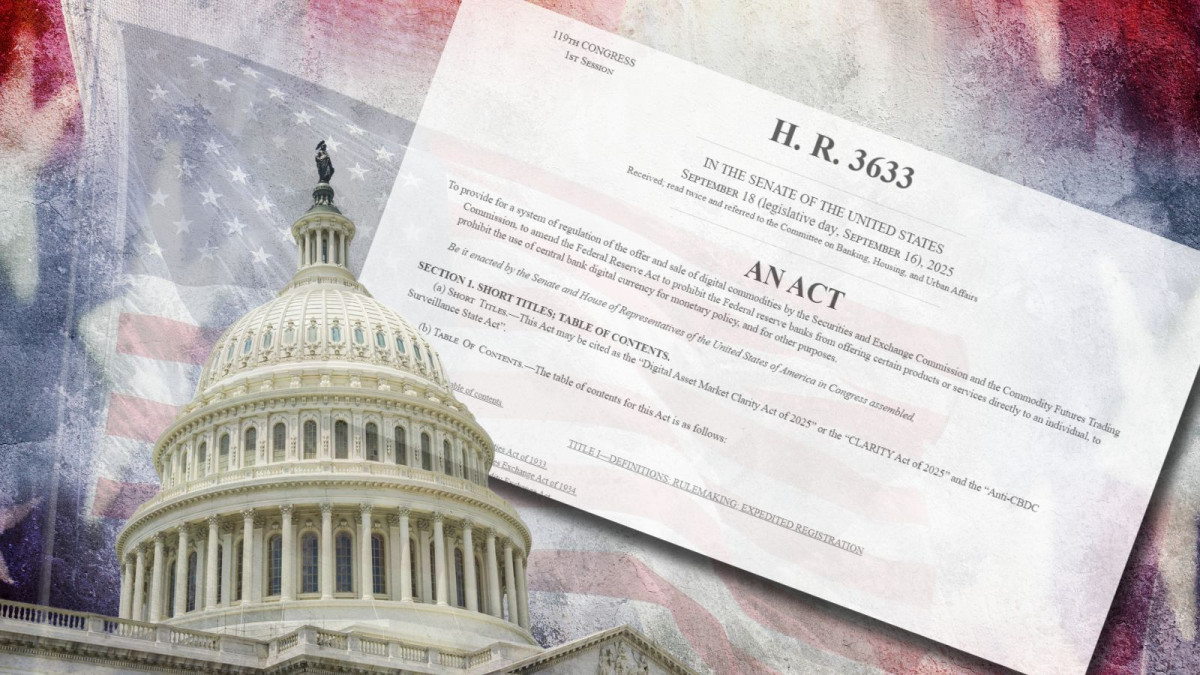
Something shifted in Washington on Friday, and the people who have been watching the CLARITY Act back and forth for months could feel it. Two key lawmakers, Republican Thom Tillis of North Carolina and Democrat Angela Alsobrooks of Maryland, reached an agreement in principle on one of the most stubbornly contested provisions in the bill: stablecoin yield. It is the kind of deal that, when the details finally shake out, may well be remembered as the moment the United States stopped kicking the crypto regulatory can down the road.
The news broke late Friday and was first reported by Politico. Senator Alsobrooks confirmed it plainly. "Sen. Tillis and I do have an agreement in principle," she said. "We've come a long way. And I think what it will do is to allow us to protect innovation, but also gives us the opportunity to prevent widespread deposit flight." The White House's crypto executive director, Patrick Witt, called it a "major milestone" and added that more work remains, but that progress toward passing the CLARITY Act was now real and tangible.
Senator Cynthia Lummis, the Wyoming Republican who chairs the Senate Banking Committee's crypto subcommittee and has been one of the most tireless advocates for this legislation, marked the occasion in her own way. She posted a photo on X of a "yield" sign. No caption needed.
The Stablecoin Yield Standoff, Explained
For months, the stablecoin yield question was the immovable object blocking the CLARITY Act from getting its Senate Banking Committee hearing.
The GENIUS Act, signed into law by President Trump in July 2025, prohibits stablecoin issuers from paying interest directly to holders. The intent was to prevent stablecoins from functioning as de facto bank deposit accounts, which would put them in direct competition with traditional savings products and, as the American Bankers Association argued loudly, threaten deposit flows into community banks. The concern: if Coinbase or another platform could offer users 4% on their dollar-pegged tokens simply for holding them, why would anyone keep money in a checking account?
The problem is that the GENIUS Act only covered issuers. It left a gap for third-party platforms that might offer rewards to customers who hold stablecoins on their systems. The ABA saw this as a loophole and spent months in Washington lobbying to close it. Crypto companies, for their part, said those rewards programs were fundamentally different from deposit interest and should be allowed.
Section 404 of the Senate Banking Committee's draft tried to thread this needle. It prohibits digital asset service providers from paying interest or yield "solely in connection with the holding of a payment stablecoin," while explicitly allowing "activity-based" rewards tied to transactions, payments, platform use, loyalty programs, liquidity provision, and other behaviors. The distinction is real: a reward for moving money through a system is not the same thing as interest paid for parking money in one.
Senator Mike Rounds, a South Dakota Republican on the Banking Committee, captured the nuance at an ABA summit earlier this month: rewards cannot be simply about how much money sits in an account, but they might reasonably be tied to how active that account is. "We're trying to reflect that in the discussions," he said.
Lummis had suggested the final compromise would disallow anything that "sounds like banking product terminology" and bar rewards tied to the size of a user's balance. Coinbase CEO Brian Armstrong, whose withdrawal of support in January helped torpedo a scheduled markup hearing, has been described by Lummis as "really pretty good about being willing to give on this issue."
From 99% to Done
The past week has been a rapid acceleration. As recently as Thursday, sources familiar with the situation described the stablecoin yield issue as being on the verge of resolution. A closed Senate Republican meeting on Wednesday, attended by White House crypto council director Patrick Witt, produced what Lummis told reporters afterward were significant breakthroughs, with "major light bulbs" switched on among the participants.
FinTech Weekly, which has closely tracked the legislative calendar, reported that stablecoin yield negotiations were "99% of the way to resolution" coming out of that meeting. The digital asset provisions of the bill more broadly were described as being in a "good place." The remaining friction, sources said, was not technical but political, specifically around whether community bank deregulation provisions might be attached to the CLARITY Act as part of a broader legislative trade.
Then came Friday's agreement. "We've come a long way," Alsobrooks told Politico, with a formality that understated just how much ground has been covered since January, when the scheduled markup hearing collapsed under the weight of over 100 proposed amendments and an industry revolt over the yield language.
What Comes Next and Why the Timeline Matters
An agreement on yield does not mean the CLARITY Act is done. Several other issues need resolution, decentralized finance remains a live debate, and the bill still needs to clear the Senate Banking Committee before it can go to a full Senate vote. After that, it must be reconciled with the version that passed the Senate Agriculture Committee in January. And before the President can sign it, that combined Senate text has to be reconciled with the House-passed version from July 2025.
But the clock is ticking here. Senate Majority Leader John Thune controls the floor calendar, and it is crowded. Unrelated fights, including the Republican voter-ID bill and ongoing debate over the situation in Iran, are competing for limited floor time. Haun Ventures CEO Katie Haun, in a CNBC interview Friday, put it directly: "The big question on the Clarity Act is, is Congress going to get a bill to the floor on time to vote?"
Lummis has said she expects a Banking Committee hearing in the latter half of April, after the Easter recess. Advocates have been hoping for a May resolution. Prediction markets are currently pricing the odds of the CLARITY Act being signed in 2026 at around 72%, according to FinTech Weekly. Treasury Secretary Scott Bessent has described passage as a spring 2026 target. Ripple CEO Brad Garlinghouse has put the odds at 80 to 90%.
JPMorgan analysts have described CLARITY Act passage by midyear as a positive catalyst for digital assets, pointing to regulatory clarity, institutional scaling, and tokenization growth as the key drivers. The crypto industry committed nearly $150 million to the Fairshake political action committee in the current cycle and announced a $193 million war chest around the Agriculture Committee markup in January. The companies behind that spending are waiting.
What This All Means
The stakes of the CLARITY Act extend well beyond Senate procedure. Markets are waiting. Institutions that have been slowly building out crypto infrastructure, custody solutions, tokenized asset offerings, trading desks, need to know what the rules are before they can fully commit capital and resources. The SEC's interpretation helps, but as Atkins himself acknowledged, it is not a substitute for law.
The CLARITY Act, if signed, would give the CFTC clear jurisdiction over most digital asset spot markets, create a path to register exchanges and brokers, establish consumer protections with real enforcement teeth, and provide the kind of statutory framework that companies can build businesses around. It would, in the language of its Senate Banking Committee sponsors, establish the United States as the crypto capital of the world, not just by rhetoric but by law.
If the bill fails this year, the status quo continues. Crypto companies operate under regulatory uncertainty. The SEC retains broad discretion to treat digital assets as securities. Institutional adoption continues but without a clear statutory framework. And the crypto lobby, which has made clear it will treat failure as a political liability, turns its $193 million war chest into something that looks a lot more like electoral pressure.
Friday's agreement does not guarantee passage. It does something important though. It removes the single biggest substantive obstacle to moving forward. The stablecoin yield question, which derailed a January markup hearing and has consumed months of negotiations, now has a resolution in principle. The path ahead still has obstacles, but for the first time in a while, it looks like an actual path.
Senators Tillis and Alsobrooks just handed the crypto industry something it has been asking for since the last bull market: a credible signal that Washington is finally going to do its job. The deal is in principle, the details are not yet public, and there is still legislative work ahead. But after years of false starts, shelved bills, collapsed markup hearings, and agency standoffs, this is the moment the trajectory changed.

SEC Approves Nasdaq Tokenized Stock Trading Pilot

The U.S. Securities and Exchange Commission (SEC) on Wednesday approved Nasdaq’s proposal to launch a pilot program for tokenized stock trading.
The proposal, first filed in September 2025, sought SEC approval to allow trading of both traditional and tokenized versions of high-volume stocks on the Nasdaq exchange. With the program now approved, traders will be able to trade both traditional stocks and their tokenized counterparts on the Nasdaq.

These tokenized stocks, according to the approval filing, will trade on the same order book at the same price, under the same ticker, with the same identifying number and rights as their traditional counterparts.
The pilot program will not be open to everyone. According to the SEC approval filing, participation will be limited to eligible participants. While Nasdaq has not disclosed the criteria, participants are likely to include Nasdaq-approved broker-dealers and firms approved by the Depository Trust Company (DTC).
It is also important to note that these tokenized stocks will be limited to securities in the Russell 1000 index, which tracks the 1,000 largest publicly traded companies in the United States, as well as exchange-traded funds that track the S&P 500 and Nasdaq-100 indices.
The Booming Tokenized Stocks Market
The tokenized stocks and equities market has experienced a remarkable surge over the past few months, growing from around $32 million at the start of 2025 to $963 million by January 2026, an increase of approximately 3,000%.
This growth has been attributed to the wider accessibility and faster settlement times offered by tokenized stocks compared with their traditional counterparts.
A wave of large fintech and crypto companies has also entered the tokenized equity market. In 2024, the cryptocurrency exchange Robinhood built a custom layer-2 blockchain for tokenization and began offering tokenized U.S. stocks to European users the following year.
Other cryptocurrency exchanges, including Kraken, Gemini, and eToro, have also begun offering tokenized U.S. stocks across multiple blockchains, such as Solana, BNB Chain, Arbitrum, and Ethereum. Most recently, Kraken, in partnership with Backed Finance, launched xChange, an on-chain trading engine for tokenized equities.
With the rapid attention and growth the tokenized equities market has seen, its market capitalization is projected by multiple research reports to reach trillions of dollars in the coming years.
SEC Drops Case Against BitClout Founder Nader Al-Naji
The U.S. Securities and Exchange Commission (SEC) has dropped its two-year case against Nader Al-Naji, founder of the blockchain-based social media platform BitClout.
The stipulation of dismissal was filed in the U.S. District Court for the Southern District of New York, and, according to the US regulator, the dismissal was based on a reassessment of evidentiary records.

Since the dismissal was issued with prejudice, the SEC will not be able to file the same charges against Al-Naji or any of the relief defendants named in the case, including his wife, mother, or any companies associated with him.
However, the SEC cautioned against treating the dismissal as a precedent for other cases. “The Commission’s decision to exercise its discretion and seek dismissal of this litigation is based on the particular facts and circumstances of this case and does not necessarily reflect its position on any other case,” it said.
Reacting to the dismissal, Nader Al-Naji, founder of BitClout, described the initial lawsuit as unreasonable. “In the coming days and weeks, I will be hopping on some podcasts to tell the whole story,” Al-Naji said.
Why the Sec Filed a Lawsuit Against Al-Naji
On July 30, 2024, the U.S. Securities and Exchange Commission (SEC) filed a civil lawsuit against Al-Naji. The regulator alleged multiple complaints against him, including offering unregistered securities. According to the SEC, Al-Naji failed to register BTCLT, BitClout’s native token, which he sold to investors, raising over $257 million from its sales.
The SEC also accused Al-Naji of fraud and misrepresenting the use of investor funds, claiming he spent more than $7 million on luxury properties in Beverly Hills and extravagant cash gifts for family members.
In addition to the SEC’s civil case, the U.S. Department of Justice (DOJ) alleged that Al-Naji committed wire fraud by misleading investors about the use of their funds, leading to his arrest in July 2024. However, these criminal charges were later dropped.
An Increase in the Number of Case Dismissals by the SEC
The dismissal of the BitClout case is one of several recent SEC case dismissals, particularly since the start of the Trump administration.
In January 2026, the SEC jointly dismissed its lawsuit against Gemini Trust Company and Gemini Earn. The regulator had initially alleged that Gemini Earn offered unregistered securities but dropped the charges without imposing penalties.
In 2025, the SEC voluntarily dismissed its case against the blockchain platform Dragoncoin, which it had accused of making misrepresentations. The case was closed with prejudice, and no penalties were imposed.
Nasdaq and Kraken Are Building the Bridge Between Wall Street and DeFi

Wall Street and crypto have been circling each other for years. On Monday, they shook hands.
Nasdaq and Kraken's parent company Payward announced a partnership to develop what they're calling an equities transformation gateway, a piece of infrastructure designed to let tokenized versions of publicly listed stocks move between the traditional, regulated financial system and the open, permissionless world of decentralized finance. The deal is one of the most significant convergences between a legacy exchange operator and a major crypto platform the industry has seen, and it arrives at a moment when several of the world's biggest exchanges appear to be racing to plant flags in the tokenized securities space.
Nasdaq President Tal Cohen said the exchange believes tokenization "has the potential to unlock the benefits of an always-on financial ecosystem" and to improve how investors access markets and how issuers engage with shareholders. The equity token design, which Nasdaq expects to become operational in the first half of 2027, is designed to preserve issuer control, existing regulatory frameworks, and the underlying rights associated with company shares.
What's Actually Being Built
Nasdaq's equity token design is not just about putting a blockchain wrapper around a stock. The initiative is structured so that blockchain records are integrated directly into the issuer's official share register, meaning a transfer of the token represents an actual transfer of the underlying security itself. Full legal and regulatory equivalence is the goal, not a synthetic approximation of it.
Kraken's xStocks framework powers the permissionless side of that equation. Since launching less than a year ago, xStocks has processed more than $25 billion in total transaction volume, with over $4 billion of that settled directly on-chain. More than 85,000 unique holders across supported networks have used the product, which currently covers more than 70 tokenized equities and ETFs, each backed 1:1 by the underlying asset. Fractional shares are available from $1. Trading runs around the clock on-chain, and dividends flow back automatically as additional tokens.
Under the partnership, the equities transformation gateway will allow clients in eligible jurisdictions to swap tokenized equities between the regulated, permissioned Nasdaq environment and the permissionless DeFi ecosystem. Payward Services will handle KYC and AML onboarding for participants accessing the gateway. Kraken will serve as the primary settlement layer for Nasdaq equity token transactions for an initial period, in the markets where xStocks are available.
It's worth being precise about geography. xStocks are not registered under the U.S. Securities Act and are not available to U.S. persons or in the United Kingdom. The initial rollout targets Europe and other international markets where Payward holds the relevant registrations and licenses.
The Regulatory Foundation Is Already Laid
None of this is happening in a vacuum. Nasdaq filed a proposal with the SEC in September 2025 that sought to allow tokenized versions of its listed stocks and ETFs to trade alongside traditional shares and settle through the Depository Trust and Clearing Corporation. That proposal argued for working within existing rules rather than around them, a notable contrast to tokenization projects that have tried to carve out space outside traditional regulatory structures.
The regulatory environment has also shifted meaningfully. The SEC's 2026 Staff Statement on Tokenized Securities classifies tokenized equities the same as regular equity securities under federal law, giving the Nasdaq initiative a cleaner legal runway than it might have had even a year ago. SEC Chairman Paul Atkins has been publicly supportive of American leadership in digital financial technology, and the commission has asked staff to work with firms on tokenized securities distribution.
Nasdaq's equity token design is set up as an issuer-sponsored, voluntary program. Public companies listed on Nasdaq would be able to opt in as the framework develops. The exchange plans to engage issuers, transfer agents, regulators, and market infrastructure providers as the project evolves.
Kraken's Vertical Integration Play
For Kraken, the Nasdaq partnership is the latest move in what looks increasingly like a deliberate strategy to own the entire tokenized equity stack. In December 2025 the company acquired Backed Finance, the Swiss issuer that sits behind the xStocks product, deepening its vertical integration along the tokenization value chain. In February of this year it expanded xStocks to the 360X platform operated by Deutsche Boerse Group. And in late 2025 Kraken launched what it described as the world's first regulated tokenized equity perpetual futures, offering up to 20x leverage for non-U.S. clients across more than 110 countries.
Kraken also became the first crypto company to secure approval for a Federal Reserve master account, a regulatory win that drew criticism from several U.S. banking groups but also marked a genuine shift in how regulators are thinking about the boundary between crypto platforms and the traditional banking system. The company is separately targeting a public listing in 2026.
Arjun Sethi, Kraken's Co-CEO, framed the Nasdaq deal in terms of capital efficiency as much as access. His argument is that equities today sit largely frozen inside brokerage systems where their utility is limited to directional exposure and, in some cases, venue-specific margin. Tokenized equities on programmable infrastructure, he suggested, can function as collateral across a much broader set of trading, lending, and hedging environments simultaneously, without the capital fragmentation that comes when each venue requires isolated collateral deposits.
"When collateral can move programmatically between systems," Sethi said, "settlement friction decreases and capital can move more dynamically between strategies and markets."
The Race Is On
The Nasdaq-Kraken announcement does not exist in isolation. It arrived in a week that saw the Intercontinental Exchange, the parent company of the New York Stock Exchange, make a strategic investment in OKX at a reported $25 billion valuation, signing a deal to bring tokenized NYSE-listed stocks and crypto futures to OKX's platform. ICE separately announced development of a new digital trading platform combining the NYSE's Pillar matching engine with blockchain-based post-trade systems. That platform would support 24/7 trading of U.S.-listed equities and ETFs, instant settlement via tokenized capital, and stablecoin-based funding. ICE said it would seek regulatory approvals for the venue, with NYSE-linked tokenized shares targeting availability in the second quarter of 2026.
Nasdaq also separately announced a partnership with Seturion, the tokenized settlement platform operated by Boerse Stuttgart Group, to connect its European trading venues to infrastructure supporting trading and settlement of tokenized securities.
What's emerging is something that looked improbable even two years ago: a genuine competition among the world's largest exchange operators over who gets to own the infrastructure layer for tokenized securities. The race is less about whether tokenized equities will happen and more about which institutions get to control the plumbing.
If the Nasdaq-Kraken infrastructure reaches full operation, the implications for how capital markets function could be substantial. Tokenized equities with 24/7 on-chain settlement would, in theory, compress the settlement cycle that still takes two business days in conventional U.S. equity markets. Shareholders would retain full governance rights, including proxy voting and dividend entitlements, automated through smart contract logic rather than managed through layers of intermediaries.
For international retail investors in markets where traditional brokerage distribution is limited or expensive, access to tokenized U.S. equities through a crypto exchange represents a potentially meaningful expansion of the investable universe. Fractional share availability starting at $1 removes one of the practical barriers that has kept some investors out of high-priced stocks.
The more speculative scenario, and the one Sethi seems most interested in, is what happens when tokenized equities can be used as collateral across DeFi lending protocols, perpetual futures markets, and other on-chain financial applications. The argument is that programmable collateral is more efficient than static collateral, and that the firms which build the infrastructure to move it across venues will capture a meaningful slice of the value created.
There's obviously a long way to go. The Nasdaq equity token design isn't expected to be operational until mid-2027. Regulatory approvals still need to be worked through. Issuer adoption is voluntary and therefore uncertain. The U.S. market itself remains off-limits for xStocks. And building genuine liquidity in tokenized equity markets, as Sethi himself acknowledged, requires more than technology alone.
Still, the direction of travel is increasingly clear. The question is no longer whether traditional exchange operators will engage with blockchain-based infrastructure. It's who gets there first, and whose plumbing ends up underneath everyone else's trades.

Coinbase Shareholder Sues Executives Over Compliance Issues

A Coinbase shareholder has filed a derivative lawsuit against several top executives and board members of the crypto exchange, alleging compliance and disclosure failures by the company’s leadership.
On Tuesday, Kevin Meehan, one of Coinbase’s shareholders, filed a complaint in a U.S. district court in New Jersey. The court filing cited several of Coinbase’s top directors, including CEO Brian Armstrong, co-founder Fred Ehrsam, Chief Legal Officer Paul Grewal, and Chief Financial Officer Alesia Haas, among other executives.

Image credit: PACER
According to the filing, the plaintiff accused the defendants of making false and misleading statements between April 2021, when the exchange became a publicly traded company, and June 2023. The complainant alleged that a compliance failure by the exchange's leadership exposed the company to several stringent regulatory actions.
On behalf of Coinbase, the complainant, Kevin, is seeking damages, requesting that the court implement corporate governance reforms, and requesting recovery of any profits the exchange's leadership may have obtained during the period when the exchange faced these compliance cases.
However, since this is a shareholder derivative lawsuit, any financial recovery from Coinbase's directors will go to Coinbase rather than directly to the shareholders.
Coinbase Battle With Compliance
Over the past few years, Coinbase has faced several legal and compliance challenges, paying millions of dollars in damages and penalties.
In January 2023, the New York State Department of Financial Services sued the exchange for major failures in its Anti-Money Laundering (AML) program. The regulator accused Coinbase of having weak Know-Your-Customer (KYC) checks and failing to properly review suspicious transactions.
As part of the settlement, Coinbase agreed to pay $100 million: $50 million in penalties and $50 million to improve its compliance checks and systems.
In June 2023, Coinbase was hit with a $5 million penalty by the New Jersey Bureau of Securities. The regulator accused the exchange of allowing the trading of unregistered securities on its platform, prompting several other states to impose restrictions on its staking services at the time.
Coinbase has also faced legal challenges from the U.S. Securities and Exchange Commission (SEC). In 2023, the SEC filed a lawsuit against the company, alleging it operated an unregistered exchange. Following the announcement, Coinbase’s stock dropped sharply, falling from over $60 to under $50 within minutes of the news breaking.

SEC Drops Justin Sun Fraud Charges as Rainberry Pays $10M Fine

After nearly three years of legal battle, the U.S. Securities and Exchange Commission officially dismissed its civil fraud claims against Tron founder Justin Sun, the Tron Foundation, and the BitTorrent Foundation on Thursday. The resolution, entered by the U.S. District Court for the Southern District of New York, comes with one notable condition: Rainberry Inc., the entity that developed the BitTorrent protocol and the BTT cryptocurrency token under Sun's direction, agreed to pay a $10 million civil penalty to the agency.
The final judgment still requires approval from a federal judge, but the terms represent a clean exit from what had been one of the higher-profile enforcement actions of the Gensler-era SEC. Rainberry, previously known as BitTorrent Inc. and acquired by Sun in June 2018, will also be permanently barred from engaging in deceptive market practices for securities, though it did not admit guilt as part of the agreement. Critically, the dismissal against Sun himself and the two foundations was entered "with prejudice," meaning the SEC cannot refile the same allegations in this federal court.
A Case History
The commission first filed the lawsuit in March 2023, during former Chairman Gary Gensler's tenure. The charges were sweeping. The SEC accused Sun and his related entities of orchestrating the unregistered offer and sale of two crypto assets, Tronix (TRX) and BitTorrent (BTT), which it classified as securities. Beyond that, regulators alleged Sun personally directed employees to execute hundreds of thousands of coordinated wash trades in TRX, generating roughly $31 million in artificial trading proceeds and inflating the appearance of legitimate market activity. The complaint also alleged Sun paid celebrity endorsers to promote his tokens without publicly disclosing those payments — a violation of securities laws that require such arrangements to be made transparent to investors.
The SEC argued that Sun had tight personal control over each of the entities involved, calling Tron Foundation, BitTorrent Foundation, and Rainberry his "alter egos" and noting that he had spent significant time on U.S. soil during the relevant period, including approximately 180 days in 2019 alone. The agency said a reasonable investor would have seen Sun as the unified face of the entire TRX and BTT ecosystem.
Sun's legal team did not take the charges quietly. In early 2024, Tron Foundation and Sun's lawyers moved to dismiss the suit on jurisdictional grounds, arguing that the SEC had no authority over Sun as a foreign national residing abroad and that the agency had failed to prove Sun exercised meaningful control over the Tron and BitTorrent networks. Rainberry, incorporated in California, did not contest jurisdiction but sought dismissal on different grounds — primarily that the company had no fair notice that its activities could be subject to securities claims.
The SEC pushed back on those arguments aggressively in an amended complaint filed in April 2024, countering that Sun's physical presence in the United States over multiple years was extensive and well-documented, and that his dominance over each entity was impossible to dispute given his public profile and behavior at industry events.
By late 2024 and early 2025, the political climate had shifted dramatically. Donald Trump's return to the White House brought with it a sharp reversal in the SEC's posture toward crypto enforcement. Gary Gensler stepped down, and the commission came under the acting leadership of Commissioner Mark Uyeda before Paul Atkins, a Washington lawyer widely seen as supportive of the digital asset industry, was confirmed as chairman. In February 2025, the SEC and Sun's legal team jointly asked Judge Edgardo Ramos in Manhattan to put the case on hold while both sides explored a potential resolution, citing the interests of both parties and the public.
What Comes Next For Tron and Sun
The resolution closes a legal chapter, but Sun's year has not been without turbulence. The relationship with World Liberty Financial grew complicated in September 2025 when, days after WLFI tokens became publicly tradable, blockchain data revealed that Sun's wallet address holding roughly 595 million unlocked WLFI tokens was blacklisted by the project's smart contracts. WLFI had fallen sharply from its debut price, and on-chain data showed Sun had made several outbound transfers, including one worth approximately $9 million, to addresses associated with exchanges. The WLFI team cited concerns about suspicious activity. Sun denied any manipulation, publicly appealing to the team to restore his access and invoking the decentralization principles the project claimed to champion. As of late 2025, his tokens reportedly remained frozen and had declined significantly in value.
For the Tron and BitTorrent ecosystems themselves, the dismissal removes a substantial legal overhang. TRX and BTT holders had long operated under uncertainty about whether the tokens could ultimately be classified as securities in federal court. While the settlement does not resolve broader policy debates in Washington about how digital tokens should be classified, it does remove the specific threat of a federal court ruling in this case.
The $10 million Rainberry penalty is notable primarily for what it is not. Given the scale of what was alleged, including hundreds of millions of dollars in token distributions and deliberate wash trading to manipulate market prices, the fine is modest. Critics are likely to point to the figure as further evidence that the current SEC has little appetite for meaningful accountability in the crypto space, while supporters of the settlement structure will argue it brings resolution without years of additional litigation that may have yielded uncertain outcomes anyway.
For Sun, the outcome is a practical victory, even if the legal-ese technically routes the penalty through Rainberry rather than through him directly. He emerged without personal liability in a case where the SEC had once described him as the singular controlling force behind everything. Whether the political dynamics that contributed to that outcome constitute a coincidence or something more transactional is a question that Senate and House oversight committees appear intent on pressing in the months ahead