#tokenization

Hana Bank Issues South Korea’s First Digital Bond Using Euroclear Blockchain

Hana Bank, one of South Korea’s major commercial banks, has issued a $100 million digital bond using the Euroclear blockchain.
The five-year bond, which was issued using Euroclear's Digital Financial Market Infrastructure, achieved T+0 settlement, with the bond allocations and payments completed on the same day.
"The $100 million digital bond issuance and implementation of T+0 settlement represent a significant step beyond simply diversifying our funding channels, as they bring blockchain technology into the capital market," a Hana Bank official said.
"We will continue to adopt advanced infrastructure and explore innovative funding solutions that meet the needs of global investors," the official added.
With Standard Chartered serving as the sole lead manager overseeing the bond issuance and sale, Hana leverages the fast settlement times of distributed ledger technology, cutting the settlement time from what would typically take 3 to 5 days to complete to less than a day.
About Euroclear
Headquartered in Brussels, Belgium, Euroclear is one of the major global financial market infrastructure (FMI) providers and a leader in central securities depositories (CSDs) and international CSDs (ICSDs).
In 2023, it launched its blockchain initiative, the Euroclear blockchain platform (D-FMI), for the primary purpose of facilitating the issuance, distribution, and primary market settlement of fully dematerialised international securities.
By leveraging the fast settlement times of blockchain technology, D-FMI allows for same day settlement (T+0) and the issuance and allocation of digital bonds.
Since the launch of Euroclear's blockchain platform, several financial institutions have settled and issued digital bonds on it, including the World Bank, Asian Infrastructure Investment Bank (AIIB), Emirates NBD, Doha Bank, and Akbank.
S&P Global to Acquire Blockchain Security Firm OpenZeppelin

S&P Global, the leading financial information services company, has agreed to acquire blockchain security company OpenZeppelin for an amount that has yet to be disclosed.
According to an S&P press release, the acquisition is aimed at complementing the company’s global risk assessment and ecosystem development capabilities in the digital asset market.
The deal will also enable S&P Global to create the next generation of on chain security assessments and benchmarks while delivering essential intelligence, especially as the capital market moves on chain.

"Our digital assets strategy centers on bringing trusted data, benchmarks and transparent risk assessment to markets as they move on chain," said Yann Le Pallec, President of S&P Global Ratings.
"As digital assets and tokenized markets continue to mature, OpenZeppelin's technology and expertise will complement our smart contract and on-chain technology risk assessment capabilities, giving traditional financial institutions and DeFi native companies alike the confidence to build and transact in this new environment."
Although the terms of the transaction have yet to be disclosed and the deal remains subject to closing conditions, OpenZeppelin will continue to operate under the OpenZeppelin name, with its CEO, Demian Brener, leading the company.
About OpenZeppelin
Founded in 2015, OpenZeppelin is a leading blockchain security firm that promotes secure development practices for teams aiming to build safely and securely on-chain.
Prior to this acquisition deal with S&P Global, OpenZeppelin had achieved several milestones, including launching OpenZeppelin Contracts, the first major open-source smart contracts library that eventually became the de facto industry standard for secure smart contracts.
The firm also pioneered professional smart contract security audits, which audited over $37 trillion in cumulative value, while also conducting over 900 security audits that identified more than 10,000 vulnerabilities.
OpenZeppelin powers 9 of the top 10 stablecoins, including Circle USDC, Ripple RLUSD, PayPal USD (PYUSD), Ethena USDe, BitGo USD1, and 10 of the top 10 tokenized funds, including BlackRock BUIDL, Centrifuge Anemoy JTRSY, Circle USYC, and Ondo OUSG and USDY.
Italy’s Second Largest Bank UniCredit Weighs Crypto Custody

UniCredit, Italy’s second largest bank, is reportedly considering entering the crypto and digital asset custody market, according to a Bloomberg report.
Although UniCredit has yet to publicly announce its intention to offer crypto custody services, Bloomberg, citing people familiar with the matter, reported that the bank is already selecting a provider to build custodial infrastructure that would allow it not only to hold digital assets but also facilitate their buying and selling.
In addition to custodial services, Bloomberg also reported that the bank is considering other areas of crypto, including tokenized investment products and fixed income securities, the use of stablecoins, and exposure to cryptocurrencies, as possible areas of expansion.
UniCredit’s expansion into crypto custody comes at a time when financial institutions are also considering expanding into the sector.
Just recently, Jack Dorsey owned financial technology company Block formally applied to the Office of the Comptroller of the Currency (OCC) to establish a National Trust Bank that would allow it to offer crypto custody services.
In August, Citibank also announced plans to launch a native Bitcoin custody service that would allow its clients to hold Bitcoin alongside traditional assets such as stocks and bonds.
While UniCredit has yet to officially issue a public statement regarding the move, speculation surrounding the bank’s plans to expand into crypto custody could be a significant development for the crypto industry if successful, as it would enhance crypto adoption, bridging the gap between blockchain-based finance and traditional finance.
London Stock Exchange Partners With Payward to Expand Onchain Access to Stocks

The London Stock Exchange (LSE) has partnered with Payward, the parent company of cryptocurrency exchange Kraken, to expand access to stocks through tokenized equities.
Through the partnership, the LSE will provide traders with access to stocks of the 100 largest companies listed on its exchange through xStocks, Kraken’s tokenized equities framework, which provides 1:1 backing for publicly traded stocks and exchange traded funds (ETFs).
“Tokenization has the potential to change how investors access, and how issuers use, financial markets, but it must develop in a way that preserves the trust, rights and role of regulated markets,” said Julia Hoggett, CEO of the London Stock Exchange.
“By working with Payward, and continuing to collaborate across the market infrastructure ecosystem, we are exploring how issuers and investors can benefit from new forms of access while maintaining the standards that underpin public markets.”
Subject to regulatory approval, the London Stock Exchange will, in the coming weeks, begin listing xStocks on LSE 24, the exchange’s recently launched 24 hour trading venue.
Once live, the suite of supported xStocks will comprise tokenized equities of companies listed in the U.S., EU, UK and Hong Kong, in addition to several other asset classes, enabling traders to interact with global markets from a regulated and familiar trading environment.
xStocks 1 Year Performance
Launched in June 2025 by Payward, xStocks is a tokenized equities framework that issues 1:1 backed tokens representing publicly traded assets and ETFs. It was launched to bridge traditional finance with crypto and make tokenized equities more accessible.
Since its launch, xStocks has recorded impressive growth, with total transaction volume exceeding $40 billion and on-chain transaction volume reaching roughly $20.5 billion. The platform has also launched more than 700 tokenized stocks, ETFs and related assets across multiple blockchain networks, including Solana, Ethereum and TON.
Ripple, SettleMint Partner to Boost Custody and Tokenization in Asia Pacific

Ripple has partnered with SettleMint, a global leader in digital asset lifecycle management, to offer financial institutions in the Asia Pacific region a unified solution for custody and tokenized asset management across different asset lifecycles.

The partnership combines Ripple’s institutional grade digital asset custody infrastructure with SettleMint’s Digital Asset Lifecycle Platform (DALP), giving institutions a more compliant way to custody and manage their assets through a single solution rather than multiple vendors.
“Financial institutions across Asia Pacific are putting digital assets to work. They are asking how to do more without stitching together separate solutions for custody, issuance and governance,” said Fiona Murray, Managing Director, Asia Pacific at Ripple. “This partnership gives them the foundation to roll out digital assets and future proof them from there: Ripple Custody to hold and govern those assets, and SettleMint to manage their entire lifecycle.”
Although the platform will initially be available to financial institutions in Asia, it will subsequently expand to other markets as institutional demand for the platform increases.
About Ripple’s Custody and SettleMint’s DALP
Ripple’s custody infrastructure provides financial institutions, such as banks, asset managers and fintechs, with a secure way to manage their digital assets, including stablecoins and real world assets, without compromising security or control.
To strengthen the security and flexibility of this infrastructure, Ripple uses multi party computation (MPC) and hardware security modules (HSMs) for private key management, with options for self custody or cloud and on premises deployments.
The Digital Asset Lifecycle Platform, or DALP, is an institutional grade, composable digital asset platform designed by SettleMint to help financial institutions manage the lifecycle of tokenized assets.
By integrating with Ripple’s Custody infrastructure, DALP provides a unified way for institutions to manage the entire asset lifecycle, including the seamless handling of issuance, settlement and asset servicing from a single platform
Bitwise Launches Tokenized U.S. Stock Portfolios for Non-U.S. Investors

Bitwise Asset Management, the global crypto asset manager, has launched an automated token portfolio (ATP) that allows non U.S. investors to align their tokenized stock portfolios with Bitwise’s published model portfolios.
The portfolio, developed in partnership with Coinbase and Glider, allows investors to maintain full custody of their portfolio assets, eliminating the need to constantly transfer their assets to a pooled vehicle or place them in the hands of a fund sponsor.
"For over a century, getting a professional model meant handing your assets to a fund. ATPs mean you can keep the assets in your own wallet, and the model comes to you," said Matt Hougan, CIO of Bitwise. "ATPs unlock a new way for people to access thematic exposures more quickly and precisely than many traditional structures. We're just scratching the surface."
Since the stocks will remain in users’ wallets under their control, investors will be able to use them for other yield bearing opportunities, including lending or borrowing against them through DeFi protocols. However, investors will be responsible for any associated risks.
According to Bitwise, the tokenized portfolio will be rolled out in the coming weeks and will provide investors with broad exposure to a variety of stocks, which will be categorized into three distinct portfolios.
These include the Mag7X ATP, which provides exposure to the seven largest U.S. technology companies, and the Robotics and AI Leaders ATP, which will provide exposure to leading AI and robotics companies.
Bitwise’s launch of its automated tokenized portfolio comes at a time when crypto exchange Coinbase has also launched tokenized stocks of Nvidia, Apple, Meta, and Alphabet on Base. The tokenized stocks, which are supported by about 50 protocols, including Aave, Morpho, and Euler, will only be made available to eligible users outside the United States.
U.S.-UK Transatlantic Taskforce Releases Policy Report Promoting Digital Asset Innovation

Image credit: open access government
The United States Department of the Treasury and the United Kingdom's HM Treasury have jointly released a framework outlining recommendations to strengthen economic cooperation between the two countries.
Although the report is not solely about cryptocurrencies, the framework focuses on the broader digitalization of the financial sector, including stablecoins, tokenized financial assets, and digital market infrastructure.
According to a press release from the U.S. Department of the Treasury, the recommendations, which build on the longstanding relationship between the U.S. and U.K. financial markets, aim to reduce unnecessary friction hindering economic ties between the two countries while identifying opportunities to enhance cross-border capital raising, strengthen supervisory cooperation, and provide greater clarity for tokenized financial activity.
Regarding the goal of the Transatlantic Taskforce, U.S. Treasury Secretary Scott Bessent said, "The Transatlantic Taskforce for Markets of the Future reflects the strength and depth of U.S. and UK markets and our shared commitment to fostering economic growth and advancing global standards that reward innovation and competition."
Following the Taskforce's recommendations, the United States and the United Kingdom released a joint statement on stablecoins. The statement reaffirmed both countries' shared commitment to well-regulated stablecoins as a tool for financial innovation.
The two countries also emphasized the need for stablecoins to be fully backed on a one-to-one basis by high-quality liquid assets, with strong safeguards for reserves, consumer protection, timely redemption, and financial stability.
The Transatlantic Taskforce's release of the policy report comes shortly after the U.K. government published its first tokenized finance roadmap. The report, developed alongside task forces from 54 major financial institutions, including BlackRock, JPMorgan, and Goldman Sachs, focuses on scaling tokenization through initiatives such as the issuance of tokenized government bonds, tokenized repo and collateral markets, and stablecoin-enabled settlement.
The report projects that tokenizing wholesale financial markets could add up to £33 billion in annual GDP and £14 billion in tax revenue by 2035.
About the U.S.-UK Transatlantic Taskforce
The U.S. UK Transatlantic Taskforce for Markets of the Future was established by HM Treasury and the U.S. Department of the Treasury, led by U.S. Treasury Secretary Scott Bessent and UK Chancellor of the Exchequer Rachel Reeves, in September 2025.
The task force was established to strengthen bilateral cooperation between the two countries, enabling them to explore collaboration in capital markets and digital assets, including stablecoins and tokenization.
In addition to HM Treasury and the U.S. Department of the Treasury, the task force works with regulators from both countries, including the Financial Conduct Authority, the U.S. Securities and Exchange Commission, the Commodity Futures Trading Commission, the Federal Reserve, the Federal Deposit Insurance Corporation, and the Office of the Comptroller of the Currency.
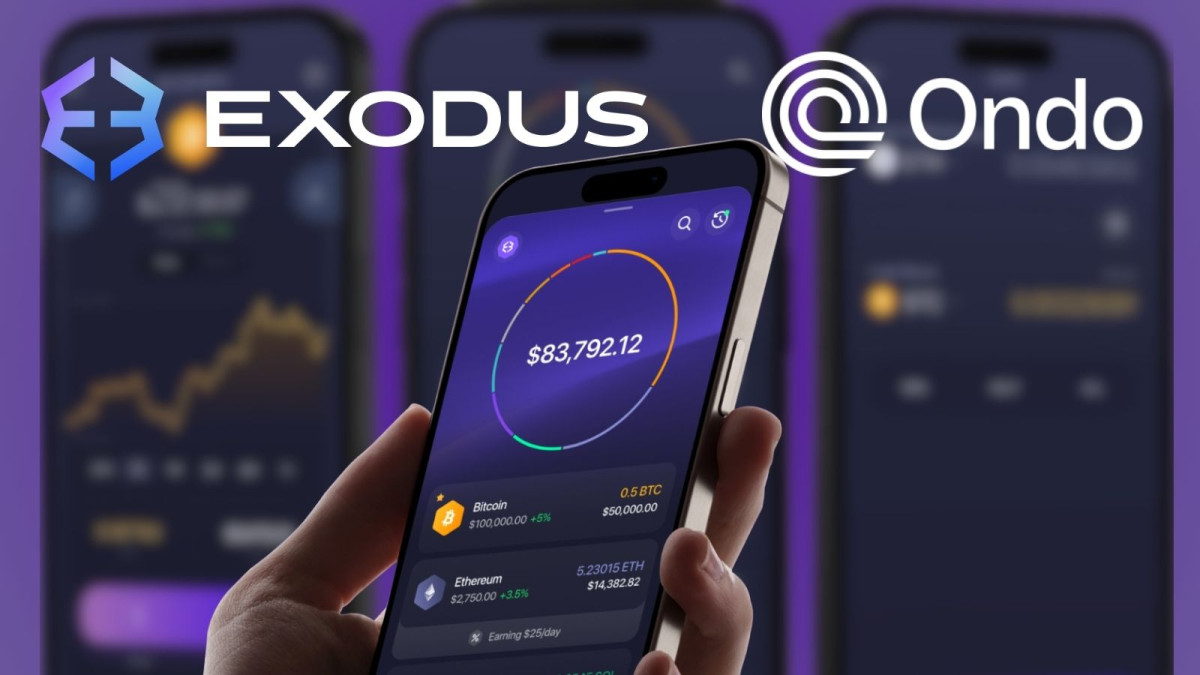
Exodus Partners With Ondo To Launch Tokenized Stocks

Exodus Movement Inc. (NYSE American: EXOD), a publicly traded financial technology company and developer of the Exodus wallet, has partnered with Ondo Finance to launch Exodus Markets, a platform for trading tokenized assets.

With Exodus Markets, users can now buy and sell more than 200 tokenized stocks, exchange-traded funds (ETFs), and real-world assets directly in the Exodus wallet app on the Solana blockchain.
"Tokenized stocks are one of the most important developments in modern finance," said JP Richardson, CEO and co-founder of Exodus.
"For the first time, our customers can trade and hold tokenized equities with the same direct control and global access they expect from crypto. Exodus is becoming the front door to every asset you hold, without compromising on trust and control."
The launch of Exodus Markets aligns with Exodus’s goal of transforming from a custodial wallet into a full financial platform that allows users to trade, earn rewards, send, spend, and manage money.
As part of its efforts to become a comprehensive financial app, Exodus launched Exodus Pay, a self-custodial payment feature within the Exodus app that enables users to transact with digital assets, including stablecoins, for everyday purchases. The company also launched XO Cash, a stablecoin pegged to the U.S. dollar.
The Tokenization Space
The tokenization space, particularly real-world assets (RWAs), has experienced significant growth over the past 1 to 2 years. Excluding stablecoins, the tokenization sector grew from roughly $5 billion to $6 billion at the start of 2025 to $27 billion to $31 billion or more by mid 2026, representing an increase of more than 400% over a period of 15 to 18 months.
Several institutions are also entering this growing sector, with Bitget most recently launching Reality, its real-world asset (RWA) platform. Kraken has also launched xChange, an on-chain trading engine designed for trading tokenized equities. MetaMask, Trust Wallet, Blockchain.com, and Robinhood have also made strategic moves to enter the sector, partnering with RWA firms and rolling out tokenized assets and stocks.
Given the level of growth and adoption the real-world asset and tokenization sector has seen so far, several projections have been made regarding its future potential. The Boston Consulting Group and Ripple have projected that the sector could be worth more than $15 trillion by 2030.
Wall Street Giants Pour $355M Into Canton Network

Digital Asset, the firm behind the Canton Network, has closed a $355 million funding round led by a16z crypto, pulling in a sprawling cast of Wall Street names and at least one sovereign wealth fund along the way.
Digital Asset, the company quietly building out the plumbing for tokenized capital markets, has just pulled off one of the bigger raises in cryptos institutional corner this year. The firm announced Thursday that it closed a $355 million round led by Andreessen Horowitz's crypto arm, a16z crypto, which alone wrote a $100 million check. The size of the raise, and the names attached to it, say a lot about where smart money thinks blockchain infrastructure is headed next ... and it's not toward retail trading apps.
The round's backer list reads like a who's who of global finance. Citadel Securities, Apollo, BNP Paribas, HSBC, S&P Global, CME Ventures, Coinbase Ventures, Optiver, SoFi, Tradeweb and SBI Group all participated, alongside a subsidiary of the Abu Dhabi Investment Authority, one of the world's largest sovereign wealth funds. Smaller but notable names like 7RIDGE, Polychain, Broadridge and William Blair rounded things out. It's a genuinely odd mix of old guard TradFi and crypto native venture money, which is sort of the whole point of Canton in the first place.
What Exactly is Canton, and Why Does Wall Street Care
Canton is a layer-1 blockchain, but it doesn't look much like the chains most crypto users are familiar with. It was designed from the ground up for regulated finance, with built-in privacy controls that let institutions keep sensitive transaction data hidden from competitors while still settling on a shared, synchronized ledger. Digital Asset describes it as a network of networks, meaning banks and asset managers can run their own permissioned systems that plug into the broader Canton ecosystem without giving up control over their own data or compliance processes.
This is basically the opposite of how chains like Bitcoin or Ethereum work. There's no anonymous validator set, no permissionless access, and institutions retain authority over the assets they issue. Some purists aren't thrilled about that. TD analyst Lance Vitanza wrote back in February that some experts consider Canton a glorified database in the cloud, and not really consistent with the open, trustless architecture that defines Bitcoin. Fair point, maybe, but it also might be missing why banks are actually showing up.
Since launching nearly two years ago, Canton has reportedly supported around $6 trillion in tokenized issuance, and the network now counts more than 700 ecosystem participants according to Digital Asset CEO Yuval Rooz. That's a big number for a network most retail crypto traders have probably never interacted with directly. Its native token, CC, was trading around 16 cents at the time of the announcement, up roughly 12% over the prior week, though still well below its February all time high near 19 cents.
A Valuation That's Climbing Fast
This isn't Digital Asset's first rodeo with a16z. The new $355 million round comes on the heels of a previously reported $300 million raise from just a month earlier, which valued the company at close to $2 billion, again with a16z leading. Before that, in 2025, Digital Asset raised $50 million from backers including Nasdaq and Bank of New York Mellon. Add it all up, and Digital Asset has now raised somewhere north of $800 million across its various rounds, a pace that's hard not to notice in a sector where many infrastructure plays are still pre revenue.
Speaking of revenue, that's another detail buried in the announcement worth pulling out. According to reporting from ChainCatcher, Digital Asset says it has now reached profitability following this latest raise. For a blockchain infrastructure company, that's a fairly rare claim to make, and it's likely one reason institutional investors who don't typically touch crypto, like Apollo or HSBC, felt comfortable writing checks.
Where The Money is Going
Digital Asset says the fresh capital will go toward three buckets, forging new partnerships, pursuing mergers and acquisitions, and expanding the broader Canton ecosystem. There's also a developer angle here. Rooz has been fairly vocal about wanting to deepen engagement with the people actually building on Canton, not just the institutions issuing assets on top of it.
"Blockchain adoption will be defined by practical, production-grade applications in the world's largest markets," Rooz said in a statement tied to the announcement. "For capital markets to move onchain, institutions need infrastructure that reflects how they actually operate, with privacy, compliance, scale, and interoperability built in from the start."
Notably, this round also marks the formal start of a partnership between Digital Asset and a16z crypto, not just a check. Ali Yahya, a general partner at a16z crypto, framed it as a bet on a thesis that's been floating around crypto circles for years finally becoming real, real world assets and institutional workflows actually moving onchain, rather than just being talked about at conferences.
The bigger picture for RWAs
Zoom out a bit and this raise fits a pattern that's been building for a while now. Tokenization of real world assets, things like bonds, money market funds, equities and commodities, has gone from a niche talking point to something BlackRock, Franklin Templeton and a growing list of traditional asset managers are actively building around. Canton's pitch is that it can be the settlement layer underneath a lot of that activity, handling the messy parts around privacy and regulatory compliance that public chains generally weren't built to handle.
Whether Canton ends up being the dominant rail for this kind of activity, or just one of several competing standards, is still very much an open question. Other institutional focused networks and consortia are chasing similar territory, and banks have a long history of building their own private ledgers rather than relying on shared infrastructure. But with this round, Digital Asset has clearly bought itself runway, credibility, and a deep bench of new institutional relationships, which in this market counts for a lot.
Financial Technology Partners served as the exclusive financial advisor on the deal, according to the company's release. For now, the immediate market reaction has been modest, with CC ticking higher alongside a broader crypto rally this week, but the more interesting story here probably isn't the token price. It's the growing list of names from Citadel to ADIA who are now, at least on paper, aligned with Canton's success.
Bitget Launches Reality for Tokenized Stocks and ETFs

Bitget, a global cryptocurrency exchange, has launched Reality, a real-world asset (RWA) platform that gives users access to tokenized traditional financial assets.
With Reality, Bitget aims to bring tokenized U.S. stocks and exchange-traded funds into its trading ecosystem, enabling access to financial instruments that have traditionally been difficult to access due to geographic restrictions, market hours, and settlement barriers.

The launch aligns with Bitget’s Universal Exchange (UEX) roadmap, which aims to transform Bitget from a crypto exchange into a global trading platform that allows users to trade cryptocurrencies, tokenized stocks, exchange-traded funds, commodities, forex, and other real-world assets through a single account using cryptocurrencies.
“Reality is built around Bitget’s 10% vision: by 2030, nearly 10% of financial assets could exist in tokenized form,” said Gracy Chen, Bitget CEO. “Stablecoins, faster blockchain settlement, and growing interest from major exchanges are pushing RWAs from experiment to market infrastructure. Reality is Bitget’s step toward making that future accessible to global users.”
How Reality Will Work
Reality will be natively integrated into Bitget and serve as the exchange’s specialized arm for tokenizing traditional financial instruments. It will also serve as the primary layer for standardizing traditional market value in the crypto economy.
The Reality platform will issue rTokens to users, which are on-chain representations of publicly traded equities and exchange-traded funds (ETFs). Each rToken will be backed 1:1 by real shares held with a FINRA-registered, SIPC-protected U.S. broker-dealer.
To ensure the highest level of transparency, the Reality platform will be regularly audited by third-party auditors. These audits will provide a live proof-of-asset dashboard and CPA-level audit reports to ensure verifiable asset integrity at all times.
Reality will initially focus on providing tokenized exposure to selected U.S. stocks and ETFs, with the team introducing additional tokenized assets as the platform expands. However, access to the platform, including user eligibility, product availability, and trading features, will depend on applicable geographical laws and regional restrictions.
Bitget’s entry into the RWA tokenization industry comes as several institutions, including Payward, Bitwise, and Nasdaq, are tapping into the growing sector. The RWA tokenization market is currently valued at around $34 billion, with the Boston Consulting Group projecting it to reach $16 trillion by 2030.
Wall Street Is Going To Tokenize Everything

There was a version of this story...told many moons ago that gets told as a prediction. Some future moment when the old guard of finance finally meets crypto on equal footing, when the suits and the degens find common ground, when a BlackRock executive and a DeFi protocol share the same balance sheet. Well that story is now pretty outdated...it's no longer some vision of an oracle peering into a crystal ball. We are already living in it. The future is here.
What we are seeing happen in global finance with tokenization is not some pilot program or a hedge. It is a structural transformation, and it is accelerating faster than most people outside of these two worlds seem to understand. Wall Street is no longer on the outside looking in, just dipping their toes in, to test the water. They have taken the plunge.
The Old System Was Always Broken
Here is something traditional finance never really wanted to say out loud: the infrastructure holding it together is ancient, slow, and held up largely by institutional inertia. Settlements that take days. Liquidity locked to six-and-a-half-hour trading windows. Layers of intermediaries, each one clipping a fee, each one adding time. For the largest players, those inefficiencies were baked into the cost of doing business. For everyone else, especially retail investors in markets outside the U.S., they were just walls.
Blockchain does not fix all of this overnight. But it offers something that legacy systems fundamentally cannot: a shared, programmable, real-time record of ownership that does not require three middlemen to reconcile. The World Economic Forum, in its 2025 report on asset tokenization, described the transition as potentially the next major phase in the development of financial market architecture, drawing a comparison to the shift away from paper certificates in the 1960s. That is not a crypto inside touting to his followers on X. That is the WEF stating how tokenization could transform finance.
When even the most establishment-facing institutions are framing this as a generational infrastructure shift, it's probably worth paying attention to.
The Institutions Are Not Coming. They Are Here.
BlackRock has a tokenized fund on Ethereum. JPMorgan launched a second tokenized money market product backed by U.S. Treasuries. Fidelity brought its own Digital Interest Token on-chain. Franklin Templeton has been quietly building its tokenized money market fund, BENJI, across multiple blockchains for years. These are live products managing real capital.
The total market for tokenized real-world assets crossed $75 billion in 2025. Projections from market analysts put the long-term ceiling at $18.9 trillion by 2033, and some estimates, citing the total addressable market of traditional finance, go much higher. Larry Fink has publicly stated, more than once, that he believes every financial asset can eventually be tokenized. When the CEO of the world's largest asset manager says that with conviction, the rest of the industry listens.The total crypto market sits at just shy of $2.6 trillion right now, to add some perspective to the type of volume tokenization can bring to the space.
And the whole idea behind this is not ideological. It is practical. Blockchain cuts settlement time, removes redundant intermediaries, enables fractional ownership, and allows assets to be composable across different financial products. For institutions moving hundreds of billions, those efficiency gains compound into something very significant, very quickly.
xStocks and the Part Where It Gets Really Interesting
Tokenized treasuries and money market funds are the institutional on-ramp. But the development that best captures where all of this is truly heading is xStocks, and it is worth understanding why it matters as much as it does.
Launched in June 2025 by Backed Finance, a Swiss RWA issuer, xStocks put more than 60 fully collateralized U.S. equities on Solana as SPL tokens. Apple. Tesla. Nvidia. Amazon. Each one backed 1:1 by real shares held under regulated custody. Not synthetic. Not a derivative. The actual stock, on-chain. Available the same day on Kraken and Bybit to users in over 185 countries, and within hours, live across Solana's DeFi ecosystem on Raydium, Jupiter, and Kamino.
The numbers since launch have been hard to argue with. Over $25 billion in total transaction volume. More than 80,000 unique on-chain holders. The platform has since expanded to 100 fully backed listings, and xStocks recently launched xChange, a unified execution layer for tokenized equities running 24/5 across Ethereum and Solana with atomic settlement built in. And we'll go back to the numbers. xStocks is amazing. It's done over $25 billion in volume. But daily stock market volume just in the U.S. is roughly $500-700 billion. Daily. Just in the U.S. Starting to get the big picture here? The much, much bigger picture?
What makes this genuinely different from everything that came before it is composability. With a brokerage account, you own a stock and that is more or less the end of the story. With xStocks inside Solana's DeFi ecosystem, you can use Nvidia as collateral in a lending protocol, provide liquidity with Apple against a stablecoin, or swap Tesla for SOL without touching a broker, a clearinghouse, or a trading window. That kind of programmable financial infrastructure does not exist in traditional markets. It simply never has.
Who This Actually Opens the Door For
For investors in the U.S., this is interesting. For investors everywhere else, it is potentially transformative. Access to U.S. equity markets has historically required meeting regulatory hurdles, working through licensed brokers, and navigating banking infrastructure that many parts of the world simply do not have. xStocks changes that math entirely. Trading starts at one euro. Dividends reinvest automatically. No broker required. No minimum account size. Just a wallet and a connection.
Franklin Templeton's partnership with Kraken, announced in early 2026, is another data point worth noting here. The two are exploring on-chain versions of Franklin's financial products, including tokenized stocks, yield instruments, and compliant custody solutions. A legacy asset manager and a crypto exchange building joint infrastructure is the kind of thing that a few years ago would have sounded like a very optimistic projection. Now it is a press release.
The Narrative Has Shifted. Permanently.
Crypto spent a long time fighting to be taken seriously by traditional finance. That fight is over, and crypto won it on the merits. What is replacing it is something more interesting: a negotiation over what the merged system actually looks like, who controls it, and how fast it scales.
The regulatory environment is improving. Interoperability between chains is being worked out. Liquidity in tokenized asset markets is growing month over month. The WEF framed the barriers as real but solvable, pointing to legacy infrastructure integration, inconsistent global standards, and cross-chain friction as the remaining friction points. None of those are permanent problems. They are engineering and coordination challenges, and the talent and capital now focused on solving them is enormous.
The General Manager of xStocks said it about as cleanly as it can be said: the question is no longer whether equities belong on-chain, but how fast they can be scaled. With 100 listings and $25 billion in volume already behind the platform, the model is proven. The next stage is expansion to every major U.S. equity and, eventually, global equities across international markets.
That is not a roadmap for some distant future version of crypto. That is the roadmap for the next few years. And if the last twelve months are any indication, it will probably move faster than anyone is currently projecting, including myself. As bullish as I am on all of this, I have a feeling that the transition to tokenize the world will be bigger than anything I could ever imagine.
Payward and Franklin Templeton Expand Tokenized Asset Market

Payward, the parent company of the cryptocurrency exchange Kraken, has partnered with Franklin Templeton, the leading global investment management company, bringing traditional financial products on-chain.
The partnership, which aims to converge traditional finance and digital asset markets and expand the utility of tokenized assets, leverages Franklin Templeton’s decades of experience as a global investment manager and leader in the tokenization space, alongside Payward’s crypto-native trading, custodial, and on-chain infrastructure.
Since tokenization is at the center of the partnership, the companies will explore launching several new actively managed investment strategies on xStocks, Payward’s tokenized asset platform. As a result, the two companies are expected to introduce tokenized yield-focused products and equities available to institutional clients through Kraken’s Prime and over-the-counter services. To offer the best investment experience, these tokenized products will be transparent, flexible, and programmable.
“Payward and Franklin Templeton are building toward a model of finance where the distinction between traditional assets and digital infrastructure no longer holds,” said Arjun Sethi, Co CEO of Payward and Kraken.
“The convergence between these two worlds is only going to deepen, and what collaborations like this one unlock is a new class of products that would not have been possible even three years ago: assets that carry the credibility of multi-decade managers and the programmability of digital infrastructure.”
BENJI Integration to Follow
Part of the partnership plans will involve integrating BENJI into Kraken's infrastructure. BENJI is a digital token created by Franklin Templeton that represents ownership of, or shares held by, an investor in a regulated money market fund. It is what investors actually hold and trade on-chain.
By integrating BENJI into Kraken, Franklin Templeton makes it easier for institutions to access and use the BENJI money market fund within its trading and custody systems, increasing capital efficiency and the fund's utility.
“The focus should be on making on-chain assets more functional for the full range of market participants once they are there,” said Sandy Kaul, Head of Digital Assets and Innovation at Franklin Templeton.
“By expanding the utility of BENJI and exploring new tokenized products, our work with Payward reflects the growing need to serve both digital native and institutional customers with solutions built for how capital increasingly moves on-chain.”