#Tokenized Stocks
Bitwise Launches Tokenized U.S. Stock Portfolios for Non-U.S. Investors

Bitwise Asset Management, the global crypto asset manager, has launched an automated token portfolio (ATP) that allows non U.S. investors to align their tokenized stock portfolios with Bitwise’s published model portfolios.
The portfolio, developed in partnership with Coinbase and Glider, allows investors to maintain full custody of their portfolio assets, eliminating the need to constantly transfer their assets to a pooled vehicle or place them in the hands of a fund sponsor.
"For over a century, getting a professional model meant handing your assets to a fund. ATPs mean you can keep the assets in your own wallet, and the model comes to you," said Matt Hougan, CIO of Bitwise. "ATPs unlock a new way for people to access thematic exposures more quickly and precisely than many traditional structures. We're just scratching the surface."
Since the stocks will remain in users’ wallets under their control, investors will be able to use them for other yield bearing opportunities, including lending or borrowing against them through DeFi protocols. However, investors will be responsible for any associated risks.
According to Bitwise, the tokenized portfolio will be rolled out in the coming weeks and will provide investors with broad exposure to a variety of stocks, which will be categorized into three distinct portfolios.
These include the Mag7X ATP, which provides exposure to the seven largest U.S. technology companies, and the Robotics and AI Leaders ATP, which will provide exposure to leading AI and robotics companies.
Bitwise’s launch of its automated tokenized portfolio comes at a time when crypto exchange Coinbase has also launched tokenized stocks of Nvidia, Apple, Meta, and Alphabet on Base. The tokenized stocks, which are supported by about 50 protocols, including Aave, Morpho, and Euler, will only be made available to eligible users outside the United States.
Robinhood Launches Mainnet Blockchain

Robinhood Chain, the mainnet blockchain of Robinhood Markets Inc., is now live after about 5 months of running its public testnet.
The mainnet chain, unveiled at the recent "Robinhood Presents: The World is Flat" event at the Old Royal Naval College in London, is built on the Arbitrum blockchain and aims to bridge the gap between traditional and decentralized finance.
“Decentralized finance unlocks possibilities beyond what traditional finance can offer, but historically, it has required technical expertise to navigate,” said Johann Kerbrat, SVP and General Manager of Crypto and International at Robinhood.
“We’re bringing the best of traditional finance and DeFi together, and in doing so, expanding financial ownership to every corner of the globe.”
According to the Robinhood team, Uniswap will serve as the chain's primary public liquidity protocol and will deploy a dedicated Automated Market Maker (AMM), while decentralized trading firm Pleiades will also deploy a proprietary AMM and serve as the chain's primary proprietary trading venue. The chain also features fast block times and a permissionless environment where builders can innovate seamlessly.
Other Product Launches
The Robinhood team also launched new stock tokens that allow eligible users in more than 120 countries to trade directly 24/7 on the Robinhood Chain. Users will be able to trade spot tokens through decentralized exchanges such as Uniswap, Lighter, and 1Inch. The first set of these stock tokens, known as Classic Stock Tokens, will be available to European users through the Robinhood app.
Robinhood Earn, a product that allows users to lend their Global Dollar (USDG) stablecoin at an estimated annual percentage yield (APY) of 7%, was also rolled out. This lending infrastructure is powered by Morpho Protocol.
The launch of the Robinhood Chain comes shortly after Robinhood trimmed its workforce by 10% last month, a move aimed at achieving greater impact with a leaner team. Following its recent entry into Canada and Singapore, Robinhood has also revealed plans to enter the UK market. Robinhood currently serves 28 million users across 38 countries and three continents.
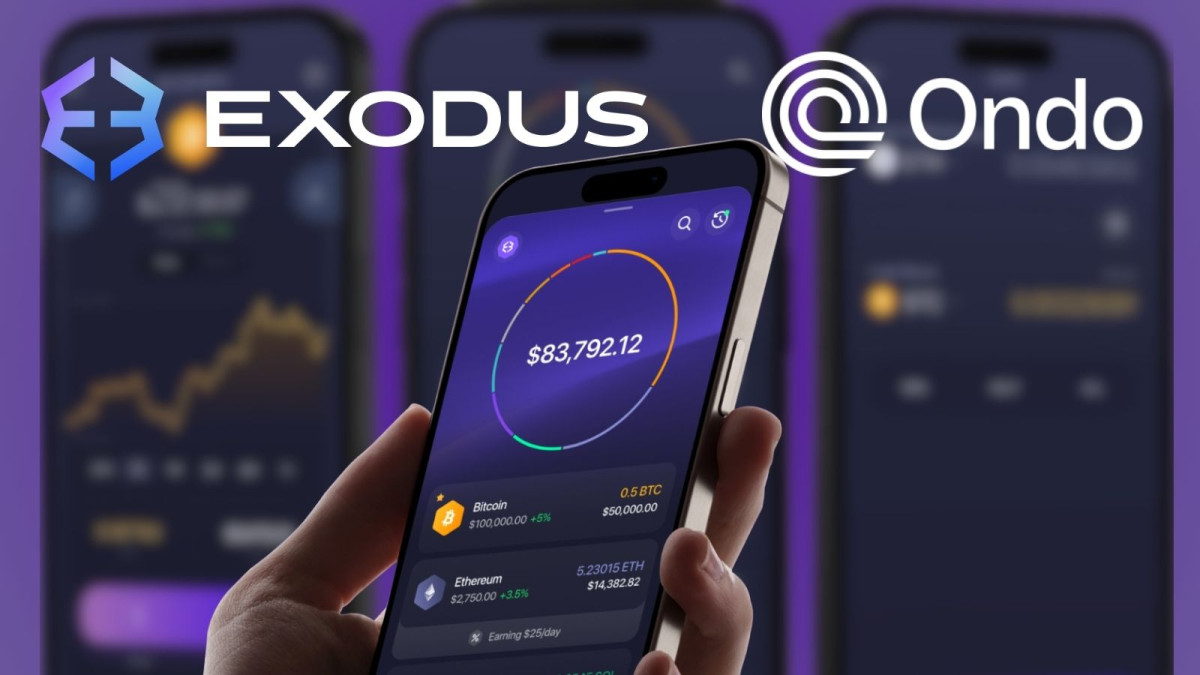
Exodus Partners With Ondo To Launch Tokenized Stocks

Exodus Movement Inc. (NYSE American: EXOD), a publicly traded financial technology company and developer of the Exodus wallet, has partnered with Ondo Finance to launch Exodus Markets, a platform for trading tokenized assets.

With Exodus Markets, users can now buy and sell more than 200 tokenized stocks, exchange-traded funds (ETFs), and real-world assets directly in the Exodus wallet app on the Solana blockchain.
"Tokenized stocks are one of the most important developments in modern finance," said JP Richardson, CEO and co-founder of Exodus.
"For the first time, our customers can trade and hold tokenized equities with the same direct control and global access they expect from crypto. Exodus is becoming the front door to every asset you hold, without compromising on trust and control."
The launch of Exodus Markets aligns with Exodus’s goal of transforming from a custodial wallet into a full financial platform that allows users to trade, earn rewards, send, spend, and manage money.
As part of its efforts to become a comprehensive financial app, Exodus launched Exodus Pay, a self-custodial payment feature within the Exodus app that enables users to transact with digital assets, including stablecoins, for everyday purchases. The company also launched XO Cash, a stablecoin pegged to the U.S. dollar.
The Tokenization Space
The tokenization space, particularly real-world assets (RWAs), has experienced significant growth over the past 1 to 2 years. Excluding stablecoins, the tokenization sector grew from roughly $5 billion to $6 billion at the start of 2025 to $27 billion to $31 billion or more by mid 2026, representing an increase of more than 400% over a period of 15 to 18 months.
Several institutions are also entering this growing sector, with Bitget most recently launching Reality, its real-world asset (RWA) platform. Kraken has also launched xChange, an on-chain trading engine designed for trading tokenized equities. MetaMask, Trust Wallet, Blockchain.com, and Robinhood have also made strategic moves to enter the sector, partnering with RWA firms and rolling out tokenized assets and stocks.
Given the level of growth and adoption the real-world asset and tokenization sector has seen so far, several projections have been made regarding its future potential. The Boston Consulting Group and Ripple have projected that the sector could be worth more than $15 trillion by 2030.
Bitget Launches Reality for Tokenized Stocks and ETFs

Bitget, a global cryptocurrency exchange, has launched Reality, a real-world asset (RWA) platform that gives users access to tokenized traditional financial assets.
With Reality, Bitget aims to bring tokenized U.S. stocks and exchange-traded funds into its trading ecosystem, enabling access to financial instruments that have traditionally been difficult to access due to geographic restrictions, market hours, and settlement barriers.

The launch aligns with Bitget’s Universal Exchange (UEX) roadmap, which aims to transform Bitget from a crypto exchange into a global trading platform that allows users to trade cryptocurrencies, tokenized stocks, exchange-traded funds, commodities, forex, and other real-world assets through a single account using cryptocurrencies.
“Reality is built around Bitget’s 10% vision: by 2030, nearly 10% of financial assets could exist in tokenized form,” said Gracy Chen, Bitget CEO. “Stablecoins, faster blockchain settlement, and growing interest from major exchanges are pushing RWAs from experiment to market infrastructure. Reality is Bitget’s step toward making that future accessible to global users.”
How Reality Will Work
Reality will be natively integrated into Bitget and serve as the exchange’s specialized arm for tokenizing traditional financial instruments. It will also serve as the primary layer for standardizing traditional market value in the crypto economy.
The Reality platform will issue rTokens to users, which are on-chain representations of publicly traded equities and exchange-traded funds (ETFs). Each rToken will be backed 1:1 by real shares held with a FINRA-registered, SIPC-protected U.S. broker-dealer.
To ensure the highest level of transparency, the Reality platform will be regularly audited by third-party auditors. These audits will provide a live proof-of-asset dashboard and CPA-level audit reports to ensure verifiable asset integrity at all times.
Reality will initially focus on providing tokenized exposure to selected U.S. stocks and ETFs, with the team introducing additional tokenized assets as the platform expands. However, access to the platform, including user eligibility, product availability, and trading features, will depend on applicable geographical laws and regional restrictions.
Bitget’s entry into the RWA tokenization industry comes as several institutions, including Payward, Bitwise, and Nasdaq, are tapping into the growing sector. The RWA tokenization market is currently valued at around $34 billion, with the Boston Consulting Group projecting it to reach $16 trillion by 2030.
Tokenized Stocks Hit $1B Market Cap Milestone

Tokenized stocks have crossed the $1 billion market cap marking a major turning point for RWAs on-chain. Public equities drove the surge, with platforms like Ondo Global Markets and xStocks leading the charge, while tokenized private equities on Solana continue to gain early traction and expand rapidly.

The rise of tokenized stocks brings several benefits to investors as they enable 24/7 global trading without the traditional T+2 settlement delays, allowing markets to operate continuously rather than shutting down after regular hours. Fractional ownership lowers the barrier for smaller investors to gain exposure to stocks and private investments. Assets can be used directly as collateral in DeFi protocols, creating new opportunities for yield generation and liquidity with instant settlement that reduces counterparty risk and improves capital efficiency.
Ondo Finance and xStocks together account for over 90% of the tokenized stock market cap. Ondo leads at $741.1M (heavily on Ethereum at $440.1M and BNB Chain at $283.2M), followed by xStocks at $315.2M (dominant on Solana with $258.4M and reach through CEXs like Kraken and Bybit). The rest includes Superstate, Robinhood on Arbitrum, Dinari, and PreStocks’ $17.8M in tokenized private equities. Launched in June 2025, xStocks has already facilitated over $3.5 billion in on-chain transaction volume and $25 billion in total trading volume, tokenizing major assets like SPYx, QQQx, NVDAx, and TSLAx.

Another interesting segment is tokenized pre-IPO stocks that bring exposure to private companies like Anthropic directly onto Solana via platforms such as PreStocks. These tokens are created through Special Purpose Vehicles (SPVs) that hold shares or exposure acquired on secondary markets. PreStocks then issues 1:1 backed SPL tokens on Solana that track the company's implied valuation which lets holders get price exposure with 24/7 trading on DEXes like Jupiter. The tokenized pre-IPO sector has grown roughly 200% year-to-date, with Anthropic leading the surge.

However, Ethereum is still the clear leader when it comes to bringing stocks on-chain, as it’s become the primary home for major financial moves as the value of funds moving onto Ethereum has grown 20x since the start of 2024, thanks to massive names like BlackRock and Fidelity launching their own products there. This dominance extends across other major real-world asset categories as well, with the network maintaining a strong position in tokenized commodities, funds, and stablecoins.

Nasdaq has secured SEC approval to trade tokenized Russell 1000 stocks and major index ETFs on the same order book as their traditional counterparts, while the NYSE is building a 24/7 on-chain venue with instant settlement and stablecoin funding in partnership with Securitize and the DTCC’s tokenization infrastructure. Firms like Franklin Templeton, JPMorgan, and Apollo are rolling out tokenized money market funds, credit strategies, and other securities across networks that reache beyond Ethereum and Solana to include chains like Polygon, Avalanche, Base, Aptos, and Stellar, reflecting a multi-chain strategy to plug directly into different DeFi ecosystems.
Ondo Global Markets, now one of the main issuers of tokenized U.S. stocks and ETFs, blocks U.S. users and anyone trading from inside the country, and pushes those restrictions through partners like MetaMask, Binance Wallet, and centralized exchanges that list its products. Kraken’s xStocks do the same, limiting access to non U.S. clients in a set list of jurisdictions and explicitly excluding residents of the United States, Canada, the U.K., and Australia. On Solana, the pre-IPO names led by PreStocks let people trade tokens linked to companies like Anthropic, but they sit in a gray zone because they’re SPV based claims with no audited, public proof of backing, wide gaps between implied token prices and private round valuations, thin liquidity, and no clear path for U.S. retail to participate. So while Binance, OKX, Kraken, and others rush to put tokenized stocks in front of millions of users, most of the real volume is still offshore, and U.S. investors are mostly stuck watching from the sidelines until policy catches up.
SEC Approves Nasdaq Tokenized Stock Trading Pilot

The U.S. Securities and Exchange Commission (SEC) on Wednesday approved Nasdaq’s proposal to launch a pilot program for tokenized stock trading.
The proposal, first filed in September 2025, sought SEC approval to allow trading of both traditional and tokenized versions of high-volume stocks on the Nasdaq exchange. With the program now approved, traders will be able to trade both traditional stocks and their tokenized counterparts on the Nasdaq.

These tokenized stocks, according to the approval filing, will trade on the same order book at the same price, under the same ticker, with the same identifying number and rights as their traditional counterparts.
The pilot program will not be open to everyone. According to the SEC approval filing, participation will be limited to eligible participants. While Nasdaq has not disclosed the criteria, participants are likely to include Nasdaq-approved broker-dealers and firms approved by the Depository Trust Company (DTC).
It is also important to note that these tokenized stocks will be limited to securities in the Russell 1000 index, which tracks the 1,000 largest publicly traded companies in the United States, as well as exchange-traded funds that track the S&P 500 and Nasdaq-100 indices.
The Booming Tokenized Stocks Market
The tokenized stocks and equities market has experienced a remarkable surge over the past few months, growing from around $32 million at the start of 2025 to $963 million by January 2026, an increase of approximately 3,000%.
This growth has been attributed to the wider accessibility and faster settlement times offered by tokenized stocks compared with their traditional counterparts.
A wave of large fintech and crypto companies has also entered the tokenized equity market. In 2024, the cryptocurrency exchange Robinhood built a custom layer-2 blockchain for tokenization and began offering tokenized U.S. stocks to European users the following year.
Other cryptocurrency exchanges, including Kraken, Gemini, and eToro, have also begun offering tokenized U.S. stocks across multiple blockchains, such as Solana, BNB Chain, Arbitrum, and Ethereum. Most recently, Kraken, in partnership with Backed Finance, launched xChange, an on-chain trading engine for tokenized equities.
With the rapid attention and growth the tokenized equities market has seen, its market capitalization is projected by multiple research reports to reach trillions of dollars in the coming years.
Kraken Launches xChange for Tokenized Stock Trading

Crypto exchange Kraken has launched xChange, a new on-chain trading engine designed to facilitate trading of its tokenized stocks, xStocks, across Ethereum and Solana.
According to Kraken, xChange supports on-chain trading of more than 70 tokenized equities with 1:1 price backing to their underlying shares. To ensure transparency, the platform allows these tokenized equities to track their prices in the public stock market.
As a result, tokenized equities on the xChange platform will track their corresponding prices in the public stock market without the involvement of third-party intermediaries.
How xChange Is Transforming the Tokenized Equity Market
The tokenized equity market has grown remarkably. According to a January report from DL Research, it expanded approximately 2,800% year over year, rising from about $32 million in January 2024 to $963 million in January 2025.
In fact, Token Terminal reported that the tokenized stock and equity market reached an all-time high valuation of $1.2 billion in December 2025.

As tokenized equities continue to gain traction, with monthly trading volumes reaching $800 million, Kraken launched xChange to build on this momentum.
By providing a unified execution layer that connects liquidity across Ethereum and Solana, xChange enables users to execute large trades quickly with minimal slippage.
xChange offers atomic on-chain settlement, allowing users to execute trades indivisibly. There are no intermediate states during a trade; orders are either executed in full at the quoted price or not executed at all.
xChange also operates 24 hours a day, five days a week across the Ethereum and Solana blockchains. The benefit? Traders can continue trading tokenized equities beyond traditional market hours.
What xStocks Are
Launched in June 2025, xStocks are tokenized representations of real U.S. stocks and exchange-traded funds (ETFs). Although they were launched by Kraken, they are issued by Backed Finance.
Although they are not available to users in the United States and the United Kingdom, they are available in more than 140 countries, and their performance so far has been impressive.

Since launch, they have recorded $3.5 billion in on-chain transaction volume and $25 billion in total trading volume across exchanges, with approximately $225 million in tokenized assets held across 80,000 blockchain wallets.
Robinhood Chain Launches Ethereum L2 Testnet

Robinhood is going deeper into crypto infrastructure.
The company has launched the public testnet for Robinhood Chain, its own Ethereum layer 2 network built on Arbitrum’s rollup technology. Until now, Robinhood has mostly acted as a gateway, letting users trade crypto and, in some regions, tokenized equities. This move changes that. It is now building the underlying blockchain where those assets could live.
It is a meaningful shift. Running a brokerage app is one thing. Operating blockchain infrastructure is another.
What Robinhood Chain Actually Is
Robinhood Chain is a permissionless Ethereum layer 2. It uses Arbitrum’s technology, which means it inherits Ethereum’s security while offering lower transaction costs and higher throughput through rollups.
“With Arbitrum’s developer-friendly technology, Robinhood Chain is well-positioned to help the industry deliver the next chapter of tokenization and permissionless financial services,” said Steven Goldfeder, Co-Founder and CEO of Offchain Labs. “Working alongside the Robinhood team, we are excited to help build the next stage of finance.”
For developers, it is EVM compatible. Smart contracts built for Ethereum can be deployed here with standard tooling. Wallets, developer libraries, and infrastructure services should feel familiar.
On paper, nothing radical. The differentiation is not in the virtual machine. It is in the intended use case.
The Core Bet: Tokenized Stocks
Robinhood is clearly focused on tokenized real world assets, especially public equities and ETFs.
The company has already offered tokenized stock exposure in Europe. Now it is building infrastructure that could support broader issuance and trading of these assets directly onchain.
A big part of the pitch is continuous trading. Crypto markets operate 24 7. Traditional stock exchanges do not. If equities are represented as tokens on a blockchain, they can, in theory, trade at any time and settle much faster than traditional systems.
That sounds straightforward. In practice, it depends heavily on regulatory clarity. Tokenized securities raise questions around custody, investor protections, and jurisdictional restrictions. Robinhood has acknowledged this and appears to be designing the chain with compliance in mind.
Compliance Is Not an Afterthought
Unlike many general purpose layer 2 networks, Robinhood Chain is being built with regulated financial products as the primary target.
That means infrastructure that can handle minting and burning of tokenized securities in a controlled way. It likely also means features that support jurisdiction based restrictions and other compliance requirements at the protocol or system level.
Robinhood has not framed this as a purely decentralized experiment. It is positioning the network as financial infrastructure, with guardrails.
That will appeal to some institutions. It may frustrate parts of the crypto community. Both reactions are predictable.
Infrastructure Partners in Place
Robinhood is not building this alone.
Chainlink is involved to provide oracle services, which are essential if you are dealing with tokenized stocks that need accurate real world price feeds. Alchemy is supporting developer infrastructure. Other analytics and compliance firms are integrated from the outset.
This is not a bare bones testnet thrown into the wild. It is being launched with a fairly complete infrastructure stack.
The company is also rolling out developer documentation and encouraging builders to start experimenting immediately.
The Exchange Layer 2 Trend
Robinhood joins a growing list of exchanges and fintech firms launching their own Ethereum layer 2 networks.
Coinbase operates Base. Kraken is developing its own network. Other trading platforms are exploring similar strategies.
The rationale is not complicated. If tokenized assets and onchain trading grow, exchanges would prefer that activity to happen on networks they influence, rather than on third party chains. Controlling infrastructure can mean more flexibility in product design, fee structures, and integration with existing platforms.
For Robinhood, which already serves millions of retail users, owning a layer 2 could tighten the loop between its app, its wallet, and onchain markets.
Testnet Today, Mainnet Later
Right now, Robinhood Chain is in public testnet. Developers can deploy contracts, test integrations, and experiment with wallet flows, including direct testing with Robinhood Wallet. No production assets are live yet.
To drive activity, Robinhood is backing developer engagement with hackathons and incentives, including a seven figure prize pool aimed at financial applications built on the network.
A mainnet launch is expected later this year, though exact timing has not been pinned down publicly. Technical stability and regulatory comfort will likely dictate the pace.
The Bottom Line
Robinhood Chain is a signal that tokenized finance is not just a side project for major platforms anymore.
If tokenized equities become widely accepted, infrastructure will matter as much as distribution. Robinhood already has distribution through its app. Now it is trying to build the rails underneath.
There are open questions. Will regulators in the US allow meaningful onchain trading of tokenized securities? Will liquidity concentrate on exchange backed layer 2s or on more neutral networks? Will users care which chain their tokenized stock sits on?
For now, Robinhood has made its position clear. It wants to be more than a broker. It wants to operate the blockchain layer where digital versions of traditional assets trade and settle.
The testnet is the first real step in that direction.
MetaMask Adds Tokenized Stocks, ETFs via Ondo

Metamask, the popular self-custody wallet announced it now supports tokenized U.S. stocks, ETFs, and commodities through an integration with Ondo Global Markets. For eligible users outside the United States, this means exposure to names like Apple, Tesla, Nvidia, major index ETFs, and even gold and silver, all from inside the MetaMask wallet.
It is one of the clearest signals yet that tokenized real-world assets are moving from theory into everyday crypto products.
What’s Actually Being Offered
The new offering includes more than 200 tokenized securities at launch. These tokens track the price of publicly traded U.S. stocks, ETFs, and commodity funds. Users can buy them with stablecoins, hold them in their wallet, and transfer them onchain just like any other ERC-20 token.
These are not shares in the legal sense. Holding a tokenized stock does not give voting rights or direct ownership of the underlying equity. Instead, the tokens provide economic exposure to the price movements of the asset, backed by traditional market infrastructure on the other side.
For many crypto users, that distinction may matter less than the experience itself. The ability to gain U.S. market exposure without opening a brokerage account or leaving a self-custodial wallet is the real draw.
How It Works Inside MetaMask
The integration runs through MetaMask Swaps, meaning users do not need to leave the wallet or interact with unfamiliar interfaces. Trades are executed onchain, while pricing and asset backing are handled through Ondo’s infrastructure.
Minting and redemption of the tokens generally follow U.S. market hours, reflecting how the underlying assets trade in traditional markets. Transfers between wallets, however, can happen at any time. That hybrid setup blends old market rules with blockchain flexibility, even if it is not fully 24/7 trading yet.
Fractional exposure is also built in, allowing users to buy small amounts of high-priced stocks or ETFs without committing large sums of capital.
Who Can Use It
Access is limited to eligible users in supported jurisdictions outside the U.S. and several other regions. Regulatory restrictions around securities remain a major factor, and MetaMask has been clear that availability depends on local rules.
For now, the product is primarily aimed at international users who want U.S. market exposure without navigating the friction of legacy brokerage systems.
The Bigger Industry Context
This move highlights how quickly real-world assets are becoming part of the crypto stack.
For years, tokenized stocks were discussed as a future use case. Today, they are appearing inside one of the most widely used wallets in the industry. That changes the conversation. Instead of asking whether tokenization will happen, the focus shifts to how fast it scales and how regulators respond.
It also reframes MetaMask’s role. The wallet is no longer just a gateway to DeFi and NFTs. It is starting to look more like a universal financial interface, one that sits between crypto markets and traditional assets.
For users, the appeal is simplicity. One wallet, one interface, exposure to crypto, equities, ETFs, and commodities. No bank logins, no brokerage apps, no asset silos.
MetaMask’s integration with Ondo fits into a broader push across the industry. Tokenization is being explored by crypto-native firms, fintech platforms, and even large financial institutions. The idea is straightforward. Traditional markets are slow, fragmented, and geographically constrained. Blockchains promise faster settlement, global access, and programmable assets.
Tokenized real-world assets already represent tens of billions of dollars in value, and many expect that number to grow sharply if regulatory clarity improves.
Still, challenges remain. Regulatory uncertainty is the biggest one. Liquidity and pricing ultimately depend on traditional markets. And for some investors, the lack of shareholder rights will always be a drawback.
The Bottom Line
Ondo has said it plans to expand its catalog to thousands of assets over time. If that happens, wallets like MetaMask could become primary access points for global capital markets, especially in regions underserved by traditional finance.
For now, the launch marks a clear trend. Crypto wallets are no longer just about holding crypto. They are becoming portals into the broader financial system, one token at a time.
NYSE Plans 24/7 Tokenized Stock and ETF Trading on Blockchain

The New York Stock Exchange is imagining a world without a closing bell.
NYSE, through its parent company Intercontinental Exchange, is building a blockchain-powered platform that would allow stocks and ETFs to trade 24/7 in tokenized form. If regulators sign off, it would be one of the clearest signals yet that traditional finance is no longer just experimenting with crypto infrastructure, it is actively rebuilding around it.
The pitch is straightforward but far-reaching. Take real stocks and ETFs, represent them as blockchain tokens, and let them trade continuously. No market open. No market close. No waiting a day for settlement to finish in the background.
For an institution that has defined how markets work for more than 200 years, this is a radical shift.
This Is Not a Side Project
This is not NYSE dipping a toe into crypto.
ICE is designing a separate trading platform that merges NYSE’s core matching technology with blockchain-based settlement, custody, and clearing. Orders still look familiar, bids and asks meet in an order book, but what happens after execution is where things change.
Instead of the standard T+1 settlement cycle, ownership could move almost instantly onchain. Stablecoins are expected to handle funding, allowing trades to clear at any hour without relying on traditional banking rails. Investors may also be able to place dollar-based orders instead of buying whole shares, making fractional ownership the default rather than an add-on.
Structurally, it starts to resemble how crypto markets already operate, just wrapped around regulated assets.
Why Tokenized Stocks Are a Big Deal
Tokenized stocks are not new, but they have mostly lived at the edges of the financial system.
What changes here is credibility. When the NYSE moves toward tokenization, blockchain stops looking like an alternative system and starts looking like core infrastructure.
Tokenization allows equities and ETFs to trade globally, settle instantly, and operate without the friction built into traditional market plumbing. It removes time zone barriers. It compresses settlement risk. It turns stocks into programmable financial objects.
For investors who already trade crypto around the clock, the idea that equities shut down every afternoon feels increasingly outdated.
Crypto Trained the Market to Expect 24/7
This move did not come out of nowhere.
Crypto markets have normalized nonstop trading. Platforms like Robinhood and Coinbase are already pushing toward tokenized equities and extended hours. Asset managers are testing onchain settlement in private markets and fund structures.
Meanwhile, traditional clearing and settlement remain slow, expensive, and operationally complex. Blockchain promises efficiency, but only if institutions are willing to rethink the system rather than patch it.
NYSE’s entry into this space suggests legacy exchanges see the risk clearly. If liquidity, trading volume, and investor attention move onchain elsewhere, exchanges that stay static risk being left behind.
Regulation Decides Everything
For now, all of this lives in proposal form.
Tokenized stocks are still securities. That means U.S. securities laws apply, even if the assets settle on a blockchain. Continuous trading raises hard questions around surveillance, volatility controls, investor protections, and systemic risk. Stablecoins add another regulatory layer.
How regulators respond to an NYSE-backed tokenized market will likely shape how far and how fast tokenization spreads across public markets.
What Happens If This Actually Works
If this platform launches and gains traction, it could reshape how markets function.
Stocks that trade nonstop would change liquidity patterns and price discovery. Global participation would increase. Settlement could become faster, cheaper, and more transparent. Post-trade infrastructure might finally catch up with the digital age.
There are tradeoffs. Continuous markets can amplify volatility. Liquidity could fragment across venues. Retail investors may face more noise and fewer natural breaks.
Still, the direction feels unmistakable.
Crypto infrastructure is no longer sitting outside the financial system. It is being welded into it.
The NYSE is not turning stocks into memecoins. But it is signaling that the future of equities looks more onchain, more global, and far less dependent on a bell ringing at 4 p.m. Eastern.
The wall between crypto markets and traditional markets is thinning fast, and one of the oldest institutions in finance just acknowledged it.
Securitize Plans to Bring Stocks On-Chain as Tokenized Equities Gain Momentum
Securitize is making a move that, not long ago, would have sounded more theoretical than practical. The company plans to launch tokenized versions of stocks on-chain, pushing one of the most traditional parts of finance a little closer to blockchain infrastructure.
This is not about meme stocks or crypto-native experiments. Securitize operates squarely within the existing regulatory system. It has spent years working with asset managers, institutions, and regulators, quietly building the pipes needed to issue and manage digital versions of real-world assets.
That context matters. Putting stocks on-chain is not just a technical upgrade. It is an attempt to modernize how equities are issued, traded, and settled, without breaking the legal framework that keeps markets functioning.
What Putting Stocks On-Chain Really Looks Like
Tokenized stocks are essentially digital representations of real shares, recorded on a blockchain. These are not synthetic products that simply track prices. Each token is designed to correspond to an actual share, with ownership recognized in corporate and legal records.
In practice, that means the blockchain handles transfer and settlement, while traditional systems still govern shareholder rights, compliance, and corporate actions. It is less a replacement of existing markets and more a new layer running alongside them.
The appeal is straightforward. Blockchain settlement is faster. Transfers can happen in minutes rather than days. Tokens can also be divided into smaller pieces, which makes fractional ownership easier and potentially opens the door to a broader set of investors.
It is not revolutionary on its own, but it is meaningfully more efficient.
Why Securitize Is in a Position to Try This
Securitize has been focused on tokenization long before it became a popular narrative. The company already handles issuance, compliance, and transfer agent duties for tokenized funds and other financial products. Billions of dollars in assets have passed through its platform.
Because it operates with regulatory approval, Securitize has been able to work inside the system rather than around it. That makes its push into tokenized stocks feel less speculative and more like a logical next step.
If funds, bonds, and private assets can be tokenized, public equities were always going to be part of the conversation. The question was when, not if.
Why This Matters for Markets
The strongest case for tokenized equities comes down to efficiency.
Settlement in traditional stock markets still takes two days. Blockchain-based settlement happens much faster, which reduces counterparty risk and frees up capital.
There is also the question of access. Tokenized stocks can, in theory, trade around the clock and reach investors beyond traditional market hours and geographies, depending on regulatory constraints.
Fractional ownership is another piece. Smaller units of stock make it easier for investors to gain exposure without committing large amounts of capital.
And once equities live on-chain, they become programmable. Compliance checks, dividend payments, and other corporate actions can be automated in ways that legacy systems struggle to match.
None of this guarantees widespread adoption. But for institutions that spend heavily on operational complexity, the benefits are hard to ignore.
Regulation Still Sets the Pace
None of this works without regulators. Stocks are among the most tightly governed financial instruments in the world, and tokenization does not change that.
Securitize’s approach has been to treat tokenized stocks as securities first. Identity checks remain in place. Transfers are restricted based on jurisdiction and eligibility. Corporate governance follows existing rules.
That conservative stance may slow things down, but it also makes the product usable for institutions that cannot afford regulatory uncertainty.
Around the world, regulators are moving carefully. Some are experimenting with blockchain-based trading and settlement systems. Others are still figuring out how digital records fit into long-standing legal definitions of ownership.
The progress is uneven, but the direction is clear. Tokenization is no longer being dismissed. It is being studied.
Part of a Bigger Shift
Securitize’s move fits into a broader trend across financial markets. Tokenization is spreading from pilot projects to real issuance. Bonds, private credit, and structured products are increasingly being brought on-chain, often with the backing of established financial players.
Stocks are different. They are more visible and more symbolic. Bringing them on-chain would signal that blockchain technology has moved beyond niche use cases and into the core of global markets.
That shift, once it starts, tends to be difficult to unwind.
The Challenges Are Real
There are still open questions.
Liquidity is a big one. Tokenized stocks only matter if there are enough buyers and sellers to create healthy markets. That takes time.
Interoperability is another. Bridging blockchain systems with legacy infrastructure adds complexity and introduces new risks.
And then there is trust. Investors tend to be conservative with assets as central as stocks. New formats have to earn credibility slowly.
None of these challenges are deal breakers, but they help explain why this transition is likely to be gradual rather than dramatic.
A Quiet but Important Step
Securitize putting stocks on-chain is not a revolution. It is something more understated.
It suggests that the future of markets may be less about tearing down existing institutions and more about updating the infrastructure beneath them. Blockchain, in this framing, becomes a tool rather than a statement.
If that vision holds, tokenized stocks may eventually feel unremarkable. They will simply be another way equities move through the system, faster, cleaner, and mostly behind the scenes.
And that is often how real change shows up in finance.
Stay Connected
You can stay up to date on all News, Events, and Marketing of Rare Network, including Rare Evo: America’s Premier Blockchain Conference, happening July 28th-31st, 2026 at The ARIA Resort & Casino, by following our socials on X, LinkedIn, and YouTube.
Bybit Expands Into Real-World Assets with Backed Finance Partnership for Tokenized Stocks
Bybit Expands Into Real-World Assets with Backed Finance Partnership for Tokenized
A new wave of tokenized equity products is reshaping how investors access global markets, and xStocks is leading the charge. Created by Backed Finance in partnership with Bybit and Mantle, xStocks allows tokenized versions of major U.S. company shares such as Nvidia (NVDA), Apple (AAPL), and MicroStrategy (MSTR) to be traded on-chain in a regulated, transparent, and globally accessible format.
Each xStock token is backed one-to-one by the underlying equity, which is held in custody by regulated third-party custodians. This approach ensures full backing while enabling the shares to move seamlessly within decentralized finance (DeFi) ecosystems.
How xStocks Works
For every xStock minted, a real-world share of the corresponding company is held by the issuer in custody. These tokens can then be traded 24/7 on platforms such as Bybit and used within DeFi protocols for lending, borrowing, or liquidity provision.
Bybit supports deposits and withdrawals of xStocks through the Mantle Network, which acts as the blockchain infrastructure layer connecting centralized and decentralized platforms. Mantle’s low fees and high performance make it an ideal environment for on-chain trading of real-world assets.
This structure allows investors to gain global exposure to leading U.S. equities without the limitations of traditional brokerage systems or market hours. Tokenized stocks can also be composed into smart contracts, collateral systems, and decentralized trading strategies, creating new opportunities for both traders and developers.
Why Tokenized Stocks Matter
The launch of xStocks marks a major step toward convergence between traditional finance (TradFi) and decentralized finance. By tokenizing shares of publicly traded companies and making them available on-chain, the project introduces a host of benefits:
-
Global access: Investors from almost any region can gain exposure to U.S. stocks without relying on traditional brokerages.
-
Composability: Tokenized stocks can integrate with DeFi platforms, enabling creative use cases such as yield farming or collateralized lending.
-
Continuous trading: Unlike traditional markets, xStocks can trade around the clock, while still tracking underlying asset prices through custodial backing and oracle feeds.
-
Fractional ownership: Smaller investors can gain access to high-value stocks through fractionalized token units.
This level of accessibility and flexibility represents a meaningful expansion of the global financial system into blockchain-based environments.
Key Partnerships Driving xStocks
-
Backed Finance serves as the issuer and compliance manager for xStocks, ensuring that each token is fully backed by a corresponding equity share and held under regulated custody.
-
Bybit, one of the world’s top crypto exchanges, provides the liquidity, infrastructure, and user base to make tokenized stock trading seamless.
-
Mantle Network delivers the blockchain infrastructure that underpins the system, offering a modular Layer 2 framework with high throughput and low transaction costs.
Together, these partners form a complete pipeline for bringing traditional assets onto the blockchain. Shares are securely held, tokenized, and then made accessible through regulated on-chain channels.
Use Cases and Early Listings
The initial lineup for xStocks includes a mix of technology and finance leaders such as Nvidia, Apple, Tesla, Coinbase, and MicroStrategy. Each stock is represented by a corresponding xStock token (for example, NV DAX for Nvidia and MSTRX for MicroStrategy).
Holders can store these tokens in self-custody wallets, trade them directly on Bybit, or integrate them into DeFi applications across the Mantle ecosystem. Over time, more equities and potentially ETFs may be added to expand the offering.
Regulatory and Market Considerations
While the concept is groundbreaking, tokenized securities carry some caveats:
-
No voting or dividend rights: Token holders typically gain economic exposure but not shareholder privileges like voting or direct dividend collection.
-
Jurisdictional restrictions: Residents of certain countries, including the United States, may be restricted from purchasing or holding xStocks until further licensing is obtained.
-
Price variance risk: During off-market hours, token prices can deviate from the underlying asset price, creating both arbitrage opportunities and liquidity risks.
-
Regulatory evolution: The treatment of tokenized stocks varies across jurisdictions, and projects like xStocks will likely face ongoing regulatory review as adoption grows.
Even with these considerations, the model represents a significant advancement toward a future where on-chain representations of real-world assets can coexist with traditional financial infrastructure.
A New Era for Real-World Assets
Tokenization of assets like equities, bonds, and commodities has long been viewed as the next frontier for blockchain adoption. Projects such as xStocks demonstrate that this vision is now moving from concept to implementation.
By combining regulatory compliance, on-chain transparency, and cross-border accessibility, xStocks delivers a clear example of how tokenized finance could evolve. The initiative also highlights the growing appetite for real-world assets (RWAs) among DeFi participants, who are increasingly seeking stable, yield-bearing alternatives to purely speculative tokens.
Final Thoughts
The xStocks launch represents more than a new trading product. It is part of a broader transformation of financial infrastructure — one that connects traditional equity markets to the programmable, borderless nature of blockchain.
Bybit, Mantle, and Backed Finance are positioning themselves at the intersection of these two worlds. If xStocks succeeds, it could pave the way for widespread tokenization of major assets, potentially redefining how investors trade, store, and leverage real-world value in the digital age.
As more institutions explore on-chain settlement, custodial bridges, and tokenized asset offerings, xStocks may be remembered as one of the early milestones that made Wall Street truly interoperable with Web3.
Stay Connected
You can stay up to date on all News, Events, and Marketing of Rare Network, including Rare Evo: America’s Premier Blockchain Conference, happening July 28th-31st, 2026 at The ARIA Resort & Casino, by following our socials on X, LinkedIn, and YouTube.