#Brian Armstrong

Coinbase Reverses Base App Strategy, Brings Back Coinbase Wallet

Coinbase is reversing its Base App strategy and bringing back Coinbase Wallet after falling short of the “everything app” vision it initially had for the platform.
This reversal comes just a year after the exchange rebranded Coinbase Wallet as the Base App during its “A New Day One” event, held in Los Angeles on July 26 last year. The goal of the rebrand was to create an on-chain “everything app” or “super app” for users.

To create the “everything app” platform, Coinbase combined the self custodial wallet features of Coinbase Wallet with social networking, messaging, payments, trading, and creator features, all within the Base App. This created a complete on chain experience where users could trade, create, interact, and discover new apps.
Amid all of this, the Base App strategy failed to gain traction. According to Coinbase CEO Brian Armstrong, it was an experiment that did not quite work, stating that the exchange will focus more on trading while bringing back the self custodial features of Coinbase Wallet.
Remember that Jesse Pollak, the creator of Base, also recently resigned from his leadership role at Base after admitting that his bet on-chain social products this year had failed. According to Pollak, the social side of the on-chain market had completely disintegrated.
The Plan Going Forward
Following the rebrand, Coinbase Wallet will serve as a “test kitchen” for features that are not readily available on the Coinbase cryptocurrency exchange. According to Ryan Kass, Head of Coinbase Wallet Product, Coinbase Wallet will give users access to on chain finance.
Among the first set of asset offerings to be made available to users are perpetual futures powered by Hyperliquid, including more than 290 derivative markets spanning cryptocurrency, equity, and commodity markets.
Coinbase Shareholder Sues Executives Over Compliance Issues

A Coinbase shareholder has filed a derivative lawsuit against several top executives and board members of the crypto exchange, alleging compliance and disclosure failures by the company’s leadership.
On Tuesday, Kevin Meehan, one of Coinbase’s shareholders, filed a complaint in a U.S. district court in New Jersey. The court filing cited several of Coinbase’s top directors, including CEO Brian Armstrong, co-founder Fred Ehrsam, Chief Legal Officer Paul Grewal, and Chief Financial Officer Alesia Haas, among other executives.

Image credit: PACER
According to the filing, the plaintiff accused the defendants of making false and misleading statements between April 2021, when the exchange became a publicly traded company, and June 2023. The complainant alleged that a compliance failure by the exchange's leadership exposed the company to several stringent regulatory actions.
On behalf of Coinbase, the complainant, Kevin, is seeking damages, requesting that the court implement corporate governance reforms, and requesting recovery of any profits the exchange's leadership may have obtained during the period when the exchange faced these compliance cases.
However, since this is a shareholder derivative lawsuit, any financial recovery from Coinbase's directors will go to Coinbase rather than directly to the shareholders.
Coinbase Battle With Compliance
Over the past few years, Coinbase has faced several legal and compliance challenges, paying millions of dollars in damages and penalties.
In January 2023, the New York State Department of Financial Services sued the exchange for major failures in its Anti-Money Laundering (AML) program. The regulator accused Coinbase of having weak Know-Your-Customer (KYC) checks and failing to properly review suspicious transactions.
As part of the settlement, Coinbase agreed to pay $100 million: $50 million in penalties and $50 million to improve its compliance checks and systems.
In June 2023, Coinbase was hit with a $5 million penalty by the New Jersey Bureau of Securities. The regulator accused the exchange of allowing the trading of unregistered securities on its platform, prompting several other states to impose restrictions on its staking services at the time.
Coinbase has also faced legal challenges from the U.S. Securities and Exchange Commission (SEC). In 2023, the SEC filed a lawsuit against the company, alleging it operated an unregistered exchange. Following the announcement, Coinbase’s stock dropped sharply, falling from over $60 to under $50 within minutes of the news breaking.
White House Calls Out Dimon on Stablecoin Yields

Washington's stablecoin standoff just got a whole lot more personal.
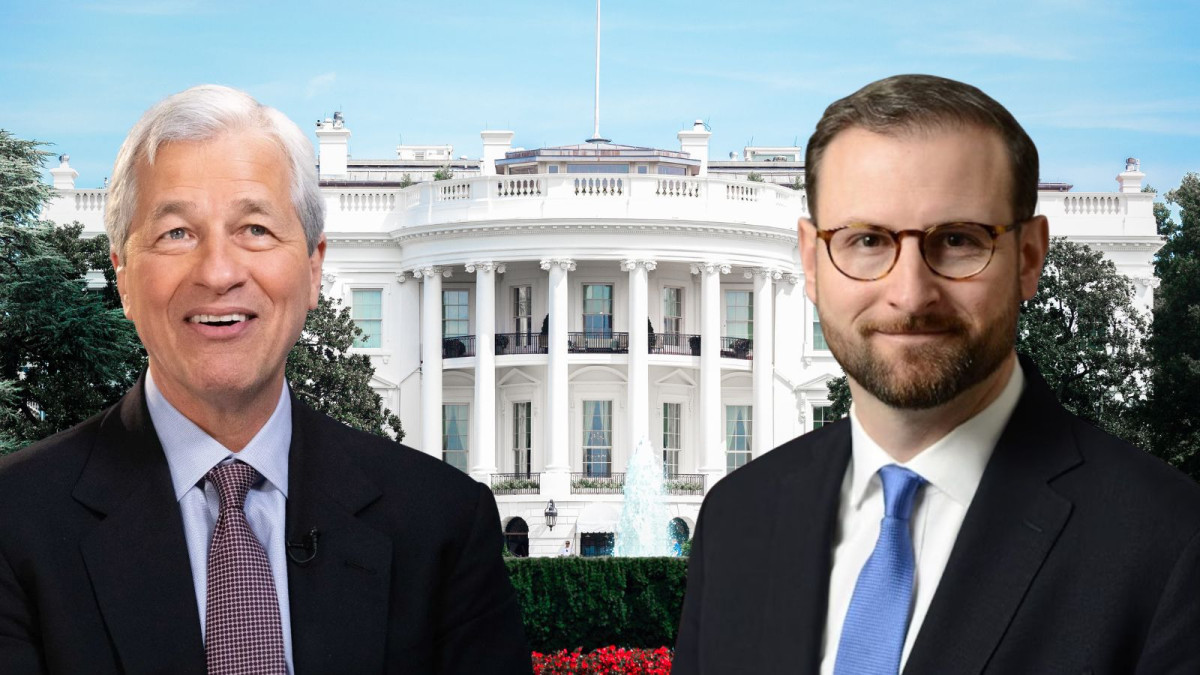
Patrick Witt, the executive director of the President's Council of Advisors for Digital Assets, publicly fired back at JPMorgan Chase CEO Jamie Dimon on Tuesday, calling his arguments about stablecoin yields misleading and, in Witt's own word, a "deceit."
The exchange marks one of the sharpest moments yet in a months-long tug-of-war between Wall Street and the White House over the future of digital asset regulation in America.
Dimon Draws a Line in the Sand
It started Monday, when Dimon went on CNBC and didn't mince words. His position was simple, if uncompromising: any platform holding customer balances and paying interest on them is functionally a bank, and should be regulated like one.
"If you do that, the public will pay. It will get bad," Dimon warned, arguing that a two-tiered system where crypto firms operate with fewer restrictions than banks is unsustainable.
Dimon suggested a narrow compromise: platforms could offer rewards tied to transactions. But he drew a clear line at interest-like payments on idle balances, saying, "If you're going to be holding balances and paying interest, that's a bank."
The list of obligations Dimon believes should apply is long, FDIC insurance, capital and liquidity requirements, anti-money laundering controls, transparency standards, community lending mandates, and board governance requirements. "If they want to be a bank, so be it," he said.
For Dimon, it's fundamentally about fairness. JPMorgan uses blockchain in its own operations, and the CEO was careful to frame his argument not as anti-crypto but as pro-competition on equal terms. "We're in favor of competition. But it's got to be fair and balanced," he said.
The White House Fires Back
Witt wasn't going to let that stand. In a post on X late Tuesday, he went directly at Dimon's framing, calling it deliberately misleading.
"The deceit here is that it is not the paying of yield on a balance per se that necessitates bank-like regulations, but rather the lending out or rehypothecation of the dollars that make up the underlying balance," Witt wrote. "The GENIUS Act explicitly forbids stablecoin issuers from doing the latter."
The argument gets at something technically important. What makes a bank risky, and therefore subject to heavy regulation, isn't that it pays interest. It's that banks take deposits and lend them back out, creating credit and the systemic risk that comes with it. If too many people want their money back at once, that's a bank run. Stablecoin issuers operating under the GENIUS Act must maintain reserves at a 1:1 ratio. There is no fractional reserve lending, no rehypothecation, no credit creation.
In Witt's view, stablecoin balances aren't deposits, and treating them as such misrepresents what's actually happening. He closed with a pointed equation: "Stablecoins ≠ Deposits."
President Donald Trump didn't stay quiet either. On Tuesday, he took to Truth Social with a message that made his position unmistakably clear.
"The U.S. needs to get Market Structure done, ASAP. Americans should earn more money on their money. The Banks are hitting record profits, and we are not going to allow them to undermine our powerful Crypto Agenda that will end up going to China, and other Countries if we don't get the Clarity Act taken care of," Trump wrote.
Senator Cynthia Lummis quickly reposted Trump's message, adding her own call to action: "America can't afford to wait. Congress must move quickly to pass the Clarity Act."
The same day Trump posted, a Coinbase delegation led by CEO Brian Armstrong visited the White House for talks. The timing was not subtle.
The Real Stakes: The CLARITY Act
To understand why this debate matters so much right now, you need to understand the legislation being held hostage by it.
The GENIUS Act, signed into law in July 2025, established the first federal framework for payment stablecoins. The CLARITY Act is its sequel: a broader market structure bill that would assign clear regulatory jurisdiction to the SEC and CFTC over the crypto industry, and is widely seen as the piece of legislation needed to unlock large-scale institutional participation in digital assets.
The bill cleared the House comfortably but has been mired in Senate gridlock since January, when the Senate Banking Committee indefinitely postponed a planned markup vote. The trigger was Coinbase withdrawing support over a proposed amendment that would have restricted stablecoin rewards for users.
That withdrawal, announced by CEO Brian Armstrong in a post on X the night before the scheduled committee vote, split the crypto industry. a16z crypto's Chris Dixon publicly disagreed, posting "Now is the time to move the Clarity Act forward." Kraken's co-CEO Arjun Sethi also pushed back, writing that "walking away now would not preserve the status quo in practice" and warning it "would lock in uncertainty and leave American companies operating under ambiguity while the rest of the world moves forward."
The stakes for Coinbase are concrete. Stablecoins contribute nearly 20% of Coinbase's revenue, roughly $355 million in the third quarter of 2025 alone, and most of USDC's growth is occurring on Coinbase's platform. Coinbase currently offers 3.5% yield on USDC, a figure most traditional bank accounts can't come close to matching.
Banks Are Scared, and They Have the Numbers to Show It
The banking lobby's concern isn't hypothetical. Banking trade groups, led by the Bank Policy Institute, have warned that unrestricted stablecoin yield could trigger deposit outflows of up to $6.6 trillion, citing U.S. Treasury Department analysis. Bank of America CEO Brian Moynihan put a similar figure forward, reportedly suggesting as much as $6 trillion in deposits, representing roughly 30-35% of all U.S. commercial bank deposits, could be at risk.
Stablecoins registered $33 trillion in transaction volume in 2025, up 72% year-over-year. Bernstein projects total stablecoin supply will reach approximately $420 billion by the end of 2026, with longer-run forecasts from Citi putting the market at up to $4 trillion by 2030. Those aren't niche numbers anymore. At that scale, deposit competition becomes a serious macroeconomic question.
The American Bankers Association and 52 state bankers' associations explicitly urged Congress to extend the GENIUS Act's yield prohibitions to partners and affiliates of stablecoin issuers, warning of deposit disintermediation.
The Bottom Line
What's playing out right now is a genuine philosophical disagreement about what money is and how it should be regulated, wrapped inside a very consequential legislative fight, a prize fight with Banks in one corner and Crypto in the other.
Dimon's argument is not frivolous. Banks are regulated as heavily as they are because of what they do with deposited money, and a world where consumers move trillions into yield-bearing crypto instruments held at lightly regulated platforms carries real risks. The history of financial crises is largely a history of regulatory arbitrage gone wrong.
But Witt's counter is also not frivolous. The GENIUS Act was designed specifically to prevent stablecoin issuers from doing the things that make banks dangerous. A fully reserved, non-lending stablecoin issuer is structurally different from a fractional reserve bank, and applying the same regulatory framework to both risks conflating two fundamentally different business models.
What's harder to square is that the banking lobby's intervention in the CLARITY Act seems, to many in the crypto world, less about prudential regulation and more about protecting market share. President Trump has not been subtle about that read, accusing banks of holding the CLARITY Act hostage to protect incumbent interests against crypto competition.
With the legislative window narrowing, Armstrong back at the White House, and Trump openly calling out the banking lobby by name, this standoff has reached the kind of inflection point where someone is going to have to blink. The question is whether either side is willing to do it before time runs out entirely.
CFTC Names 35 Crypto, Finance Leaders to Advisory Panel

-
Hayden Adams, CEO, Uniswap Labs
-
Brian Armstrong, CEO, Coinbase
-
Shayne Coplan, CEO, Polymarket
-
Brad Garlinghouse, CEO, Ripple
-
Luke Hoersten, CEO, Bitnomial
-
Tarek Mansour, CEO, Kalshi
-
Kris Marszalek, CEO, Crypto.com
-
Nathan McCauley, CEO, Anchorage Digital
-
Peter Mintzberg, CEO, Grayscale
-
Sergey Nazarov, CEO, Chainlink Labs
-
Arjun Sethi, Co CEO, Kraken
-
Peter Smith, CEO, Blockchain.com
-
Tyler Winklevoss, CEO, Gemini
-
Anatoly Yakovenko, CEO, Solana Labs
-
Andrej Bolkovic, CEO, Options Clearing Corporation
-
Thomas Chippas, CEO, Rothera Markets
-
Professor Harry Crane, Representative
-
Chris Dixon, General Partner, a16z Crypto
-
Craig Donohue, CEO, Cboe Global Markets
-
Terry Duffy, Chair and CEO, CME Group
-
Tom Farley, CEO, Bullish
-
Adena Friedman, Chair and CEO, Nasdaq
-
Christian Genetski, President, FanDuel
-
Frank LaSalla, President and CEO, Depository Trust and Clearing Corporation
-
Walt Lukken, CEO, FIA
-
Scott D. O’Malia, CEO, ISDA
-
Alana Palmedo, Managing Partner, Paradigm
-
Vivek Raman, CEO, Etherealize
-
Professor Carla Reyes, Representative
-
Jason Robins, CEO, DraftKings
-
David Schwimmer, CEO, LSEG
-
Vance Spencer, Co founder, Framework Ventures
-
Jeff Sprecher, CEO, Intercontinental Exchange
-
Vlad Tenev, CEO, Robinhood
-
Don Wilson, CEO, DRW