#Blockchain Infrastructure
Mastercard Completes Acquisition of BVNK

Mastercard has completed its acquisition of stablecoin payment infrastructure company BVNK.
According to Mastercard, the acquisition marks a step toward advancing the company's strategy of enabling seamless value exchange between people and businesses through interoperability between fiat and digital currencies.
"In a multi-money world where fiat, stablecoins, tokenised deposits, and other forms of value coexist, the next payments paradigm will be defined by how effectively each rail, network, or form of money connects and works together," said Jorn Lambert, chief product officer at Mastercard.
"By combining Mastercard's global network with BVNK's on-chain infrastructure and stablecoin native technology, we can deliver a more efficient, trusted, and seamless payment experience."
Mastercard's acquisition of BVNK comes five months after it announced that it had reached a definitive agreement to acquire BVNK for $1.8 billion. The agreement was reached after Coinbase, the principal contender that had also been pursuing an acquisition of BVNK, mutually ended acquisition talks.
About BVNK
Founded in 2021, BVNK is a London-based crypto infrastructure company that bridges the gap between traditional finance and blockchain finance.
Through its stablecoin payment infrastructure, BVNK makes stablecoins compliant and practical for real-world use. The company also provides the infrastructure that enables businesses, fintechs, and payment service providers to receive, convert, and settle payments across fiat and digital currencies.
Prior to its acquisition, BVNK had raised more than $90 million across two seed funding rounds. By the end of 2025, the company had reached an annualised payment volume of nearly $30 billion, onboarded 226 new enterprise clients during the year, and supported payments in more than 230 countries.
SBI Group, Solana Foundation to Launch Japan-Based Onchain Financial Market

SBI Group, one of Japan's largest financial companies, has partnered with the Solana Foundation to launch Japan's first on-chain financial markets.
According to a press release from SBI Group, the partnership aims to establish Japan as Asia's leading hub for on-chain finance by leveraging the Solana Foundation's Layer 1 blockchain technology and Japan's vast financial market.

Image credit: x.com
As part of the collaboration, SBI R3 Japan Co., Ltd. will tentatively change its trade name to SBI Solana Group Co., Ltd. Together with its shareholders, SBI Holdings and Sumitomo Mitsui Financial Group, Inc., SBI Group will pursue a new growth strategy that includes developing cross-border settlement infrastructure and supporting the issuance and distribution of stablecoins and tokenized real-world assets (RWAs).
SBI Group's partnership with the Solana Foundation comes shortly after the launch of JPYSC, Japan's first yen stablecoin backed by a trust bank. Issued by SBI subsidiary Shinsei Trust, JPYSC was launched to create a regulated, efficient yen based on a chain payment and liquidity infrastructure that bridges traditional finance (TradFi) and on-chain finance.
Unlike earlier funds-transfer or prepaid yen stablecoins, JPYSC has no transaction limit, making it suitable for use as a tradable asset by large institutions and corporations. It also offers significantly lower transaction costs than traditional payment methods.
JPYSC Lending Coming Soon
With the successful launch of the JPYSC stablecoin, SBI Group has announced the JPYSC Lending Service, a fixed-term lending product that allows users to lend their JPYSC holdings to SBI VC Trade, its cryptocurrency exchange subsidiary, and earn yield in return. Applications for the lending program will open on July 16, with the service scheduled to begin on July 23.
Wall Street Giants Pour $355M Into Canton Network

Digital Asset, the firm behind the Canton Network, has closed a $355 million funding round led by a16z crypto, pulling in a sprawling cast of Wall Street names and at least one sovereign wealth fund along the way.
Digital Asset, the company quietly building out the plumbing for tokenized capital markets, has just pulled off one of the bigger raises in cryptos institutional corner this year. The firm announced Thursday that it closed a $355 million round led by Andreessen Horowitz's crypto arm, a16z crypto, which alone wrote a $100 million check. The size of the raise, and the names attached to it, say a lot about where smart money thinks blockchain infrastructure is headed next ... and it's not toward retail trading apps.
The round's backer list reads like a who's who of global finance. Citadel Securities, Apollo, BNP Paribas, HSBC, S&P Global, CME Ventures, Coinbase Ventures, Optiver, SoFi, Tradeweb and SBI Group all participated, alongside a subsidiary of the Abu Dhabi Investment Authority, one of the world's largest sovereign wealth funds. Smaller but notable names like 7RIDGE, Polychain, Broadridge and William Blair rounded things out. It's a genuinely odd mix of old guard TradFi and crypto native venture money, which is sort of the whole point of Canton in the first place.
What Exactly is Canton, and Why Does Wall Street Care
Canton is a layer-1 blockchain, but it doesn't look much like the chains most crypto users are familiar with. It was designed from the ground up for regulated finance, with built-in privacy controls that let institutions keep sensitive transaction data hidden from competitors while still settling on a shared, synchronized ledger. Digital Asset describes it as a network of networks, meaning banks and asset managers can run their own permissioned systems that plug into the broader Canton ecosystem without giving up control over their own data or compliance processes.
This is basically the opposite of how chains like Bitcoin or Ethereum work. There's no anonymous validator set, no permissionless access, and institutions retain authority over the assets they issue. Some purists aren't thrilled about that. TD analyst Lance Vitanza wrote back in February that some experts consider Canton a glorified database in the cloud, and not really consistent with the open, trustless architecture that defines Bitcoin. Fair point, maybe, but it also might be missing why banks are actually showing up.
Since launching nearly two years ago, Canton has reportedly supported around $6 trillion in tokenized issuance, and the network now counts more than 700 ecosystem participants according to Digital Asset CEO Yuval Rooz. That's a big number for a network most retail crypto traders have probably never interacted with directly. Its native token, CC, was trading around 16 cents at the time of the announcement, up roughly 12% over the prior week, though still well below its February all time high near 19 cents.
A Valuation That's Climbing Fast
This isn't Digital Asset's first rodeo with a16z. The new $355 million round comes on the heels of a previously reported $300 million raise from just a month earlier, which valued the company at close to $2 billion, again with a16z leading. Before that, in 2025, Digital Asset raised $50 million from backers including Nasdaq and Bank of New York Mellon. Add it all up, and Digital Asset has now raised somewhere north of $800 million across its various rounds, a pace that's hard not to notice in a sector where many infrastructure plays are still pre revenue.
Speaking of revenue, that's another detail buried in the announcement worth pulling out. According to reporting from ChainCatcher, Digital Asset says it has now reached profitability following this latest raise. For a blockchain infrastructure company, that's a fairly rare claim to make, and it's likely one reason institutional investors who don't typically touch crypto, like Apollo or HSBC, felt comfortable writing checks.
Where The Money is Going
Digital Asset says the fresh capital will go toward three buckets, forging new partnerships, pursuing mergers and acquisitions, and expanding the broader Canton ecosystem. There's also a developer angle here. Rooz has been fairly vocal about wanting to deepen engagement with the people actually building on Canton, not just the institutions issuing assets on top of it.
"Blockchain adoption will be defined by practical, production-grade applications in the world's largest markets," Rooz said in a statement tied to the announcement. "For capital markets to move onchain, institutions need infrastructure that reflects how they actually operate, with privacy, compliance, scale, and interoperability built in from the start."
Notably, this round also marks the formal start of a partnership between Digital Asset and a16z crypto, not just a check. Ali Yahya, a general partner at a16z crypto, framed it as a bet on a thesis that's been floating around crypto circles for years finally becoming real, real world assets and institutional workflows actually moving onchain, rather than just being talked about at conferences.
The bigger picture for RWAs
Zoom out a bit and this raise fits a pattern that's been building for a while now. Tokenization of real world assets, things like bonds, money market funds, equities and commodities, has gone from a niche talking point to something BlackRock, Franklin Templeton and a growing list of traditional asset managers are actively building around. Canton's pitch is that it can be the settlement layer underneath a lot of that activity, handling the messy parts around privacy and regulatory compliance that public chains generally weren't built to handle.
Whether Canton ends up being the dominant rail for this kind of activity, or just one of several competing standards, is still very much an open question. Other institutional focused networks and consortia are chasing similar territory, and banks have a long history of building their own private ledgers rather than relying on shared infrastructure. But with this round, Digital Asset has clearly bought itself runway, credibility, and a deep bench of new institutional relationships, which in this market counts for a lot.
Financial Technology Partners served as the exclusive financial advisor on the deal, according to the company's release. For now, the immediate market reaction has been modest, with CC ticking higher alongside a broader crypto rally this week, but the more interesting story here probably isn't the token price. It's the growing list of names from Citadel to ADIA who are now, at least on paper, aligned with Canton's success.
OKX Launches Exchange OS on X Layer for On-Chain Markets

Cryptocurrency exchange OKX has launched Exchange OS, a major protocol upgrade built on X Layer, its EVM-compatible Layer 2 network, allowing developers, institutions, and ecosystem participants to create spot, perpetual, and outcome markets.

Exchange OS is designed to address fragmented infrastructure, one of the biggest obstacles limiting the expansion and adoption of on-chain finance.
“While blockchain enabled open asset issuance, the infrastructure for trading, settlement, margining, and liquidity remains siloed across disconnected venues and applications,” Star Xu wrote in a blog post. “Builders still face the same tradeoff: rely on centralized infrastructure or rebuild complex exchange systems from scratch,” he added.
By launching Exchange OS, OKX aims to create a shared market infrastructure that enables developers and institutions to launch new trading experiences efficiently while maintaining flexibility in core areas, including risk controls, compliance, market structure, and frontend design.
Exchange OS moves core exchange functions, including matching, margining, liquidation, settlement, and risk management, to the protocol layer of X Layer, creating a shared execution environment that allows developers to build different types of markets within a single environment.
Using the configurable components of Exchange OS infrastructure, developers and institutions can create trading venues, or marketplaces where trading takes place. As a result, Exchange OS enables developers to build customized trading platforms.
With Exchange OS, users can deploy trading venues permissionlessly via the X Layer Improvement Proposal for Exchange OS (XIP Exchange OS), choosing their own assets, oracle systems, revenue models, and compliance frameworks without requiring approval from a centralized entity. Regulated institutions can also launch fully KYC-compliant trading platforms.
Exchange OS also serves traders by enabling a unified account and margin system across spot, perpetual, and outcome markets, allowing capital to move seamlessly between markets rather than being trapped across fragmented platforms.
OKX to Debut Trading Venue on Exchange OS
To demonstrate its commitment to the newly launched Exchange OS platform, OKX will launch the first trading venue on Exchange OS.
“In June, we will launch the 2026 World Cup Outcomes, a simulated outcome market deployed directly on the infrastructure. We wanted to build on the system ourselves before opening it more broadly because the best way to demonstrate open market infrastructure is to use it in production first,” OKX said in a blog post.
Circle Raises $222M in Arc Token Presale

Stablecoin issuer Circle has raised $222 million in a private presale of its Arc token, the native token of its institutional stablecoin-focused Layer 1 blockchain.
The presale was led by venture capital firm Andreessen Horowitz, which invested $75 million. Investors, including BlackRock, Apollo Global Management, Intercontinental Exchange, SBI Group, Janus Henderson Investors, Standard Chartered, General Catalyst, Marshall Wace, ARK Invest, IDG Capital, Haun Ventures, and crypto exchange Bullish, also participated in the funding round.
Speaking in an exclusive interview with CNBC, Circle CEO Jeremy Allaire said the company was building an operating system with multiple stakeholders and major companies that would run the infrastructure supporting the network and contribute to its governance.
Allaire also likened the Arc blockchain to a mobile operating system or cloud platform, saying the network was designed to allow major companies to build and operate infrastructure on the chain while participating in governance.
The Arc token has an initial total supply of 10 billion tokens. Circle has allocated 60% of the token supply to participants building, using, and contributing to the Arc blockchain. Circle itself will hold a 25% stake, enabling it to act as a validator for the network, while the remaining 15% has been allocated to a long-term reserve. The fundraising gives Arc a fully diluted network valuation of $3 billion.
The launch of the Arc blockchain is aimed at expanding Circle’s business beyond USDC issuance, allowing the company to generate additional revenue from its stablecoin operations while owning and controlling the settlement and distribution infrastructure on which the USDC stablecoin operates. This would reduce Circle’s reliance on blockchains such as Ethereum and Solana, as well as its dependence on Coinbase.
Circle Publishes Its First-Quarter Stablecoin Report
Alongside the announcement of its successful presale round, Circle also released its first quarter report for this year, which highlighted strong momentum and adoption of its stablecoin.
According to the report, total revenue and reserve income for its USDC stablecoin reached $694 million, marking a 20% year over year increase. USDC on-chain transaction volume also surged to $21.5 trillion in the last quarter, representing a 263% year over year increase.

Although net income from continuing operations fell 15%, USDC in circulation grew 28% year over year to $77.0 billion by the end of the quarter. The report also highlighted the introduction of Agent Stack, a platform designed by Circle that allows AI agents to conduct autonomous financial transactions using USDC.
OpenTrade Raises $17M to Scale Stablecoin Yield Platform

OpenTrade, an institutional-grade stablecoin yield platform used by fintechs and exchanges, has raised $17 million to scale its stablecoin yield infrastructure.
The capital was raised in a strategic funding round led by Mercury Fund and Notion Capital, with other investors including a16z Crypto, AlbionVC, and CMCC Global also participating in the round, bringing the total funds raised to more than $30 million.

As part of its expansion efforts, the new funding will be used to scale OpenTrade’s permissioned and permissionless blockchain infrastructure, as well as support the growth of its Curation+ investment services. The funding will also be used to expand OpenTrade’s engineering, asset management, and trading teams, while building a dedicated customer support team to serve its growing client base.
OpenTrade was initially designed to provide plug-and-play infrastructure that enables financial institutions, including fintechs, exchanges, and neobanks, to offer multicurrency dollar and euro-denominated stablecoin yield products without having to build their own investment, custody, or infrastructure systems.
However, as the stablecoin yield market expanded, companies began seeking additional capabilities. Asset issuers started looking for distribution channels through decentralized markets. Non-custodial wallets and platforms also began seeking ways to enable users to earn yield without directly handling funds, all without having to build stablecoin yield infrastructure or internal investment teams from scratch.
To meet this demand, OpenTrade expanded its infrastructure to include its permission protocol layer and Curation+ services. Curation+ is a suite of sophisticated vault curation services designed to create and manage complex investment strategies, removing the operational burden associated with yield generation.
This infrastructure, together with OpenTrade’s broader platform, is currently used by companies including Littio, Midas Kripto, and Glim to deliver stablecoin yield products without having to build infrastructure or investment teams from the ground up.
“As we grew, it became clear that our infrastructure could also serve non-custodial platforms, treasuries, and asset issuers that all need the same thing: a safe, scalable way to connect stablecoins to diversified yield strategies,” said David Sutter, OpenTrade’s CEO.
“This raise allows us to scale that infrastructure and support a much broader range of use cases without compromising on risk management or quality of execution.”
OpenTrade recently surpassed $200 million in total value locked, or TVL, after processing more than $250 million in transaction volume last year. The team expects this volume to reach $1 billion by the end of the year and has already processed more than $300 million in transaction volume this year.
S&P Tokenizes iBoxx US Treasury Index on Canton Network

S&P Dow Jones Indices and digital asset data firm Kaiko have tokenized a major US Treasury bond index and put it on a blockchain. The iBoxx US Treasuries Index, one of the most closely tracked fixed-income benchmarks in global finance, is now live on the Canton Network as a native digital asset. It is the first time a benchmark of this caliber has been issued directly onchain, and the implications for how institutional markets handle data infrastructure are worth unpacking.
To be clear about what this is and what it is not: the tokenized index is not a tradeable or investable product. Nobody is buying a token and getting exposure to Treasuries. What S&P and Kaiko have created is closer to a permissioned data pipeline, one that wraps licensing rights, compliance controls, and benchmark data into a single non-fungible token. Authorized institutions get access to end-of-day pricing, intraday data, and corporate actions through that token, without going through the traditional off-chain licensing and feed processes that have long been a friction point in finance.
Why Treasuries?
The choice of the iBoxx index as the starting point was not random. US Treasuries have become the de facto entry point for institutional tokenization activity, and the numbers back that up. The total tokenized real-world asset market sits at roughly $27 billion, and US government bonds account for the largest share of that, with more than $12.5 billion in Treasuries already issued onchain across various platforms. That is still a fraction of the nearly $28 trillion in outstanding US debt, but the direction of travel is not really in question anymore.
Cameron Drinkwater, Chief Product and Operations Officer at S&P Dow Jones Indices, said the rising use of Treasuries as onchain collateral is creating genuine demand for benchmark data that institutions can access natively on a blockchain. The idea is that as more financial products get built on-chain infrastructure, the underlying reference data needs to live there too. The iBoxx index serves as that reference for countless fixed-income products and strategies. Getting it onchain, in Drinkwater's puts it, is less about novelty and more about meeting clients where the market is heading.
Kaiko CEO Ambre Soubiran has made this point before, the absence of institutional-grade data natively onchain has been one of the persistent infrastructure gaps holding back the broader tokenization market. Asset managers, exchanges, and DeFi protocols that want to reference the iBoxx benchmark previously had to rely on off-chain integrations that were cumbersome and introduced certain data risks. The tokenized version eliminates that middleman step.
Why Canton Network?
The decision to launch on Canton Network rather than a more public or crypto-native chain reflects what S&P and Kaiko were aiming for. Canton is an institutional-grade public blockchain with over 600 participating institutions and validators. Goldman Sachs and Citadel are among its backers, which gives it a credibility for the kind of regulated players S&P is trying to reach. The network has also been building its Treasury infrastructure for a while: the Depository Trust & Clearing Corporation (DTCC) has been running a tokenization service on Canton focused on US Treasuries, with a broader industry rollout expected later in 2026.
But the S&P play is not a solo move at all. Moody's recently integrated its credit ratings with Canton Network, and Bloomberg struck a deal with Kaiko in February to develop on-chain access for its Data License offerings through the same infrastructure, with an initial focus on Treasury and repo workflows. And the pattern is unmistakable, a cluster of major financial data providers is steadily converging on Canton as a shared layer for institutional-grade onchain data. That is a pretty meaningful development for the ecosystem, even if it is not generating the price-action headlines that typically drive crypto coverage.
RWA Tokenization Is Becoming The Play
The iBoxx announcement lands during what has genuinely been a breakout stretch for real-world asset tokenization. The total RWA market grew somewhere in the range of 266% through 2025, crossing $24 billion by early 2026. BlackRock's BUIDL fund, Franklin Templeton's onchain government money market product (FOBXX), and a growing roster of institutional players have moved from announcing tokenization pilots to running live products at scale. McKinsey has estimated the market could hit $2 trillion by 2030, a figure that felt wild two years ago and now seems more like a floor than a ceiling.
What is changing most visibly is not just asset issuance but infrastructure. For tokenized markets to function like real markets, they need reliable pricing data, trusted benchmarks, and compliance tooling that works natively in a blockchain environment. The S&P and Kaiko collaboration is an attempt to build exactly that, extending S&P's existing intellectual property protections and licensing frameworks into the onchain world rather than recreating them from scratch. The companies said the approach can be expanded to other indexes if demand warrants it, which is a clear signal that this is a product line in progress rather than just some one-off experiment.
The tokenized Treasury market has arrived at a point where the asset side is pretty well developed. The harder problem now is data and settlement: ensuring that when institutions build onchain products referencing US Treasuries, they can do so with the same data quality and rigor they would expect in traditional markets. S&P and Kaiko are making a direct play that institutions will pay for that, and given the trajectory of the market, that play looks like a very good one.
The iBoxx tokenization does not change what Treasuries are or how they behave. But it does change, how the financial infrastructure around them gets built. And at this stage of the onchain transition, infrastructure moves like this tend to matter more than they first appear to look.
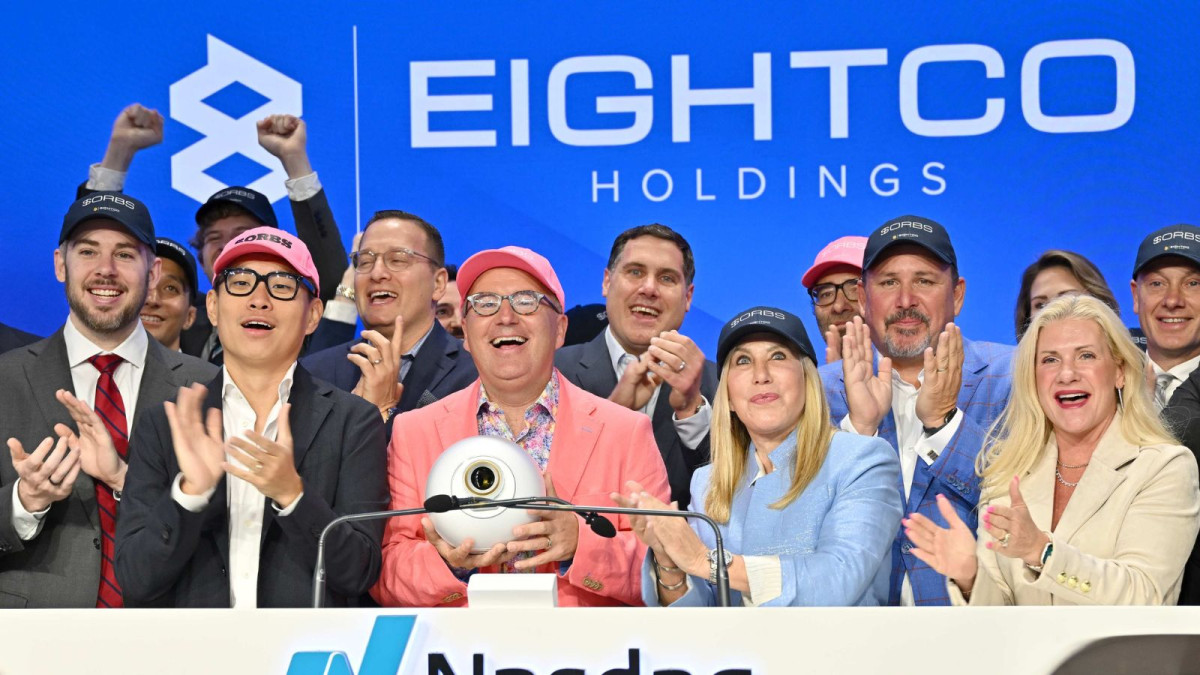
Eightco Shares Jump 25% After $125M Raise Led by Bitmine, ARK Invest, and Kraken

Eightco Holdings (NASDAQ: ORBS) pulled off a real power play on Wall Street Thursday, with shares jumping roughly 25% after the company announced it had locked in $125 million in new institutional commitments from a lineup that includes Bitmine Immersion Technologies, Cathie Wood's ARK Invest, and Payward, the parent company of crypto exchange Kraken.
The raise was led by Bitmine, which committed $75 million, with ARK Invest pledging at least $25 million and Payward rounding out the headline trio with another $25 million of its own. The full investor roster behind ORBS reads like a who's who of the crypto world: Coinfund, Pantera Capital, GSR, FalconX, Discovery Capital Management, and the World Foundation are all listed as backers.
But the capital raise wasn't even the most eyebrow-raising piece of news in Thursday's announcement. Eightco simultaneously disclosed it had already closed initial strategic investments of $50 million into OpenAI and $25 million into MrBeast and Beast Industries.
The OpenAI investment, worth approximately $52.5 million in economic interests in the company's equity, closed on March 6, just days before this announcement.
To understand how we got here, we kind of have to dive a bit deeper. Eightco has had one of the stranger corporate transformations of recent years. The Pennsylvania-based company pivoted from inventory management to cryptocurrencies and is currently developing a universal framework for digital identity and authentication. Not too long ago, its main business was making cardboard boxes through a subsidiary called Ferguson Containers.
Now, the company's identity is built around Worldcoin (WLD), the biometric-based digital identity project co-founded by OpenAI CEO Sam Altman. As of March 5, 2026, Eightco's treasury holdings included 277,222,975 WLD tokens, 11,068 ETH, and $82 million in cash. That WLD position, the company says, represents nearly 10% of the token's circulating supply, making ORBS the largest public market holder of Worldcoin on any exchange.
The company continues to hold Worldcoin and Ethereum as a long-term believer in the world's second-most valuable cryptocurrency, and frames its Worldcoin stake as foundational to a "proof of humanity" authentication layer it's building out.
The vision, as ORBS tells it, is to combine Worldcoin's biometric identity infrastructure with OpenAI's foundational models to create something at the intersection of AI verification, blockchain rails, and mass consumer reach. And it seems that it's clearly a compelling enough pitch to draw in some serious institutional names.
Who's Backing It, and Why
Tom Lee, Chairman of Bitmine, is joining Eightco's Board of Directors, while Brett Winton, Chief Futurist at ARK Invest, will serve as an advisor to the board.
Lee's involvement through Bitmine is notable. Bitmine itself has been on an aggressive crypto treasury strategy of its own, positioning itself as the leading Ethereum treasury company in public markets. Bitmine has combined crypto, cash, and "moonshot" holdings ranging well into the billions, and adding Eightco to that ecosystem tightens the connection between the two companies considerably. Lee getting a board seat means this isn't a passive financial bet.
His take on the investment was direct. Bitmine sees Eightco sitting at the center of some of the most important future needs and developments in AI, with what Lee described as tremendous synergy between Proof of Human via Worldcoin, OpenAI's foundational models, and the reach of the world's biggest content creator in MrBeast.
ARK Invest's Cathie Wood weighed in too, describing ORBS as taking on a unique initiative at the intersection of AI, blockchain, and creator-driven platforms.
Kraken's Arjun Sethi was perhaps the most philosophical about the whole thing. The Payward co-CEO framed it around power-law dynamics, suggesting that a small number of platforms tend to capture a disproportionate share of value in technological revolutions, and that ORBS is trying to position itself at the convergence of AI, cryptographic infrastructure, and global digital distribution.
MrBeast and the Distribution Play
The $25 million bet on Beast Industries deserves its own look. On March 10, Eightco invested approximately $25 million in shares of Beast Industries, with $7 million of that amount structured as committed capital that may be funded within 60 days in exchange for additional stock.
Beast Industries is the broader enterprise behind YouTube megastar Jimmy Donaldson, better known as MrBeast. The company spans entertainment, consumer products, and CPG, with the snack brand Feastables among its faster-growing launches. MrBeast's YouTube channel has over 450 million subscribers and generates more than 5 billion monthly views across all channels.
For a blockchain infrastructure play trying to build out digital identity at scale, having a meaningful stake in the world's most-subscribed YouTube channel is an unusual but not entirely illogical move. Distribution is distribution, and Eightco seems to be betting that the future of human authentication online will require massive consumer reach to actually work.
Taken together, Eightco is making a bold argument that the convergence of AI identity verification, blockchain infrastructure, and mass consumer distribution represents a huge opportunity, and that a small public company out of Pennsylvania is somehow positioned to sit at the center of it.
Whether the OpenAI stake, the MrBeast bet, the Worldcoin treasury, and the Ethereum holdings actually compound into something concrete is still up in the air. The risk disclosures in ORBS's own SEC filings acknowledge this as well, flagging the company's lack of control over private companies where it holds minority stakes, and the ongoing challenges of maintaining Nasdaq listing compliance while burning cash.
But the investor lineup announced today isn't made up of amateurs. Pantera, Brevan Howard, Coinfund, and ARK all know what they're doing, and they all decided this particular combination of bets was worth backing.

Coinbase Launches Agentic Wallets on Base

Coinbase is not introducing AI agents to crypto. Those have been here for years.
What Coinbase is doing now is different. It is trying to formalize and secure that reality.
With the release of what it calls Agentic Wallets, Coinbase is offering wallet infrastructure built specifically for autonomous AI agents. Not dashboards with AI features. Not analytics copilots. Actual wallets engineered so software agents can hold and move funds in a way that is safer, cleaner, and more production ready than the duct taped setups many teams rely on today.
Agentic Infrastructure
Erik Reppel, who leads engineering on the Coinbase Developer Platform, has been fairly direct about the problem they are solving.
Today, when developers say an agent “has a wallet,” that often means a private key is sitting somewhere it probably should not be. Maybe in a config file. Maybe in memory. Maybe loosely protected. If that agent gets manipulated, exploited, or simply misbehaves, the blast radius can be severe.
Reppel’s argument is that key isolation needs to be non negotiable. With Agentic Wallets, private keys are stored in secure execution environments, separated from the agent’s reasoning layer. The agent never directly touches raw key material. Instead, it interacts through controlled sessions with predefined permissions and limits.
He has described this architecture as orders of magnitude safer than letting an AI system operate with exposed keys.
That framing is important. Coinbase is not claiming to invent autonomous agents. It is trying to make them viable in production environments where security and compliance actually matter.
Built on Base and Wired Through x402
Two technical components sit at the core of this release: Base and x402.
Agentic Wallets are designed to run natively on Base, Coinbase’s Ethereum layer 2 network. Base offers lower fees and faster settlement compared to mainnet Ethereum, which makes it more practical for continuous automated activity. Bots and agents do not sleep. They monitor, adjust, and transact around the clock. Running that on a cheaper, faster chain is not a luxury, it is a necessity.
Then there is x402, Coinbase’s machine-to-machine payments protocol.
If that name sounds obscure, the idea is straightforward. x402 is built to allow services to pay other services directly onchain. It has already processed tens of millions of transactions in scenarios where APIs, compute layers, or other digital services require automated payment.
In the context of Agentic Wallets, x402 becomes the settlement layer for autonomous systems. An agent can pay for API access, purchase data feeds, cover inference costs, or settle fees with other services without a human approving every transaction. It is programmable, onchain, and designed for machines transacting with machines.
Put differently, Base provides the execution environment. x402 provides the payment rails. Agentic Wallets sit on top as the secure container that ties everything together.
Agents Already Trade. This Makes It Cleaner.
It is worth saying clearly: AI driven trading is not new.
Quant desks, DeFi vaults, MEV bots, and arbitrage engines have been programmatically making trades for years. In many cases those systems are highly sophisticated. But the wallet layer underneath them has often been an afterthought. Keys get managed in inconsistent ways. Access control is custom built. Security depends heavily on the engineering discipline of each individual team.
What Coinbase is offering is a standardized wallet layer designed for autonomous operation from day one.
With Agentic Wallets, developers can:
- - Set configurable spend caps per transaction or per session
- - Limit what contracts or addresses an agent can interact with
- - Isolate keys from the model or decision engine
- - Monitor transactions through built in compliance tooling
That does not suddenly give agents new superpowers. They were already capable of executing trades, reallocating liquidity, and managing positions. What this does is reduce the fragility in how those systems are wired into capital.
For teams building serious onchain automation, that difference matters.
Guardrails Are the Product
The safety architecture is arguably the most important part of this launch.
Prompt injection attacks, model manipulation, and logic exploits are not theoretical. If an agent is given broad financial authority and can be tricked into executing malicious instructions, the damage can be immediate and irreversible.
Coinbase’s model is to narrow the surface area.
Private keys live in secure enclaves. Agents operate through session credentials rather than raw key access. Developers can define how much value an agent can move and under what conditions. Transaction monitoring tools screen for high risk interactions before they are finalized.
None of this eliminates risk. Autonomous systems interacting with open financial networks will always carry some degree of unpredictability. But compared to the common practice of handing a bot a hot wallet and hoping for the best, this is a structural upgrade.
The Bottom Line
Zooming out, this fits into Coinbase’s broader strategy.
The company has been expanding its developer platform, pushing Base as a default settlement layer, and experimenting with tools that make onchain activity easier to embed into applications. Agentic Wallets extend that logic into the AI domain.
If AI systems continue to mediate financial activity, whether that is portfolio management, payments, or automated strategy execution, they will need infrastructure. Wallets are the choke point. Whoever controls that layer controls a meaningful slice of the stack.
Coinbase clearly wants to be that provider.
There are still regulatory and philosophical questions hanging over all of this. When an autonomous agent executes a trade or interacts with a protocol, who ultimately bears responsibility? The developer? The operator? The infrastructure provider? Those debates are just beginning.
But in practical terms, agents are already here. They are already trading. They are already moving markets.
Autonomous systems are currently participating in crypto. The wallet layer just needs to catch up.
Agentic Wallets are an attempt to do exactly that.
Robinhood Chain Launches Ethereum L2 Testnet

Robinhood is going deeper into crypto infrastructure.
The company has launched the public testnet for Robinhood Chain, its own Ethereum layer 2 network built on Arbitrum’s rollup technology. Until now, Robinhood has mostly acted as a gateway, letting users trade crypto and, in some regions, tokenized equities. This move changes that. It is now building the underlying blockchain where those assets could live.
It is a meaningful shift. Running a brokerage app is one thing. Operating blockchain infrastructure is another.
What Robinhood Chain Actually Is
Robinhood Chain is a permissionless Ethereum layer 2. It uses Arbitrum’s technology, which means it inherits Ethereum’s security while offering lower transaction costs and higher throughput through rollups.
“With Arbitrum’s developer-friendly technology, Robinhood Chain is well-positioned to help the industry deliver the next chapter of tokenization and permissionless financial services,” said Steven Goldfeder, Co-Founder and CEO of Offchain Labs. “Working alongside the Robinhood team, we are excited to help build the next stage of finance.”
For developers, it is EVM compatible. Smart contracts built for Ethereum can be deployed here with standard tooling. Wallets, developer libraries, and infrastructure services should feel familiar.
On paper, nothing radical. The differentiation is not in the virtual machine. It is in the intended use case.
The Core Bet: Tokenized Stocks
Robinhood is clearly focused on tokenized real world assets, especially public equities and ETFs.
The company has already offered tokenized stock exposure in Europe. Now it is building infrastructure that could support broader issuance and trading of these assets directly onchain.
A big part of the pitch is continuous trading. Crypto markets operate 24 7. Traditional stock exchanges do not. If equities are represented as tokens on a blockchain, they can, in theory, trade at any time and settle much faster than traditional systems.
That sounds straightforward. In practice, it depends heavily on regulatory clarity. Tokenized securities raise questions around custody, investor protections, and jurisdictional restrictions. Robinhood has acknowledged this and appears to be designing the chain with compliance in mind.
Compliance Is Not an Afterthought
Unlike many general purpose layer 2 networks, Robinhood Chain is being built with regulated financial products as the primary target.
That means infrastructure that can handle minting and burning of tokenized securities in a controlled way. It likely also means features that support jurisdiction based restrictions and other compliance requirements at the protocol or system level.
Robinhood has not framed this as a purely decentralized experiment. It is positioning the network as financial infrastructure, with guardrails.
That will appeal to some institutions. It may frustrate parts of the crypto community. Both reactions are predictable.
Infrastructure Partners in Place
Robinhood is not building this alone.
Chainlink is involved to provide oracle services, which are essential if you are dealing with tokenized stocks that need accurate real world price feeds. Alchemy is supporting developer infrastructure. Other analytics and compliance firms are integrated from the outset.
This is not a bare bones testnet thrown into the wild. It is being launched with a fairly complete infrastructure stack.
The company is also rolling out developer documentation and encouraging builders to start experimenting immediately.
The Exchange Layer 2 Trend
Robinhood joins a growing list of exchanges and fintech firms launching their own Ethereum layer 2 networks.
Coinbase operates Base. Kraken is developing its own network. Other trading platforms are exploring similar strategies.
The rationale is not complicated. If tokenized assets and onchain trading grow, exchanges would prefer that activity to happen on networks they influence, rather than on third party chains. Controlling infrastructure can mean more flexibility in product design, fee structures, and integration with existing platforms.
For Robinhood, which already serves millions of retail users, owning a layer 2 could tighten the loop between its app, its wallet, and onchain markets.
Testnet Today, Mainnet Later
Right now, Robinhood Chain is in public testnet. Developers can deploy contracts, test integrations, and experiment with wallet flows, including direct testing with Robinhood Wallet. No production assets are live yet.
To drive activity, Robinhood is backing developer engagement with hackathons and incentives, including a seven figure prize pool aimed at financial applications built on the network.
A mainnet launch is expected later this year, though exact timing has not been pinned down publicly. Technical stability and regulatory comfort will likely dictate the pace.
The Bottom Line
Robinhood Chain is a signal that tokenized finance is not just a side project for major platforms anymore.
If tokenized equities become widely accepted, infrastructure will matter as much as distribution. Robinhood already has distribution through its app. Now it is trying to build the rails underneath.
There are open questions. Will regulators in the US allow meaningful onchain trading of tokenized securities? Will liquidity concentrate on exchange backed layer 2s or on more neutral networks? Will users care which chain their tokenized stock sits on?
For now, Robinhood has made its position clear. It wants to be more than a broker. It wants to operate the blockchain layer where digital versions of traditional assets trade and settle.
The testnet is the first real step in that direction.
MultiversX Moves Early on Agentic Payments With Google and Coinbase

The idea of autonomous software agents paying for things on the internet has floated around for years. It usually sounds futuristic, theoretical, or slightly impractical. That is starting to change.
MultiversX has taken a concrete step into that future by supporting a new payments standard designed specifically for AI agents, aligning itself with infrastructure backed by both Google and Coinbase. While much of the industry is still debating what “agentic commerce” actually means, MultiversX is already shipping real integrations.
At a time when blockchains are competing for relevance beyond speculation, this move places MultiversX squarely inside one of the most important conversations happening in tech right now, how AI systems will transact value on their own.
From Smart Contracts to Autonomous Commerce
Agentic commerce is simple in concept but complex in execution. Instead of humans clicking buttons and entering card details, software agents discover services, decide whether they are worth paying for, and complete payments automatically.
That requires more than just fast block times or cheap fees. It needs payment infrastructure that works natively with the internet itself, without logins, dashboards, or human workflows.
This is where the x402 payment protocol comes in.
Originally developed by Coinbase, x402 reimagines an old web standard, HTTP 402 Payment Required, and turns it into a real, usable payment flow. A server can request payment as part of a normal web response, and an AI agent can respond by sending a blockchain payment, all in one continuous interaction.
MultiversX now supports this model directly on its network.
Why MultiversX Fits This Moment
MultiversX has long positioned itself as a high performance, developer focused blockchain. What makes this integration notable is how cleanly it fits the chain’s existing strengths.
Fast finality, low fees, and native support for smart contracts make MultiversX a natural environment for autonomous agents that need to move quickly and operate at scale. Agentic systems do not wait for confirmations the way humans do. They make decisions continuously, sometimes hundreds or thousands per minute.
By enabling x402 payments, MultiversX allows these agents to pay for data, services, or compute the same way they request information today, through simple web interactions.
This is not a demo or concept release. Builders can already deploy agents that transact autonomously on MultiversX without custom billing systems or off chain payment logic.
Google’s Standards Push Adds Gravity
What makes this development more significant is that it does not exist in isolation.
Google has been quietly building its own framework for agent based commerce, known as the Agent Payments Protocol, or AP2. Rather than reinventing payments, Google’s approach is to support multiple settlement rails, including blockchain based ones.
x402 is one of those supported rails.
That means agents built using Google aligned standards can interact with services that settle payments on MultiversX, without bespoke integrations. In practical terms, it creates a bridge between traditional web infrastructure, AI agent frameworks, and blockchain settlement.
For MultiversX, this is a strong validation signal. It suggests the network is not just compatible with the next wave of AI commerce, but already aligned with how major technology companies expect that wave to work.
What This Enables
Most blockchain adoption stories focus on users. Wallets, apps, and onboarding flows. Agentic payments flip that perspective.
The primary users here are machines.
AI agents do not care about branding or narratives. They care about reliability, speed, and cost. If MultiversX can consistently provide those, it becomes part of the default stack for autonomous systems, quietly embedded beneath the surface.
This is arguably more durable than hype driven consumer adoption. Once agents are built around a payment rail, switching costs rise quickly.
With agentic payments live on MultiversX, a new set of use cases becomes practical rather than theoretical.
Autonomous agents can pay for API access on demand instead of negotiating contracts. Data providers can charge per request rather than per month. Agents can subscribe, cancel, and reallocate spending dynamically based on performance.
Over time, this opens the door to fully machine driven marketplaces, where services compete in real time for agent demand, priced in stablecoins, settled instantly.
MultiversX becomes the settlement layer underneath that activity.
The Bottom Line
There are still open questions. Regulation, security, and governance will matter more as autonomous payments scale. But the direction is clear.
AI systems are moving from passive tools to active economic participants. Payments are no longer a side feature. They are a core requirement.
By moving early and integrating with standards backed by Google and Coinbase, MultiversX has positioned itself as a serious infrastructure player in the emerging agentic economy.
In a market crowded with promises, shipping quietly but effectively may turn out to be the most bullish signal of all.
WLFI and Spacecoin Push Crypto Payments Into Orbit With Satellite Internet Deal

World Liberty Financial, the crypto project behind the USD1 stablecoin, has announced a partnership with Spacecoin, a blockchain-native satellite internet company, to bring crypto payments directly into satellite connectivity networks. The goal is simple in theory but ambitious in execution, combine decentralized finance with decentralized internet access, starting in regions where both are limited or nonexistent.
The partnership signals a growing shift in crypto away from purely digital experiments and toward physical infrastructure, particularly in space.
What the Partnership Actually Does
At the core of the deal is the integration of WLFI’s USD1 stablecoin into Spacecoin’s satellite network. The two projects completed a strategic token swap, tying their ecosystems together and aligning incentives long term.
USD1 is intended to act as the settlement layer for payments and services across Spacecoin’s network. In practice, that means users who connect to Spacecoin’s satellite internet could also transact financially using a dollar-pegged digital asset, without relying on traditional banks or local payment rails.
This is not just about paying for internet access. The broader vision is to enable commerce, remittances, and digital services in areas where stable connectivity and reliable currencies are both hard to come by.
Who Is Spacecoin
Spacecoin is part of a growing wave of DePIN projects, or decentralized physical infrastructure networks. Instead of building centralized telecom systems, Spacecoin is deploying low-Earth orbit satellites that interact with blockchain infrastructure on the ground. The company recently launched three satellites into orbit as part of the company's place to exand global internet access.
According to Spacecoin, satellite-based connectivity requires an integrated financial layer. The company sees USD1 as a way to allow new users to transact digitally as soon as they gain internet access. While it remains early stage compared to incumbents like Starlink, Spacecoin is positioning itself as a permissionless alternative, one that treats connectivity as an open network rather than a closed service.
Why WLFI Is Betting on Satellites
World Liberty Financial has drawn attention in part due to its political associations, but strategically the project is trying to do something familiar in crypto, expand the reach of a stablecoin beyond exchanges and trading desks.
USD1 is designed to be a transactional stablecoin, not just a store of value. WLFI has been exploring debit cards, points programs, and onchain incentives. Plugging USD1 into a satellite network takes that logic further, pushing the asset into environments where traditional finance struggles to operate.
For WLFI, satellites offer a way to bypass fragile local infrastructure and leap directly into global usage.
The Bigger Picture
This deal sits at the intersection of several fast-moving trends.
Satellite internet is expanding rapidly as launch costs fall and demand for global connectivity rises. At the same time, stablecoins are quietly becoming one of crypto’s most widely used tools, especially in emerging markets where currency volatility is a daily concern.
By combining the two, WLFI and Spacecoin are effectively testing whether crypto can function as a default financial layer in places that skipped earlier generations of banking and broadband.
It is a bold idea, but also a risky one.
The Challenges Ahead
Satellite-based payments are not trivial. Latency, reliability, and security all become more complex when transactions are routed through orbit. Regulatory uncertainty is another major factor, especially when stablecoins cross borders without clear oversight.
There is also competition. Spacecoin is entering a crowded satellite market dominated by well-funded players with existing user bases and proven performance. Convincing users, developers, and governments to adopt a decentralized alternative will take time.
And then there is execution. Many crypto-infrastructure partnerships sound compelling on paper but struggle to move from announcement to real-world usage.
Why This Still Matters
Even with those risks, the partnership stands out because it points toward a version of crypto that is less abstract and more physical.
Instead of arguing about narratives and token prices, this model asks a practical question. What happens when internet access and money are delivered together, from space, without intermediaries?
If WLFI and Spacecoin can make even a fraction of that vision work, it could reshape how people think about both connectivity and finance in the most underserved parts of the world.
Crypto has always promised to be global. This time, it is trying to prove it literally.