#institutional crypto
Deutsche Bank Set to Launch Crypto Custody Service for Institutions

Deutsche Bank has just announced its plan to launch its digital asset custody solution this year, depending on how soon it completes the necessary regulatory requirements.
Making the announcement in a press release this Wednesday, the bank said the new custody solution will provide its institutional and corporate clients with secure and regulated custody services for their digital assets, with Deutsche Bank managing the clients’ wallets and private keys.
“Digital assets are not a replacement for the traditional financial system but an important complement to it. We see them as new rails that can coexist with existing market infrastructures while benefiting from the trust, security and safeguards that regulated financial institutions provide. Our aim is to offer clients a secure and regulated gateway to this evolving market,” said Gerald Podobnik, Co-Head of Corporate Bank at Deutsche Bank.
At launch, the custody solution will support only a selected range of digital assets, including Bitcoin and Ether, as well as a few stablecoin assets such as USDC, EURC and EURAU, with possible expansion to support more assets depending on clients’ demand and regulatory processes. Tokenized financial instruments are also included in the bank’s roadmap.
Security Measures to Protect Clients' Assets
To enhance the safety and security of clients’ assets under its custody, Deutsche Bank will implement multiple layers of security for the custodial solution, with the bank stating that these security mechanisms will operate under strict governance.
Among the various security measures that will be implemented to safeguard clients’ assets are secure key generation and hardware-based protection, segregation of duties, multi-person approval processes, separate warm and cold storage environments, and controlled backup and recovery arrangements.
As its initial focus, the custodial solution will be made available first to qualified Deutsche Bank institutional clients across Europe, including corporates, asset managers, hedge funds, custodians, brokers and sovereign institutions.
Standard Chartered Launches Institutional Spot Trading in the UAE

Standard Chartered, the British multinational banking and financial services group, has expanded its presence in the UAE by launching institutional spot trading for Bitcoin and Ether.
While this is not the first time institutional BTC and ETH spot trading has been launched in the UAE, Standard Chartered’s launch is unique, as it is the first Global Systemically Important Bank (G-SIB) to offer institutional Bitcoin and Ether deliverable spot trading in the region and is currently the only global bank offering such capabilities in the Emirates.
By launching these institutional grade spot trading services, Standard Chartered enables eligible institutional clients to access deliverable Bitcoin and Ether spot trading through its electronic trading channels.
“The UAE has developed a clear digital assets regulatory framework that supports institutional participation and innovation,” Rola Abu Manneh, Chief Executive Officer, UAE, Middle East and Pakistan at Standard Chartered, said.
“Extending our Bitcoin and Ether spot trading capability to institutional clients is a significant step in broadening our regulated digital asset proposition in the market. By combining execution with secure custody, governance and the connectivity of a global bank, we are providing clients with a more integrated way to participate in digital asset markets.”
The launch of Standard Chartered’s institutional spot trading service came just a few days after the bank became the first authorized bank distributor of the HKD-backed stablecoin developed by Anchorpoint Financial Limited.
Standard Chartered has also been involved in several pro crypto and tokenization friendly moves, launches and partnerships. Notable among these was its acquisition of Zodia Custody in May, a move designed to support institutional clients.
Ripple, SettleMint Partner to Boost Custody and Tokenization in Asia Pacific

Ripple has partnered with SettleMint, a global leader in digital asset lifecycle management, to offer financial institutions in the Asia Pacific region a unified solution for custody and tokenized asset management across different asset lifecycles.

The partnership combines Ripple’s institutional grade digital asset custody infrastructure with SettleMint’s Digital Asset Lifecycle Platform (DALP), giving institutions a more compliant way to custody and manage their assets through a single solution rather than multiple vendors.
“Financial institutions across Asia Pacific are putting digital assets to work. They are asking how to do more without stitching together separate solutions for custody, issuance and governance,” said Fiona Murray, Managing Director, Asia Pacific at Ripple. “This partnership gives them the foundation to roll out digital assets and future proof them from there: Ripple Custody to hold and govern those assets, and SettleMint to manage their entire lifecycle.”
Although the platform will initially be available to financial institutions in Asia, it will subsequently expand to other markets as institutional demand for the platform increases.
About Ripple’s Custody and SettleMint’s DALP
Ripple’s custody infrastructure provides financial institutions, such as banks, asset managers and fintechs, with a secure way to manage their digital assets, including stablecoins and real world assets, without compromising security or control.
To strengthen the security and flexibility of this infrastructure, Ripple uses multi party computation (MPC) and hardware security modules (HSMs) for private key management, with options for self custody or cloud and on premises deployments.
The Digital Asset Lifecycle Platform, or DALP, is an institutional grade, composable digital asset platform designed by SettleMint to help financial institutions manage the lifecycle of tokenized assets.
By integrating with Ripple’s Custody infrastructure, DALP provides a unified way for institutions to manage the entire asset lifecycle, including the seamless handling of issuance, settlement and asset servicing from a single platform

Sui Co-Founder Unveils Havenex Exchange for Institutional Clients

Kostas Chalkias, co-founder and chief cryptographer of Mysten Labs, the company behind the Sui blockchain, has announced Havenex, an exchange designed for institutional clients.
Announcing Havenex, which is currently in the development and pre-launch stage, Chalkias said the exchange is not intended to become another Coinbase, Binance, Bybit, or Kraken.
According to the Sui co-founder, Havenex is designed to enable financial institutions to offer digital and traditional financial assets to their customers while meeting high standards of regulation, security, and transparency.

Giving a hint about the exchange's infrastructure, Chalkias said Havenex will have multisig enabled by default, quantum safe keys, hardware 2FA wallets, 100% multichain support, verifiable custody, as well as self custody and key loss protection mechanisms.
Despite Havenex still being in the development stage, the exchange is currently undergoing the necessary authorization process with Austria's Financial Market Authority (FMA). Once it receives the green light from the FMA, Havenex will have the legal basis to offer regulated financial services, including institutional custody, trading, and other related digital asset services.
Havenex is also currently conducting its first Series A funding round.
Although details regarding how much is being raised and the investors involved remain undisclosed, several reports have speculated that the round could be oversubscribed, particularly given Chalkias’ involvement as a co-founder of Mysten Labs, which raised $336 million to support the development of the Sui blockchain.
Wall Street Giants Pour $355M Into Canton Network

Digital Asset, the firm behind the Canton Network, has closed a $355 million funding round led by a16z crypto, pulling in a sprawling cast of Wall Street names and at least one sovereign wealth fund along the way.
Digital Asset, the company quietly building out the plumbing for tokenized capital markets, has just pulled off one of the bigger raises in cryptos institutional corner this year. The firm announced Thursday that it closed a $355 million round led by Andreessen Horowitz's crypto arm, a16z crypto, which alone wrote a $100 million check. The size of the raise, and the names attached to it, say a lot about where smart money thinks blockchain infrastructure is headed next ... and it's not toward retail trading apps.
The round's backer list reads like a who's who of global finance. Citadel Securities, Apollo, BNP Paribas, HSBC, S&P Global, CME Ventures, Coinbase Ventures, Optiver, SoFi, Tradeweb and SBI Group all participated, alongside a subsidiary of the Abu Dhabi Investment Authority, one of the world's largest sovereign wealth funds. Smaller but notable names like 7RIDGE, Polychain, Broadridge and William Blair rounded things out. It's a genuinely odd mix of old guard TradFi and crypto native venture money, which is sort of the whole point of Canton in the first place.
What Exactly is Canton, and Why Does Wall Street Care
Canton is a layer-1 blockchain, but it doesn't look much like the chains most crypto users are familiar with. It was designed from the ground up for regulated finance, with built-in privacy controls that let institutions keep sensitive transaction data hidden from competitors while still settling on a shared, synchronized ledger. Digital Asset describes it as a network of networks, meaning banks and asset managers can run their own permissioned systems that plug into the broader Canton ecosystem without giving up control over their own data or compliance processes.
This is basically the opposite of how chains like Bitcoin or Ethereum work. There's no anonymous validator set, no permissionless access, and institutions retain authority over the assets they issue. Some purists aren't thrilled about that. TD analyst Lance Vitanza wrote back in February that some experts consider Canton a glorified database in the cloud, and not really consistent with the open, trustless architecture that defines Bitcoin. Fair point, maybe, but it also might be missing why banks are actually showing up.
Since launching nearly two years ago, Canton has reportedly supported around $6 trillion in tokenized issuance, and the network now counts more than 700 ecosystem participants according to Digital Asset CEO Yuval Rooz. That's a big number for a network most retail crypto traders have probably never interacted with directly. Its native token, CC, was trading around 16 cents at the time of the announcement, up roughly 12% over the prior week, though still well below its February all time high near 19 cents.
A Valuation That's Climbing Fast
This isn't Digital Asset's first rodeo with a16z. The new $355 million round comes on the heels of a previously reported $300 million raise from just a month earlier, which valued the company at close to $2 billion, again with a16z leading. Before that, in 2025, Digital Asset raised $50 million from backers including Nasdaq and Bank of New York Mellon. Add it all up, and Digital Asset has now raised somewhere north of $800 million across its various rounds, a pace that's hard not to notice in a sector where many infrastructure plays are still pre revenue.
Speaking of revenue, that's another detail buried in the announcement worth pulling out. According to reporting from ChainCatcher, Digital Asset says it has now reached profitability following this latest raise. For a blockchain infrastructure company, that's a fairly rare claim to make, and it's likely one reason institutional investors who don't typically touch crypto, like Apollo or HSBC, felt comfortable writing checks.
Where The Money is Going
Digital Asset says the fresh capital will go toward three buckets, forging new partnerships, pursuing mergers and acquisitions, and expanding the broader Canton ecosystem. There's also a developer angle here. Rooz has been fairly vocal about wanting to deepen engagement with the people actually building on Canton, not just the institutions issuing assets on top of it.
"Blockchain adoption will be defined by practical, production-grade applications in the world's largest markets," Rooz said in a statement tied to the announcement. "For capital markets to move onchain, institutions need infrastructure that reflects how they actually operate, with privacy, compliance, scale, and interoperability built in from the start."
Notably, this round also marks the formal start of a partnership between Digital Asset and a16z crypto, not just a check. Ali Yahya, a general partner at a16z crypto, framed it as a bet on a thesis that's been floating around crypto circles for years finally becoming real, real world assets and institutional workflows actually moving onchain, rather than just being talked about at conferences.
The bigger picture for RWAs
Zoom out a bit and this raise fits a pattern that's been building for a while now. Tokenization of real world assets, things like bonds, money market funds, equities and commodities, has gone from a niche talking point to something BlackRock, Franklin Templeton and a growing list of traditional asset managers are actively building around. Canton's pitch is that it can be the settlement layer underneath a lot of that activity, handling the messy parts around privacy and regulatory compliance that public chains generally weren't built to handle.
Whether Canton ends up being the dominant rail for this kind of activity, or just one of several competing standards, is still very much an open question. Other institutional focused networks and consortia are chasing similar territory, and banks have a long history of building their own private ledgers rather than relying on shared infrastructure. But with this round, Digital Asset has clearly bought itself runway, credibility, and a deep bench of new institutional relationships, which in this market counts for a lot.
Financial Technology Partners served as the exclusive financial advisor on the deal, according to the company's release. For now, the immediate market reaction has been modest, with CC ticking higher alongside a broader crypto rally this week, but the more interesting story here probably isn't the token price. It's the growing list of names from Citadel to ADIA who are now, at least on paper, aligned with Canton's success.

Morpho Raises $175M to Expand DeFi Lending Network

Morpho, a leading decentralized finance lending protocol, has raised $175 million in a funding round led by Paradigm, a16z crypto, and Ribbit Capital. Other firms involved in the round include Apollo Funds, Circle Ventures, VanEck, Ledger Cathay, Variant, Wintermute Ventures, Prelude, IOSG, HashKey, Mirana, NJJ Capital, SBI Group, Bpifrance, and Bam Azizi.

With the funds raised, Morpho aims to further deepen its technical and commercial integrations with strategic partners and continue its mission of developing and strengthening the on-chain infrastructure businesses need to build programmable credit products.
“The true value of finance has always been held back by outdated infrastructure, fragmented systems, and extractive intermediaries,” says Paul Frambot, co-founder of Morpho. “We started Morpho to change that. We’re building the open credit network for the world, connecting those with excess capital to those who need financing globally.”
About Morpho
Morpho is a leading decentralized, permissionless lending protocol operating across Ethereum, Base, and other EVM-compatible blockchain networks. Launched in 2021, Morpho aims to efficiently connect lenders and borrowers globally through its decentralized credit network.
Morpho claims to have facilitated more than $11 billion in deposits since its launch. Its decentralized lending platform is currently used by several institutional clients, including Bitwise, Galaxy, Anchorage Digital, Ledger, Trezor, Bitpanda, Coinbase, Kraken, and Binance. In total, Morpho has raised more than $244 million, with a valuation of approximately $2 billion.
The State of DeFi Lending
On-chain lending remains one of the largest and most mature sectors in decentralized finance. According to data from DeFiLlama, the total value locked in DeFi lending across more than 600 protocols stands at approximately $35.5 billion to $35.8 billion, with Aave, Morpho, and SparkLend holding the largest market shares in the sector.
Institutional adoption in DeFi lending has also accelerated significantly, with blockchain protocols such as Morpho launching Morpho Blue and MetaMorpho vaults, which allow easier integration of the Morpho platform with other centralized finance and institutional platforms. SparkLend has also launched dedicated products targeting institutional clients.
Several other companies, including Gemini, Crypto.com, Fireblocks, Bitwise, J.P. Morgan, and VanEck, have also become involved in institutional DeFi lending through partnerships or the launch of DeFi lending products.

Saylor Signals Bitcoin Buy as Strategy Pushes STRC Vote

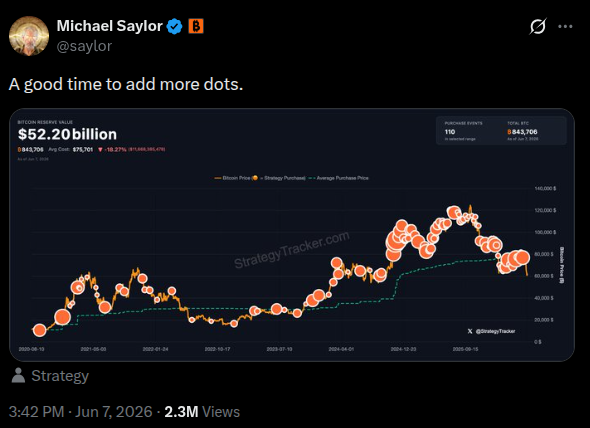
Michael Saylor did what he always does before Strategy opens its wallet. On Sunday morning, the executive chairman of the world's largest corporate Bitcoin holder posted a bubble chart to X.com, this one captioned "A good time to add more dots". For anyone who has followed Strategy long enough, the move reads like clockwork: Saylor posts the orange-dot chart, and a purchase filing with the SEC follows within days.
The post landed alongside a more pressing piece of company business. Strategy is asking its retail shareholders to approve a change to dividend payment frequency on its STRC perpetual preferred stock, shifting from monthly to semi-monthly payouts. The proxy vote deadline is June 8, and as of Sunday, the company was still scrambling to drive participation from a base that has historically been slow to engage.
The Orange Dot Chart and What It Means
Strategy's orange-dot chart has become one of the more recognizable signals in digital asset markets. Each bubble represents a Bitcoin purchase, with larger circles tied to larger acquisitions. The clustering of oversized dots across late 2024 and into 2025 visually narrates what has become an aggressive, almost relentless accumulation campaign.
At the time of Saylor's Sunday post, Strategy held 818,869 BTC, with a total reserve value of roughly $64 billion based on dashboard figures. Bitcoin was trading near $78,262 at the time, putting the company's per-share BTC equivalent at 213,391 satoshis. MSTR stock had closed Friday at $177.42, down 5.11% on the week, with a market cap of $62.31 billion and an enterprise value of $81.85 billion.
By mid-afternoon on Sunday, the post had racked up 2.3 million views. CEO Phong Le added his own endorsement, writing that the company's goal remains to "increase net Bitcoin and Bitcoin per share over time." The confirmation from two senior executives in one afternoon removed any ambiguity about the direction of travel.
The signal proved accurate. Strategy subsequently filed an 8-K confirming it had purchased 24,869 BTC for approximately $2.01 billion between May 11 and May 17, at an average price of $80,985 per coin. That brought total holdings to 843,738 BTC, funded in part through at-the-market sales of MSTR shares and proceeds from STRC preferred stock issuances.
The STRC Dividend Vote: A Harder Sell
The buy signal was the easy part. The proxy vote has been a different story.
Strategy wants to change how it pays dividends on STRC, its Variable Rate Series A Perpetual Stretch Preferred Stock. The proposal would move payments from monthly to twice monthly. The company argues the shift would reduce reinvestment lag, improve liquidity, and cut volatility in the stock's price. Saylor put it plainly in prior remarks: going semi-monthly would provide more entry and exit points for investors, and with only 176 companies in the entire market paying monthly dividends, Strategy would distinguish itself further by going even more frequent.
The challenge is getting retail investors to actually vote. Strategy says 80% of outstanding STRC shares are held by retail investors, not institutions. That is a problem because, according to a November 2024 research note from the Harvard Law School Forum on Corporate Governance, retail holders have voted only around 29% of their shares across the last five proxy seasons. Institutional holders, by contrast, vote roughly 77% of their shares.
Ahead of the June 8 deadline, both Saylor's personal account and Strategy's official social media channels were actively nudging holders to submit their ballots. The company had already scheduled a live Q&A with Saylor and CEO Phong Le on May 20 in an effort to build awareness. Strategy also engaged proxy solicitor Alliance Advisors to help drive participation, though the firm had not disclosed a vote count as of Sunday.
Context: Financing, Volatility, and a Quarterly Loss
The dual push comes at a complicated moment for Strategy. The company reported a quarterly net loss of roughly $12.5 billion earlier in the year, a figure driven largely by unrealized BTC valuation swings rather than operational trouble. Still, the headline spooked some corners of the market and briefly renewed debate over the sustainability of the company's treasury model.
Adding to the noise, Strategy had on May 15 announced an agreement to repurchase approximately $1.5 billion of its 0% convertible senior notes due 2029. The filing noted that sources of funds for the repurchase could include cash reserves, securities-sale proceeds, and Bitcoin-sale proceeds. That last option rattled traders briefly, given that any hint of BTC liquidation from the world's largest corporate holder tends to move markets.
Options activity around MSTR reflected the heightened attention. Open interest in MSTR-linked options stood at $49.49 billion heading into the weekend, with implied volatility at 60% and historical 30-day volatility at 71%. For a company that is, at its core, a leveraged Bitcoin position wrapped in a corporate structure, those figures are not out of the ordinary. But they do underscore how closely the market tracks Saylor's every post.
What Comes Next
The STRC dividend vote wrapped June 8, with results to be disclosed by the company in the following days. Whether the proxy measure passed likely hinges on how many retail holders bothered to log in and click a button, a notoriously difficult outcome to engineer without institutional guardrails.
As for the Bitcoin buying, the confirmed $2 billion purchase puts Strategy's total cost basis at roughly $63.9 billion, with an average acquisition price of $75,700 per coin. At current levels, that implies a paper gain in the low billions, and a holdings base now equivalent to more than 4% of Bitcoin's fixed 21 million supply cap. For Saylor, the orange dots keep getting bigger. The question for everyone else is whether the strategy holds if the market really turns and we see much much lower prices.

Grayscale Targets To Corner HYPE ETF Market With Lowest Fee

Grayscale is making a run at the growing Hyperliquid ETF market, filing an amended S-1 registration statement with the Securities and Exchange Commission on Monday that sets a sponsor fee of 0.29% for its Grayscale Hyperliquid Staking ETF, ticker HYPG. The updated filing also confirms the fund will list on Nasdaq, and according to Bloomberg Intelligence ETF analyst James Seyffart, a launch could come as soon as this week.
That fee sits just below the 0.30% charged by 21Shares on its THYP fund, and meaningfully below Bitwise's BHYP, which carries a 0% introductory rate for the first month before jumping to 0.34%. It's a deliberate pricing move, and in a market where basis points can drive significant asset flows, Grayscale is clearly trying to get ahead before the institutional money settles.
Grayscale's entry would make HYPG the third U.S.-listed spot HYPE product, following Bitwise's BHYP and 21Shares' THYP, which launched in May on Nasdaq. Early demand for these funds has been hard to ignore. HYPE-focused ETFs pulled in over $132 million in net inflows in roughly their first month of trading, with zero outflow days recorded during an 8-day streak that coincided with HYPE hitting new all-time highs. For context, that run came while Bitcoin and Ethereum ETFs were actually losing assets.
The 21Shares THYP fund collected more than $5 million within days of its May 12 debut, with Eli Ndinga, the firm's global head of research, describing the early response as evidence of real investor appetite for regulated, round-the-clock exposure to crypto-linked markets. Bitwise's BHYP held more than $40 million in net assets as of late May, while the two funds combined purchased roughly $16 million in spot HYPE in a single 24-hour window as share issuance expanded.
What Is Hyperliquid Anyway?
For people still getting familiar with the name, Hyperliquid is a decentralized derivatives exchange built on its own Layer-1 blockchain. It lets traders open perpetual futures positions entirely on-chain, without the custodial risk of a centralized venue. That 24/7 availability and non-custodial structure has made it increasingly attractive to both retail and institutional traders, particularly as centralized exchange perpetuals volumes dropped roughly 34% in early 2026.
The protocol's native token, HYPE, now ranks among the top 10 cryptocurrencies by market cap, sitting around $16 to $17 billion as of early June. The token has climbed from roughly $20 at the start of 2026 to recent all-time highs above $73, a move that reflects both the platform's surging trading volumes and the structural demand created by HYPE buybacks. Hyperliquid directs nearly all of its trading fee revenue toward buying back and burning HYPE tokens, a mechanism that Grayscale's own research team described as a standout feature in a May 28 report calling the protocol "the breakout success story" of modern crypto.
Hyperliquid logged roughly $2.9 trillion in perpetual futures volume during 2025, and open interest has consistently ranked third globally, behind only Binance and Bybit. At a Bernstein conference in late May, Jeff Sprecher, chief executive of Intercontinental Exchange and owner of the New York Stock Exchange, said the 11-person platform had made a bigger impact on finance than Nasdaq. Whether or not that comparison holds up over time, it signals how seriously traditional finance is paying attention.
Seed Investment and Staking Angle
Grayscale's amended filing isn't just about fees. The firm has also been in discussions to secure a seed investment of around $115 million in HYPE tokens ahead of launch, a figure that would give HYPG substantial early liquidity. The fund's full name, the Grayscale Hyperliquid Staking ETF, suggests it intends to incorporate staking into its strategy, similar to Bitwise's BHYP, which targets staking roughly 70% of fund assets and reports a 2.25% gross staking reward rate. Coinbase is listed as custodian.
The staking component matters because it gives the ETF a yield angle that pure spot exposure does not. With HYPE's token unlock for core contributors worth roughly $684 million scheduled for June 6, near-term price volatility is possible, though analysts note the unlock represents just around 1% of total supply. The protocol's aggressive buyback engine and continued inflows into ETF products remain the more dominant forces.
Fee War Is Just Getting Started
The fee gap between Grayscale, 21Shares, and Bitwise looks small right now, but history suggests that it won't stay there. The same dynamic played out in Bitcoin ETF competition in 2024, where initial fee differentials narrowed sharply as issuers competed for long-term AUM. Grayscale is entering behind competitors who already have first-mover brand recognition in HYPE, so pricing aggressively from day one is arguably the right call.
With Seyffart expecting a launch by the end of the week, HYPG could be live before most investors have had a chance to compare their options. HYPE has generated more institutional interest per dollar of market cap than almost any altcoin this cycle and Grayscale is betting that being the cheapest option in a fast-growing category is enough to corner the market. For now anyway.
Bitcoin Options Are Coming to NASDAQ

The SEC just greenlighted cash-settled Bitcoin iindex options on NASDAQ.
On May 22, the U.S. Securities and Exchange Commission published a 34-page order clearing Nasdaq PHLX to list cash-settled bitcoin index options under the ticker QBTC. The order hands everyday brokerage account holders a direct path to trade bitcoin volatility right alongside their Apple and Nvidia shares, no separate accounts, no crypto wallets, no extra steps.
The approval came on an accelerated basis under SEC Chairman Paul Atkins, and it is conditional. Before a single QBTC contract can trade, the Commodity Futures Trading Commission still needs to grant exemptive relief. Bitcoin is legally classified as a commodity in the U.S., so the CFTC gets a say. No timeline has been announced for that step. But the direction things are moving is pretty hard to misread at this point.
What QBTC Actually Is
QBTC options are European-style and cash-settled. There is no physical delivery of bitcoin at expiration. When a contract expires, the exchange credits or debits the dollar difference between the strike price and the final index value. No bitcoin wallet. No custody headaches. The contracts track the Nasdaq Bitcoin Index, which represents one one-hundredth of the CME CF Bitcoin Real Time Index, a benchmark pulling aggregated order book data from eight regulated venues roughly every 200 milliseconds.
Unlike options tied to individual spot bitcoin ETFs (say, BlackRock's IBIT), these contracts reference the broader bitcoin market directly. That gives institutional managers a cleaner hedge against general bitcoin price exposure without fund-specific tracking differences bleeding into their positions. It is a subtle but meaningful difference for anyone running a real book.
Size Is the Real Story Here
This is where retail traders should actually pay attention. Each QBTC contract delivers exposure equal to exactly one bitcoin, using a 1/100th index scaling factor with a standard $100 multiplier. CME's standard bitcoin options are sized at five bitcoin per contract. At current prices, one CME contract can represent several hundred thousand dollars in notional exposure. Fine for a large hedge fund, not so practical for smaller shops or individual investors trying to manage a position with any precision.
CME's bitcoin options also require a dedicated derivatives account, which is another layer of friction before anyone can even place a trade. QBTC options will sit on the same Nasdaq platform as the technology stocks most investors already own. Your existing brokerage account should work. That is a real accessibility improvement, not just a marketing claim.
For the record: the per-side position limit is set at 24,000 contracts, which the SEC noted works out to roughly 0.12% of bitcoin's outstanding supply. Minimum price increment is $0.01. The mechanics are deliberately designed to feel familiar to anyone who has ever traded index options.
The Regulatory Picture Is Messy, but Getting Better
The road to approval was not totally smooth. CME Group submitted a comment letter last October arguing these contracts fall under the CFTC's exclusive jurisdiction. The SEC pushed back, leaning on Section 717 of the Dodd-Frank Act to argue that shared jurisdiction is permissible when the CFTC provides exemptive relief. That jurisdictional tension is still technically unresolved, which is exactly why CFTC sign-off remains the final hurdle.
The SEC approval itself came nine months after Nasdaq PHLX originally filed back in September 2025, following multiple rounds of public commentary and extension periods. Nine months is actually fast by historical standards for a novel derivative product. The original spot bitcoin ETF approvals took something like four years from first filing to clearance, under the Gensler administration's much more skeptical posture toward crypto.
People following this space closely see QBTC as part of a broader shift that started taking shape in early 2025. The Atkins-led SEC has dropped numerous enforcement actions against crypto firms and moved toward more permissive regulatory frameworks. Add in the ongoing CLARITY Act discussions in Congress, and it feels less like a string of isolated approvals and more like a deliberate effort to build out the full institutional crypto stack inside traditional market infrastructure.
What Happens Next
A realistic launch window is probably the second half of 2026, assuming CFTC exemptive relief comes through on a normal timeline. Once trading begins, any U.S. options broker supporting index options should be able to facilitate QBTC trades without any special setup required on the user end.
The longer-term picture is worth thinking about. Crypto options volume has grown sharply over the past two years, driven by institutional demand for hedging tools and yield strategies. With QBTC in the mix, investors would have access to spot bitcoin ETFs, ETF-specific options, CME futures, and now broad index-linked options, all sitting within traditional exchange infrastructure. The institutional crypto derivatives stack is starting to look, piece by piece, a lot like what already exists for gold and oil.
How quickly the CFTC moves on exemptive relief will say a lot about whether the two agencies are genuinely coordinated on crypto or just moving in parallel. The market is watching that closely. And given everything that has happened over the past 18 months, it would be surprising if this one got stuck for long.
HYPE Hits All-Time High as ETF Inflows Hit $53M
Hyperliquid's native token HYPE surged past $62 to reach a new all-time high on Wednesday, posting gains of more than 20% in a single session as a wall of institutional money continued pouring into freshly launched U.S. spot ETFs. The move left most of the crypto market behind, with Bitcoin, Ethereum, Solana, and XRP all sitting deep in negative territory for the year while HYPE climbed more than 100% year-to-date.
The immediate catalyst seemed to be record ETF flow data. U.S. spot Hyperliquid ETFs hauled in $25.5 million in net inflows on Wednesday alone, pushing cumulative flows to $53.5 million within just seven trading days of launch. The figures dwarfed anything the funds had seen in their opening sessions, with Monday drawing only $4.4 million and Tuesday logging $11 million before Wednesday's breakout.
21Shares and Bitwise Lead the Charge
The 21Shares Hyperliquid ETF, trading under the ticker THYP, led Wednesday's haul with $16.7 million in single-day inflows, up sharply from $5.3 million the day before. Bitwise's BHYP fund, which began trading on May 15, added another $8.8 million. Bloomberg senior ETF analyst Eric Balchunas described THYP's volume trajectory as growing "8x over day one," calling it a "really good sign of organic interest."
Analysts noted that on a market-cap-adjusted basis, institutions are absorbing HYPE at a faster clip than they did early bitcoin ETFs, something that would have seemed far-fetched a year ago.
Bitwise made its conviction known in another way, too. The firm said it plans to use 10% of management fees earned from BHYP to purchase and stake HYPE tokens directly on its own balance sheet. That is a very aggressive endorsement from a major asset manager, and Bitwise CIO Matt Hougan has gone even further, publicly labeling HYPE one of crypto's most mispriced assets even after its 77% run this year. Hougan's thesis centers on Hyperliquid's ambition to serve as a "super app" targeting the $600 trillion global asset market rather than just the $3 trillion crypto sector.
Grayscale Accumulates, Goldman Shifts Exposure
The ETF frenzy has drawn in some of the bigger names on Wall Street. Blockchain analytics platforms have flagged wallets linked to Grayscale as having accumulated more than 682,000 HYPE tokens, worth approximately $41.6 million, over the past week. Grayscale is also pursuing regulatory approval for its own Hyperliquid ETF, suggesting the accumulation may serve as pre-positioning ahead of a potential product launch.
Goldman Sachs, meanwhile, disclosed in a recent 13F filing that it had exited its positions in Solana and XRP ETFs and rotated into HYPE treasury via Hyperliquid Strategies. The disclosure added fresh fuel to the narrative that institutional capital is starting to concentrate specifically inside the Hyperliquid ecosystem, a trend that is showing up in relative price performance across the large-cap crypto space.
The Revenue Model That Really Stands Out
Part of what is drawing this level of attention is Hyperliquid's fee structure. The decentralized trading platform funnels 99% of all fees it generates into token buybacks. Annualized, that comes to roughly $618 million in buyback support, according to DefiLlama data. At the token's current market cap of around $13 to $14 billion, that puts the implied buyback yield at a multiple that some analysts think is still too cheap given the platform's growth rate.
Hougan drew a comparison to traditional financial exchanges, noting that Robinhood trades at roughly 37 times earnings and CME at 24 times, neither of which is expanding anywhere near as quickly as Hyperliquid. The argument has gained traction partly because the platform has been quietly broadening its reach. Last week, Coinbase and Circle announced an agreement making Coinbase the official USDC treasury deployer on Hyperliquid, with around 90% of stablecoin reserve yield flowing back to the protocol.
Price Discovery Time?
HYPE's prior all-time high sits at $59.37, set in September 2025. The token pushed passed that today, but settled slightly lower around $57.35, we should see another push at the price soon and the question after is whether the ETF-driven momentum is enough to push it through into fresh record territory or whether a wave of profit-taking will cap the move. The token had fallen to near $20 as recently as January 2026, making this a recovery of more than 150% from those lows in just a few months.
Retail sentiment has also picked up. Chatter on Stocktwits around Hyperliquid moved into what the platform classifies as "extremely bullish" and "extremely high" volume territory, a dynamic that tends to amplify both upside and downside swings. Veteran crypto trader Arthur Hayes this week reiterated a long-term price target of $150 for HYPE, a call that would require roughly a 2.5x move from current levels.
For now, Wall Street seems to be running the show. ETF issuers collectively purchased 2.5 times more HYPE than Hyperliquid's own Assistance Fund acquired and burned over the same period, tightening circulating supply while adding consistent bid-side pressure to markets. We'll see what happens during the next couple of days and if all of this bullish sentiment will push HYPE higher or traders will take profit and wait for another move later.

Galaxy Digital Lands New York BitLicense

Galaxy Digital has finally gotten what it spent years working toward: full regulatory clearance to operate as a licensed crypto business in New York State. The New York State Department of Financial Services (NYDFS) granted GalaxyOne Prime NY, a wholly owned subsidiary of Galaxy Digital Inc. (Nasdaq: GLXY), both a BitLicense and a Money Transmission License on Monday, May 18. The move gives the firm direct, regulated access to the most capital-dense institutional market in the United States.
For Galaxy, it is a landmark. New York-based registered investment advisors, hedge funds, and family offices can now tap Galaxy's full suite of digital asset trading and custody products through a regulated state-licensed entity. The firm currently manages roughly $9 billion in client assets across its digital asset business, and executives have made no secret of their ambitions to grow that number substantially by pushing deeper into institutional channels.
A License That Has Eluded Many
The BitLicense, introduced by NYDFS back in 2015, remains one of the toughest regulatory hurdles in the global crypto industry. The application process involves extensive compliance documentation, capital reserve requirements, anti-money laundering controls, and cybersecurity standards that have tripped up or outright deterred dozens of firms over the years. Some companies, including Paxos and Gemini, have opted instead for a New York Banking Law charter, which carries similar compliance expectations but a different legal structure. Either way, the NYDFS does not make it easy, and the framework has drawn persistent industry criticism over its cost and complexity.
Galaxy is only the second company to receive a BitLicense in 2026. Jack Mallers' bitcoin payments firm Strike picked up its approval from NYDFS in March, putting Galaxy in small company. The broader licensed cohort includes the likes of Coinbase, Robinhood, Circle, and PayPal, firms that have become fixtures of mainstream digital finance. Galaxy's inclusion in that group signals how far the company has come from its earlier profile as a more speculative crypto-native outfit.
Novogratz Makes the Case Directly
Galaxy founder and CEO Mike Novogratz did not mince words about what the approval means strategically. "New York is home to the deepest pool of institutional capital in the country, and digital assets are no longer sitting at the edge of those allocations," he said in a statement released Monday. "Galaxy was built to meet that demand, and now we can better serve New York's institutions directly."
Galaxy has spent the better part of the past three years repositioning itself as a serious financial services operator. The company expanded into data center infrastructure, now operates the 1.6 gigawatt Helios campus in Texas, and has built out a broad product lineup spanning trading, asset management, investment banking, and custody. The New York license slots into that picture as a missing piece that was always going to matter.
50 Licenses and Counting
With NYDFS now in the fold, Galaxy's regulatory footprint stretches past 50 licenses worldwide. The company has offices across North America, Europe, the Middle East, and Asia, and has been methodically acquiring the permissions it needs to operate as a multi-jurisdictional institutional platform. That kind of regulatory breadth is not cheap or quick to build, and it increasingly functions as a competitive moat against crypto-native upstarts that lack the compliance infrastructure to serve sophisticated institutional clients.
The timing is notable. Galaxy reported a net loss of $216 million in the first quarter of 2026, driven largely by softer digital asset prices, though the number came in better than what analysts had expected. The stock has continued to trade under pressure. But the BitLicense announcement is a longer-game move. Institutional clients in New York represent a structural revenue opportunity that does not turn on any single quarter's price action. Getting licensed to serve them directly, rather than through workarounds or third-party arrangements, changes the calculus considerably.
New York regulators, for their part, have signaled that the BitLicense framework is not going away. Enforcement activity has continued into 2026, and the NYDFS has made clear it sees itself as a baseline standard-setter for crypto businesses operating in the state. For Galaxy, that means the hard work of getting licensed is also a signal to institutional counterparties that the firm has been through the scrutiny and passed. In New York's financial culture, that matters.

KRWQ Stablecoin Expands to Solana for KRW Trading

KRWQ, a stablecoin pegged to the South Korean won, is expanding to Solana following a recent announcement from IQ, the company behind the stablecoin.
The expansion, according to IQ, is aimed at enhancing KRWQ support for various Korean won-denominated trading applications on Solana, including perpetual futures, on-chain foreign exchange markets, arbitrage strategies, cross-margin trading, and other institutional and algorithmic trading systems and applications.

“The Korean won is a major global currency with substantial activity in offshore derivatives markets, yet it has remained largely inaccessible in crypto native trading systems,” IQ said in a statement to reporters. “KRWQ allows market participants to trade, hedge, and deploy capital using Korean won liquidity directly on chain.”
Regarding its decision to launch KRWQ on Solana, the IQ team cited Solana’s low latency and deep liquidity as key reasons for selecting the network.
“Solana provides the performance and ecosystem depth needed to scale KRW liquidity on chain,” said Dave Shin, chief operating officer of KRWQ. “We are seeing clear demand for non-USD trading pairs, particularly in derivatives.”
As KRWQ’s adoption continues to grow among both retail and institutional users, IQ expects increased usage of the stablecoin across a wide range of applications, including cross-border settlements and advanced trading systems.
About the KRWQ stablecoin
KRWQ is a stablecoin developed by IQ in collaboration with Frax Finance, a notable decentralized finance project. It was created with the main goal of bringing the Korean won (KRW) onto the chain.
By enabling 24/7 trading, instant settlement, and low-cost on-chain transactions, KRWQ addresses major inefficiencies in offshore KRW trading, increasing demand for and use of KRW in global payments and decentralized finance, while reducing dependence on US dollar-pegged stablecoins.
Since its launch in October 2025, KRWQ has rapidly gained traction as the first on-chain settlement layer for Korean won trading, expanding beyond Base, its initial deployment chain, and going live on Fraxtal, Codex, Morph, and Hydrex. KRWQ was also recently listed on EDX Markets, an institutional-focused cryptocurrency exchange, across spot and perpetual futures.
KRWQ now has a spot trading volume of nearly $40 billion and a Non-Deliverable Forward (NDF) market worth about $60 billion.