#decentralized finance

Morpho Raises $175M to Expand DeFi Lending Network

Morpho, a leading decentralized finance lending protocol, has raised $175 million in a funding round led by Paradigm, a16z crypto, and Ribbit Capital. Other firms involved in the round include Apollo Funds, Circle Ventures, VanEck, Ledger Cathay, Variant, Wintermute Ventures, Prelude, IOSG, HashKey, Mirana, NJJ Capital, SBI Group, Bpifrance, and Bam Azizi.

With the funds raised, Morpho aims to further deepen its technical and commercial integrations with strategic partners and continue its mission of developing and strengthening the on-chain infrastructure businesses need to build programmable credit products.
“The true value of finance has always been held back by outdated infrastructure, fragmented systems, and extractive intermediaries,” says Paul Frambot, co-founder of Morpho. “We started Morpho to change that. We’re building the open credit network for the world, connecting those with excess capital to those who need financing globally.”
About Morpho
Morpho is a leading decentralized, permissionless lending protocol operating across Ethereum, Base, and other EVM-compatible blockchain networks. Launched in 2021, Morpho aims to efficiently connect lenders and borrowers globally through its decentralized credit network.
Morpho claims to have facilitated more than $11 billion in deposits since its launch. Its decentralized lending platform is currently used by several institutional clients, including Bitwise, Galaxy, Anchorage Digital, Ledger, Trezor, Bitpanda, Coinbase, Kraken, and Binance. In total, Morpho has raised more than $244 million, with a valuation of approximately $2 billion.
The State of DeFi Lending
On-chain lending remains one of the largest and most mature sectors in decentralized finance. According to data from DeFiLlama, the total value locked in DeFi lending across more than 600 protocols stands at approximately $35.5 billion to $35.8 billion, with Aave, Morpho, and SparkLend holding the largest market shares in the sector.
Institutional adoption in DeFi lending has also accelerated significantly, with blockchain protocols such as Morpho launching Morpho Blue and MetaMorpho vaults, which allow easier integration of the Morpho platform with other centralized finance and institutional platforms. SparkLend has also launched dedicated products targeting institutional clients.
Several other companies, including Gemini, Crypto.com, Fireblocks, Bitwise, J.P. Morgan, and VanEck, have also become involved in institutional DeFi lending through partnerships or the launch of DeFi lending products.
Jupiter, Bitwise Launch Institutional USDe Lending Market

Jupiter, the Solana-based decentralized finance platform, has partnered with crypto asset manager Bitwise Asset Management and decentralized lending infrastructure protocol Fluid to launch an Ethena (USDe) focused lending market on the Jupiter platform.
The partnership will see the launch of an institutional grade USDe lending market on Jupiter’s lending platform, with Bitwise serving as the curator of the new market, setting risk parameters and overseeing operations, while Fluid powers the lending infrastructure.

By assigning USDe lending curation responsibilities to Bitwise, a traditional finance asset management firm, Jupiter aims to achieve institutional grade credibility and easier access to large scale institutional capital, with the potential for the market to grow into the billions of dollars.
“USDe is an institutional grade savings product built for scale. By combining Jupiter Lend's advanced lending infrastructure with Bitwise's asset management expertise, we have created an efficient USDe market ready for DeFi and institutional adoption,” said Guy Young, founder and chief executive officer of Ethena Labs.
Before now, institutional capital and DeFi lending mostly operated separately. However, with the launch of this USDe lending market for institutional access, all entities involved, including TradFi and DeFi participants, can work together: Jupiter providing the lending market, Bitwise curating the market, Ethena supplying the asset, and Fluid powering the infrastructure.
“Now more than ever, it is imperative that we take DeFi risk seriously. That is precisely why we are excited to partner with Bitwise, who bring both the expertise and the institutional credibility needed to help scale on chain lending from a niche into the default way to do finance,” said Kash Dhanda, chief operating officer of Jupiter.
“And by working with Ethena and Fluid, two of the most technically innovative teams in the space, we are thrilled to deliver a product experience like no other.”
Institutions Double Down on DeFi
With DeFi growing rapidly and its TVL reaching new highs of around $150 billion to $225 billion in 2025, there has been an increase in the number of institutions entering and doubling down on DeFi.
Institutional capital reportedly made up around 11.5% to 20% of DeFi volume or lending TVL in parts of 2025, with institutions like BlackRock, Bitwise, and JPMorgan Chase doubling down on real world asset tokenization and stablecoins.
Boundary Labs to Launch Verifiable Stablecoin USBD

Stablecoin startup Boundary Labs is preparing to launch USBD, a “verifiable” institutional-grade stablecoin, following its most recent successful fundraising round.
The $2 million preseed funding round, which began last year, was led by Galaxy Ventures, with other investors, including First Block Capital and BlackWood, also participating in the round.

Following its recent fundraising success, the Boundary Labs team aims to create a stablecoin whose reserves are completely verifiable on-chain, including the stablecoin’s net asset value and protocol performance. This marks a sharp contrast with other stablecoins that depend on trust-based off-chain reporting and attestations.
“The Boundary protocol provides daily reporting on system state, including overcollateralization levels and real-time NAV calculations. USBD is engineered with explicit over-collateralization and delta neutral hedging to protect against market direction risk and volatility,” said Matthew Mezger, co-founder and CEO of Boundary Labs, about the USBD stablecoin.
Because trust is important for enhancing institutional adoption of USBD, especially for treasury management, collateral, and fiduciary use cases, Mezger said the team is building the entire USBD infrastructure with advanced smart contract code that moves the industry from monthly off-chain attestations to daily on-chain verification. By doing so, Boundary aims to transition from common trust-based stablecoin systems to a trustless one.
“This shift provides the structural resilience and auditability required for safe, permissionless staking and institutional fiduciary use cases, effectively transforming stablecoins into robust financial infrastructure,” Mezger said.
Boundary Lab’s Yield-Generation Strategies
Unlike other yield-generating stablecoins, USBD will not be a yield-bearing stablecoin. Nevertheless, Boundary Labs will create sUSBD, a separate staked token that will enable institutional clients to earn yield from the protocol’s decentralized finance strategies.
The revenue generated by the protocol will be used to build treasury reserves, fund operations, and will also be distributed to sUSBD stakers through an on-chain allocation system. The reward system will be fully on-chain and available for users to track and audit.
To onboard early institutional clients, Boundary Labs is planning to launch a private placement campaign with the goal of reaching $100 million in total value locked (TVL). Both USBD and sUSBD will be launched on Ethereum.
Aave Launches on OKX X Layer, Expands DeFi Access

Aave, the leading decentralized lending protocol, has launched on X Layer, an Ethereum-based layer-2 blockchain network developed by cryptocurrency exchange OKX.
The launch, which took place on Monday, March 30, saw Aave v3 integrated onto X Layer. The integration is intended to expand decentralized finance (DeFi) accessibility while also supporting the growth of the X Layer ecosystem, positioning OKX further as a DeFi hub.
Launched in 2024 by OKX, X Layer is a layer-2 blockchain built on top of Ethereum. It is designed to enable faster, lower-cost, and more scalable transactions compared to the Ethereum mainnet.

Rather than processing all transactions directly on Ethereum, which can be slower and more expensive, X Layer processes transactions off-chain before settling them on Ethereum.
According to OKX, the network can handle transactions at an average cost of approximately $0.0005, with processing times of around 0.4 seconds. It also uses zero-knowledge (ZK) technology to verify transactions while preserving data privacy.
The integration of Aave with X Layer is expected to enable DeFi users to conduct activities within the OKX ecosystem, including lending and borrowing crypto assets and earning yields, without relying on cross-chain bridges or additional DeFi infrastructure.
Although X Layer currently has relatively low total value locked (TVL), at around $25 million, more than 100 DeFi platforms have integrated with the network, including Aave, Uniswap, and Chainlink for oracle services.
The integration of Aave into OKX’s X Layer is seen as a step toward bridging centralized exchanges (CEXs) and decentralized finance, potentially expanding access to DeFi services for OKX users. According to reports, X Layer has also seen a 20% increase in user activity following Aave’s integration.
Aave v4 Launch
The integration of Aave into X Layer comes amid the launch of Aave v4, which went live on Ethereum on March 30.
Aave v4 introduces a “hub-and-spoke” architecture in which liquidity is organized into hubs connected to multiple markets. The design aims to improve capital efficiency and interoperability, and it expands the protocol’s capabilities to support additional lending types, including fixed-rate lending and real-world asset (RWA) collateral.
Aave is currently the largest decentralized lending protocol, with cumulative lending volume exceeding $1 trillion, total value locked (TVL) of approximately $23.9 billion, and 24-hour trading volume of around $179 million.
Aave “Will Win” Plan Sends Revenue to DAO
Aave Labs has put forward one of the most consequential governance proposals in the protocol’s history. The plan, titled “Aave Will Win,” would redirect 100 percent of revenue generated by Aave-branded products to the Aave DAO, reshaping how value flows across one of DeFi’s largest lending ecosystems.
The proposal arrives at a sensitive moment. Aave remains a dominant force in decentralized finance, but internal debates over revenue allocation, brand ownership, and governance control have intensified over the past year. At the center of it all is a fundamental question: who should capture the economic upside of the Aave brand, the development company building products, or the decentralized autonomous organization that governs the protocol?
A Structural Reset for Revenue
Under the proposed framework, all gross revenue from Aave-branded products would be sent directly to the DAO treasury. That includes income generated through the aave.com front end, the Aave mobile app and card products, institutional and enterprise offerings, real world asset initiatives, as well as interface level swap fees and other third party integrations.
Revenue would be defined as gross product revenue minus any shares owed to external partners. In practical terms, Aave Labs would no longer retain earnings from these business lines. Instead, the DAO would collect and manage those funds, centralizing economic control under token holder governance.
For token holders, this represents a clearer path to value accrual. Historically, the DAO controlled protocol fees generated directly by lending markets, while product level revenues tied to branded interfaces and integrations flowed through Labs. That dual structure created friction and, at times, mistrust. The new proposal attempts to eliminate that ambiguity and reset expectations around who benefits from ecosystem growth.
Aave DAO has seen a sharp rise in revenue over the past year as DeFi volumes rebounded and lending demand strengthened. With tens of millions flowing through the ecosystem, questions around value capture became harder to ignore.
Tensions escalated after community members scrutinized how certain front end integration fees were routed, particularly when some income streams were directed to wallets associated with Labs rather than to the DAO. Delegates argued that product level income tied to the Aave brand should belong to token holders by default.
The debate expanded quickly. What began as a discussion about swap fees evolved into broader conversations about intellectual property, trademark ownership, and the long term governance structure of the ecosystem. Some community members floated proposals to transfer brand ownership to a DAO controlled entity, while others pushed for more aggressive structural changes to redefine the relationship between Labs and the DAO.
“Aave Will Win” appears to be an effort to consolidate those discussions into a single framework. Rather than renegotiating revenue stream by stream, the proposal places all branded product revenue under DAO oversight in one move.
Stani Kulechov, Founder of Aave Labs stated that “The framework formalizes Aave Labs’ role as a long-term contributor to the Aave DAO under a token-centric model, with 100% of product revenue directed to the DAO,” he added that, “As onchain finance enters a decisive new phase, with fintechs and institutions entering DeFi, this framework positions Aave to capture major growth markets and win over the next decade."
The Governance Trade Off
Supporters argue that the change would align incentives more cleanly. If all branded product revenue flows to the DAO, token holders directly benefit from ecosystem expansion, whether that growth comes from retail users interacting through the front end or institutions deploying capital through enterprise channels. That clarity could strengthen valuation narratives and reduce uncertainty for larger investors evaluating the protocol’s sustainability.
It also reinforces the idea that Aave is not a company with a token attached, but a token governed protocol that contracts service providers to execute development.
Critics, however, raise practical concerns. Fully decentralizing revenue control may slow execution. DAOs, by design, move more deliberately than centralized teams. Budget approvals, development funding, and strategic pivots require governance cycles that can stretch for weeks. There is also the question of incentives. If Aave Labs no longer retains product revenue, its compensation model would need to rely on DAO approved budgets or grants. That shift increases transparency, but it also introduces a new layer of dependency on governance votes.
In short, the proposal strengthens decentralization while introducing new operational constraints. Whether that trade off proves beneficial will depend on how efficiently the DAO can allocate capital.
Aave V4 and Expansion Ambitions
The revenue overhaul is intertwined with broader strategic goals, including formal ratification of Aave V4. The next iteration of the protocol is expected to emphasize modular architecture, cross chain liquidity coordination, and expansion into new asset categories. In exchange for this new proposal, Aave Labs is asking for $25 million in stablecoins, 75,000 AAVE tokens (worth roughly $8.3 million), and a mandate to build Aave V4. This has raised some questions among the Aave community.
Real world assets remain a central focus. Institutional interest in tokenized treasuries and structured credit products has accelerated, and Aave has positioned itself as infrastructure for that emerging market. By routing all product revenue to the DAO, the protocol would strengthen its treasury and, at least in theory, expand its capacity to fund long term initiatives in both crypto native and traditional finance adjacent markets.
The framing of the proposal suggests confidence rather than retreat. It presents consolidation under the DAO as a competitive advantage, not merely a governance concession.
Recent movements in AAVE’s token price have reflected sensitivity to governance headlines. Signals that token holders could receive a more direct claim on ecosystem revenue are often interpreted as constructive. That said, price volatility does not resolve deeper governance questions. The more significant issue is whether the DAO can responsibly manage an expanded treasury while continuing to fund innovation at a pace that keeps Aave competitive.
The Bottom Line
The proposal will move through Aave’s standard governance pipeline, beginning with community discussion and formal requests for comment before progressing to an on chain vote. Approval would mark a structural turning point, formalizing Aave’s evolution into a more explicitly DAO centric economic system. Rejection or substantial amendment would signal that the community remains divided on how far decentralization should extend.
Either outcome carries implications beyond Aave. As mature DeFi protocols generate meaningful revenue and develop recognizable brands, informal arrangements between core contributors and token holders become harder to sustain.
Aave is confronting that tension directly. The result may help define how the next generation of decentralized protocols balance decentralization, execution speed, and economic alignment in a sector that is no longer experimental, but increasingly institutional.
Solana Co-Founder Anatoly Yakovenko Reveals Percolator, a New Perp DEX Design
Anatoly Yakovenko, co-founder of Solana, has introduced a blueprint for a decentralized perpetual futures exchange called Percolator. The design was released publicly and is positioned as a potential Solana-native alternative to established platforms such as Hyperliquid and Aster.
A Solana-Native Exchange Concept
Percolator is described as an “implementation-ready” framework for a perpetual futures DEX that runs directly on Solana. Unlike centralized exchanges, it would rely on a sharded architecture to distribute trading activity across multiple “slabs.” Each slab acts as an independent engine, handling its own set of markets in parallel.
A router layer would manage collateral, portfolio margining, and the routing of trades between slabs. The goal is to achieve low-latency execution at scale, reduce congestion during high demand, and allow users to retain custody of their assets while trading.
Yakovenko has suggested that this design could enable centralized-exchange-level speeds within a fully decentralized structure. If implemented, it would represent a step forward in marrying the performance advantages of Solana with the growing demand for decentralized derivatives.
Addressing a Market Gap
Perpetual futures have become one of the most active areas of crypto trading, often accounting for a large share of overall derivatives volume. Platforms such as Hyperliquid and Aster have attracted significant activity, but Solana has not yet established a dominant native alternative in this space.
Percolator is seen as a way to change that. By offering a blueprint for a scalable and efficient perp DEX, the design could strengthen Solana’s DeFi ecosystem and attract more sophisticated traders. It would also broaden the network’s use cases beyond its reputation for high-speed transactions and meme coin speculation.
Open Development Approach
One notable feature of Yakovenko’s announcement was the decision to publish the design openly on GitHub. Rather than launching Percolator as a closed project, he invited developers to experiment, adapt, and build upon the code.
This open-source approach aligns with Solana’s broader strategy of encouraging community-driven innovation. It positions Percolator not just as a single potential product, but as a framework that could inspire multiple teams and projects across the ecosystem.
Challenges and Risks
Despite the enthusiasm, there are several challenges. Yakovenko himself has downplayed expectations, noting that the release was experimental and not necessarily a commitment to launching a production-ready DEX.
Regulatory pressure is another factor. Perpetual futures are leveraged products that have drawn scrutiny from regulators worldwide. Operating such markets in a decentralized structure could bring legal uncertainty, especially if they attract high volumes.
Technical risks also remain. Building and maintaining a sharded DEX with multiple trading engines introduces complexity, and it is unclear how the design would perform under sustained high-volume trading. Competition is also fierce, with other perp DEXs already establishing liquidity and user bases.
The Outlook for Solana
Even with these risks, Percolator underscores Solana’s ambition to expand into more advanced financial infrastructure. The release highlights the network’s strengths in throughput and efficiency, while showing a willingness to experiment in areas that are becoming increasingly important to crypto markets.
If the concept develops into a working platform, it could elevate Solana’s role in decentralized finance and attract a new wave of derivatives traders. Even if it does not, the blueprint has already sparked discussion about what is possible when high-performance blockchains are combined with open-source collaboration.
Conclusion
Percolator is not yet a product, but it is a statement of intent. It reflects Yakovenko’s ongoing focus on technical experimentation and Solana’s drive to compete at the highest levels of decentralized finance. Whether it emerges as a functioning exchange or remains a reference design, it signals a move toward more complex, scalable infrastructure that could shape the future of on-chain derivatives.
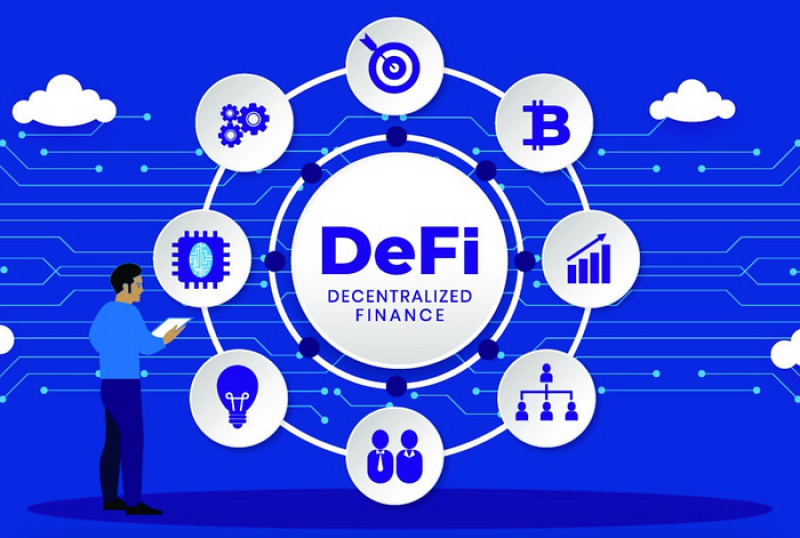
Decoding DeFi: A Comprehensive Beginner’s Guide to Digital Finance
Decentralized finance (DeFi) is revolutionizing the financial industry by eliminating intermediaries and providing innovative financial products and services.
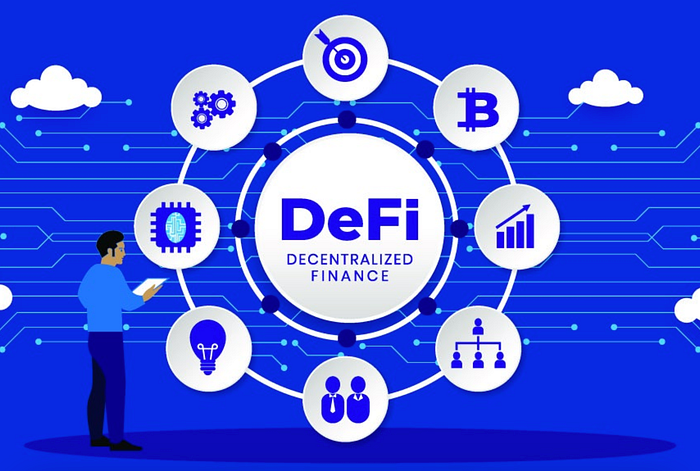
This article offers an in-depth look at DeFi: its components, use cases, and associated risks.
With examples, cited sources, and analogies for complex concepts given along the way, I hope this provides an engaging, educational, and informative introduction to DeFi.
What is Decentralized Finance (DeFi)?
DeFi refers to financial services built on blockchain technology that operate without a central authority.

DeFi platforms leverage smart contracts, which are self-executing contracts with the terms of the agreement directly coded onto the blockchain, to facilitate various financial transactions.
One well-known example of a DeFi platform is Compound Finance, a lending protocol that enables users to earn interest on their cryptocurrency holdings or borrow against them.
DeFi Components
DeFi comprises several components, each playing a crucial role in the ecosystem.
We’ll explore these components in detail below:
Decentralized Exchanges (DEXs)
Decentralized exchanges facilitate the trading of digital assets without requiring users to relinquish control of their funds to a centralized entity.

Uniswap, an Ethereum-based DEX, is one prominent example. DEXs like Uniswap use automated market makers (AMMs) and liquidity pools to enable trading without an order book, making the process more efficient and trustless.
Think of DEXs like a farmers’ market, where people can directly buy and sell goods from one another without a centralized authority overseeing the transactions.
Aggregators and Wallets
Aggregators act as decentralized asset management platforms, moving users’ crypto assets between various yield-farming platforms to generate the highest returns. An example of an aggregator is Yearn Finance, which optimizes yield farming strategies for its users.
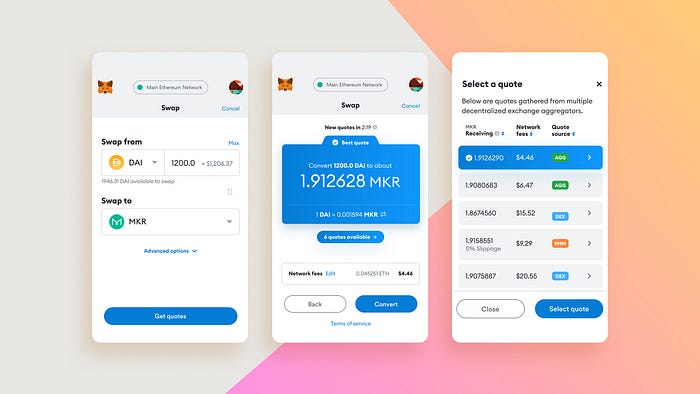
Wallets, on the other hand, are like digital bank accounts for storing and transacting digital assets.
Self-hosted wallets, such as MetaMask, allow users to retain control of their private keys and interact with various DeFi platforms.
Decentralized Marketplaces
Decentralized marketplaces allow users to transact with one another without an intermediary.
Ethereum is the leading blockchain for decentralized marketplaces, but other blockchains, like Binance Smart Chain, also support such platforms.
A popular use case for decentralized marketplaces is trading non-fungible tokens (NFTs), as seen on platforms like OpenSea.
Oracles and Prediction Markets
Oracles provide off-chain data to blockchains through third-party providers, enabling DeFi platforms to access real-world information.
Prediction markets, such as Augur, leverage oracles to facilitate bets on the outcomes of various events.
Layer-1 Solutions
Layer-1 refers to the underlying blockchain on which DeFi applications are built.
Ethereum is the predominant layer-1 solution, but other blockchains like Solana, Polkadot, and Cosmos are gaining traction.
DeFi Use Cases
DeFi offers a plethora of use cases, including lending and borrowing, margin and leverage trading, liquidity pools, and yield farming.
Platforms like Aave and MakerDAO have gained popularity for their lending and borrowing solutions, while Balancer and Curve Finance are known for their innovative liquidity pool designs.
Payments and Stablecoins
Stablecoins play a vital role in DeFi by providing a stable unit of account for transactions and contracts.
Pegged to fiat currencies like the US dollar, stablecoins offer reduced volatility compared to other cryptocurrencies, making them ideal for commerce and trading. Tether (USDT) and USD Coin (USDC) are two popular examples of stablecoins.
Margin and Leverage Trading
DeFi platforms like dYdX and Synthetix offer margin and leverage trading, allowing users to borrow cryptocurrencies using their existing holdings as collateral.
These platforms use smart contracts to incorporate leverage, potentially increasing returns for users while also raising their risk exposure.
DeFi-native Activities: Liquidity Pools and Yield Farming
Liquidity pools are essential for many DEXs, providing trading liquidity for buyers and sellers.
Users can deposit funds into a liquidity pool, earning fees from traders who interact with the pool. In exchange, they receive pool tokens, which can be redeemed for their deposited funds.
Yield farming, also known as liquidity mining, involves participating in liquidity pools to earn passive income through interest or additional tokens.
DeFi platforms like SushiSwap and PancakeSwap have popularized yield farming, attracting users seeking to maximize their returns on investment.
DeFi Risks
Despite its potential, DeFi is not without risks.
This nascent market still faces challenges related to scalability, regulatory uncertainty, and adoption. Slow transactions and high fees on some platforms may hamper user adoption, while regulatory ambiguity may pose challenges for DeFi’s integration into mainstream finance.
Investing in DeFi protocols can be risky, especially for smaller market cap tokens. Before investing, consider factors such as a protocol’s operational history, total value locked (TVL), and risk mitigation strategies.
Keep in mind that no DeFi protocol is entirely risk-free.
Making Money with DeFi
To earn passive income through DeFi, users can deposit their cryptocurrencies onto platforms that offer annual percentage yields (APYs).
Staking, or locking tokens in a smart contract in exchange for more tokens, is one such method. Yield farming, as previously discussed, is another popular way to earn income through DeFi.
To get started, users typically need to purchase cryptocurrencies, such as Ethereum or stablecoins, using fiat currency on an exchange or other on-ramp service before submitting them to the contract(s) of their choice.
DeFi is the Future
DeFi is a groundbreaking financial movement offering innovative solutions to traditional financial services.
With components like DEXs, aggregators, specialized wallets, and layer-1 solutions, DeFi platforms enable users to lend, borrow, trade, stake, and participate in liquidity pools and yield farming.
However, DeFi is not without risks, and users should carefully assess their investments and remain mindful of potential regulatory changes.
By staying informed and cautious, users can harness the power of DeFi to achieve financial autonomy and potentially earn passive income.
About The Rare Network
The Rare Network is a dynamic and growing organization that bridges the gap between traditional industry and emerging blockchain technology.
Our flagship event, Rare Evo, is the premier blockchain conference that brings together multi-chain projects, industry leaders, investors, and enthusiasts.
Rare Evo isn’t just a convention. It’s an immersive experience set in Denver, Colorado. We’ve got everything from educational sessions and networking opportunities to interactive experiences and live entertainment.
Hosted at the stunning Gaylord Rockies Resort, our luxurious and family-friendly venue ensures there’s something for everyone.
Don’t miss out on this game-changing event!
Buy your tickets, book your hotel room, and join the Web3 revolution.
Remember to stay connected with us on Twitter, YouTube, and Discord for the latest updates.