#Liquidity
OpenFX Raises $94M to Scale Stablecoin FX Payments

OpenFX, a fintech infrastructure startup founded by Prabhakar Reddy, co-founder of crypto brokerage company FalconX, has raised $94 million to expand its stablecoin-based cross-border foreign exchange (FX) payment rails.
The Series A round, which took place in March, was led by Accel and Atomico, with other investors including Lightspeed Faction, M13, Northzone, and Pantera participating.

The $94 million raised is aimed at expanding OpenFX’s presence in Latin America. Despite the region being a challenging market to enter, OpenFX reported strong success during a test deployment in Mexico, Brazil, and Argentina.
“Within six weeks, LATAM became our highest-volume region. We had succeeded at scale where so many other players were still struggling with proof of concepts,” the company said.
The team attributes its success in the region to its ability to deliver liquidity globally, quickly, and reliably, as well as its deep understanding of what payment service providers (PSPs) and remittance providers require.
OpenFX also plans to expand into Southeast Asia. Despite the region having some of the world’s more developed payment systems, cross-border payments remain slow and fragmented. By building a deep liquidity infrastructure, OpenFX aims to address this issue and has said it will be launching in Singapore, Hong Kong, and the Philippines.
With these expansion plans underway, OpenFX will extend its presence beyond the United States, United Kingdom, the United Arab Emirates, and India, where it currently operates.
The Team’s Progress So Far
Since its launch in 2024, the OpenFx cross-border infrastructure has processed billions of dollars, with an annualized processing volume of $45 billion.
In its first month of operation, the team says it processed $500,000. Eight weeks later, that figure had grown to $500,000 per week. Three months after launch, it was processing $500,000 per day, and today it processes approximately $500,000 per minute, with 98% of transactions settling in under 60 minutes.
The team also says it has onboarded more than 100 global institutional clients to its platform, including fintechs, neobanks, remittance platforms, and payroll processors.
OpenFx has now raised a total of $117 million, including $23 million in 2025 in a funding round led by Accel.

Eric Adams NYC Token Crash Fuels Rugging Claims

For a brief window, Eric Adams’ “NYC Token” looked like it might be the next Solana rocket. The price ripped higher almost immediately after launch, pushing the token to a paper valuation north of half a billion dollars.
Then it collapsed. Fast.
Within roughly 30 minutes of peaking, the token had lost more than 80 percent of its value. What looked like a breakout turned into a straight-down chart, and by the time most traders realized what was happening, liquidity was already disappearing.
This was not just volatility. The on-chain data tells a much messier story.
The Numbers Behind the Crash
At its peak, NYC Token briefly reached an estimated market capitalization of around $540 million. That number didn’t last long. As selling pressure hit, the price unraveled almost immediately, wiping out roughly $500 million in value in under an hour.
The speed matters. This was not a slow bleed or a multi-day unwind. It was a vertical move up followed by an even faster move down.
And the data shows why.
The Liquidity Move That Changed Everything
According to on-chain analysis highlighted in the original report, a wallet linked to the token’s deployer pulled roughly $2.5 million worth of USDC liquidity from the main trading pool right around the price peak.
That single action dramatically reduced the pool’s depth.
When liquidity is pulled like that, every sell becomes more painful. Slippage increases, prices gap lower, and panic compounds itself. That’s exactly what happened next.
Later, about $1.5 million in USDC was added back into the pool. But that still leaves roughly $900,000 that was never returned, at least not publicly accounted for.
To traders watching in real time, that sequence looked brutal. Liquidity out near the top, partial liquidity back after the damage was done, and silence on where the rest went.

The Supply Was Never Really Free
Then there’s the ownership data.
This was not a broadly distributed token. The top five wallets controlled roughly 92 percent of the total supply. The top ten held close to 99 percent. One wallet alone reportedly held about 70 percent.
Put simply, almost no one outside a very small group actually controlled meaningful supply.
That means price discovery was never organic. It also means that liquidity removal hit a market that was already artificially thin. Retail traders weren’t trading against thousands of independent holders. They were trading inside a structure dominated by a handful of wallets.
Once those wallets moved, the market had no choice but to follow.
Retail Traders Paid the Price
The data includes some ugly examples.
One wallet tracked on Solana bought the token five separate times, spending a total of about $745,000. Less than 20 minutes later, that same wallet sold everything for roughly $272,000.
That’s a loss of nearly $475,000 in minutes.
That pattern wasn’t unique. Many late buyers entered during the final leg of the pump, assuming liquidity would hold and momentum would continue. Instead, they became exit liquidity as soon as the pool thinned out.
This is how these collapses always look after the fact. Clean on-chain evidence, messy human behavior.
The Narrative Problem
Eric Adams positioned NYC Token as something more than a meme. The messaging leaned heavily on civic themes, education, and fighting antisemitism. It sounded closer to a mission than a gamble.
But the mechanics told a different story.
No clear public breakdown of wallet ownership. No transparent explanation of liquidity controls before launch. No smart-contract enforced locks that traders could independently verify in real time.
When the crash happened, explanations focused on market dynamics and demand rather than addressing the core issue. Liquidity was moved. Concentration was extreme. Retail traders were exposed.
In crypto, narratives don’t survive contact with block explorers.
Was It Rugged?
That depends on definitions, but the structure is hard to defend.
A token that crashes more than 80 percent within 30 minutes, after millions in liquidity are removed by a deployer-linked wallet, while one address holds the majority of supply, is going to be viewed as a rug pool by the market. Fair or not, that perception sticks.
You don’t need a hidden backdoor or malicious code. Control alone is enough.
The Bigger Takeaway
NYC Token will probably be forgotten in a few weeks. The losses won’t be.
This episode is another reminder that in crypto, structure matters more than slogans. Liquidity locks matter. Distribution matters. Transparency matters.
When those things are missing, hype fills the gap. And hype is fragile.
The data here wasn’t subtle. It was loud, fast, and unforgiving. Traders who ignored it paid the price. And the next memecoin with a famous name attached will almost certainly test the same limits again.
Because in this market, the charts always tell the truth eventually.
Stay Connected
You can stay up to date on all News, Events, and Marketing of Rare Network, including Rare Evo: America’s Premier Blockchain Conference, happening July 28th-31st, 2026 at The ARIA Resort & Casino, by following our socials on X, LinkedIn, and YouTube.

Is the End of Quantitative Tightening Setting Up Crypto’s Next Big Rebound?
The End of Quantitative Tightening Might Be Exactly What Crypto Needed

If you’ve been watching the crypto market lately, it has not felt great. Bitcoin dipping into the low 90s usually sparks panic, threads full of doom and plenty of “it’s over” takes. But this time, the headlines do not tell the full story. Something different is happening underneath the surface. Something that actually looks pretty promising.
A few major shifts are lining up at once, and together they point in one direction.
We might be closing out the long, grinding downtrend that has weighed on crypto for nearly two years.
The Federal Reserve formally ended quantitative tightening on Dec. 1, coinciding with the New York Fed conducting approximately $25 billion in morning repo operations and another $13.5 billion overnight, the largest injections that we've seen since 2020.
A Quiet Turning Point: Institutions Are Opening the Doors
For years, crypto’s biggest obstacle has not been technology or innovation. It has been access. Most big financial institutions treated crypto like a guest they did not want at the party.
That wall is finally cracking.
The clearest sign is Vanguard, managing roughly $9 trillion to $10 trillion in assets, opened its brokerage platform to third-party crypto ETFs and mutual funds tied to BTC, ETH, XRP, and SOL for the first time, creating immediate demand pressure.
This is a firm that has historically avoided anything remotely risky. They did not just ignore crypto; they actively rejected it. And now they are letting clients buy regulated crypto ETFs through the same accounts they use for retirement and index funds.
That is not a small change. When a company managing trillions finally decides that crypto belongs on the menu, it means something fundamental has shifted.
Even if only a small percentage of Vanguard’s clients add exposure, it creates a slow, steady flow of long term capital. That type of investor does not FOMO in or panic out. They allocate, rebalance and hold. That is the kind of capital that helps stabilize a market.
Crypto Moves on Liquidity, Not Hype
You can talk narratives all day, and crypto certainly loves its narratives. But the thing that consistently moves this market more than anything else is global liquidity.
And for the first time in a long while, liquidity is starting to return. The era of aggressive tightening looks like it is ending. If central banks start easing, capital gets cheaper, markets loosen up and investors take on more risk. Crypto usually reacts quickly.
The money supply had been shrinking for months. Now those indicators are stabilizing and, in some cases, ticking upward.
Look back at previous bull runs. They did not start because of tweets or new coins. They all aligned with periods of easier monetary policy.
We are entering one of those periods again.
ETFs Are Changing How Money Enters the Market
One of the underrated shifts happening right now is how investors access crypto.
Before ETFs, getting into Bitcoin or Ethereum meant dealing with exchanges, wallets, seed phrases and a bunch of complexity that ordinary investors simply did not want.
Now it is as simple as buying an index fund. ETFs are often part of automated portfolios. When crypto drops, the system buys more to rebalance. When it rises too fast, it trims. That smooths out volatility.
Investors trust the platforms they already use. If crypto is right there next to S&P 500 funds, the hesitation disappears. Those regulated products bring in the kind of capital that sticks around. Not tourists. Not gamblers. Long term investors.
This shift alone could reshape how crypto behaves during both rallies and corrections.
Why the End of Quantitative Tightening Is the Real Catalyst
The last couple of years have been rough for risk assets across the board. Higher rates, reduced liquidity and tighter financial conditions made it hard for anything speculative to breathe. Crypto got hit hardest.
Now that cycle is ending.
When quantitative tightening slows, liquidity flows back into the system. Banks lend more. Investors take more risk. Capital moves faster. Crypto is one of the first beneficiaries because it lives so far out on the risk curve.
Put simply, crypto does not need a hype cycle to turn around. It needs liquidity.
And liquidity is finally returning.
This Market Might Be Underestimating What Comes Next
People are tired. They are skeptical. And that is usually when markets quietly shift direction.
Think about the setup right now:
-
Institutions are entering.
-
ETFs are creating new pipelines.
-
Liquidity is stabilizing.
-
Rate cuts look increasingly likely.
-
Crypto is oversold and structurally stronger than it was in past cycles.
This is the kind of macro environment where bottoms form, often long before sentiment catches up.
The Foundation for the Next Run Is Taking Shape
Downtrends do not end on good news. They end when conditions change behind the scenes while everyone is too focused on the price chart.
That is what seems to be happening now.
The end of quantitative tightening is not just another headline. It is the kind of shift that has historically marked the beginning of major reversals in risk assets. And with crypto gaining easier access, stronger infrastructure and broader institutional acceptance, this could be the setup for something bigger than most people expect.
Crypto might not just recover.
It may be preparing for a stronger, more mature cycle than anything we have seen before.
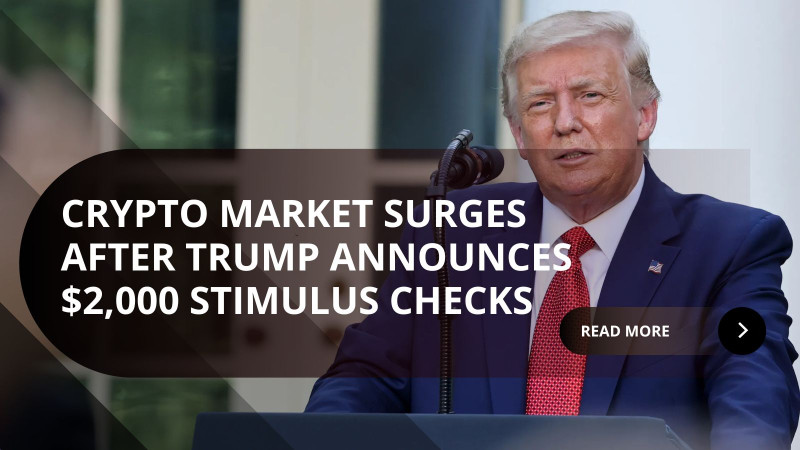
Crypto Prices Surge After Trump Announces Tariff Dividend Plan
Crypto Prices Surge After Trump Announces Tariff Dividend Plan
Crypto markets moved sharply higher after President Trump announced his intent to send “at least” a $2,000 tariff dividend to every American, funded by tariff revenues. Bitcoin climbed roughly 1.7% to trade above $103,000, while Ethereum rose more than 3% to around $3,480. Solana also gained nearly 2%, helping the broader crypto market recover from a difficult week.
The announcement, which Trump described as a “dividend for the American people,” immediately set off speculation about a new wave of consumer stimulus. Market watchers compared the idea to the 2020–2021 stimulus checks that fueled both retail investing and crypto adoption during the pandemic.
What a “Tariff Dividend” Means
The proposal is straightforward: redistribute federal tariff revenue to households in the form of direct payments. The administration framed it as “returning America’s money to Americans,” though the plan would likely require congressional authorization and a detailed funding framework.
In practical terms, this would act much like a stimulus payment, except funded through tariffs rather than new government borrowing. Whether or not it comes to fruition, the market’s reaction suggests traders are already pricing in the possibility of renewed liquidity entering the system.
Why Crypto Reacted: The 2020 Playbook
When the United States issued direct stimulus checks in 2020 and 2021, data showed a measurable uptick in crypto activity. Exchanges recorded surges in $1,200 deposits — the same amount as the first stimulus payment — and analysts noted a wave of new retail wallets buying Bitcoin and Ethereum.
In other words, stimulus checks created a wealth shock that found its way into digital assets. The pattern was clear: free cash plus frictionless access to trading apps equaled inflows into crypto.
If a 2025 “tariff dividend” reaches consumer bank accounts, it could produce a similar reaction:
-
Immediate liquidity shock: Households receive cash, and some percentage of it flows into high-risk, high-reward assets.
-
Ease of access: It is easier than ever to buy crypto directly through apps that support bank transfers and debit cards.
-
Narrative power: Headlines about free money drive social media buzz, which has historically amplified market moves.
-
Altcoin momentum: In 2020 and 2021, retail inflows often rotated into smaller tokens, fueling broader speculative rallies.
How 2025 Differs From 2020
There are important differences between the two environments.
-
Economic backdrop: Interest rates are higher, inflation is more persistent, and households are facing tighter budgets. Liquidity injections might not carry the same purchasing power they did during lockdowns.
-
Policy complexity: A tariff dividend is not an emergency measure. It would require legislation, debate, and administrative systems to distribute funds.
-
Market maturity: Crypto ownership is broader and more institutionalized now. Retail checks could still drive excitement, but large funds and ETFs dominate trading volume.
-
Tariff revenue limits: Total tariff collections may not fully cover such large payments, which could influence how much money actually reaches citizens.
Even with these caveats, the narrative alone can move markets. Traders have a short memory for policy hurdles but a long memory for liquidity events.
Possible Scenarios
Scenario 1: Full $2,000 payments in early 2025.
Expect an immediate increase in retail deposits and small-ticket crypto buys. Bitcoin would likely lead the rally, followed by Ethereum and major Layer 1 tokens. Within days, altcoins could outperform as speculative capital spreads through the market.
Scenario 2: Reduced or delayed payments.
A scaled-down version would still spark optimism, but the impact would be smaller. Prices could rise on anticipation and then fade if payments are limited or phased in over time.
Scenario 3: No payments, only rhetoric.
If Congress rejects or delays the plan, the initial market rally could unwind quickly. Traders would shift focus back to macro factors such as interest rates and ETF inflows.
What to Watch Next
-
Policy developments: Official statements from the White House and Treasury will clarify how serious the proposal is.
-
Legislative signals: Watch for draft bills or congressional discussions that determine timing and funding.
-
Exchange activity: Look for clustering of retail-sized purchases near the proposed check amount, as seen in 2020.
-
Altcoin breadth: If retail flows return, altcoins typically benefit first due to their lower market caps and higher volatility.
-
Tariff policy shifts: Increased tariffs could pressure supply chains and offset some of the stimulus effect, adding complexity to market sentiment.
Final Thoughts
Today’s market reaction shows how sensitive crypto remains to liquidity narratives. History suggests that direct payments to households act as fuel for risk assets, particularly digital currencies.
In 2020, stimulus checks helped ignite one of the strongest bull runs in crypto history. Bitcoin’s price more than tripled in less than a year as new retail investors piled in. If a 2025 “tariff dividend” delivers similar injections of cash, it could trigger another wave of retail-driven buying — especially in the smaller, more speculative corners of the market.
Still, the outcome depends on whether policy turns into action. Until checks start landing, investors should treat this as a potential catalyst rather than a certainty. Yet if history is any guide, the prospect of free money flowing into crypto is enough to remind markets just how powerful liquidity can be.
Stay Connected
You can stay up to date on all News, Events, and Marketing of Rare Network, including Rare Evo: America’s Premier Blockchain Conference, happening July 28th-31st, 2026 at The ARIA Resort & Casino, by following our socials on X, LinkedIn, and YouTube.
Apex Fusion Unlocks Native USDC Liquidity for Cardano with Stargate Integration
Apex Fusion Brings Native USDC Liquidity to Cardano Through Stargate Integration
The Cardano DeFi ecosystem just gained a major boost. Apex Fusion, the rapidly growing interoperability and liquidity infrastructure, has officially integrated with Stargate to bring native USDC liquidity into the Cardano network.
For years, one of Cardano’s biggest challenges has been stablecoin liquidity and accessibility. With this move, Apex Fusion has not only solved a long-standing gap but also laid the groundwork for Cardano’s entry into the next era of multi-chain DeFi. This is a world where assets and liquidity flow freely across ecosystems, supported by security and efficiency.
Apex Fusion’s Mission and Vision
Apex Fusion is more than just another blockchain project. It is an interoperability framework that connects multiple ecosystems, including Cardano, Ethereum, Arbitrum, and others, while maintaining native-level security and performance.
At the heart of its architecture are two key components:
-
VECTOR, a Cardano-aligned chain designed for speed, scalability, and native interoperability.
-
NEXUS, an EVM-compatible layer that connects Apex Fusion to major ecosystems like Ethereum, Polygon, and Arbitrum.
Together, these two layers form a cross-chain bridge that allows assets and liquidity to move natively between Cardano and other leading blockchains. The goal is simple but ambitious: to build a unified and interconnected ecosystem where liquidity, applications, and users can move without friction.
By integrating with Stargate, Apex Fusion has now given Cardano direct access to native USDC, one of the most trusted and widely used stablecoins in the world.
How the Stargate Integration Works
The integration between Apex Fusion and Stargate is designed to make cross-chain liquidity transfer seamless, secure, and efficient.
-
Native USDC Liquidity Onboarding:
Stargate’s omnichain technology enables the movement of stablecoins like USDC across multiple networks. Apex Fusion has built the connection point that allows that same liquidity to reach Cardano without using wrapped or synthetic assets. -
Secure Interoperability via VECTOR and NEXUS:
Within Apex Fusion, VECTOR manages the Cardano-side logic, while NEXUS acts as the interoperability layer to EVM-compatible ecosystems. Together, they form the infrastructure that allows USDC to flow natively between chains. -
Liquidity Activation:
The Apex Fusion Foundation has seeded $2.5 million in USDC liquidity to immediately activate use cases within the Cardano DeFi space, such as lending protocols, decentralized exchanges, and yield aggregators. -
Unified Liquidity Pools:
This integration means Cardano DeFi apps can now tap into the same liquidity pools available to Ethereum, Arbitrum, and other ecosystems. This creates a unified DeFi environment where users experience real interoperability instead of isolated markets.
Why This Is a Major Win for Cardano DeFi
Cardano’s DeFi ecosystem has grown steadily in recent years, but it has often faced limitations due to the absence of deep stablecoin liquidity. That changes now.
With Apex Fusion’s Stargate integration:
-
Developers gain access to reliable stablecoin infrastructure, allowing them to build products like lending platforms, automated market makers, and cross-chain DeFi applications without workarounds.
-
Investors and liquidity providers can finally deploy USDC natively within Cardano protocols, unlocking opportunities for yield and liquidity strategies that were previously only available in EVM ecosystems.
-
Cardano’s DeFi TVL (total value locked) could see substantial growth, as stablecoins are the foundation of liquidity and DeFi scalability.
This is not just a bridge. It is a breakthrough that allows Cardano to compete directly with ecosystems like Ethereum, Solana, and Arbitrum, while maintaining its unique strengths in scalability, security, and research-driven design.
Apex Fusion: Uniting The World of Web3
What makes Apex Fusion’s achievement so powerful is its broader vision. The team is not just solving liquidity for Cardano; they are building the foundation for true multi-chain interoperability.
Recent milestones demonstrate this clearly:
-
LayerZero Integration: Apex Fusion’s NEXUS layer now connects to over 145 blockchains, enabling unified liquidity and messaging across EVM and non-EVM chains.
-
Zero-Wrapping Architecture: Assets move in native form, meaning no synthetic tokens or wrapped versions that create unnecessary risk or complexity.
-
Cross-Chain Data Flow: Beyond liquidity, Apex Fusion is building systems that allow contracts and applications to communicate across chains, a key step for the next evolution of decentralized apps.
The result is an infrastructure that benefits not only Cardano but the entire DeFi ecosystem. It is the type of cross-chain standard that blockchain developers have been waiting for — one that brings real usability, real assets, and real scalability to Web3.
The Broader Implications
This integration will likely reshape how developers and users view Cardano. For the first time, the network can fully participate in global stablecoin markets, attract liquidity from other ecosystems, and host DeFi applications that rival those on Ethereum and beyond.
It also reinforces Cardano’s reputation as a blockchain that is evolving rapidly beyond its early image. The combination of Apex Fusion’s interoperability and Cardano’s scalability positions both at the center of what could become a more unified and efficient financial layer for Web3.
Apex Fusion has proven that interoperability is not just about connecting blockchains. It is about connecting opportunities, liquidity, and innovation.
Learn More About Apex Fusion
For readers who want to explore more about Apex Fusion’s technology, mission, and ongoing integrations, visit the following official links:
- Website: https://apexfusion.org/
- Twitter (X): https://x.com/apexfusion
- Discord: https://discord.com/invite/2nSBGyvjpZ
- LinkedIn: https://www.linkedin.com/company/apexfusioncore
- Telegram: https://t.me/apexfusion
These channels provide regular updates on partnerships, cross-chain integrations, and developer programs for Apex Fusion.
Final Thoughts
The Stargate integration is a defining moment for Apex Fusion's mission of uniting the world of Web3.. It delivers something the community has long wanted: native USDC liquidity, real interoperability, and access to global DeFi capital.
For Cardano, it represents the evolution from a promising platform to a fully connected ecosystem ready to compete with the largest chains in DeFi.
For Apex Fusion, it is a validation of their approach to building bridges that do not compromise decentralization or user trust.
As DeFi continues to move toward a multi-chain world, Apex Fusion and Cardano are proving that collaboration, not isolation, is the key to growth.
By connecting the dots between ecosystems, they are not just improving liquidity — they are helping to build the infrastructure for the next era of blockchain finance.
Stay Connected
You can stay up to date on all News, Events, and Marketing of Rare Network, including Rare Evo: America’s Premier Blockchain Conference, happening July 28th-31st, 2026 at The ARIA Resort & Casino, by following our socials on X, LinkedIn, and YouTube.

Balancer Faces Over $110 Million in Outflows After Potential Exploit
Balancer Faces Over $110 Million in Outflows After Potential Exploit
The decentralized finance (DeFi) protocol Balancer is facing scrutiny after more than $110 million in assets were drained from its pools in what appears to be a large-scale exploit. Early reports surfaced from blockchain analysts, including @AdiFlips on X, who tracked the initial transactions and raised alarm over millions of dollars in outflows from Balancer’s smart contracts.
What Happened
Balancer’s smart contracts began showing suspicious transactions involving Wrapped Ether (WETH), Lido staked Ether (wstETH), and Origin staked Ether (osETH) on October 30. According to on-chain data shared by @AdiFlips, the transactions originated from Balancer’s “manageUserBalance” function, a part of its V2 smart contract system that handles user funds and pool accounting.
In just a few minutes, an unknown address moved more than $70 million worth of assets across multiple transactions. Follow-up analysis by several DeFi monitoring platforms later confirmed that total outflows exceeded $110 million, with funds being consolidated into a single wallet.
What the Analyst Found
On X, @AdiFlips posted the first thread highlighting the exploit, noting that the “manageUserBalance” function was being abused. He showed that the attacker was able to call the function in a way that bypassed standard permission checks, allowing them to drain funds from liquidity pools without ownership validation.
In his breakdown, he wrote:
“It looks like the Balancer exploit is real. Someone managed to bypass
msg.sendervalidation in themanageUserBalancefunction, allowing them to transfer tokens directly. Funds are being drained quickly.”
His real-time tracking of the attacker’s wallet provided the first public warning to liquidity providers (LPs), prompting many to start pulling funds before further losses.
Balancer’s Response
Balancer confirmed the issue shortly after the exploit began, posting an update on X:
“We are aware of a potential exploit impacting Balancer V2 pools. Our engineering and security teams are investigating with high priority.”
The team said it has contacted major blockchain security groups and forensic analysts to trace the funds and assess the exploit’s scope. Balancer has also offered a 20% white-hat bounty for the return of the stolen assets, promising leniency if the attacker cooperates.
If the funds are not returned within 48 hours, Balancer stated it would pursue the matter through law enforcement and deeper blockchain forensics, including cross-referencing IP, ASN, and timestamp data linked to on-chain activity.
How the Exploit Worked
Preliminary technical analysis suggests the attacker exploited a logic flaw in Balancer’s contract validation process. Specifically, they were able to manipulate the manageUserBalance function, which is responsible for handling deposits and withdrawals.
Normally, the function should only execute balance changes initiated by the user calling the transaction. However, a missing or incorrect sender check may have allowed the attacker to impersonate users and withdraw assets from shared liquidity pools.
This kind of bug falls under the category of access control vulnerabilities, a recurring issue in complex DeFi protocols that handle multiple users’ funds through permissioned functions.
Impact on Users
The exploit affects liquidity providers (LPs) participating in Balancer V2 pools, particularly those containing wrapped and staked Ethereum assets. If you are a Balancer LP, you should:
-
Check your wallet and pool exposure immediately.
-
Exit vulnerable pools until Balancer issues a full post-mortem.
-
Avoid interacting with any unverified Balancer contracts during the investigation period.
Balancer has not yet confirmed whether all funds can be recovered, but the incident has already shaken confidence in one of DeFi’s longest-running automated market makers.
Industry Reaction
The broader DeFi community reacted quickly. Security researchers and analysts echoed @AdiFlips’ findings, noting that the exploit underscores a recurring challenge in smart contract design. Small logic errors in permission validation can lead to massive financial losses.
Developers from other major protocols, including Curve and Uniswap, have reportedly reviewed similar functions in their contracts to ensure they are not exposed to the same vulnerability.
Meanwhile, crypto security firms have begun tracking the attacker’s wallet movements, which show small transfers through decentralized exchanges, possibly testing laundering routes or trying to break traceability before moving funds to privacy protocols.
Why This Matters
Balancer’s exploit is not just another DeFi hack. It is a reminder that code complexity equals risk, even for mature platforms. Balancer has handled billions in total value locked (TVL) since launching in 2020, making this one of the largest potential breaches in its history.
The event highlights three broader trends in DeFi:
-
Smart contract logic flaws remain a top vulnerability, even after audits.
-
Real-time community alerts like those from @AdiFlips play a crucial role in limiting damage.
-
Protocol accountability and transparency are now as important as code security itself.
What Happens Next
Balancer’s team is expected to publish a full incident report once its investigation concludes. They will likely propose governance measures to patch affected contracts and possibly establish compensation paths for liquidity providers who lost funds.
For now, on-chain watchers continue to track the exploiter wallet, which still holds tens of millions in Ether and related assets. Whether this turns into a partial recovery or another unsolved multimillion-dollar DeFi theft remains to be seen.
Final Thoughts
This exploit shows that even well-established DeFi protocols remain vulnerable to subtle design flaws. While Balancer’s prompt communication and bounty offer were commendable, the event reinforces the need for constant contract monitoring, active audits, and responsible disclosure systems across the sector.
For users, the lesson is simple: DeFi rewards innovation, but it still carries risk. Stay alert, follow verified analyst updates, and never assume any protocol is too established to be exploited.
Stay Connected
You can stay up to date on all News, Events, and Marketing of Rare Network, including Rare Evo: America’s Premier Blockchain Conference, happening July 28th-31st, 2026 at The ARIA Resort & Casino, by following our socials on X, LinkedIn, and YouTube.