#Regulated Crypto
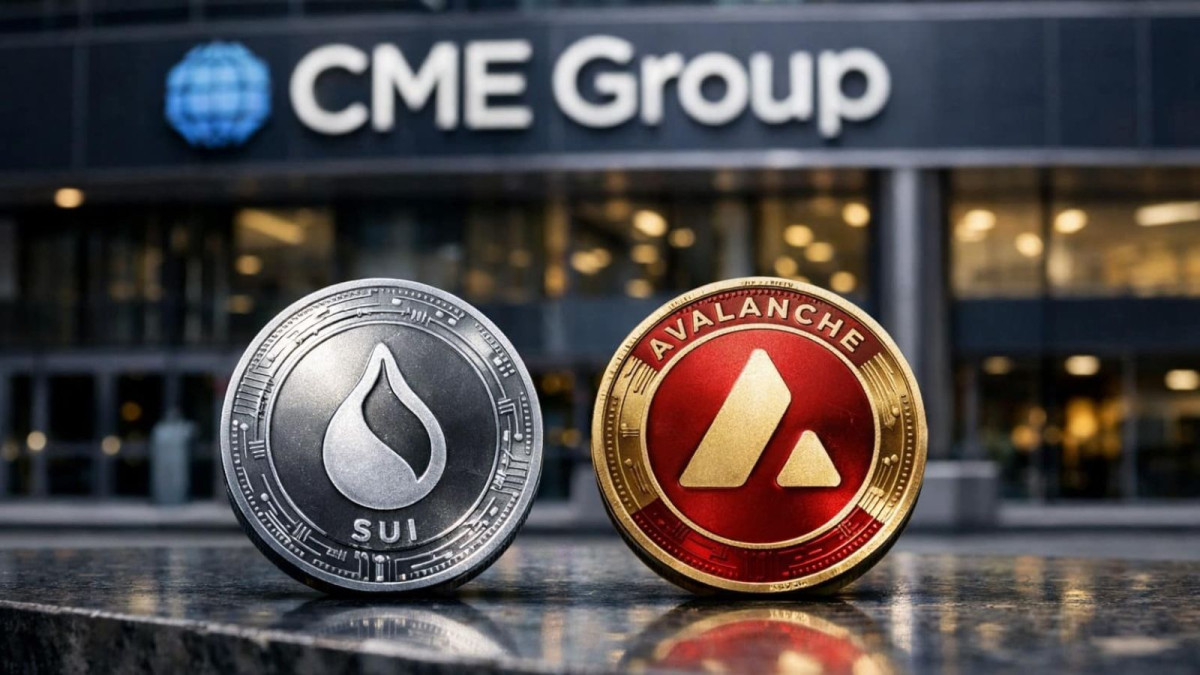
CME to Launch AVAX and SUI Futures

The Chicago Mercantile Exchange (CME), the world’s largest financial derivatives marketplace, has announced plans to launch Avalanche (AVAX) and Sui (SUI) futures contracts on May 4, pending regulatory review by the Commodity Futures Trading Commission (CFTC).
The launch of these contracts, the company says, will allow market participants and traders the option to choose between micro-sized and larger-sized futures contracts, including AVAX futures sized at 5,000 AVAX and micro AVAX futures sized at 500 AVAX, as well as SUI futures contracts sized at 50,000 SUI and micro SUI futures contracts sized at 5,000 SUI.
According to Giovanni Vicioso, CME Group Global Head of Cryptocurrency Products, the launch of this new set of futures contracts is aimed at providing clients and market participants with greater flexibility and more market options, as well as improved capital efficiency across the deeply liquid CME derivatives market.
"We continue to see strong volumes as market participants turn to our markets to manage risk and pursue opportunities, with March average daily volume up 19 percent year over year and nearly $8 billion in average notional value traded daily,” Vicioso said.
The nearly $8 billion in average notional value traded is not insignificant, as CME is one of the most liquid derivatives exchanges. According to a February trading report, the CME derivatives trading platform recorded an all-time daily trading peak of 29.6 million futures contracts in January of this year, a 15 percent year over year increase compared with January of the previous year.
The launch of the Avalanche and Sui contracts comes shortly after CME Group launched Cardano (ADA) futures, Chainlink (LINK) futures, and Stellar (XLM) futures contracts on February 9 of this year, as part of the firm’s ongoing strategy of providing trusted, regulated crypto products to all kinds of market participants.
Crypto Derivatives Market Continues to Boom
The crypto derivatives trading market, primarily the futures and options market, has continued to boom. In the first quarter of this year, crypto derivatives trading accounted for almost 90 percent of the total $20.57 trillion traded in that period, reaching $18.63 trillion, while spot trading accounted for $1.94 trillion.
There has also been an increase in the number of large institutions in recent times, including traditional finance institutions that have moved to tap into this vast section of the crypto market.
In October 2025, the global investment bank Goldman Sachs, in collaboration with DBS Bank, launched the first-ever over-the-counter interbank cryptocurrency options trade. In December last year, JPMorgan Chase, America’s largest bank, also began exploring the launch of crypto spot and derivatives trading services for its institutional clients.
ShieldUSD To Bring Privacy-First USD Stablecoin to Midnight Network

As the stablecoin market matures, a growing number of projects are focusing on what many see as the next missing piece of on-chain finance: privacy that works alongside regulation, not against it.
That is the direction W3i Software is taking with ShieldUSD, a USD-pegged stablecoin being built for the Midnight Network, a privacy-focused blockchain designed for confidential smart contracts and selective disclosure.
The project aims to deliver a digital dollar that preserves transactional privacy while remaining compatible with compliance and audit requirements, a balance that has proven difficult for most stablecoin models to strike.
A Stablecoin Designed for Real-World Privacy
ShieldUSD is being developed by W3i Software in collaboration with Moneta Digital and Norwegian Block Exchange (NBX), combining regulated issuance with Midnight’s privacy-native infrastructure.
Unlike most dollar-backed stablecoins, which expose transaction details publicly on chain, ShieldUSD is designed to allow users to transact confidentially by default. Sensitive information such as counterparties, amounts, or transaction logic can remain private, while still allowing selective disclosure when required for regulatory, legal, or audit purposes.
For many businesses and institutions, that distinction matters. Public blockchains have made settlement faster and more programmable, but the lack of confidentiality has limited adoption in areas like payroll, supplier payments, and enterprise finance. ShieldUSD is explicitly targeting those gaps.
Building on Midnight’s Privacy-Native Architecture
ShieldUSD is being built specifically for the Midnight Network, a Layer 1 blockchain developed to support privacy-preserving applications from the ground up. Midnight uses advanced cryptographic techniques to enable confidential transactions and smart contracts without sacrificing verifiability or compliance.
That design allows developers to define what data is private, what is shareable, and with whom. Rather than forcing transparency or secrecy across the board, Midnight supports selective disclosure as a native feature.
ShieldUSD fits naturally into that model. It is intended to function as a settlement asset that can move privately within applications, while still offering the assurances needed by regulators, auditors, and institutional counterparties.
W3i’s Experience With Regulated Stablecoins
W3i Software brings prior experience to the project through its work on USDM, a regulated fiat-backed stablecoin in the Cardano ecosystem. That background has shaped ShieldUSD’s approach, particularly around compliance, custody, and reserve transparency.
By pairing that experience with Midnight’s privacy infrastructure, the project aims to show that privacy-preserving finance does not need to exist in tension with regulation. Instead, it can be engineered to support it.
A Broader Shift in Stablecoin Design
ShieldUSD arrives amid a broader rethinking of how stablecoins should function as they move deeper into mainstream finance. While transparency has been a core feature of early stablecoins, it has also created unintended consequences, including transaction surveillance and data leakage that make certain use cases impractical.
As AI agents, automated trading systems, and on-chain business logic become more common, privacy is increasingly viewed as a functional requirement rather than a philosophical preference. Midnight’s architecture reflects that shift, positioning privacy as infrastructure rather than an add-on.
ShieldUSD is one of the first stablecoin projects explicitly designed around that premise.
Momentum Around the Midnight Ecosystem
The announcement also adds momentum to the Midnight Network more broadly, which has been steadily building toward mainnet readiness with a focus on regulated, privacy-aware applications. The presence of a native, privacy-preserving dollar stablecoin strengthens Midnight’s value proposition as a settlement layer for real-world finance.
While ShieldUSD will still need to build liquidity and adoption in a competitive stablecoin market, its design aligns closely with the needs of enterprises and institutions that have largely remained on the sidelines of public blockchains.
What to Expect next
Challenges remain. Privacy-preserving systems are more complex to implement, and regulatory expectations around stablecoins continue to evolve. Still, ShieldUSD represents a clear step toward a more nuanced model of on-chain money, one that treats privacy as compatible with compliance rather than something to be sacrificed.
If successful, ShieldUSD could help demonstrate how stablecoins evolve beyond transparent consumer tokens into serious financial infrastructure, and position Midnight as a network purpose-built for that next phase.
For a sector still searching for scalable, privacy-aware settlement tools, ShieldUSD and the Midnight Network offer a direction that many in the industry have been waiting for.
Stay Connected
You can stay up to date on all News, Events, and Marketing of Rare Network, including Rare Evo: America’s Premier Blockchain Conference, happening July 28th-31st, 2026 at The ARIA Resort & Casino, by following our socials on X, LinkedIn, and YouTube.
Kalshi Integrates TRON to Expand On-Chain Liquidity for Prediction Market
Kalshi is gaining deeper onchain liquidity with new TRON integration.
The U.S. regulated prediction market operator has integrated the TRON network, expanding on-chain access to liquidity for what it calls the world’s largest prediction market. The move gives traders new ways to move funds in and out of Kalshi using blockchain rails, while signaling that the company is getting more serious about meeting crypto native users where they already are.
At a basic level, the integration allows users to deposit and withdraw assets like USDT on TRON directly into Kalshi. That may sound incremental, but for a platform built inside the U.S. regulatory perimeter, it is a meaningful shift. Blockchain rails offer faster settlement, lower friction, and access to global liquidity that traditional payment systems still struggle to match.
Kalshi’s bet is that prediction markets work better when capital can move freely.
A Hybrid Market Takes Shape
Kalshi occupies a strange but increasingly important corner of finance. It operates under the oversight of the Commodity Futures Trading Commission, which gives it the ability to offer event based contracts tied to real world outcomes like inflation prints, election results, and economic data releases.
What makes Kalshi different is that it is now trying to blend that regulated structure with crypto infrastructure.
By integrating TRON, and previously Solana, Kalshi is building what amounts to a hybrid market. The core exchange remains regulated and off-chain, but the access points are increasingly on-chain. Users can tap blockchain liquidity while still trading contracts that settle under U.S. rules.
For Kalshi, liquidity is the whole game. Prediction markets only work when there are enough participants on both sides of a trade. Crypto users already understand how to move stablecoins, bridge assets, and arbitrage prices across venues. Bringing those users into Kalshi’s ecosystem could deepen markets that have historically been thinner than traditional financial products.
Why TRON
TRON’s appeal here is straightforward. It is one of the most widely used blockchain networks in the world for real payment activity, particularly stablecoin transfers. A significant portion of global USDT volume already flows through TRON every day, making it a natural fit for a platform focused on liquidity and accessibility.
For Kalshi, that usage matters more than brand perception. TRON offers fast settlement, low transaction costs, and a network that is already embedded in how traders move dollars on-chain. Those characteristics make it easier for both institutional and international users to move capital efficiently without friction eating into trading activity.
TRON’s reach outside the United States is also a feature, not a bug. Prediction markets benefit from diverse participation and constant flow, and TRON’s global footprint helps bring in users who already operate on-chain as part of their daily financial activity.
The integration also reflects a pragmatic approach. Rather than betting on hype cycles, Kalshi is aligning with infrastructure that is already proven at scale. Alongside its work on Solana, TRON adds another high throughput rail that supports Kalshi’s broader goal of making prediction markets more liquid, accessible, and always on.
Regulation Meets Crypto Reality
Kalshi’s regulatory status remains central to its pitch. Unlike fully decentralized prediction markets, Kalshi operates under explicit U.S. approval. That has allowed it to offer contracts that other platforms either cannot or will not touch.
At the same time, regulation comes with constraints. Kalshi cannot simply open the floodgates to every DeFi user worldwide. Integrating blockchains like TRON is a way to expand access without abandoning compliance.
It is a careful balancing act. Too much decentralization risks regulatory pushback. Too little innovation risks irrelevance in a market where crypto native platforms move faster.
So far, Kalshi seems intent on threading that needle.
A Growing Role in Media and Markets
Prediction markets have also become more visible in mainstream discourse, and Kalshi has leaned into that. Its data is increasingly referenced as a real time signal of market expectations, particularly around politics and macroeconomic events.
That visibility matters. Prediction markets tend to gain relevance when people start trusting them as indicators rather than curiosities. More liquidity, especially from crypto users accustomed to trading around the clock, could reinforce that feedback loop.
The more capital flows through these markets, the more informative prices become.
Stay Connected
You can stay up to date on all News, Events, and Marketing of Rare Network, including Rare Evo: America’s Premier Blockchain Conference, happening July 28th-31st, 2026 at The ARIA Resort & Casino, by following our socials on X, LinkedIn, and YouTube.