#Digital Dollars
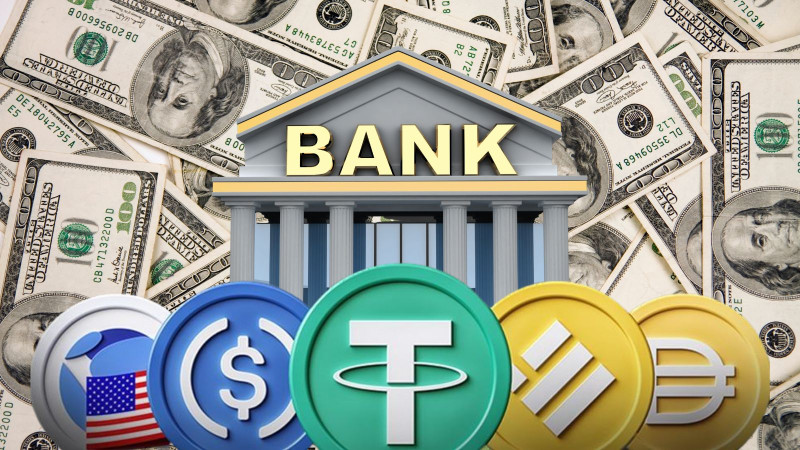
Why Banks Are Fighting So Hard Against Stablecoin Yield

There’s been a lot of language coming out of Washington lately about stablecoins.
Words like "prudence", "guardrails", and "financial stability" get thrown around whenever the CLARITY Act comes up. Coinbase recently pulled their support amid stablecoin issues in the same bill. But if you take a step back, it’s hard not to feel like something else is driving the intensity of the debate. Big banks don’t usually fight this hard over niche policy details unless there’s something material at stake.
Browsing the web, trying to find my next article for all of you, I came across a recent report from Standard Chartered’s digital assets research team, led by Geoff Kendrick, and it may just help to explain the fight a bit better.
A Forecast Banks Can’t Ignore
Kendrick’s research doesn’t treat stablecoins as a crypto sideshow. It treats them as a potential alternative home for real money, the kind of money that currently sits in checking and savings accounts. He actually estimated that $500 billion will move from bank deposits to stablecoins by 2028. The idea isn’t that everyone suddenly abandons banks. It’s subtler than that. Even a gradual shift of deposits into stablecoins changes the math for banks in ways they really don’t like. Funding becomes more expensive, liquidity assumptions get weaker, margins get squeezed. Those aren’t ideological concerns. Those are spreadsheet concerns. And spreadsheet concerns really make banks want to fight the issue.
But to understand the real threat to banks, you first have to better understand the business itself. Banks don’t just hold your money. They use it. Under fractional reserve banking, they keep only a slice and lend the rest out to earn interest for themselves. Sure, they'll keep that small portion of your deposit, but the majority gets reinvested through loans and other activities. That’s how they earn money and why they can afford to even pay any interest to you at all, even if it’s usually minimal.
This system works because deposits are assumed to be sticky. People don’t move their money often, and when they do, it usually stays within the banking system. Moving from one bank to another.
Stablecoins challenge that assumption. They make dollars mobile in a way they haven’t been before.
The Shift Is Coming
Right now, most stablecoins feel like tools, not destinations. They’re useful for transfers, trading, and crypto-native activity, but they’re not where most people park idle cash. Yield changes that. The moment a stablecoin starts paying something meaningfully better than a traditional savings account, the comparison becomes unavoidable. A digital dollar that moves instantly, works around the clock, and earns yield starts to look less like a crypto product and more like a better bank balance. That’s when stablecoins stop being adjacent to banking and start competing with it.
But, we're still talking mostly about crypto-native people. The real shift happens when stablecoins stop feeling like crypto at all, when they live inside apps people already trust and use every day. When you easily pay for your groceries on your phone without writing down that seed phrase for crypto that sits on a separate wallet that may or may not be linked to payments.
PayPal is already experimenting here. Their Paypal USD (PYUSD) exists inside a platform with hundreds of millions of users, and it already lets people move dollars instantly between PayPal and Venmo for free. That’s everyday payment stuff. It’s not a niche oracles or decentralized exchange use case. It’s peer to peer transfers in apps people use for rent, splitting bills, or sending money to family.
Cash App has also signaled support for stablecoin payments and more flexible money movement options, even if Bitcoin hasn’t become everyday cash yet. The point is simple: If stablecoins actually become integrated into the way regular people pay for things, save for short-term goals, and move money around, they stop being a "crypto thing” and become an alternative store of value and payment rail to banks.
That’s exactly the scenario a bank CFO would find unsettling.
Why the CLARITY Act Matters So Much
This is why the fight over stablecoin yield inside the CLARITY Act feels so charged. It’s not really about whether stablecoins should exist. That battle is already over. It’s about whether they’re allowed to become a true alternative to bank deposits. If yield stays restricted, stablecoins grow slowly and remain mostly transactional. If yield is allowed under a clear regulatory framework, they start to compete directly with how banks fund themselves. That’s a much bigger shift.
The Bottom Line
If you take Kendrick’s projections seriously, and I know that I do. I have been in this blockchain industry for a decade now. I have seen the shift from Silk Road and from not even being a second thought in Washington to being a presidential election policy issue and talked about at the highest levels of government, from sea to shining sea.
But pushback from banks does make sense. It’s not panic. It’s defense. Stablecoins that are easy to use, deeply integrated into everyday payment apps, how people spend their money, and capable of earning yield... threaten something fundamental. They threaten the quiet bargain where banks get cheap access to capital and customers accept low returns in exchange for convenience. Seen through that lens, the resistance to stablecoin yield isn’t surprising at all. It’s exactly what you’d expect when a new form of money starts to look a little too good at doing the job banks have always relied on to make money.
I know where I stand on the issue and I'm interested to know what you think. Do banks evolve, embrace stablecoins as inevitability or do they hold on to the old ways for dear life?

ShieldUSD To Bring Privacy-First USD Stablecoin to Midnight Network

As the stablecoin market matures, a growing number of projects are focusing on what many see as the next missing piece of on-chain finance: privacy that works alongside regulation, not against it.
That is the direction W3i Software is taking with ShieldUSD, a USD-pegged stablecoin being built for the Midnight Network, a privacy-focused blockchain designed for confidential smart contracts and selective disclosure.
The project aims to deliver a digital dollar that preserves transactional privacy while remaining compatible with compliance and audit requirements, a balance that has proven difficult for most stablecoin models to strike.
A Stablecoin Designed for Real-World Privacy
ShieldUSD is being developed by W3i Software in collaboration with Moneta Digital and Norwegian Block Exchange (NBX), combining regulated issuance with Midnight’s privacy-native infrastructure.
Unlike most dollar-backed stablecoins, which expose transaction details publicly on chain, ShieldUSD is designed to allow users to transact confidentially by default. Sensitive information such as counterparties, amounts, or transaction logic can remain private, while still allowing selective disclosure when required for regulatory, legal, or audit purposes.
For many businesses and institutions, that distinction matters. Public blockchains have made settlement faster and more programmable, but the lack of confidentiality has limited adoption in areas like payroll, supplier payments, and enterprise finance. ShieldUSD is explicitly targeting those gaps.
Building on Midnight’s Privacy-Native Architecture
ShieldUSD is being built specifically for the Midnight Network, a Layer 1 blockchain developed to support privacy-preserving applications from the ground up. Midnight uses advanced cryptographic techniques to enable confidential transactions and smart contracts without sacrificing verifiability or compliance.
That design allows developers to define what data is private, what is shareable, and with whom. Rather than forcing transparency or secrecy across the board, Midnight supports selective disclosure as a native feature.
ShieldUSD fits naturally into that model. It is intended to function as a settlement asset that can move privately within applications, while still offering the assurances needed by regulators, auditors, and institutional counterparties.
W3i’s Experience With Regulated Stablecoins
W3i Software brings prior experience to the project through its work on USDM, a regulated fiat-backed stablecoin in the Cardano ecosystem. That background has shaped ShieldUSD’s approach, particularly around compliance, custody, and reserve transparency.
By pairing that experience with Midnight’s privacy infrastructure, the project aims to show that privacy-preserving finance does not need to exist in tension with regulation. Instead, it can be engineered to support it.
A Broader Shift in Stablecoin Design
ShieldUSD arrives amid a broader rethinking of how stablecoins should function as they move deeper into mainstream finance. While transparency has been a core feature of early stablecoins, it has also created unintended consequences, including transaction surveillance and data leakage that make certain use cases impractical.
As AI agents, automated trading systems, and on-chain business logic become more common, privacy is increasingly viewed as a functional requirement rather than a philosophical preference. Midnight’s architecture reflects that shift, positioning privacy as infrastructure rather than an add-on.
ShieldUSD is one of the first stablecoin projects explicitly designed around that premise.
Momentum Around the Midnight Ecosystem
The announcement also adds momentum to the Midnight Network more broadly, which has been steadily building toward mainnet readiness with a focus on regulated, privacy-aware applications. The presence of a native, privacy-preserving dollar stablecoin strengthens Midnight’s value proposition as a settlement layer for real-world finance.
While ShieldUSD will still need to build liquidity and adoption in a competitive stablecoin market, its design aligns closely with the needs of enterprises and institutions that have largely remained on the sidelines of public blockchains.
What to Expect next
Challenges remain. Privacy-preserving systems are more complex to implement, and regulatory expectations around stablecoins continue to evolve. Still, ShieldUSD represents a clear step toward a more nuanced model of on-chain money, one that treats privacy as compatible with compliance rather than something to be sacrificed.
If successful, ShieldUSD could help demonstrate how stablecoins evolve beyond transparent consumer tokens into serious financial infrastructure, and position Midnight as a network purpose-built for that next phase.
For a sector still searching for scalable, privacy-aware settlement tools, ShieldUSD and the Midnight Network offer a direction that many in the industry have been waiting for.
Stay Connected
You can stay up to date on all News, Events, and Marketing of Rare Network, including Rare Evo: America’s Premier Blockchain Conference, happening July 28th-31st, 2026 at The ARIA Resort & Casino, by following our socials on X, LinkedIn, and YouTube.