#Circle
Binance Invests $100M in Circle, Signs 5-Year USDC Deal

Binance, the world’s largest cryptocurrency exchange by trading volume, has today announced a $100 million equity investment in Circle Internet Group, the global financial technology company behind the USDC stablecoin.

The investment, which is a renewal of an ongoing partnership that started in 2024, involved Binance purchasing Circle’s newly issued Class A common shares through a private placement at a 5% discount to the market price.

Under this agreement, Binance will accelerate the promotion, awareness, and integration of USDC across its global platform, especially in emerging markets, with Circle providing the infrastructure services that support the holding and use of USDC.
"Circle has earned its place as one of the most credible issuers in the world, spanning USDC, Arc, and the infrastructure reshaping how value moves across borders. Our $100 million investment and five-year commitment represent long-duration conviction," said Richard Teng, co CEO of Binance.
"We are helping to build a more inclusive, transparent, and compliant digital economy. A stable, trusted digital dollar should not be a privilege. It should be available to anyone with a phone. That's the future this partnership is designed to deliver."
Building on an Existing Partnership
The current partnership between both crypto giants is a continuation of a commercial agreement made in late 2024 at Abu Dhabi Finance Week, where Binance entered a strategic agreement to expand USDC availability across its product offerings.
The partnership also comes shortly after Circle launched Arc, its Layer 1 blockchain purpose-built for stablecoin finance. Since its launch a few days ago, Arc has reached a TVL of over $300 million. Transactions also crossed 7 million, dropping to 1.27 million thereafter.
Circle Launches Arc Mainnet With BlackRock, Visa as Validators

Circle Internet Group has launched the mainnet of Arc, its Layer 1 blockchain purpose built for money and financial markets, with BlackRock and Visa among the chain’s founding validators.
Announcing the launch in a press release this Wednesday, Circle said Arc was launched with native integration into Circle’s full stack platform, with more than 100 applications already built atop it and more than 100 institutional and ecosystem builders, including global banks, asset managers, payment networks, exchanges, DeFi protocols, crypto wallets, and AI platforms.
Among the validators for the Arc chain are BlackRock, The Depository Trust & Clearing Corporation (DTCC), Galaxy, ICE, Mastercard, MoneyGram, SBI Group, Standard Chartered, Sumitomo Corporation, Visa, and Worldpay.

Describing Arc’s launch as Circle’s most significant launch since the launch of the USDC stablecoin, Circle Co Founder and CEO Jeremy Allaire said the Arc chain is the embodiment of what the Circle team has operated on for 13 years.
“Today we are switching on something the world has never had before: an open, neutral, always-on economic operating system for the internet, secured by some of the most important financial institutions on Earth, and built for a world where both people and machines transact.”
According to Circle, there are six features that set Arc apart from other chains: a chain gas fee denominated in dollars, which allows gas fees to be paid in USDC; sub-second finality, which ensures fast and instant settlement; opt in privacy, which ensures confidentiality of transactions; interoperability; agentic economic activity; and institutional security.
Alongside the Arc mainnet launch, Circle also released Arc Studio and Arc App Kits, which enable builders to create stablecoin native applications from scratch.
Arc Studio is an on-chain coding agent that turns ideas into implementations, enabling builders to create applications with market ready blockchain features faster, while Arc App Kits is a unified SDK that enables builders to add payments, swaps, on ramp, and other on-chain funding features to applications with just a few lines of code.
Circle Secures New York Trust Charter

Circle Internet Group, the global financial technology company and issuer of the USDC stablecoin, has secured a limited purpose trust charter from the New York Department of Financial Services (NYDFS).

Image credit: x.com
With this approval, Circle Internet Trust Company LLC, Circle's trust subsidiary, can now operate as a regulated New York trust company, providing fiduciary, custody, and asset management services.
However, because the charter is limited in purpose, Circle will not be able to accept traditional customer deposits or make loans like a full service commercial bank.
"Earning a New York trust charter has been a longstanding objective for Circle given the regulatory clarity that comes with it," said Jeremy Allaire, Circle's co-founder and CEO.
"NYDFS is an international standard setter for digital asset regulation, and New York is Circle's global headquarters. This charter reflects more than a decade of regulatory commitment and positions USDC within a strong, respected framework as digital dollars become central to the global financial system."
Circle's New York trust charter comes shortly after it received approval for a national trust bank charter from the U.S. Office of the Comptroller of the Currency (OCC) last month. The OCC charter allows Circle to establish and operate a national trust bank focused on fiduciary digital asset custody services under federal oversight.
Commenting on the national trust bank charter, Allaire said the move was pivotal to bringing blockchain technology and digital assets into the core of the U.S. financial system.
"Federal oversight of our trust bank sets a new standard for transparency, governance, and scale for Circle's infrastructure and unlocks a new phase of adoption, where leading financial institutions can build on public blockchains with clarity and confidence," he said.

Cash App Goes Live With USDC For 60M Users

Block's Cash App has officially begun rolling out USDC stablecoin payments to its nearly 60 million monthly users. The feature went live today for roughly 25% of the platform's user base, with full availability expected by the end of the week.
The rollout covers four blockchain networks: Solana, Ethereum, Polygon, and Arbitrum. Users can now send USDC from their Cash App wallet to external wallets on any of the supported chains, and incoming USDC is automatically converted into a dollar balance within the app. No separate transfer fee applies, at least for now.
A Reluctant Pivot, Years in the Making
The launch carries some ideological weight. Jack Dorsey, Block's CEO and longtime Bitcoin maximalist, spent years positioning Cash App as a Bitcoin-first platform. He built out Bitcoin trading, backed mining hardware development, and integrated Lightning Network support for Square merchants globally. Stablecoins were not part of that vision.
That changed, grudgingly. In March, Dorsey publicly acknowledged the shift. "I don't like that we're going to support stablecoins but our customers want to use them," he said. "I don't think it's wise to go from one gatekeeper to another." The comment was candid in a way that's rare for major fintech announcements, and it framed the product addition less as strategic enthusiasm and more as a concession to market demand.
Block first hinted at the feature on the Cash App website late last year, describing stablecoins strictly as a payments mechanism rather than an investment tool. But that early hint has carried through to the live product.
Why Solana (and Why Not Just Solana)
Solana started as the sole chain involved with Cash App. Back in November 2025, Solana confirmed its involvement after sharing a demo by Circle's Jeremy Allaire showcasing a USDC transfer on the network. The choice made sense: Solana transactions typically cost under a cent and settle in under a second, conditions well-suited for the kind of peer-to-peer and remittance use cases Cash App serves.
But Block's Miles Suter framed the company's stance as "chain- and coin-agnostic" from the beginning. Solana was a starting point, not a commitment. The live rollout now includes Ethereum, Polygon, and Arbitrum alongside Solana, giving users flexibility across networks with different cost and speed profiles. Ethereum's gas fees can still spike during congestion, which is precisely why Layer 2 options like Arbitrum and Polygon matter.
The multi-chain approach also future-proofs the integration somewhat. If one network faces congestion or reliability issues at scale, users and the platform aren't locked in.
The Guardrails Are Real
Cash App is not positioning this as a DeFi on-ramp. The feature comes with meaningful restrictions. Sending is capped at $2,000 per day and $5,000 per week; receiving tops out at $10,000 weekly. The service is currently unavailable in New York and on sponsored accounts. Identity verification is required.
Perhaps most importantly, the app warns users that blockchain transactions are irreversible. Funds sent to a wrong address or unsupported network are gone permanently. That's a steep hill to climb for a consumer platform serving tens of millions of people who may be encountering on-chain transfers for the first time.
Stablecoins Are Here To Stay...and Thrive
Cash App's move lands against a backdrop of surging stablecoin adoption. As of this week, the total market value of stablecoins has hit a record $322 billion, exceeding the foreign exchange reserves of 95 nations, including the UK and Canada. USDC, issued by Circle, is the second-largest stablecoin and already sees over $14 billion in liquidity on Solana alone.
Western Union launched Solana-based remittances in the first half of 2026. Stripe has added USDC support across multiple chains. Visa has integrated Solana for stablecoin settlements. The regulatory picture has also clarified somewhat, with the GENIUS Act signed in July 2025 establishing a clearer federal framework for stablecoin issuance.
Taken together, this feels less like a novelty launch and more like a platform making its peace with where consumer payments are heading. Dorsey may not love it, but the product is live, the networks are there, and 60 million people now have a relatively frictionless path to on-chain dollar transfers whether they know what a blockchain is or not.
Circle Raises $222M in Arc Token Presale

Stablecoin issuer Circle has raised $222 million in a private presale of its Arc token, the native token of its institutional stablecoin-focused Layer 1 blockchain.
The presale was led by venture capital firm Andreessen Horowitz, which invested $75 million. Investors, including BlackRock, Apollo Global Management, Intercontinental Exchange, SBI Group, Janus Henderson Investors, Standard Chartered, General Catalyst, Marshall Wace, ARK Invest, IDG Capital, Haun Ventures, and crypto exchange Bullish, also participated in the funding round.
Speaking in an exclusive interview with CNBC, Circle CEO Jeremy Allaire said the company was building an operating system with multiple stakeholders and major companies that would run the infrastructure supporting the network and contribute to its governance.
Allaire also likened the Arc blockchain to a mobile operating system or cloud platform, saying the network was designed to allow major companies to build and operate infrastructure on the chain while participating in governance.
The Arc token has an initial total supply of 10 billion tokens. Circle has allocated 60% of the token supply to participants building, using, and contributing to the Arc blockchain. Circle itself will hold a 25% stake, enabling it to act as a validator for the network, while the remaining 15% has been allocated to a long-term reserve. The fundraising gives Arc a fully diluted network valuation of $3 billion.
The launch of the Arc blockchain is aimed at expanding Circle’s business beyond USDC issuance, allowing the company to generate additional revenue from its stablecoin operations while owning and controlling the settlement and distribution infrastructure on which the USDC stablecoin operates. This would reduce Circle’s reliance on blockchains such as Ethereum and Solana, as well as its dependence on Coinbase.
Circle Publishes Its First-Quarter Stablecoin Report
Alongside the announcement of its successful presale round, Circle also released its first quarter report for this year, which highlighted strong momentum and adoption of its stablecoin.
According to the report, total revenue and reserve income for its USDC stablecoin reached $694 million, marking a 20% year over year increase. USDC on-chain transaction volume also surged to $21.5 trillion in the last quarter, representing a 263% year over year increase.

Although net income from continuing operations fell 15%, USDC in circulation grew 28% year over year to $77.0 billion by the end of the quarter. The report also highlighted the introduction of Agent Stack, a platform designed by Circle that allows AI agents to conduct autonomous financial transactions using USDC.

Aleo Pilots Zero-Knowledge Crypto Aid in Colombia

Aleo is revolutionizing zero-knowledge technology use-cases well beyond the whitepaper and it could help benefit millions. The privacy-focused Layer-1 blockchain announced this week that it has launched a pilot program in Colombia designed to deliver stablecoin aid to displaced communities without ever exposing their personal data. It is, by most measures, one of the more ambitious real-world tests of privacy-preserving blockchain technology to date.
The project was developed alongside Mercy Corps, market-making firm GSR and its affiliated Foundation GSR, and implementation partner Humanity Link. Together, they have built a system that runs on Aleo's programmable blockchain and distributes funds using USDCx, a privacy-enabled version of USDC developed in collaboration with Circle. The stablecoin launched on mainnet in January 2026, following a testnet rollout in late 2025.
Why Colombia, and Why Now
Colombia is not a random choice. Mercy Corps has delivered humanitarian assistance to more than 514,000 people in the country since 2019, focusing on Venezuelan refugees, Colombian returnees, and host communities stretched thin by years of conflict and economic strain. Over 30 percent of Colombia's population lacks sufficient income to cover basic needs like food and housing. In that context, the friction involved in traditional aid pipelines, identity registration, exposure of personal data, and the risk of retaliation that can follow, is not just inefficient. It can be dangerous.
That is the problem Aleo's system is designed to solve. Using zero-knowledge proofs, the network can verify whether someone is eligible to receive aid without revealing who they are. Beneficiaries register through WhatsApp and collect funds using a QR code. There is no crypto wallet setup, no public transaction history, and no permanent record of their identity tied to a blockchain ledger. For populations already navigating difficult circumstances, that distinction matters.
The Role of USDCx
Central to the Colombia pilot is USDCx, which Circle and Aleo positioned from the start as a stablecoin built for real-world institutional use. Unlike privacy coins such as Zcash or Monero, which offer anonymity but carry significant volatility and regulatory risk, USDCx is pegged to the US dollar and includes what Circle calls a configurable compliance layer. That means every transaction carries a compliance record accessible to Circle in response to legitimate law enforcement requests, while remaining opaque to outside observers.
Aleo co-founder Howard Wu described the broader design logic plainly: transparent blockchains force users to leak financial data every time they transact. USDCx is meant to offer a middle path, the settlement speed and global reach of blockchain infrastructure, with the confidentiality that institutions and vulnerable populations alike tend to require.
Pilots Expanding Beyond Colombia
The Colombia rollout is not moving along by itself. A separate pilot is already underway with the Danish Refugee Council, and a second deployment is expected shortly through GOAL Global, an international humanitarian response agency. Both expand the geographic and organizational footprint of what Aleo and its partners are positioning as a scalable, privacy-first model for humanitarian cash transfers.
This is a big moment for the aid sector. Blockchain-based cash transfer programs have been discussed for years, but uptake has remained slow, partly because public ledgers create their own transparency problems. Donor organizations and beneficiaries both have legitimate reasons to want transaction data shielded. Aleo's argument is that zero-knowledge infrastructure finally makes that possible without sacrificing auditability or regulatory compliance.
ZK Tech Moves Off the Whitepaper
Aleo is a Layer-1 blockchain built with privacy as a native feature rather than a bolt-on. Its architecture separates off-chain computation, where zero-knowledge proofs are generated, from on-chain verification, where validators confirm correctness without seeing the underlying data. The network's native programming language, Leo, is designed to abstract away the cryptographic complexity for developers building privacy-preserving applications.
The project raised a $200 million Series B in 2022 at a $1.45 billion valuation, backed by SoftBank's Vision Fund 2, Andreessen Horowitz, and others. It launched its mainnet in September 2024. The Colombia pilot represents something of a maturation moment: a transition from infrastructure buildout toward use cases that can be pointed to in the real world.
Whether this particular deployment scales is an open question. But the architecture being tested here, private stablecoin transfers routed through a zero-knowledge network, accessed via smartphone messaging apps, targeted at populations with no existing crypto infrastructure, is an unusual combination. If it holds up in Colombia, the implications stretch well beyond the country's borders and could successfully benefit under-represented communities across the globe.

Tether Using Drift Hack To Take On Circle

Tether has never been shy about playing offense. And in the wake of one of the worst hacks to hit Solana's DeFi ecosystem, the world's largest stablecoin issuer saw an opening, and took it.
On April 16, Tether announced a recovery package worth up to $127.5 million for Drift Protocol, the Solana-based perpetual futures exchange that was drained of roughly $285 million on April 1 in a sophisticated hack attributed to North Korean operatives. Combined with $20 million pledged by other partners, the total rescue fund comes to nearly $150 million. But the dollar figure is almost secondary to what Tether actually got in return.
The Real Prize: Kicking USDC Off Solana's Biggest Perp DEX
As part of the deal, Drift will swap out Circle's USDC for Tether's USDT as its core settlement asset. That means 128,000 users and more than 35 ecosystem teams, including Gauntlet, Neutral, and M1, all migrate to a USDT-based trading environment. On a network where USDC has historically dominated, this is huge play.
On Solana, Circle's USDC carries a market cap of around $8.1 billion, compared to Tether's $3.05 billion. That's a more than 2.6-to-1 advantage for Circle on the chain. In global terms, the picture is reversed: USDT's circulating supply tops $185 billion versus roughly $79 billion for USDC. Tether has always dominated the overall stablecoin market; it just hasn't had much luck on Solana. Until now, maybe.
Paolo Ardoino, Tether's CEO, framed the intervention in fairly lofty terms. "Tether's role in the digital assets ecosystem is to provide a platform for individuals and institutions alike that is ready to step forward to help the industry in the moment of darkness," he said in a statement.
That said, analysts aren't exactly reading this as pure altruism. As one observer put it, the Drift exploit was, for Tether, an "operational window" to buy market share at a moment of maximum vulnerability. The funding structure itself reinforces this reading: repayments to affected users are tied to future trading activity on the relaunched platform, meaning Tether's money goes further the more Drift succeeds as a USDT venue.
Circle Gets the Blame, Tether Gets the Spoils
Tether saw the opening and definitely took it. Circle finds itself under intense scrutiny in the days following the Drift hack, after attackers transferred more than $230 million in USDC from Solana to Ethereum using Circle's own cross-chain transfer protocol. Critics, including on-chain investigator ZachXBT, pointed out that Circle had a window of at least six hours to blacklist the relevant wallets and freeze the funds, and did nothing.
Circle CEO Jeremy Allaire later defended the company's position, saying that USDC wallets are only frozen when directed by law enforcement or courts, not unilaterally during active hacks. The argument tracks with Circle's broader regulatory strategy, which prioritizes institutional alignment and compliance above all else. Whether that's the right call is debatable. What's less debatable is that a class action lawsuit has reportedly been filed against Circle in the aftermath, alleging the firm knowingly allowed attackers linked to North Korea to offload stolen funds through its own infrastructure.
Tether, by contrast, has a long history of freezing funds tied to hacks and illicit activity quickly, often without waiting for court orders. That operational difference has real consequences for platforms that care about protecting users when things go wrong.
How Drift Gets Back on Its Feet
The April 1 attack was a serious one. Blockchain analytics firm Chainalysis estimates losses at approximately $285 million. According to Drift's own postmortem, the attackers used a combination of social engineering and a technical method known as "durable-nonce pre-signing" to obtain privileged administrative access, a scheme that reportedly began at least six months before the exploit was executed. From there, the attackers deposited worthless CVT tokens as fake collateral, then withdrew real USDC, SOL, and ETH.
Drift's TVL, which was above $550 million before the attack, has since fallen to around $242 million. The protocol's recovery framework targets $295.7 million in outstanding user losses, a figure that actually exceeds its current TVL. To bridge that gap, the plan leans on future trading fee revenue flowing into a dedicated recovery pool. Users will also receive a separate recovery token representing their claim on that pool, transferable and distinct from the DRIFT governance token.
The market responded well to the announcement: DRIFT token surged roughly 22%, climbing from $0.045 to $0.055 on the day, after having fallen as much as 30% in the immediate aftermath of the exploit.
A Stablecoin War Fought One Bailout at a Time
The Drift deal lands at a time when competition in the stablecoin market is genuinely heating up. USDC has made real headway in institutional and DeFi use cases over the past couple of years, partly by positioning itself as the "clean" option for regulated environments. Circle's IPO plans have only reinforced that narrative.
Tether still holds a commanding global lead, but the gap in on-chain activity has been narrowing. Coindesk data shows USDC transaction volumes outpaced USDT's in recent months, and Circle's market share has been expanding. This makes Solana, where USDC has been strongest, a particularly important front in what is increasingly looking like a full-scale stablecoin war.
Whether the Drift bailout actually converts into lasting USDT dominance on Solana remains to be seen. Relaunch is contingent on Drift completing two independent security audits, and rebuilding trust with users after a $285 million heist takes more than a well-funded recovery plan. But Tether, at least for now, holds a key piece of Solana's DeFi architecture. And it didn't exactly have to do much begging to get it.

Alchemy Tackles AI Payment Chaos with AgentPay

Blockchain infrastructure company Alchemy has launched AgentPay, an interoperability tool designed to enable communication between AI payment systems.
AgentPay was introduced with the goal of addressing the fragmentation that exists among AI payment agents. By unifying different payment agents regardless of the payment protocols they use, AgentPay enables agents, including those from major payment companies such as Coinbase, Stripe, Visa, and Circle, to work together and communicate with one another.
The Fragmentation Problem
There has been a shift in recent times in the way AI agents are used, with AI agents evolving from being chat assistants like ChatGPT into autonomous economic actors.
These AI agents do not only assist or provide feedback. They are able to independently discover services, compare options, negotiate, and execute payments without human intervention. This development has been described by some as the agentic commerce era.
With major technology and finance institutions such as OpenAI, Anthropic, Google, Coinbase, Stripe, Visa, Mastercard, and Circle actively developing and deploying AI agents capable of conducting real transactions, the adoption of AI in commercial activity has accelerated over the past year. Because these agents often rely on different payment protocols, communication between AI payment agents and systems can be complex.
This fragmentation, if left unresolved, could hinder the growth of businesses integrating AI into their platforms. Analysts project that up to 90 percent of business-to-business purchases could be facilitated by AI agents by 2028, making compatibility with AI agents increasingly important for businesses, regardless of the underlying protocol used by the agent.
If an AI agent is not compatible with a business’s application programming interface (API) or service, it may simply move on to another platform that is compatible. In this environment, the most compatible platform may gain a significant advantage. This challenge is what Alchemy’s AgentPay aims to address.

Image credit: Alchemy
Instead of requiring businesses to build separate integrations for every protocol used by AI agents, businesses can register their existing application programming interface endpoints with Alchemy. After that, AgentPay generates a proxied endpoint, which is a single, uniform URL that AI agents can use to make payments regardless of the protocol they use, including x402, MPP, A2P, or L402.
Circle Unveils Fully Managed USDC Payments Solution
Circle is pushing even further into the global payments infrastructure. On April 8, the company officially launched CPN Managed Payments, a fully managed stablecoin settlement product built on top of its Circle Payments Network that lets banks, fintechs, and payment processors tap into USDC rails without ever touching digital assets themselves. Yes, you heard that correctly, they never even have to touch USDC.
The solution handles everything on the backend, including USDC minting and burning, payment orchestration, compliance controls, and blockchain infrastructure, so that partner institutions can operate entirely in fiat. In other words, a payment provider signs up, connects once, and Circle does the rest.
That is a huge shift in how stablecoin adoption typically works. Until now, most institutions eyeing blockchain-based settlement had to deal with the full stack: custody arrangements, internal compliance buildout, licensing questions, and the operational headaches that come with managing digital assets on a balance sheet. CPN Managed Payments is designed to help institutions overcome those barriers, including digital asset custody, licensing requirements, compliance complexity, and operational risk.
"With CPN Managed Payments, we're simplifying how institutions adopt and scale stablecoin payments," said Nikhil Chandhok, Circle's Chief Product and Technology Officer. "By combining issuance, liquidity, compliance, and programmable infrastructure into a unified solution, we are enabling financial institutions to embed stablecoin settlement into their existing payment stacks with enterprise-grade reliability and operational readiness."
The launch is an extension of CPN, which Circle first announced in April 2025 and brought live the following month. CPN was designed to connect banks, neo-banks, payment service providers, virtual asset service providers, and digital wallets to enable real-time settlement of cross-border payments using regulated stablecoins. Cross-border payments can still take longer than one business day to settle and cost more than 6%, according to the World Bank, disproportionately impacting emerging markets.
The underlying mechanics are worth understanding. On the sending side, an originating financial institution handles customer onboarding, KYC, and fiat-to-USDC conversion. On the receiving side, a beneficiary institution receives USDC and converts it to local currency for payout. Circle sits in the middle as network operator but is not holding or moving the funds itself, acting instead as a coordination layer between member institutions. With the managed payments product, Circle now absorbs even more of that operational complexity on behalf of its partners.
USDC's market cap currently sits at around $74.8 billion, and Circle reported Q4 2025 revenue of $770 million, 77% better than the same period the prior year. The company has been aggressively expanding its licensing footprint globally and is now leaning into that compliance infrastructure as a competitive moat rather than just a cost center. Circle said that USDC has supported over $70 trillion in "cumulative onchain settlement," with nearly $12 trillion of that amount coming in Q4 2025 alone.
CPN Managed Payments is built on Circle's existing infrastructure, which covers payouts across more than 20 blockchains and domestic payment rails, with connectivity to CPN fiat payout corridors worldwide. The platform is also composable, meaning institutions can start fully managed and gradually take on more of the stack themselves as their internal capabilities develop.
Launch partners include Veem, along with other global payment service providers. Earlier CPN adopters included Alfred Pay, which is using the network to enable stablecoin-to-fiat offramps via PIX and SPEI; Tazapay, supporting compliant fiat disbursements into Hong Kong; and RedotPay, initiating USDC-based payments into Brazil.
The competitive picture is getting crowded. PayPal has had its own stablecoin product on the market for over a year, and Ripple's RLUSD has been gaining ground in cross-border settlement use cases, particularly in corridors where USDC's footprint has been slower to develop. But Circle's bet with CPN Managed Payments is distinct: rather than compete stablecoin-to-stablecoin, it is trying to become the rails that other institutions use, regardless of which digital dollar eventually wins.
Circle is currently focusing on serving organizations transacting in high-value, underserved global trade corridors, with plans to explore expansion into Nigeria, the EU, UK, Colombia, India, the UAE, China, Turkey, the Philippines, Vietnam, and Argentina.
For traditional finance players who have wanted stablecoin efficiency without the crypto balance sheet exposure, the product is about as clean an entry point as the market has offered.
Circle Launches cirBTC: Wrapped Bitcoin for Institutions

In a Thursday post on X, stablecoin issuer Circle announced that it will be launching cirBTC, its own version of wrapped Bitcoin for institutional markets.

cirBTC will maintain a 1:1 backing with Bitcoin and will be launched on Ethereum as well as on Circle’s Layer-1 Arc blockchain. Circle also says the yet-to-be-launched crypto asset will be credible, claiming it was designed with the same foundations as USDC and EURC.
Despite the existence of dozens of wrapped Bitcoin products in the crypto market, Circle says several features set cirBTC apart from other versions of wrapped Bitcoin:
- Institutional-grade global standard: cirBTC is well-suited for over-the-counter (OTC) desks, market makers, and lending protocols, as well as other institutional crypto users seeking a neutral, secure, and high-performance tokenized version of Bitcoin.
- Verifiability: cirBTC reserves can be independently verified onchain in real time by any counterparty.
- Interoperable infrastructure: cirBTC is designed to be multi-chain compatible. Although it will launch on Ethereum and Arc first, support is expected to expand to additional chains over time.
Circle Joins the Wrapped Bitcoin Race
With cirBTC now in place, Circle will compete with the likes of BitGo, Coinbase, and Ren Protocol, whose wrapped versions of Bitcoin have long dominated the crypto and DeFi space.
BitGo, in combination with Kyber Network and Ren Protocol, launched its own version of wrapped Bitcoin (WBTC) in 2018. WBTC was introduced with the goal of bringing Bitcoin liquidity into Ethereum and DeFi protocols, and since its launch, it has been widely used for DeFi lending, borrowing, and trading.
WBTC currently holds a dominant market share of about 85% of the total wrapped Bitcoin market, with a market capitalization of approximately $7.9 billion, a 1:1 backing with Bitcoin, and roughly 119,000 WBTC in circulation.
Cryptocurrency exchange Coinbase also launched cbBTC, its own version of wrapped Bitcoin, in 2024. cbBTC was introduced with the goal of providing institutional-grade, exchange-native wrapped Bitcoin that would serve as an alternative to BitGo’s WBTC while tightly integrating into Coinbase services and the Base ecosystem.
cbBTC currently has a market capitalization of about $5.9 billion, a circulating supply of approximately 88,000 cbBTC tokens, and a 1:1 backing with Bitcoin.
To bring Bitcoin liquidity into DeFi, several other crypto exchanges have also created their own versions of wrapped Bitcoin, including Binance Wrapped BTC (BTCB), Kraken Wrapped BTC (kBTC), and OKX Wrapped BTC (XBTC).
Circle Faces Backlash Over USDC Wallet Freezes

Onchain sleuth ZachXBT has accused stablecoin issuer Circle of improperly freezing 16 hot crypto wallets. The freeze is reportedly linked to an ongoing civil case in the United States, but ZachXBT said the company failed to conduct adequate due diligence before taking action.

“An analyst with basic tools could have identified, within minutes, that these were operational business wallets from the thousands of transactions they process,” he said.
According to ZachXBT, the wallets were used for business purposes. “I reviewed the onchain activity, and the exchanges, casinos, and forex businesses do not appear to be related to one another,” he added.
The crypto investigator also criticized the judicial process that approved the freeze, calling it the “most incompetent” he has seen in more than five years of work in the field.
“The NY civil case is sealed and they have provided absolutely ZERO basis to freeze all of these business addresses. [...] The expert witness is liable. The judge is liable. Circle is liable,” Zach said. “This is what happens when you outsource your freezing decisions to literally any random federal judge instead of having a process,” he added.
Following the callout by the on-chain investigator, Circle reportedly unfroze one of 16 wallets. According to Zach, the wallet with the address "0x61f…e543," which holds 130,966 USDC and is linked to Goated, has been unfrozen. He expects more wallets to be unlocked soon.
The Crypto Community Reacted
The crypto community reacted with outrage, with many criticizing centralized stablecoins. “This is your 10th reminder that centrally issued stablecoins are not actually yours. They can be frozen, unlike cash,” said Mert Mumtaz, CEO of Helius Labs.
“I still find it hard to believe that token issuers can 'freeze' coins on EVM shitchains and call it a 'normal' feature. The CBDC is already here, and it's called USDC,” said Francis Pouliot, CEO of crypto platform Bull Bitcoin.
Circle’s History With Freezes
Like many centralized stablecoin issuers, Circle has a history of freezing crypto assets. In May 2025, it froze approximately $57 million in USDC linked to the memecoin project LIBRA, as well as 2,997,180 USDC held in an Ethereum address flagged for suspicious activity.
Most of these freezes were legally justified and are part of Circle's efforts to curb money laundering and other illicit activities on the blockchain.
However, some critics have raised concerns about centralization, noting that centralized stablecoin issuers can freeze users' crypto assets at their discretion, a clear departure from the user control promised by blockchain technology.
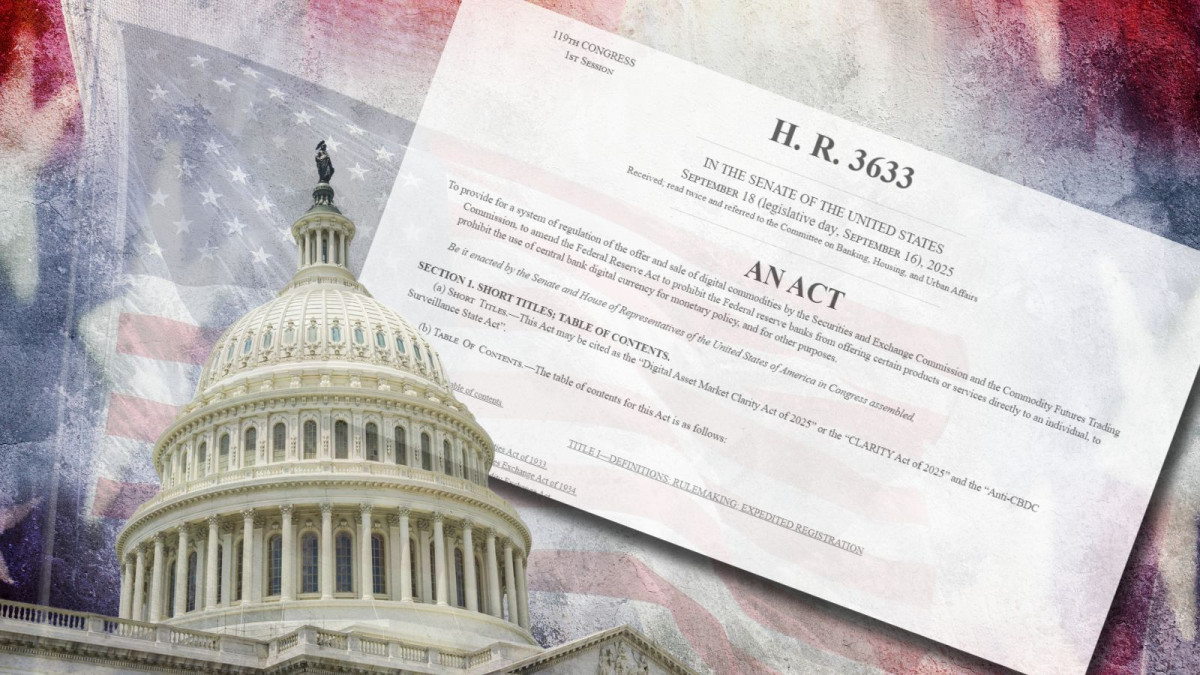
Senators Race to Save the CLARITY Act With Stablecoin Yield Compromise

The room at the Marriott Marquis in Washington was full of community bankers on Tuesday, and Senator Angela Alsobrooks walked straight into the lion's den. Speaking at the American Bankers Association's annual Washington Summit, the Maryland Democrat delivered a message neither side particularly wanted to hear: everyone involved in the Digital Asset Market Clarity Act is going to have to walk away a little bit unhappy.
It was a remarkably candid thing to say in front of 1,400 people who have spent the better part of three months trying to kill the very provision that's been holding up the bill. But Alsobrooks, along with Republican Senator Thom Tillis of North Carolina, is now the central figure in a late-stage push to get the Clarity Act off the Senate Banking Committee floor and into an actual markup hearing before the legislative window closes for good.
The two senators confirmed Tuesday they're actively working on compromise language around stablecoin yield which keeps coming up as the main issue that has stalled what was supposed to be a landmark piece of crypto regulation.
A Bill In Limbo
The Digital Asset Market Clarity Act, or CLARITY Act, was supposed to have its Senate Banking Committee markup in January. That session got pulled at the last minute. The reason was stablecoin yield, specifically, amendments co-sponsored by Alsobrooks and Tillis that would restrict crypto firms from offering interest-like returns to customers who simply hold dollar-pegged digital tokens like USDC or USDT.
Banks had been lobbying hard against any provision that allowed that kind of reward. Their argument, which they've pushed loudly and repeatedly, is that stablecoins offering yield would function like bank accounts without the regulatory obligations of bank accounts. Executives at JPMorgan and Bank of America have cited Treasury Department modeling that suggested banks could lose up to $6.6 trillion in deposits if stablecoin yield programs went mainstream. Their argument is that it would starve the lending market and ultimately destabilize smaller regional banks that are particularly dependent on deposit funding.
The crypto industry dismisses most of that as fearmongering. Coinbase CEO Brian Armstrong called out the banking lobby publicly for what he characterized as anticompetitive blocking tactics and has pulled his support for the bill. In January at Davos, JPMorgan's Jamie Dimon reportedly told Armstrong he was, in quite colorful terms, wrong. The anecdote leaked out and became something of a symbol for just how personal this fight had gotten.
"We absolutely have to have these protections to prevent the deposit flight, but we're going to probably have to make some compromises." — Senator Angela Alsobrooks, D-Md.
The White House Steps In, Then Gets Rejected
By late February, the White House had grown impatient. Administration officials spent weeks brokering what they hoped would be an acceptable middle ground: allow stablecoin yield in limited contexts, particularly for activity tied to payments and transactions, while banning rewards on idle balances that look more like savings accounts. Crypto firms signed off on the framework. The banks did not.
On March 3rd, President Trump went public with his frustration. In a Truth Social post, he wrote that banks should not be trying to undercut the GENIUS Act or hold the CLARITY Act hostage, a shot across the bow that was notable both for its directness and for the fact that it did essentially nothing to move the American Bankers Association. Two days later, the ABA formally rejected the White House compromise anyway.
The March 1st deadline the White House had set for a resolution passed without published compromise text. Prediction markets, which had briefly priced Clarity Act passage at around 80% odds, fell back toward 55% as the stalemate hardened.
What the ABA rejection didn't do, however, is kill the legislation outright. Congress has passed bills over banking lobby opposition before. The question, as analysts and lobbyists have been pointing out all week, is whether there are enough Senate votes to do it again — and whether the calendar allows the time to find out.
Can We Get A Compromise?
The emerging deal that Alsobrooks and Tillis are proposing is a slimmed-down version of what the White House tried. Under the framework being discussed, yield on stablecoin holdings that closely resemble bank deposits would remain prohibited. But rewards tied to specific activities, like using stablecoins for payments or transactions on a given platform, could remain eligible for some form of customer incentive.
Both senators and many crypto advocates actually agree on the premise that pure holding rewards that look and function like savings account interest are a problem. The dispute is over where exactly to draw the line and how to define the categories well enough that neither side can game them after the fact.
Cody Carbone, the CEO of the Digital Chamber, said this week that Tillis has been very receptive to discussions about stablecoin yield and that he's optimistic the industry can get to yes on the bill. Summer Mersinger, the CEO of the Blockchain Association, noted that the White House weighing in on the negotiations and pushing banks to engage in good faith adds important momentum as talks continue.
The banks have maintained, publicly at least, that those assurances aren't enough. Their representatives at the ABA summit this week underlined again what they see as the risks of any yield loophole to their business model. The question of whether a markup hearing happens in late March or gets delayed again, depends entirely on whether Alsobrooks and Tillis can produce language the committee will actually vote on.
Timing Is An Issue
Behind every conversation about the Clarity Act this week is an unspoken anxiety about time. The Senate calendar is tight. Midterm elections are in November, and lawmakers will start dispersing from meaningful legislating sometime around May or June as campaign season accelerates. Unfortunately it seems, Congress prefers to stop working as they try to convince voters to keep them in their jobs. I know, makes perfect sense. If a markup isn't held and a floor vote isn't scheduled by sometime in April, realistically the bill is looking at the next Congress which could be a completely different party in power. And complicating things even more. Despite which party ends up winning the midterms, this could mean another 12 to 18 months of regulatory uncertainty for an industry that has been waiting years for a clear legal framework.
That timeline matters not just for the crypto industry's domestic ambitions, but for its competitive positioning globally. Under the European Union's MiCA framework, stablecoin yield products that are restricted or banned in the U.S. are already legal in European jurisdictions. Coinbase and others have been explicit about the risk that continued regulatory ambiguity in the U.S. will push capital, talent, and product development offshore. Trump made a version of the same argument in his Truth Social post last week, warning that failure would drive the industry to China.
There's also a strategic Bitcoin Reserve angle sitting quietly in the background. According to people familiar with the situation, the Trump administration has determined it needs congressional action to operationalize the planned Strategic Bitcoin Reserve that the president signed an executive order for over a year ago. That creates at least some White House motivation to see the broader Clarity Act process succeed.
What Happens Next
The Senate Banking Committee is targeting a late-March markup. Whether that happens depends on whether the Alsobrooks-Tillis compromise language satisfies enough members to call the vote. If it does, the bill would then need to be merged with a version that already passed the Senate Agriculture Committee on a party-line vote in late 2025. The combined text would require significant Democratic support to clear a full Senate vote, always a tall ask in the current politcal environment and the fact that seven Democratic senators have separately raised concerns about potential conflicts of interest involving senior government officials, including the president himself, who have financial ties to the crypto industry.
Even if the Senate acts, the bill still needs the House, where an earlier version of the CLARITY Act passed committee last year but has yet to reach the floor. The path to a signed law before November is narrow but not impossible. It requires the Senate Banking Committee to move in the next few weeks, the combined bill to hold together politically, and a Senate floor schedule that is packed with little wiggle room.
For the moment, all of it hinges on two senators and a room full of bankers in Washington D.C., trying to decide how much compromise is actually compromise and if they can all agree to leave a bit unhappy about the results for the greater good. Typically the best compromises do make both sides a bit unhappy. In Washington, that usually means the deal is closer than it looks. It also usually means it's harder than it sounds.