#Hyperliquid

Coinbase Reverses Base App Strategy, Brings Back Coinbase Wallet

Coinbase is reversing its Base App strategy and bringing back Coinbase Wallet after falling short of the “everything app” vision it initially had for the platform.
This reversal comes just a year after the exchange rebranded Coinbase Wallet as the Base App during its “A New Day One” event, held in Los Angeles on July 26 last year. The goal of the rebrand was to create an on-chain “everything app” or “super app” for users.

To create the “everything app” platform, Coinbase combined the self custodial wallet features of Coinbase Wallet with social networking, messaging, payments, trading, and creator features, all within the Base App. This created a complete on chain experience where users could trade, create, interact, and discover new apps.
Amid all of this, the Base App strategy failed to gain traction. According to Coinbase CEO Brian Armstrong, it was an experiment that did not quite work, stating that the exchange will focus more on trading while bringing back the self custodial features of Coinbase Wallet.
Remember that Jesse Pollak, the creator of Base, also recently resigned from his leadership role at Base after admitting that his bet on-chain social products this year had failed. According to Pollak, the social side of the on-chain market had completely disintegrated.
The Plan Going Forward
Following the rebrand, Coinbase Wallet will serve as a “test kitchen” for features that are not readily available on the Coinbase cryptocurrency exchange. According to Ryan Kass, Head of Coinbase Wallet Product, Coinbase Wallet will give users access to on chain finance.
Among the first set of asset offerings to be made available to users are perpetual futures powered by Hyperliquid, including more than 290 derivative markets spanning cryptocurrency, equity, and commodity markets.

Grayscale Targets To Corner HYPE ETF Market With Lowest Fee

Grayscale is making a run at the growing Hyperliquid ETF market, filing an amended S-1 registration statement with the Securities and Exchange Commission on Monday that sets a sponsor fee of 0.29% for its Grayscale Hyperliquid Staking ETF, ticker HYPG. The updated filing also confirms the fund will list on Nasdaq, and according to Bloomberg Intelligence ETF analyst James Seyffart, a launch could come as soon as this week.
That fee sits just below the 0.30% charged by 21Shares on its THYP fund, and meaningfully below Bitwise's BHYP, which carries a 0% introductory rate for the first month before jumping to 0.34%. It's a deliberate pricing move, and in a market where basis points can drive significant asset flows, Grayscale is clearly trying to get ahead before the institutional money settles.
Grayscale's entry would make HYPG the third U.S.-listed spot HYPE product, following Bitwise's BHYP and 21Shares' THYP, which launched in May on Nasdaq. Early demand for these funds has been hard to ignore. HYPE-focused ETFs pulled in over $132 million in net inflows in roughly their first month of trading, with zero outflow days recorded during an 8-day streak that coincided with HYPE hitting new all-time highs. For context, that run came while Bitcoin and Ethereum ETFs were actually losing assets.
The 21Shares THYP fund collected more than $5 million within days of its May 12 debut, with Eli Ndinga, the firm's global head of research, describing the early response as evidence of real investor appetite for regulated, round-the-clock exposure to crypto-linked markets. Bitwise's BHYP held more than $40 million in net assets as of late May, while the two funds combined purchased roughly $16 million in spot HYPE in a single 24-hour window as share issuance expanded.
What Is Hyperliquid Anyway?
For people still getting familiar with the name, Hyperliquid is a decentralized derivatives exchange built on its own Layer-1 blockchain. It lets traders open perpetual futures positions entirely on-chain, without the custodial risk of a centralized venue. That 24/7 availability and non-custodial structure has made it increasingly attractive to both retail and institutional traders, particularly as centralized exchange perpetuals volumes dropped roughly 34% in early 2026.
The protocol's native token, HYPE, now ranks among the top 10 cryptocurrencies by market cap, sitting around $16 to $17 billion as of early June. The token has climbed from roughly $20 at the start of 2026 to recent all-time highs above $73, a move that reflects both the platform's surging trading volumes and the structural demand created by HYPE buybacks. Hyperliquid directs nearly all of its trading fee revenue toward buying back and burning HYPE tokens, a mechanism that Grayscale's own research team described as a standout feature in a May 28 report calling the protocol "the breakout success story" of modern crypto.
Hyperliquid logged roughly $2.9 trillion in perpetual futures volume during 2025, and open interest has consistently ranked third globally, behind only Binance and Bybit. At a Bernstein conference in late May, Jeff Sprecher, chief executive of Intercontinental Exchange and owner of the New York Stock Exchange, said the 11-person platform had made a bigger impact on finance than Nasdaq. Whether or not that comparison holds up over time, it signals how seriously traditional finance is paying attention.
Seed Investment and Staking Angle
Grayscale's amended filing isn't just about fees. The firm has also been in discussions to secure a seed investment of around $115 million in HYPE tokens ahead of launch, a figure that would give HYPG substantial early liquidity. The fund's full name, the Grayscale Hyperliquid Staking ETF, suggests it intends to incorporate staking into its strategy, similar to Bitwise's BHYP, which targets staking roughly 70% of fund assets and reports a 2.25% gross staking reward rate. Coinbase is listed as custodian.
The staking component matters because it gives the ETF a yield angle that pure spot exposure does not. With HYPE's token unlock for core contributors worth roughly $684 million scheduled for June 6, near-term price volatility is possible, though analysts note the unlock represents just around 1% of total supply. The protocol's aggressive buyback engine and continued inflows into ETF products remain the more dominant forces.
Fee War Is Just Getting Started
The fee gap between Grayscale, 21Shares, and Bitwise looks small right now, but history suggests that it won't stay there. The same dynamic played out in Bitcoin ETF competition in 2024, where initial fee differentials narrowed sharply as issuers competed for long-term AUM. Grayscale is entering behind competitors who already have first-mover brand recognition in HYPE, so pricing aggressively from day one is arguably the right call.
With Seyffart expecting a launch by the end of the week, HYPG could be live before most investors have had a chance to compare their options. HYPE has generated more institutional interest per dollar of market cap than almost any altcoin this cycle and Grayscale is betting that being the cheapest option in a fast-growing category is enough to corner the market. For now anyway.
HYPE Hits All-Time High as ETF Inflows Hit $53M
Hyperliquid's native token HYPE surged past $62 to reach a new all-time high on Wednesday, posting gains of more than 20% in a single session as a wall of institutional money continued pouring into freshly launched U.S. spot ETFs. The move left most of the crypto market behind, with Bitcoin, Ethereum, Solana, and XRP all sitting deep in negative territory for the year while HYPE climbed more than 100% year-to-date.
The immediate catalyst seemed to be record ETF flow data. U.S. spot Hyperliquid ETFs hauled in $25.5 million in net inflows on Wednesday alone, pushing cumulative flows to $53.5 million within just seven trading days of launch. The figures dwarfed anything the funds had seen in their opening sessions, with Monday drawing only $4.4 million and Tuesday logging $11 million before Wednesday's breakout.
21Shares and Bitwise Lead the Charge
The 21Shares Hyperliquid ETF, trading under the ticker THYP, led Wednesday's haul with $16.7 million in single-day inflows, up sharply from $5.3 million the day before. Bitwise's BHYP fund, which began trading on May 15, added another $8.8 million. Bloomberg senior ETF analyst Eric Balchunas described THYP's volume trajectory as growing "8x over day one," calling it a "really good sign of organic interest."
Analysts noted that on a market-cap-adjusted basis, institutions are absorbing HYPE at a faster clip than they did early bitcoin ETFs, something that would have seemed far-fetched a year ago.
Bitwise made its conviction known in another way, too. The firm said it plans to use 10% of management fees earned from BHYP to purchase and stake HYPE tokens directly on its own balance sheet. That is a very aggressive endorsement from a major asset manager, and Bitwise CIO Matt Hougan has gone even further, publicly labeling HYPE one of crypto's most mispriced assets even after its 77% run this year. Hougan's thesis centers on Hyperliquid's ambition to serve as a "super app" targeting the $600 trillion global asset market rather than just the $3 trillion crypto sector.
Grayscale Accumulates, Goldman Shifts Exposure
The ETF frenzy has drawn in some of the bigger names on Wall Street. Blockchain analytics platforms have flagged wallets linked to Grayscale as having accumulated more than 682,000 HYPE tokens, worth approximately $41.6 million, over the past week. Grayscale is also pursuing regulatory approval for its own Hyperliquid ETF, suggesting the accumulation may serve as pre-positioning ahead of a potential product launch.
Goldman Sachs, meanwhile, disclosed in a recent 13F filing that it had exited its positions in Solana and XRP ETFs and rotated into HYPE treasury via Hyperliquid Strategies. The disclosure added fresh fuel to the narrative that institutional capital is starting to concentrate specifically inside the Hyperliquid ecosystem, a trend that is showing up in relative price performance across the large-cap crypto space.
The Revenue Model That Really Stands Out
Part of what is drawing this level of attention is Hyperliquid's fee structure. The decentralized trading platform funnels 99% of all fees it generates into token buybacks. Annualized, that comes to roughly $618 million in buyback support, according to DefiLlama data. At the token's current market cap of around $13 to $14 billion, that puts the implied buyback yield at a multiple that some analysts think is still too cheap given the platform's growth rate.
Hougan drew a comparison to traditional financial exchanges, noting that Robinhood trades at roughly 37 times earnings and CME at 24 times, neither of which is expanding anywhere near as quickly as Hyperliquid. The argument has gained traction partly because the platform has been quietly broadening its reach. Last week, Coinbase and Circle announced an agreement making Coinbase the official USDC treasury deployer on Hyperliquid, with around 90% of stablecoin reserve yield flowing back to the protocol.
Price Discovery Time?
HYPE's prior all-time high sits at $59.37, set in September 2025. The token pushed passed that today, but settled slightly lower around $57.35, we should see another push at the price soon and the question after is whether the ETF-driven momentum is enough to push it through into fresh record territory or whether a wave of profit-taking will cap the move. The token had fallen to near $20 as recently as January 2026, making this a recovery of more than 150% from those lows in just a few months.
Retail sentiment has also picked up. Chatter on Stocktwits around Hyperliquid moved into what the platform classifies as "extremely bullish" and "extremely high" volume territory, a dynamic that tends to amplify both upside and downside swings. Veteran crypto trader Arthur Hayes this week reiterated a long-term price target of $150 for HYPE, a call that would require roughly a 2.5x move from current levels.
For now, Wall Street seems to be running the show. ETF issuers collectively purchased 2.5 times more HYPE than Hyperliquid's own Assistance Fund acquired and burned over the same period, tightening circulating supply while adding consistent bid-side pressure to markets. We'll see what happens during the next couple of days and if all of this bullish sentiment will push HYPE higher or traders will take profit and wait for another move later.

Blockchain.com Adds Perps Trading to DeFi Wallet

Crypto platform Blockchain.com has rolled out a new perpetual futures trading feature within its non-custodial DeFi wallet, allowing traders to open leveraged positions directly from the wallet.
The new feature, according to Blockchain.com, allows traders to trade perpetual futures directly where their assets are held, eliminating the need to continuously move or convert funds between exchanges and platforms. Traders on Blockchain.com can now access more than 190 crypto markets with leverage of up to 40x, without futures contracts expiring.

The newly launched feature is powered by the decentralized exchange Hyperliquid and is aimed at removing friction associated with derivatives and futures trading.
"We have spent the last decade focused on making crypto easy and borderless for everyone," said Nic Cary, co-founder and vice chairman of Blockchain.com. "We want to make the jump from holding your crypto to actually using it feel instant," he added. "By letting you fund your account with your own Bitcoin while keeping full control of your keys, we are proving that managing your own money can actually be the easiest way to trade."
Some of the features of this new perpetual futures trading offering include real-time pricing, flexible leverage options, and intuitive risk management tools, all designed to operate seamlessly within the wallet interface. Users can open, manage, and close positions while maintaining full control of their private keys.
The Perps Space is Extremely Active
Perpetual futures, which involve speculating on the price of an asset using leverage without directly owning that asset, have grown in recent times.
According to a report from CryptoQuant, perpetual futures trading volume reached $61.7 trillion in 2025, a 29% increase from the previous year and a 232% increase compared to the $18.6 trillion spot crypto trading volume for that year. There has also been an increase in institutions offering perpetual futures trading.
Just this week, prediction market platform Polymarket announced its expansion into perpetual futures trading. Meanwhile, last week, Payward, the parent company of cryptocurrency exchange Kraken, announced it would acquire crypto derivatives platform Bitnomial for up to $550 million, as part of Kraken’s broader strategy to expand into perpetual futures trading.
Hyperliquid Is Quietly Becoming the Future of Trading
Hyperliquid's RWA trading just hit a new all time high, with open interest crossing $2.3 billion on its blockchain which says a lot about how much liquidity is actually flowing into real world assets through a decentralized venue. The platform has quietly become a go-to spot for trading, building apps, and launching tokens all in one place, and the RWA growth is starting to grow rapidly. It’s fees are competing with top blockchains and stable coin companies within crypto.

On March 31, Cointelegraph reported that Ripple Prime expanded its Hyperliquid integration with HIP-3. That means institutions now get seamless on-chain perpetuals on traditional assets like gold, silver, oil, and even compute prices.
This is the kind of bridge that allows retail to hedge oil exposure at 3 a.m on a Sunday when traditional futures are closed. The same rails powering crypto perps now handle real-world commodities that move markets worldwide. It's infrastructure that pulls capital on-chain because the UX finally matches what people expect from a modern trading venue.
On the prime brokerage side, a traditional S&P futures trade runs through six different entities: prime broker, FCM, CME Clearing, and so on with multiple fee layers, T+1 settlement, financing charges, and all the custody overhead that comes with it. On HIP-3, connect your wallet, post USDC margin, trade the perp, and settle instantly on-chain. One fee, self-custody, the smart contract is the clearinghouse, and the blockchain handles custody. It's making large chunks of what they actually do look pretty unnecessary, once the regulatory picture clears up.
Hyperliquid's terms of service explicitly block US users, and enforce this with IP geoblocking, so if you're in the States you'll hit a wall at app.hyperliquid.xyz. The underlying protocol is fully permissionless since it's non-custodial and requires no KYC, but using it from the US still carries real regulatory risk given the CFTC's jurisdiction over leveraged perps. In February 2026 they launched a $29 million Policy Center in D.C. led by Jake Chervinsky, pushing for regulatory clarity around on-chain derivatives. Until something like the CLARITY Act or formal CFTC guidance moves things forward, the restriction is basically the protocol protecting itself while it keeps running 24/7 for the rest of the world. For US builders and investors, the play is watching that policy push closely because when the rails open, the infrastructure is already battle tested and ready to go.
Non-crypto assets on Hyperliquid with HIP-3 markets now cover licensed indices like the S&P 500 and Nasdaq 100, individual equities, commodities, and even compute perps tied to GPU rental rates for H100, H200, and A100 chips through projects like Global Compute Index and Hyperbolic. At peak moments these non-crypto pairs have accounted for up to 45% of total volume, with HIP-3 open interest recently sitting around $1.9 billion.
Late last year, Aster looked like it could replace Hyperliquid with BNB Chain speed, incentives, and early buzz that some called the “Hyperliquid killer.” Hyperliquid has pulled ahead in TVL, open interest, fees, and real value returned to holders. Aster remains solid, yet Hyperliquid’s dedicated L1 edge with tighter spreads, deeper books, and consistent performance has widened the gap.

@CosimoCapital posted a thread making a pretty compelling case for why a future proposal of HIP-4 prediction markets could be a serious unlock. The core problem with most prediction market platforms is thin liquidity and parlays that just don't work because every market is isolated from everything else. Hyperliquid flips that by letting prediction markets tap into the same infrastructure already handling massive perpetuals and commodities volume. "When prediction markets share a unified liquidity pool with perpetual markets," Cosimo wrote, "the parlay math transforms completely." One account, cross-margined across oil perps, equity moves, and event outcomes, all settling instantly. It's not just another betting app. It could end up being "the everything market for global event risk."

This opens up some genuinely interesting scenarios with macro hedges like "if CPI beats and the Fed holds and BTC closes green," or geopolitical risk desks chaining election outcomes to commodity moves, parametric insurance, treasury automation, you name it. Every multi-leg position multiplies fee events too, so five legs means five burns, which turns HIP-4 volume into structural HYPE supply reduction over time. Hyperliquid is pulling in roughly $700 million in annualized trading fees from its perpetuals and spot markets, and around 97 to 99% of it flows automatically into the Assistance Fund, which runs daily HYPE buybacks on a continuous basis. There's constant structural demand and deflationary pressure on circulating supply whether the market is up, down, or sideways.
And yet CEXs still dominate headlines, but Hyperliquid delivers the speed and depth traders love as everything is transparent, on-chain, and runs non-stop. For builders shipping interoperability tools, this is the tool that makes cross-border and cross-asset trading feel native.
Hyperliquid is quietly becoming a 24/7 venue where crypto-native capital meets macro and physical assets without intermediaries. The current restriction is more about protecting the protocol long term than anything else, and the policy push happening in DC is very much part of the plan. Once clarity comes, the floodgates will open and give a much needed update to trading.

Bitwise HYPE ETF Near Launch as SEC Filing Advances
Bitwise Asset Management is inching toward what could be a landmark moment for decentralized finance: the first U.S.-listed spot ETF tied to Hyperliquid's HYPE token. Bitwise filed a second amendment to its registration statement with the Securities and Exchange Commission, finalizing two key details: a ticker symbol, $BHYP, and a management fee set at 0.67%.
For people who watch the ETF market closely, these are typically the last things to be done before an ETF goes live. Bloomberg senior ETF analyst Eric Balchunas said on social media that the addition of a ticker and fee often means a launch could be coming soon, with the amended filing adding to signs the firm is preparing to go live. And when Balchunas speaks on ETF timelines, the market pays attention. He made similar calls ahead of the Bitcoin ETF approvals in early 2024.
The trust's stated goal is to give investors exposure to the value of Hyperliquid held by the fund, with staking rewards as a secondary objective. That staking component is extremely interesting. The fund includes a staking component with roughly 85% of staking rewards retained after fees, and custody will be handled by Anchorage Digital. Bitwise amended its earlier filing to include staking, while 21Shares signaled similar plans in its own proposal, suggesting issuers view staking as a way to improve investor returns beyond simple price exposure.
If approved, shares of the Bitwise Hyperliquid ETF are anticipated to list on NYSE Arca.
The competitive landscape of Hyperliquid ETFs is getting crowded fast. Bitwise was the first of the major issuers to submit a Hyperliquid ETF filing with the SEC, doing so back in September. 21Shares followed a month later with its own, while Grayscale submitted its filing in late March. VanEck, under proposed ticker VHYP, has also confirmed plans to pursue a similar product, bringing the total number of competing HYPE ETF applications to four. If any one of these gets approved first, it will be a precedent-setting moment, the first spot ETF approval for a DeFi-native token built around a decentralized exchange. A huge moment for DeFi.
One day before the latest U.S. filing update, Bitwise Europe launched the Bitwise Hyperliquid Staking ETP on Deutsche Boerse Xetra under the same BHYP ticker. The dual-market play suggests Bitwise is building out a coordinated global product strategy around HYPE.
HYPE is up roughly 65% since the start of 2026, trading around $41.96, despite a tough start to the year for the broader crypto market. Over the past 12 months, the price is also up about 182%. Balchunas noted Bitwise was likely "trying to strike while the iron was hot", a good read given where Bitcoin and Ethereum have traded in the same window.
The protocol's fundamentals have kept pace with that price action. A BitMEX research report published in early April revealed that Hyperliquid captured nearly 30% of the traditional finance perpetual swaps market in Q1 2026, posting 953% quarterly volume growth, driven heavily by commodities like gold and silver. Weekly derivatives trading volume on the platform has topped $50 billion, and the chain has dominated in on-chain revenue relative to other major networks.
The 0.67% fee sits above the 0.20-0.25% range common among Bitcoin spot ETFs, though that premium is a bit justified when you consider the staking yield component and the additional complexity of holding a DeFi-native asset in a regulated wrapper.
The regulatory backdrop has also shifted in a way that's helping all of these filings move faster. Under SEC Chair Paul Atkins, the commission has approved generic listing standards for crypto-based exchange-traded products, eliminating the need for asset-specific Section 19(b) rule change filings in many cases and opening the door for a broader wave of altcoin ETF applications.
The SEC has not yet approved the fund. But between the amended filings, the European product launch, and the queue of competing issuers pushing from behind, Bitwise has every incentive to get this across the finish line sooner rather than later. It will be interesting to watch the growing number of products beyond BTC and ETH to see what area of the crypto sector may be interesting to ETF issuers and the investors that use them.

X User Loses $24 million in a Violent Crypto Attack

An X user with the username "Sillytuna" has reportedly lost $24 million in Aave Ethereum USDC (aEthUSDC) in an attack that involved a combination of violence, sexual assault, weapons, and threats to life.

"Bruised, held off while I could, but can't do that much with axes over your hands and feet," Sillytuna wrote. The user further stated that he was, at this point, done with crypto. In his words, "And now... definitely out of crypto ****ers."
While the matter has already been reported to law enforcement, no official statement has been issued by the authorities. However, the X user has announced a 10% bounty for whoever helps recover the stolen funds.

How the Crypto Community Reacted
Shortly after the news went viral, the crypto community reacted with mixed feelings, with many commiserating with the user over their loss. Some also raised awareness about the deplorable state of security in the United Kingdom. Apparently, the victim is a UK resident.

Amid the sympathy from the global crypto community, some, however, doubted the authenticity of the victim's story.
According to YokaiCapital, an X user, the victim had not posted anything about crypto before. He also alleges that the victim's account appears to have been bought recently.
"He will probably shill the coin at some point or say that he will take donations from the coin," YokaiCapital went on to write.
However, the victim has denied allegations that he intentionally wanted to trend and claims the stolen funds were long-term holdings.
How the Attackers Moved the Stolen Funds
Tracking the stolen funds, blockchain analytics firm Arkham Intelligence said that the attackers moved the funds across Layer 2 networks, Bitcoin, and Monero, obviously to evade trail.

Roughly $20 million of the stolen funds were stored in two Ethereum addresses as DAI, a stablecoin on the Ethereum network, while $2.48 million was bridged to USDC on Arbitrum.
Arkham reported that the attackers sent $2.47 million to Hyperliquid through 19 separate Wagyu accounts, which were used to convert the funds to Monero (XMR).
The attackers also bridged $1.1 million to the Bitcoin blockchain using LiFi, noting that 0.5 BTC was deposited into a mixing service, Arkham added.

Ripple Integrates Hyperliquid for Institutional DeFi Access

Ripple is pushing further into decentralized markets.
The company said it will support Hyperliquid through Ripple Prime, its institutional brokerage platform, giving professional trading firms access to on-chain derivatives without having to interact directly with DeFi infrastructure.
For Ripple, the move is about meeting institutional demand where it already exists. Many hedge funds and asset managers want exposure to decentralized markets, but they still operate inside traditional risk, margin, and reporting systems. Ripple Prime is designed to sit between those worlds.
With Hyperliquid now supported, Ripple Prime clients can trade decentralized perpetual futures while managing exposure alongside more familiar products like FX and cleared derivatives.
What Changes for Institutions
The biggest shift here is not access, but structure.
Instead of setting up wallets, managing smart contracts, or splitting capital across multiple venues, institutions can route trades through Ripple Prime and maintain a single counterparty relationship. Margin, collateral, and reporting remain centralized, even though execution happens onchain.
That matters for firms that are comfortable trading derivatives but not interested in rebuilding their internal processes for DeFi. It also reduces capital inefficiencies that come from isolating on-chain positions from the rest of a trading book.
This is not retail access. It is aimed squarely at professional desks.
Why Hyperliquid Keeps Showing Up
Hyperliquid has become one of the more active decentralized derivatives platforms in crypto, largely because it does not feel like most DeFi exchanges.
It runs an on-chain order book instead of an automated market maker, which allows for tighter spreads and execution that better suits high-volume traders. Perpetual futures on major assets make up most of the activity, with new markets continuing to roll out.
That combination has drawn liquidity, which is still the hardest thing to build in decentralized markets. For institutions, liquidity tends to matter more than ideology.
Ripple’s support puts Hyperliquid in front of firms that may not have considered trading on a decentralized venue before.
Part of a Bigger Institutional Shift
This announcement fits into a wider trend across crypto infrastructure.
Firms that serve institutions are no longer treating DeFi as a separate category. Instead, they are trying to make it another venue, similar to how traditional desks access exchanges, clearing houses, or OTC markets.
Ripple’s approach reflects that thinking. The company is not asking institutions to learn DeFi. It is packaging DeFi in a way that looks familiar enough to be usable.
That model is starting to show up more often, especially as tokenized assets and on-chain credit products gain traction.
What It Means for XRP Markets
For XRP, deeper on-chain liquidity and derivatives access matter.
Derivatives tend to pull in more sophisticated traders, which can tighten spreads and improve price discovery over time. Connecting XRP-related markets to high-performance decentralized venues adds another layer to its institutional story.
It also shows how fragmented crypto markets are slowly being stitched together, with execution happening in one place and risk managed somewhere else.
Risks Are Still There
Decentralized derivatives come with obvious risks.
Leverage, liquidations, and volatility can move fast, and regulatory attention around perpetual futures is not going away. Even with a prime brokerage layer in front, institutions are still exposed to market dynamics that can get messy.
Ripple’s platform can simplify access and controls, but it does not remove those risks.
The Bottom Line
Ripple’s Hyperliquid support is not a flashy consumer announcement. It is infrastructure work.
It points to a future where on-chain markets are accessed the same way institutions already access everything else, through familiar systems, familiar counterparties, and familiar controls.
Whether that future scales depends on liquidity, regulation, and market demand. But for now, Ripple is clearly positioning itself to be part of that next phase.

Hyperliquid Begins Team Token Unlock With First HYPE Distribution

Hyperliquid has taken its first visible step in releasing tokens to its team, unstaking around 1.2 million HYPE ahead of a planned distribution in early January. While the move was always part of the project’s vesting plan, it is the first time those mechanics have shown up clearly on chain, which is why it caught the market’s attention.
The tokens were unstaked in late December and are expected to land with contributors on January 6. According to the team, this is not a one-off event. Future releases are set to follow a monthly rhythm, with additional tokens unlocking on the sixth day of each month as vesting milestones are reached.
On its own, the amount is relatively small. Still, in crypto, any unexpected token movement tends to raise questions, especially when it involves team allocations.
Why the Unstake Raised Eyebrows
The initial on-chain activity sparked speculation that Hyperliquid was preparing a much larger release. Some traders circulated figures suggesting that close to 10 million tokens could hit the market at once, a scenario that would have meaningfully increased circulating supply.
That interpretation turned out to be off the mark. The team later clarified that the unstake was simply a procedural step tied to an existing vesting schedule, not an acceleration or change in plans. Once that context became clearer, concerns eased, though the episode highlighted how quickly uncertainty can spread when token movements appear without explanation.
For now, the unstaked tokens remain part of the team allocation. They are scheduled to be distributed to individual contributors in early January rather than sold or transferred immediately.
What Hyperliquid Is Building
Hyperliquid is a trading-focused crypto project that has taken a different route than most decentralized platforms. Instead of launching a general-purpose blockchain and layering applications on top, the team built a high-speed perpetual futures exchange first, then designed a custom Layer-1 network around it. Hyperliquid remains the largest decentralized perps DEX by volume.
The exchange has been the main draw so far. It offers deep liquidity, advanced order types, and execution speeds that feel closer to centralized trading venues than what most on-chain platforms can deliver. That performance focus has helped Hyperliquid attract active traders, including professional market makers who typically avoid decentralized exchanges due to latency and reliability issues.
To make that possible, Hyperliquid runs its own blockchain rather than relying on shared infrastructure. The network is optimized specifically for financial activity, prioritizing throughput and consistency over broad flexibility. It is not trying to support every type of application, but it does aim to do trading extremely well. The model has worked. Hyperliquid has generated almost $1B in fees, with another $843B in total revenue in 2025.

How the Token Supply Is Structured
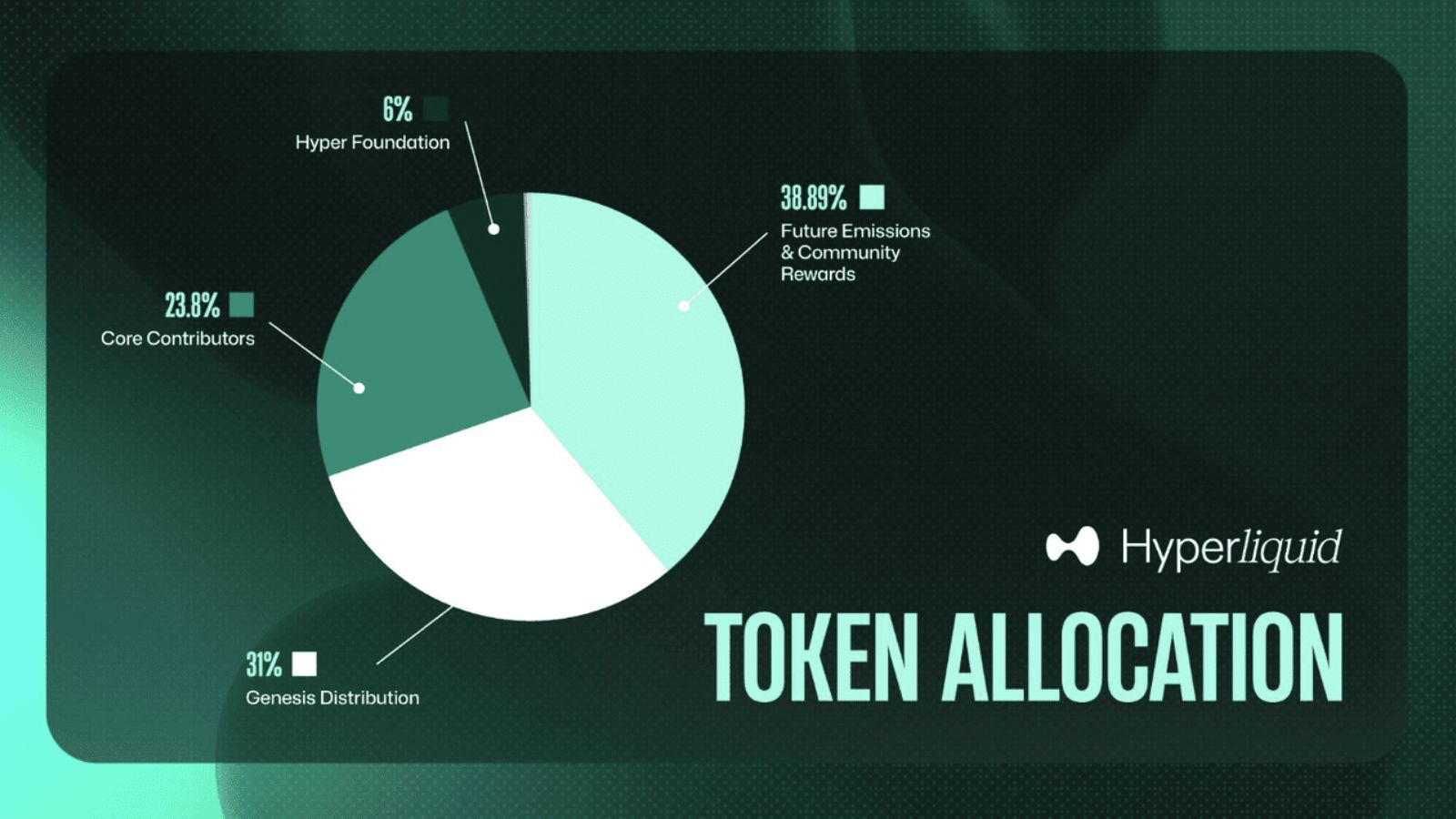
HYPE has a fixed supply of one billion tokens. The protocol did not raise money from traditional venture capital firms and instead distributed a large share of its token supply directly to users through a genesis airdrop. That decision helped build early loyalty, while leaving the team with a significant role in guiding the protocol as it grows
About 24 percent is allocated to core contributors, with the rest split between community rewards, the initial user airdrop, and funds set aside for ecosystem development and operations.
Team tokens were locked at launch and are subject to a multi-year vesting schedule. Earlier unlocks affecting developers and contributors began in late 2025, but the bulk of the allocation remains locked and will continue to enter circulation gradually over time.
The January distribution represents a small slice of the total team allocation. Even so, these releases are closely watched because they incrementally increase circulating supply, which can influence liquidity and price dynamics.
How the Market Has Responded
So far, the reaction has been relatively calm. HYPE has continued trading within a fairly tight range, suggesting that traders are treating the unlock as expected rather than disruptive.
Market observers often point out that predictable vesting schedules tend to be easier for investors to digest than irregular or poorly communicated releases. By committing to a consistent monthly timeline, Hyperliquid appears to be trying to set clearer expectations around future supply changes.
That does not mean future unlocks will be ignored. Larger tranches and shifts in broader market conditions could still shape sentiment as time goes on.
What to Watch Going Forward
As more team tokens vest in the months and years ahead, attention will likely shift toward how those tokens are handled. Whether contributors hold, stake, or sell their allocations will matter, particularly as Hyperliquid continues to expand its trading and blockchain infrastructure.
For now, the first team distribution serves as a reference point. It gives the market a clearer sense of how Hyperliquid plans to manage token releases while continuing to scale its platform. The longer-term test will be whether that transparency holds as the numbers grow and expectations rise.
Stay Connected
You can stay up to date on all News, Events, and Marketing of Rare Network, including Rare Evo: America’s Premier Blockchain Conference, happening July 28th-31st, 2026 at The ARIA Resort & Casino, by following our socials on X, LinkedIn, and YouTube.

Solana Co-Founder Anatoly Yakovenko Reveals Percolator, a New Perp DEX Design
Anatoly Yakovenko, co-founder of Solana, has introduced a blueprint for a decentralized perpetual futures exchange called Percolator. The design was released publicly and is positioned as a potential Solana-native alternative to established platforms such as Hyperliquid and Aster.
A Solana-Native Exchange Concept
Percolator is described as an “implementation-ready” framework for a perpetual futures DEX that runs directly on Solana. Unlike centralized exchanges, it would rely on a sharded architecture to distribute trading activity across multiple “slabs.” Each slab acts as an independent engine, handling its own set of markets in parallel.
A router layer would manage collateral, portfolio margining, and the routing of trades between slabs. The goal is to achieve low-latency execution at scale, reduce congestion during high demand, and allow users to retain custody of their assets while trading.
Yakovenko has suggested that this design could enable centralized-exchange-level speeds within a fully decentralized structure. If implemented, it would represent a step forward in marrying the performance advantages of Solana with the growing demand for decentralized derivatives.
Addressing a Market Gap
Perpetual futures have become one of the most active areas of crypto trading, often accounting for a large share of overall derivatives volume. Platforms such as Hyperliquid and Aster have attracted significant activity, but Solana has not yet established a dominant native alternative in this space.
Percolator is seen as a way to change that. By offering a blueprint for a scalable and efficient perp DEX, the design could strengthen Solana’s DeFi ecosystem and attract more sophisticated traders. It would also broaden the network’s use cases beyond its reputation for high-speed transactions and meme coin speculation.
Open Development Approach
One notable feature of Yakovenko’s announcement was the decision to publish the design openly on GitHub. Rather than launching Percolator as a closed project, he invited developers to experiment, adapt, and build upon the code.
This open-source approach aligns with Solana’s broader strategy of encouraging community-driven innovation. It positions Percolator not just as a single potential product, but as a framework that could inspire multiple teams and projects across the ecosystem.
Challenges and Risks
Despite the enthusiasm, there are several challenges. Yakovenko himself has downplayed expectations, noting that the release was experimental and not necessarily a commitment to launching a production-ready DEX.
Regulatory pressure is another factor. Perpetual futures are leveraged products that have drawn scrutiny from regulators worldwide. Operating such markets in a decentralized structure could bring legal uncertainty, especially if they attract high volumes.
Technical risks also remain. Building and maintaining a sharded DEX with multiple trading engines introduces complexity, and it is unclear how the design would perform under sustained high-volume trading. Competition is also fierce, with other perp DEXs already establishing liquidity and user bases.
The Outlook for Solana
Even with these risks, Percolator underscores Solana’s ambition to expand into more advanced financial infrastructure. The release highlights the network’s strengths in throughput and efficiency, while showing a willingness to experiment in areas that are becoming increasingly important to crypto markets.
If the concept develops into a working platform, it could elevate Solana’s role in decentralized finance and attract a new wave of derivatives traders. Even if it does not, the blueprint has already sparked discussion about what is possible when high-performance blockchains are combined with open-source collaboration.
Conclusion
Percolator is not yet a product, but it is a statement of intent. It reflects Yakovenko’s ongoing focus on technical experimentation and Solana’s drive to compete at the highest levels of decentralized finance. Whether it emerges as a functioning exchange or remains a reference design, it signals a move toward more complex, scalable infrastructure that could shape the future of on-chain derivatives.