#cardano ecosystem
Midnight Mainnet Is Live, A New Era Of Blockchain Begins

This is the launch that the blockchain industry has spent years waiting for. The Midnight network has announced that mainnet is live, and with this groundbreaking moment, something that no previous generation of blockchain has managed to deliver: end-to-end programmable privacy that is flexible, enforceable, and built for the real world. After years of research, development, and collaboration involving scientists, engineers, developers, and institutional partners across the globe, the fourth generation of blockchain technology is officially here.
The timing could not feel more significant. Within days of the mainnet going live, Midnight confirmed what may be the most consequential real-world blockchain deal announced in years. Monument Bank, a Bank of England-regulated institution serving over 100,000 clients with more than 7 billion pounds in savings deposits, announced plans to tokenize up to 250 million pounds of retail customer deposits directly on the Midnight network. Those deposits remain interest-bearing, fully backed in sterling, and protected under the UK's Financial Services Compensation Scheme. It is the first time a UK-regulated bank has ever moved retail deposits onto a public blockchain, and it happened at the exact moment Midnight's mainnet came to life.
Charles Hoskinson, founder of Input Output Group and the visionary behind Midnight and Cardano, was candid about the scale of what this represents. Writing on X following the Monument announcement, he called it "one of the largest deals we've ever done" and said it could bring "hundreds of millions to billions of TVL" to the Midnight ecosystem. More striking is what Monument Technology plans to do next: offer the same tokenized deposit infrastructure to other banks through a Banking-as-a-Service platform.
A New Generation of Blockchain, Built for the Real World
To understand why this launch matters so much, it helps to understand what came before it. Hoskinson has framed Midnight's arrival in the clearest possible terms: Satoshi gave us sound money, Ethereum gave us programmability, Cardano brought interoperability and governance, and Midnight "gives us our identity and privacy back." Each generation solved the limitations of the last. Midnight is solving the biggest one remaining.
The world's value has stayed off-chain for a reason. Trillions of dollars in real estate, private equity, debt, and currency cannot be digitized on transparent public ledgers without exposing the sensitive data that institutions and individuals depend on keeping private. Midnight changes that equation fundamentally. Its hybrid ledger architecture combines public and private data, allowing applications to process and verify sensitive personal, financial, and commercial information without ever exposing it to the network. Zero-knowledge proofs are generated locally on a user's device and submitted for validation, meaning identity, credit, and compliance verification can all happen on-chain with the underlying data never leaving the user's hands.
The tokenomics are equally well-designed for mainstream adoption. Midnight operates on a dual-component model: NIGHT, the governance and utility token, and DUST, the renewable resource used to power transactions. NIGHT holders generate DUST over time, and developers can hold NIGHT to cover transaction costs for their users entirely. For the first time, end-users can interact with a blockchain-powered application without ever needing to hold or even be aware of a crypto token. That is not a small thing. That is how you build for a billion users.
The caliber of institutions that signed on to run Midnight's founding federated nodes is genuinely unprecedented for a blockchain launch. Google Cloud, MoneyGram, Vodafone's Pairpoint division, eToro, Blockdaemon, Bullish, Worldpay, AlphaTON Capital, and Shielded Technologies are all running live infrastructure on the Midnight network right now. This is not a list of logos on a website. These entities are producing blocks on a live, production blockchain.
Consider what each of those names brings. Blockdaemon secures over 110 billion dollars in digital assets across networks globally. MoneyGram operates payment infrastructure spanning more than 200 countries and territories, and is already exploring how private on-chain payments can flow across that entire footprint. eToro carries more than 35 million registered users. Google Cloud brings enterprise-grade infrastructure and Confidential Computing capabilities backed by Mandiant security monitoring. Hoskinson put it plainly at launch: "For the first time, organisations of this scale have committed not only to running critical infrastructure but also to building and deploying live applications on a public network."
The rollout is structured in phases, which reflects how seriously the Midnight Foundation is taking stability and security at this stage. The current Kukolu phase establishes the operational foundation. The Mohalu phase, targeted for Q2 2026, will bring in Cardano stake pool operators and activate the DUST Capacity Exchange, beginning the move toward broader decentralization. Full cross-chain interoperability with networks including Ethereum and Solana is planned for the Hua phase in Q3 2026. This is a network being built to last, not rushed to market.
Privacy That Works With Compliance, Not Against It
What makes Midnight's privacy architecture so significant is that it has been designed from the ground up for regulated environments. This is not a privacy coin. Midnight is not trying to make transactions untraceable. What it delivers is something far more powerful for institutional adoption: the ability to prove facts about data without revealing the data itself. KYC status, solvency, eligibility, and settlement completion can all be verified on-chain while the underlying customer records remain completely shielded from public view.
The scale of the opportunity this unlocks is staggering. Aleo's 2025 Privacy Gap Report found that approximately 1.22 trillion dollars in institutional stablecoin transaction volume currently moves through on-chain rails, with just 0.0013% of that settling on privacy-enabled infrastructure. The gap has not existed because institutions lack interest. It has existed because no compliant privacy tooling was available. Midnight is the tooling. The Monument deal is the proof.
Midnight Foundation President Fahmi Syed captured the broader vision at launch: "When privacy is built into the system itself, it becomes possible to bring real-world activity and assets on-chain without exposing the underlying data, unlocking entirely new forms of economic value that were previously impossible on transparent infrastructure." That is not marketing language. It is a description of what the Monument deal already demonstrates in practice.
The Community Behind the Network
Midnight arrived at its genesis block with one of the broadest token holder bases in blockchain history already in place. The Glacier Drop distribution attracted participants from across eight major blockchain ecosystems, with over 3.5 billion NIGHT tokens claimed. A second phase, the Scavenger Mine, drew over 8 million unique wallet addresses, setting an industry record for distribution volume. NIGHT is now live on Kraken, OKX, Binance, Bitpanda, and a growing list of exchanges, and gained around 5% in the days immediately leading up to the mainnet launch as the momentum built.
The developer community has also been building with real urgency. The Midnight Summit hackathon in November 2025 brought together over 120 builders working on privacy applications across healthcare, AI, governance, and finance. Smart contract deployments on the Preprod network surged 1,617% in November alone. Midnight's Compact smart contract language, a domain-specific language built on familiar TypeScript syntax, is already enabling developers to build ZK-powered applications without needing years of cryptographic expertise. The technical barrier to building on Midnight is lower than it has ever been for any privacy-focused network.
There is a real sense across the space that something genuinely new has arrived. Hoskinson's generational framing resonates because the history backs it up. Bitcoin, Ethereum, and Cardano each opened doors that the previous generation could not. Midnight opens the door to the world's real economy, the trillions in assets that have remained off-chain because no infrastructure could protect them adequately. That door is now open. The genesis block has been written, the institutional partners are live, the first bank deal is signed, and the ecosystem is just getting started. The dawn of Midnight is here.
Cardano Founders Unite to Accelerate Ecosystem Adoption in 2026
For years, the Cardano ecosystem has been defined by its methodical engineering, its scientific foundations, and its strong governance ideals. What has been missing is a moment of unmistakable unity. A moment where the core entities behind Cardano chose collaboration over friction.
That moment has arrived.
The three founding organizations of Cardano, Input Output, EMURGO, and the Cardano Foundation, have aligned behind a single historic proposal that aims to prime Cardano for explosive growth in 2026. Joined by newer power players such as Intersect and the Midnight Foundation, these groups have demonstrated what the ecosystem has long hoped to see. True unity. Shared vision. Coordinated action.
This proposal represents something bigger than a budget request. It signals a turning point for Cardano. A signal that the ecosystem is ready to build at a pace and scale that rivals any top blockchain in the world.
A Unified Front: The End of Fragmentation and the Start of Acceleration
For years, the three founding entities worked within different mandates. Engineering. Commercial adoption. Standards and ecosystem development. These missions often created different priorities and, at times, different strategies.
But Cardano has reached a stage where the market is demanding more. DeFi is global. Stablecoins dominate daily volume. Analytics, oracles, bridges, custody, and cross chain liquidity are not luxuries. They are requirements.
Rather than operating independently, these institutions have chosen a coalition approach. They came together, aligned their agendas, and built a unified path forward. That level of alignment sends a loud message to builders, investors, institutions, and the entire crypto industry.
Cardano is ready to scale.
What the Proposal Delivers: Five Engines of Ecosystem Expansion
The proposal focuses on five integrations that can transform Cardano from a technically impressive chain into a globally competitive financial network. Each one has proven transformative on other blockchains. Now, Cardano is preparing to join that level of capability.
1. Tier One Stablecoins
Other chains became financial powerhouses because they onboarded major stablecoins like USDC and USDT. Ethereum, Solana, Avalanche, Base, and Arbitrum all exploded because stablecoins unlocked liquidity, trading volume, and on chain payment flows.
Imagine Cardano gaining a robust USDC market, deep liquidity pairs across DEXs, stablecoin lending markets, RWA settlement, and enterprise treasury flows. This single integration could ignite a new era of DeFi activity on Cardano.
2. Institutional Custody and Advanced Wallets
Chains with strong custody infrastructure consistently attract institutional capital. Ethereum and Solana are prime examples, with custody solutions enabling fund participation, corporate treasury adoption, and compliant trading.
If Cardano secures similar institutional grade custody, it could open the door for asset managers, fintechs, and enterprises that want exposure to ADA, RWAs, and Cardano based financial products.
3. High Quality Analytics and Data Infrastructure
Blockchains like Ethereum, Solana, and Polygon benefit from real time dashboards, compliance grade monitoring, developer analytics, TVL trackers, and chain wide intelligence.
By building similar analytics layers, Cardano could unlock a clearer view of economic activity, better security tooling for protocols, and the transparency institutions require before deploying serious capital. Data infrastructure is the backbone of a mature economy.
4. Cross Chain Bridges
Look at the explosive growth of chains that integrated secure and trusted bridges. Solana saw massive inflows through Wormhole. Avalanche gained traction through its bridge with Ethereum. LayerZero supercharged cross chain liquidity across dozens of ecosystems.
Cardano gaining safe and battle tested bridging would mean:
-
Capital from Ethereum, Solana, and Base can flow into ADA DeFi
-
New users can port assets easily
-
Interoperability with RWAs, gaming, and AI networks becomes seamless
Bridges remove isolation. They unlock global liquidity.
5. Institutional Grade Oracles
DeFi is only as strong as its data feeds. Chains that integrate major oracles such as Chainlink gain:
-
Secure price feeds for lending
-
Real world data streams for RWAs
-
Automation for smart contracts
-
Enhanced reliability for stablecoins
With similar oracle support, Cardano could unlock lending markets, derivatives, insurance protocols, prediction systems, and enterprise grade financial applications.
Why These Integrations Matter: Cardano Can Finally Go Toe to Toe with Top Chains
Other ecosystems grew because they built essential infrastructure first. That infrastructure created liquidity, utility, and developer confidence. Now Cardano has the chance to adopt these proven components and apply them through its unique strengths such as eUTxO, formal verification, governance, and sustainability.
These integrations could allow Cardano to:
-
Attract billions in stablecoin liquidity
-
Distribute RWAs across compliant channels
-
Secure institutional partnerships
-
Enable cross chain applications
-
Launch high throughput financial products
-
Boost developer growth across sectors
-
Increase DeFi TVL significantly
-
Expand into global payments and fintech
Cardano could leap from an underutilized giant to a competitive financial layer in the crypto economy.
A Catalyst for 2026 and Beyond
The alignment behind this proposal proves that Cardano’s leadership is no longer content to wait for growth to emerge organically. The coalition is making a clear and coordinated move to build what the ecosystem needs most.
If approved, these integrations could mark the beginning of Cardano’s next era. One defined by liquidity, adoption, interoperability, and enterprise use cases. One where the community sees rapid, tangible progress instead of slow, incremental evolution.
This is the moment many in the ecosystem have been waiting for. A unified front. A strategic plan. A vision shared by founders. And a roadmap that could position Cardano as one of the most capable and competitive blockchains in the world.
2026 could be the year Cardano becomes unstoppable.
Stay Connected
You can stay up to date on all News, Events, and Marketing of Rare Network, including Rare Evo: America’s Premier Blockchain Conference, happening July 28th-31st, 2026 at The ARIA Resort & Casino, by following our socials on X, LinkedIn, and YouTube.
Cardano SDK for Unreal Engine 5 Is Now Live and Free to Use
Cardano SDK for Unreal Engine 5 Is Now Live and Free to Use
Flux Point Studios has officially released the Cardano SDK for Unreal Engine 5, giving developers the tools to merge blockchain technology with high-end gaming. The new software development kit brings native support for ADA payments, NFTs, wallet connections, and on-chain interactions directly into Unreal Engine 5. Even better, it is completely free to use.
This release marks a major milestone for both Cardano and the broader Web3 gaming ecosystem, offering a fast, secure, and accessible way for developers to build games that integrate real ownership and digital economies.
A New Era of Game Development on Cardano
The SDK allows Unreal Engine developers to easily plug blockchain functionality into their games without the need for complex code or external infrastructure. Teams can connect Cardano wallets, process ADA payments, mint and transfer NFTs, and build full in-game economies with just a few simple integrations.
Flux Point Studios designed the SDK to be fully compatible with Unreal Engine 5’s most powerful features. Developers can now build visually stunning, AAA-quality experiences with built-in Web3 functionality. It bridges the gap between next-generation visuals and real blockchain ownership.
Key Features for Developers
ADA and Wallet Integration
The SDK lets players use their ADA wallets directly inside the game, allowing for seamless payments, asset transfers, and wallet logins.
NFT Creation and Ownership
Developers can mint and manage Cardano NFTs that represent in-game assets such as skins, weapons, or collectibles. Players gain true ownership of their digital items, which they can trade or sell freely.
Easy Setup and Full Documentation
The SDK includes complete Unreal Engine integration and user-friendly documentation. Developers can start testing blockchain features in minutes, using either Cardano’s test network or mainnet.
Community Alignment
Flux Point Studios is introducing a community-driven approach that ensures the SDK’s success benefits Cardano’s growth. The goal is to give more power to developers while strengthening Cardano’s presence in the gaming space.
Why This Release Matters
This launch is more than a technical update. It represents a real step forward for Web3 gaming adoption and a proof of concept for Cardano’s potential in mainstream game development. Until now, integrating blockchain into major game engines often required complex backend work. The new SDK removes those barriers, allowing creators to focus on gameplay, design, and storytelling while still taking advantage of blockchain utility.
The integration of Cardano with Unreal Engine 5 also strengthens the network’s reputation as a developer-friendly, energy-efficient, and scalable platform. It places Cardano among the top blockchain ecosystems pushing gaming innovation forward.
The Future of Gaming on Cardano
With the SDK now live, attention will shift toward early adopters and studios that start using it to build interactive worlds. These projects will define what blockchain gaming can become when advanced technology meets creativity.
This launch signals the beginning of a new era in gaming, one where players own their assets, creators earn directly from their communities, and games evolve into living economies rather than closed systems.
The combination of Unreal Engine 5’s power and Cardano’s efficiency opens the door for immersive worlds with real-world value and cross-platform interoperability.
Final Thoughts
Flux Point Studios’ release of the free Cardano SDK for Unreal Engine 5 is a landmark moment for developers everywhere. It levels the playing field, gives creators direct access to powerful blockchain tools, and reinforces Cardano’s position as a developer-first ecosystem.
For studios, this is an opportunity to join the next generation of gaming where blockchain meets cinematic-quality experiences. For players, it is a glimpse into the future of true digital ownership and innovation.
The boundary between traditional and blockchain gaming just disappeared, and Cardano is now leading the charge. You can download the SDK at https://fluxpointstudios.com/cardano-ue-sdk.
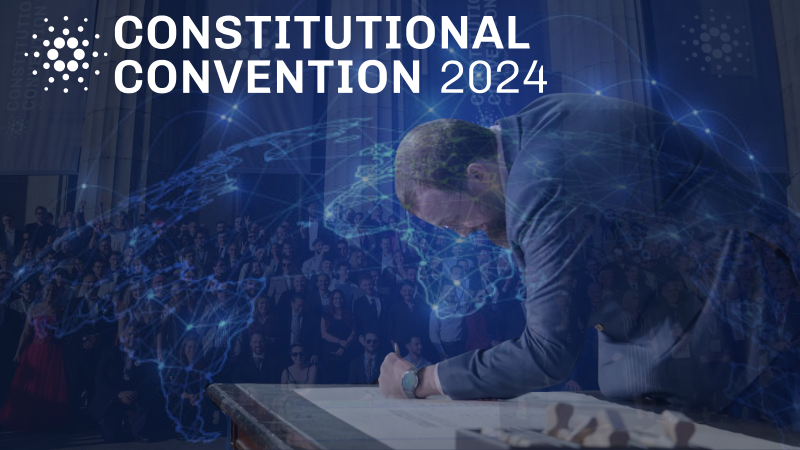
The Cardano Constitution: Building a Decentralized Future in Buenos Aires
The Cardano Constitution: Building a Decentralized Future in Buenos Aires
The recent gathering in Buenos Aires marked a significant milestone for Cardano, as the global community came together to draft the Cardano Constitution—a framework poised to guide the ecosystem’s decentralized governance. This event was not merely about drafting a document; it was a celebration of the progress, collaboration, and shared vision that define the journey that is Cardano.
The End of the Beginning
“Welcome to the end of the beginning,” opened Charles Hoskinson, the founder of Cardano. His words resonated deeply with the audience, encapsulating the transition from an era of building foundational technologies to one focused on community-led governance. For over a decade, Cardano has evolved through distinct eras, each represented by phases like Byron, Shelley, Goguen, Basho, and Voltaire. With the technical roadmap largely complete, the baton has now been passed to the community to shape the future.
A Dream Realized
The gathering in Buenos Aires was symbolic. Flags from across the globe adorned the venue, representing the diverse nations that contribute to Cardano’s mission. Hoskinson’s reflections emphasized that behind every nation, every building, and every institution, there were founders—individuals who dared to dream and took action. Similarly, Cardano’s journey has been built on the dreams and efforts of its global community.
“It was a dream I had for a long time,” Hoskinson shared. “Everything in the world that we have—this building we stand in, the governments we live under, the languages we speak—had a founder. It came from somewhere, from some idea, big or small.”
Overcoming Challenges Together
Cardano’s evolution has not been without challenges. The past decade saw moments of triumph and setbacks. From the launch of smart contracts to navigating global crises like the COVID-19 pandemic and economic downturns, the ecosystem persevered. Hoskinson candidly reflected on the hurdles, acknowledging both the mistakes made and the lessons learned.
“The antidote to mistakes isn’t pity or deeper self-reflection,” he said. “It’s realizing that in something as complicated as this, the only way forward is to make it everybody’s problem.” This ethos underscores the importance of decentralized governance, where collective intelligence and collaboration drive progress.
The Cardano Constitution: A Collaborative Vision
The drafting of the Cardano Constitution is a pivotal step in the Voltaire era, which focuses on governance and sustainability. This document aims to provide a set of principles and rules that the community can adapt and evolve over time. Unlike traditional systems that rely on centralized decision-making, Cardano’s governance model is built on equality and inclusivity.
“Every person behind those flags could potentially be a person in our ecosystem,” Hoskinson noted. “And all that makes them special can be ours, can be part of this, and make us better.”
The Constitution is not just about establishing rules; it’s about fostering a culture of collaboration, accountability, and innovation. It serves as a reminder that governance is not static but a living, breathing process that evolves with the needs and aspirations of the community.
A Symbol for the Future
The Buenos Aires event highlighted the transformative potential of collective action. Hoskinson drew parallels to historic achievements, such as humanity’s journey from the Wright brothers’ first flight to landing on the moon. These milestones were achieved through collaboration and determination—qualities that define the Cardano community.
“We are truly the stewards of the future,” Hoskinson proclaimed. “If we don’t like the way the world works, we’re not going to complain about it; we’re just going to change it.”
The Road Ahead
While the drafting of the Constitution is a significant achievement, it is only the beginning. The next steps involve onboarding more members, addressing diverse perspectives, and ensuring that the governance model scales effectively. Hoskinson emphasized the importance of continuing this journey with inclusivity and dedication.
“My roadmap’s over; your roadmap has begun,” he concluded. “The Cardano community’s roadmap will be a reflection of the culture that is here and not yet represented. Together, we can keep moving forward and show the world what is possible.”
The Cardano Constitution is more than a document—it is a testament to the power of unity, resilience, and shared purpose. It is a blueprint for a decentralized future, driven by a community determined to make the world a better place.