#Geopolitics
U.S. Seizes $1B in Crypto From Iran

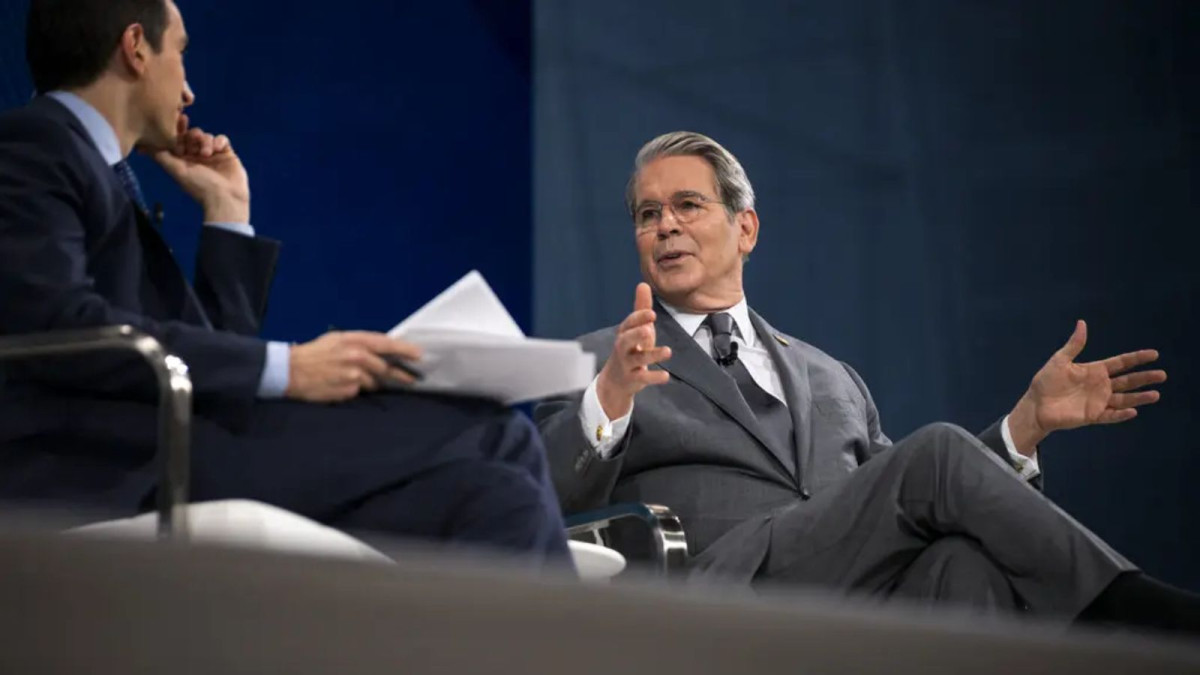
Speaking at the 2026 Reagan National Economic Forum in Simi Valley, California, Treasury Secretary Scott Bessent told Fox Business host Larry Kudlow that the United States has seized roughly $1 billion worth of cryptocurrency from entities linked to Iran's military since conflict broke out in February.
"We just outright grabbed the wallets," Bessent said. "Some of them may be typing in right now, and they might not have realized that their wallet had been grabbed."
Operation Economic Fury
The seizures Bessent referenced didn't happen overnight. They are the product of a campaign called Operation Economic Fury, a Treasury-led financial pressure initiative that kicked off around March 2025 under the Trump administration's direction. The goal, broadly, has been to cut off Iran's ability to move money internationally by targeting its revenue streams, weapons funding infrastructure, and sanctions evasion networks.
Before this campaign intensified, Iran had reportedly been routing $400 million to $500 million per month through crypto, primarily USDT on the Tron blockchain, to fund oil sales and Islamic Revolutionary Guard Corps operations. It's a shadow banking pipeline built on a stablecoin that, for various reasons, became the preferred dollar substitute in sanctioned economies around the world.
The Treasury's Office of Foreign Assets Control has since sanctioned more than 1,000 Iran-linked entities and wallet addresses. It has also gotten some notable help from the private sector.
Tether as a Sanctions Tool
On April 24, 2026, Tether froze $344 million in USDT across two Tron blockchain addresses tied to Iran's IRGC and the Central Bank of Iran. One wallet held approximately $213 million; the other, $131 million. Blockchain analytics firm Chainalysis had flagged the addresses based on on-chain patterns consistent with known Iranian military wallets, and the freeze was coordinated directly with U.S. law enforcement and updated OFAC designations published the same day.
USDT circulates heavily on Tron precisely because it became a preferred rail for cross-border transfers in regions where traditional dollar-based banking is unavailable or restricted. By working with Tether to freeze those wallets, the Treasury effectively turned the world's largest stablecoin into a live sanctions enforcement mechanism. That's a significant shift in how financial pressure campaigns work in the digital asset era.
The implications go beyond Iran. Tether's cooperation confirms, in practice, that USDT is not a neutral financial instrument. It is subject to the same policy levers as the dollar-based correspondent banking system it was often pitched as an alternative to.
Bitcoin, Hormuz, and the Limits of "Untraceable" Crypto
The IRGC's crypto ambitions have not been limited to stablecoins. In April, the Financial Times reported that Iran was planning to require oil tankers passing through the Strait of Hormuz to pay transit fees in Bitcoin. An Iranian official quoted at the time said the fees "can't be traced or confiscated due to sanctions." That quote aged poorly.
This month, Iran's state-affiliated Fars news agency reported that the IRGC promoted a Bitcoin-settled maritime insurance platform called Hormuz Safe. The scheme is a direct response to the ongoing blockade of the waterway, through which roughly 20% of the world's oil flows. With oil revenues choked and the regime under mounting financial pressure, digital assets have become one of the few remaining channels to keep funds moving.
Bessent did not directly link the $1 billion in seizures to the Bitcoin toll scheme. He also did not confirm whether Bitcoin itself was among the seized assets. Those details remain unspecified. What he did confirm is that the campaign is ongoing, that the seizures are substantial, and that some of those holding the funds may still be unaware.
Legal Fallout and Frozen Funds
The frozen Tether tranche is already the subject of a legal battle. A group of American terrorism victims, families connected to a 1997 Hamas bombing in Jerusalem, filed a motion in Manhattan federal court in mid-May seeking to have the $344 million transferred directly to their attorneys. Their unpaid court judgments against Iran total more than $2.4 billion across multiple terrorism-related cases. The plaintiffs served restraining notices on Tether just three days after the original freeze.
It is a legally complex situation. Tether froze the wallets by blacklisting the addresses at the smart contract level. Whether those funds can be redirected to private plaintiffs rather than held by the government is an open question, and one that federal courts will likely spend considerable time untangling.
Where This Leaves Iran, and Crypto
Bessent's comments Friday came as negotiations over a potential ceasefire deal were apparently inching forward. Reports citing Axios indicated that negotiators had reached a preliminary agreement pending Trump's approval. Whether that changes the pace of seizures is unclear.
What is clear is that Iran's crypto holdings are larger than the seized amount. Estimates put total Iranian digital asset holdings at roughly $7.7 billion, with about half attributed to the IRGC. The billion seized so far is meaningful pressure but not a knockout blow.
For the broader crypto market, the episode lands as a reminder that the "permissionless" framing of digital assets has always had limits. When the asset is a dollar-pegged stablecoin issued by a centralized company, and that company cooperates with the U.S. Treasury, the network rails may be decentralized but the kill switch is not. That reality is going to shape how governments, firms, and bad actors all think about crypto infrastructure for years to come.
Crypto Markets Drop as Trump Threatens to Hit Iran 'Extremely Hard'

Whatever optimism had crept back into crypto markets over the past two days got wiped out Thursday morning after President Trump's primetime address to the nation offered not a path to peace, but a harder line. Crypto fell. Stocks fell. Oil surged past $106. The familiar cycle repeated itself, for roughly the fifth or sixth time in five weeks.
Bitcoin dropped 3% to around $66,000, giving back the gains it had quietly built on Tuesday. Ethereum fell by a similar margin, sliding to $2,056. BNB shed 4.9% to $580, XRP lost 3.5% to $1.30, and Solana's SOL had the worst session of the major tokens, off 5.2% and now down roughly 13% on the week. It was an ugly morning across the board, and it felt awfully familiar.
A Rally Built on Hope, Not Reality
Tuesday had been, briefly, a good day. Trump had made offhand comments suggesting the Iran conflict could wrap up within weeks and that a formal deal was not necessarily a prerequisite for a resolution. That was enough. Asian equities surged 4%. S&P 500 futures climbed. Bitcoin pushed back toward $69,000. The crypto Fear and Greed Index, which had been pinned at single digits for weeks, got a bit of air.
Then came the Wednesday speech. In nearly 20 minutes, Trump outlined no real shift in Iran policy, offered no pathway to a ceasefire, and gave no timeline for reopening the Strait of Hormuz, the critical oil shipping lane that has been effectively closed since mid-March. He said the strait would reopen 'naturally' once hostilities subside. That was not what markets had priced in and our small rally just went away.
The Real Problem Underneath the Headlines
Analysts and traders increasingly point out that tracking Trump's daily commentary on Iran may be beside the point. The underlying oil market situation has been quietly deteriorating, independent of whatever the president says on any given afternoon. The International Energy Agency's member nations authorized the largest coordinated strategic petroleum reserve release in the organization's 50-year history, around 426 million barrels in total, to compensate for the near-shutdown of Hormuz flows. Those flows represent about 20% of the world's seaborne oil trade.
The problem is that those emergency reserves are expected to run dry within weeks. When that happens, the manageable shortfall of roughly 4.5 to 5 million barrels per day could balloon to 10 or 11 million, which would be an entirely different kind of crisis. Ship insurance premiums for Hormuz transits remain elevated. Tanker traffic through the strait has not recovered. The real-world picture, independent of political statements, is not improving.
Going Nowhere Fast
Bitcoin has essentially traded between $60,000 and $73,000 for the entirety of the conflict, now entering its sixth week. It sells off on escalation headlines, bounces on de-escalation headlines, and ends up more or less where it started. The Fear and Greed Index has been stuck between 8 and 14 for a month, deep in extreme fear territory. The pattern has become almost mechanical at this point.
There are some who see reasons for cautious optimism, and they are not entirely without basis. April has historically been one of Bitcoin's stronger months, finishing green in 10 out of 15 years with an average gain of around 20.9%. Bitcoin also bounced clearly off two-month uptrend support near $60,000 last week and is attempting to reclaim its 50-day moving average. Spot Bitcoin ETFs have seen roughly $2.5 billion in net inflows over the past month, a sign that institutional interest has not collapsed. BlackRock noted this week that large investors are concentrating specifically in Bitcoin and Ether rather than spreading into the broader altcoin market.
But seasonality does not trade against a war. Until the conflict itself shows signs of genuinely unwinding, the pattern of hope, headline, reversal is unlikely to change. Wednesday was just another reminder of that.
The next few weeks will likely be decisive, not because of anything Trump says, but because of what happens with oil supply fundamentals that have been quietly building toward a breaking point regardless of the diplomatic noise.

Prediction Markets Top $20 Billion In Monthly Volume

Prediction markets used to be weird section of the internet where die-hard political junkies placed small bets on election outcomes. That version appears to be gone. According to new data from blockchain intelligence firm TRM Labs, prediction markets have now cracked $20 billion in monthly trading volume, and the category driving most of that activity is not sports or elections but geopolitics.
That says something real about how the world has changed. Traders are no longer just wagering on who wins a Senate seat. They are pricing the odds of a Russia-Ukraine ceasefire, assessing the likelihood of a Chinese military action in Taiwan, and putting money on whether Iran's Supreme Leader survives the year. These are not just fringe markets. They are, increasingly, some of the most liquid on the entire platform landscape.
The shift reflects a broader transformation in how both retail and institutional participants are using prediction markets. According to TRM Labs, geopolitics now accounts for the majority of activity by volume, a reversal from even 18 months ago when political elections and sports dominated the leaderboard. The firm's report points to a world in which macro uncertainty, military escalation, and trade conflict have become reliable generators of trading interest.
The numbers behind this story are hard to argue with. The global prediction market industry processed roughly $63.5 billion in total notional trading volume across 2025, up from about $15.8 billion the year prior. Yes, that's correct...four times the amount. In a single year. In 2022, the entire sector did around $500 million. The growth is extraordinary.
Two platforms sit at the center of all this. Polymarket and Kalshi together accounted for approximately 97.5 percent of total industry volume in 2025, according to aggregated data tracked by multiple research outlets. Kalshi, the CFTC-regulated exchange backed by a $1 billion Series E led by Paradigm, processed over $23 billion in notional volume last year. Polymarket, the blockchain-based platform that operates globally and recently cleared its U.S. legal hurdles following the change in administration, brought in comparable figures, though some of its reported numbers are complicated by a structural double-counting issue flagged by Paradigm in December.

By February 2026, the combined monthly run rate for the two platforms had climbed to roughly $16.8 billion, with Kalshi accounting for about $9.8 billion of that and Polymarket the remaining $7 billion. At that pace, the sector is on track to top $200 billion in annual volume, with some forecasts reaching $325 billion if growth continues. A report cited by CNBC projects prediction markets could approach $1.1 trillion in annual volume by the end of the decade.
What makes the TRM Labs data particularly interesting is the composition of what is being traded. The firm has been tracking prediction market activity not just for volume but for what that volume reveals about where geopolitical risk is being priced. As the Ukraine conflict has dragged on and tariff uncertainty under the current U.S. administration has remained elevated, contracts tied to those outcomes have attracted serious capital. Russia-Ukraine ceasefire contracts on Polymarket have shifted repeatedly in response to diplomatic signals, functioning in a way that closely mirrors how traditional derivatives respond to macro news. Some institutional desks now watch these contracts alongside oil futures and sovereign bond spreads.
The Council on Foreign Relations noted earlier this year that prediction markets had demonstrated real forecasting credibility in a high-profile case. When the Trump administration was weighing strikes on Iran's nuclear program in mid-2025, many analysts dismissed the prospect as unlikely. Prediction markets assigned a 58 percent probability to strikes by the end of that week. Seven B-2 stealth bombers were already airborne.
That kind of accuracy does not happen every time, and anyone betting on these platforms should know that. Liquidity constraints still limit reliability on smaller or more obscure contracts, and the platforms have faced criticism over resolution disputes and rules design that has occasionally left winning bettors on the losing side. But on major geopolitical events where information is widely available and traders are motivated to get it right, the markets have shown a notable ability to aggregate collective judgment quickly.
The regulatory backdrop in the United States has shifted considerably in the past year. The Biden-era hostility to prediction markets has given way to a CFTC posture that is, by most accounts, far more permissive. Polymarket, which had been operating outside the U.S. and faced a federal investigation that included a raid on its founder's apartment, was cleared to operate domestically in late 2025. Kalshi, which had won its own legal battle over political markets in late 2024, has since integrated with Robinhood and Webull, putting its contracts in front of tens of millions of retail brokerage users.
The competition is intensifying. DraftKings and FanDuel have entered prediction markets, though analysts have suggested the two sports betting giants may have arrived too late to challenge Polymarket and Kalshi's entrenched liquidity. CertiK, the blockchain security firm, published a report in early 2026 flagging structural questions about sustainability once platform incentives fade, and noted that wash trading had inflated some Polymarket volumes in prior periods. Those are legitimate concerns for anyone trying to assess whether the sector's growth is as clean as the headline numbers suggest.
Still, the direction of travel is clear. Prediction markets have moved past the stage where they can be dismissed as a gambling novelty. The data from TRM Labs, taken alongside the broader market statistics, describes a financial layer that is increasingly responsive to the same forces that move bond markets and currency pairs. Geopolitics has always moved markets. What is new is that there is now a market specifically for geopolitics itself.
Bitcoin Climbs Past $71,000 as Trump Claims Iran Ceasefire

Bitcoin surged to $71,200 on Monday as investors are optimisitc on de-escalation of the Iran conflict.
The move started when President Trump posted on Truth Social that he had instructed the Department of War to postpone planned strikes against Iranian power plants and energy infrastructure for five days, following what he called "very good and productive" talks with Tehran. Crypto jumped roughly 5% on the news. Ether climbed above $2,100, BNB pushed through $650, and XRP traded above $1.40. Oil plunged around 11%, S&P 500 futures gained nearly 4%, and global markets added an estimated $2.5 trillion in value within about 20 minutes.
Then Iran's state-affiliated Fars News Agency cited an unidentified source denying any talks had taken place. Gains started reversing almost immediately. Bitcoin is now up about 2.5% on the day and down roughly 5% on the week, sitting just under $71,000 after hitting an intraday high of $71,224 per CoinGecko data.
The session is the latest chapter in a conflict that has rattled crypto markets since Operation Epic Fury launched on February 28, when the U.S. and Israel struck targets across Iran and killed Supreme Leader Ali Khamenei. Iran's subsequent blockade of the Strait of Hormuz, a critical chokepoint for global oil flows, has kept energy prices elevated and risk appetite suppressed. The Federal Reserve, meeting earlier this month against that backdrop, revised its 2026 inflation forecast upward to 2.7% and signaled a higher-for-longer stance on rates.
Despite the chaos, Bitcoin has held above its pre-war price level, a fact that has not gone unnoticed. When the strikes began on a Saturday morning and every traditional market was closed, crypto was the only liquid venue available for investors to respond. That 24/7 trading reality, once seen as a volatility risk, has started looking more like a feature.
The five-day pause, if it holds at all, does not end the conflict. Iran continues to strike targets across the Gulf, and Israel would need to sign on to any broader ceasefire. Israel has publicly said it has thousands of remaining targets and requires at least three more weeks of operations. Prediction markets currently favor a ceasefire by late April at the earliest.
Bitcoin's 30-day implied volatility index has bounced to 60%, and $791 million in total leveraged positions have been wiped across crypto markets this session according to CoinGlass, with $425 million of those being longs. The clock on Trump's five-day window is ticking, and so is the market's patience.
Crypto Withdrawals Surge After US-Israel Airstrikes in Iran

There was a surge in crypto withdrawals minutes after the U.S. and Israel launched targeted military airstrikes in Tehran, Iran’s capital, last Saturday.
In a recent post, London-based blockchain analytics company Elliptic gave a report on the aftermath of the airstrikes in Iran. Elliptic reported a significant increase in crypto withdrawals from Nobitex, Iran's largest cryptocurrency exchange.
According to the firm, outgoing transaction volume from Nobitex spiked by over 700% within minutes after the first airstrike hit Tehran on Saturday, with crypto outflows reaching nearly $3 million in a single hour that same day.

Image credit: elliptic.co
Further tracing these funds, Elliptic reported that most of the withdrawals were sent to foreign crypto exchanges, potentially indicating intense capital flight amid uncertainty in the region.
"Nobitex allows rials to be converted to cryptoassets, which can then be withdrawn to any external wallet…initial tracing of recent outflows from Nobitex suggests that the funds are being sent to overseas cryptoasset exchanges," Elliptic stated.
Although this outflow persisted for most of that day, it fell sharply afterward, an event attributed to the nation's widespread internet outage. Yes, there was a 99% decline in internet connectivity in the country.
However, contrary to the "capital flight" situation being reported by Elliptic, blockchain intelligence firm TRM Labs seems to hold a different view and cautions against drawing a "capital flight" conclusion.
"It appears that the country's crypto ecosystem is not showing signs of acceleration or capital flight, but instead is experiencing a downturn in both transactions and volume as the regime enforces strict internet blackouts," TRM Labs said.
The State of Crypto in Iran
Despite ongoing unrest, the Iranian cryptocurrency economy appears to be among the largest crypto markets in the world. In 2025, over $10 billion in volume was processed, with Nobitex processing over $5 billion.
Iranian crypto exchanges have had to deal with massive crypto outflows, the largest of which occurred on January 9 of this year, after the nationwide demonstrations in the country.

Image credit: elliptic.co
To adapt to changing events, cryptocurrency exchanges in the country have had to make operational adjustments and move to risk-containment modes.
Wallex, a domestic crypto exchange, suspended crypto withdrawals until further notice, citing infrastructure instability. Nobitex, Aban Tether, and Ramzinex, which are all Iranian-based cryptocurrency exchanges, have also had to suspend deposits and withdrawals.
However, despite these challenges, cryptocurrencies and digital assets have come to the rescue of many who have had to cope with the several economic sanctions plaguing the country.