#dao
Tally Shuts Down DAO Platform, Cites Sustainability Issues

Tally, a decentralized autonomous organization (DAO) governance platform built on Ethereum, is shutting down after five years of operation in the crypto industry.
The decision, according to co-founder and CEO Dennison Bertram, was driven by a lack of sustainability in the decentralized governance tooling industry. Despite its success as a DAO governance platform, Bertram said Tally had not yet realized its original vision.
“We have spent years championing the DAO vision. But at some point, you have to accept the world as it is, not as you hoped it would be. The reality is that we can no longer build a viable business around this,” he said.
Bertram also said Tally will not move forward with its ICO plans, adding that the team was not confident it could fulfill any promises it would make to token holders if it sold them tokens.
Prior to the announcement, Tally had built a notable presence in the crypto space, including:
- Serving over one million users, with tens of millions of tokenholder addresses participating in governance through its platform.
- Processing more than $1 billion in crypto payments and, at one point, helping secure over $80 billion through systems it supported.
- Supporting hundreds of organizations on its governance platform, including Uniswap DAO, Arbitrum, zkSync, Wormhole, and EigenLayer.
Reflecting on these successes, as well as Tally’s ability to avoid major security incidents and navigate regulatory uncertainty under the previous SEC chair, Tally CEO Dennison Bertram said he was “incredibly proud” of what the team had accomplished.
Although the team will wind down operations by the end of the month, it is working with major partners to ensure its enterprise clients continue to be served and will keep its interface live until the transition is complete.
The Crypto Community Reacted
The announcement of Tally’s shutdown was met with disappointment across the crypto community, with some describing it as the “end of an era” and others recounting their experiences using the platform during the early days of Arbitrum and Uniswap governance.
“I still remember writing governance proposals for Uniswap on Tally back in 2021. Those were fun times. It’s disappointing that DAOs didn’t meet expectations. While stablecoins have achieved the strongest product-market fit in crypto, I still believe DAOs will ultimately get there, though perhaps not for another three to 10 years,” said Getty Hill, CEO of DeFi trading platform Oku Trade.
“Human labor coordination is one of the hardest problems. DAOs will need to evolve, and their applications must improve. The 2020–2021 era of DAO governance was a lot of fun,” he added.
Aave “Will Win” Plan Sends Revenue to DAO

Aave Labs has put forward one of the most consequential governance proposals in the protocol’s history. The plan, titled “Aave Will Win,” would redirect 100 percent of revenue generated by Aave-branded products to the Aave DAO, reshaping how value flows across one of DeFi’s largest lending ecosystems.
The proposal arrives at a sensitive moment. Aave remains a dominant force in decentralized finance, but internal debates over revenue allocation, brand ownership, and governance control have intensified over the past year. At the center of it all is a fundamental question: who should capture the economic upside of the Aave brand, the development company building products, or the decentralized autonomous organization that governs the protocol?
A Structural Reset for Revenue
Under the proposed framework, all gross revenue from Aave-branded products would be sent directly to the DAO treasury. That includes income generated through the aave.com front end, the Aave mobile app and card products, institutional and enterprise offerings, real world asset initiatives, as well as interface level swap fees and other third party integrations.
Revenue would be defined as gross product revenue minus any shares owed to external partners. In practical terms, Aave Labs would no longer retain earnings from these business lines. Instead, the DAO would collect and manage those funds, centralizing economic control under token holder governance.
For token holders, this represents a clearer path to value accrual. Historically, the DAO controlled protocol fees generated directly by lending markets, while product level revenues tied to branded interfaces and integrations flowed through Labs. That dual structure created friction and, at times, mistrust. The new proposal attempts to eliminate that ambiguity and reset expectations around who benefits from ecosystem growth.
Aave DAO has seen a sharp rise in revenue over the past year as DeFi volumes rebounded and lending demand strengthened. With tens of millions flowing through the ecosystem, questions around value capture became harder to ignore.
Tensions escalated after community members scrutinized how certain front end integration fees were routed, particularly when some income streams were directed to wallets associated with Labs rather than to the DAO. Delegates argued that product level income tied to the Aave brand should belong to token holders by default.
The debate expanded quickly. What began as a discussion about swap fees evolved into broader conversations about intellectual property, trademark ownership, and the long term governance structure of the ecosystem. Some community members floated proposals to transfer brand ownership to a DAO controlled entity, while others pushed for more aggressive structural changes to redefine the relationship between Labs and the DAO.
“Aave Will Win” appears to be an effort to consolidate those discussions into a single framework. Rather than renegotiating revenue stream by stream, the proposal places all branded product revenue under DAO oversight in one move.
Stani Kulechov, Founder of Aave Labs stated that “The framework formalizes Aave Labs’ role as a long-term contributor to the Aave DAO under a token-centric model, with 100% of product revenue directed to the DAO,” he added that, “As onchain finance enters a decisive new phase, with fintechs and institutions entering DeFi, this framework positions Aave to capture major growth markets and win over the next decade."
The Governance Trade Off
Supporters argue that the change would align incentives more cleanly. If all branded product revenue flows to the DAO, token holders directly benefit from ecosystem expansion, whether that growth comes from retail users interacting through the front end or institutions deploying capital through enterprise channels. That clarity could strengthen valuation narratives and reduce uncertainty for larger investors evaluating the protocol’s sustainability.
It also reinforces the idea that Aave is not a company with a token attached, but a token governed protocol that contracts service providers to execute development.
Critics, however, raise practical concerns. Fully decentralizing revenue control may slow execution. DAOs, by design, move more deliberately than centralized teams. Budget approvals, development funding, and strategic pivots require governance cycles that can stretch for weeks. There is also the question of incentives. If Aave Labs no longer retains product revenue, its compensation model would need to rely on DAO approved budgets or grants. That shift increases transparency, but it also introduces a new layer of dependency on governance votes.
In short, the proposal strengthens decentralization while introducing new operational constraints. Whether that trade off proves beneficial will depend on how efficiently the DAO can allocate capital.
Aave V4 and Expansion Ambitions
The revenue overhaul is intertwined with broader strategic goals, including formal ratification of Aave V4. The next iteration of the protocol is expected to emphasize modular architecture, cross chain liquidity coordination, and expansion into new asset categories. In exchange for this new proposal, Aave Labs is asking for $25 million in stablecoins, 75,000 AAVE tokens (worth roughly $8.3 million), and a mandate to build Aave V4. This has raised some questions among the Aave community.
Real world assets remain a central focus. Institutional interest in tokenized treasuries and structured credit products has accelerated, and Aave has positioned itself as infrastructure for that emerging market. By routing all product revenue to the DAO, the protocol would strengthen its treasury and, at least in theory, expand its capacity to fund long term initiatives in both crypto native and traditional finance adjacent markets.
The framing of the proposal suggests confidence rather than retreat. It presents consolidation under the DAO as a competitive advantage, not merely a governance concession.
Recent movements in AAVE’s token price have reflected sensitivity to governance headlines. Signals that token holders could receive a more direct claim on ecosystem revenue are often interpreted as constructive. That said, price volatility does not resolve deeper governance questions. The more significant issue is whether the DAO can responsibly manage an expanded treasury while continuing to fund innovation at a pace that keeps Aave competitive.
The Bottom Line
The proposal will move through Aave’s standard governance pipeline, beginning with community discussion and formal requests for comment before progressing to an on chain vote. Approval would mark a structural turning point, formalizing Aave’s evolution into a more explicitly DAO centric economic system. Rejection or substantial amendment would signal that the community remains divided on how far decentralization should extend.
Either outcome carries implications beyond Aave. As mature DeFi protocols generate meaningful revenue and develop recognizable brands, informal arrangements between core contributors and token holders become harder to sustain.
Aave is confronting that tension directly. The result may help define how the next generation of decentralized protocols balance decentralization, execution speed, and economic alignment in a sector that is no longer experimental, but increasingly institutional.
How Should Crypto Protocols Really Create Value for Token Holders?
Crypto has never been great at answering a simple question: what do token holders actually get?
For a long time, the answer was basically “number go up.” You bought a token because you believed the protocol would matter someday, and if that happened, the token would be worth more. Sometimes much more. And you could sell those tokens to someone else who believed that same as you, just a bit later in the timeline. That was enough in a market driven by growth, hype, and reflexivity.
But, now the industry is older, and presumably more mature. DeFi protocols generate real revenue. Some of them generate a lot of it. And once real money starts flowing through systems, people start asking uncomfortable but reasonable questions. Who benefits from this? Where does the value go? And why should I hold the token instead of just trading it to the next guy?
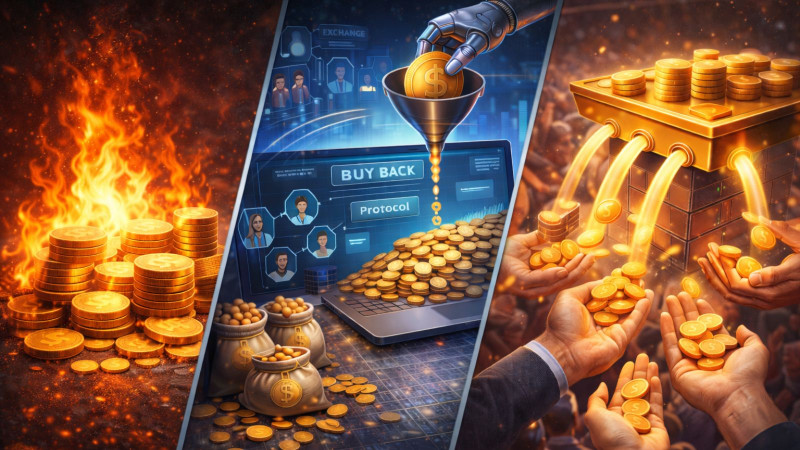
There are answers that show up again and again: burns, buybacks, and dividend-style payouts.
Each one says something different about how a protocol thinks about ownership.
The Good Old Token Burn: Familiar, Clean, and a Little Hollow
Burning tokens is crypto’s comfort food. It is simple, emotionally satisfying, and easy to explain on social media. Fewer tokens, more scarcity, higher price. Well, in theory.
And to be fair, burns can work, especially in strong markets. They create a sense of discipline. They tell holders that supply is being managed, that inflation is not running wild.
But burns do not actually give anyone anything. No cash, no yield, no participation in revenue. You are still relying on the market to do the rest of the work.
That can be fine if demand is strong. It is much less convincing when demand is uncertain. Scarcity alone does not create value, it only amplifies it if something else is already there.
Burns feel like an answer from an earlier era of crypto, when optics mattered more than fundamentals.
Token Buybacks: More Serious, Still Indirect
Buybacks feel like crypto growing up and borrowing language from public markets.
Instead of destroying tokens automatically, protocols use revenue or treasury funds to buy their own tokens on the open market. The signal is clear: the protocol believes the token is undervalued and is willing to spend real money to prove it.
That matters. Buybacks introduce actual demand. They are less abstract than burns. They also force protocols to think more carefully about treasury management and sustainability.
But at the end of the day, buybacks still work through price. If the market reacts, holders benefit. If it does not, they do not. There is no guarantee, no direct transfer of value, no moment where a holder can say, “I received this because the protocol performed well.”
In traditional finance, buybacks are often paired with dividends. In crypto, they are usually positioned as the whole story. That gap is something worth paying attention to.
Dividends and Revenue Sharing: The Awkward but Honest Option
Dividend-style payouts in crypto tend to make people uncomfortable. They feel a bit too close to traditional finance. And the instinctive reaction is usually something like, aren’t we supposed to be reinventing all of this?
In some ways, yes. There are definitely parts of the financial system that deserve to be challenged or rebuilt entirely. But that does not automatically mean everything old is useless. Some mechanisms stuck around because they solved real problems. Dividends are one of those.
At its core, the idea is pretty simple. If a protocol makes money, some of that money goes back to the people holding the token. Maybe you have to stake. Maybe you have to lock tokens for a while. Maybe the payout changes over time. The specifics can vary, but the relationship is clear enough. When the protocol does well, holders benefit.
That alone changes the dynamic. You are no longer just holding a token and hoping it becomes more desirable later. You are actually participating in the economics of the thing you own.
It also forces a kind of honesty. If revenue drops, payouts drop. If the protocol grows, holders feel it directly. There is not much room to hide behind supply tweaks or clever treasury narratives.
The objections are predictable. Regulation. Complexity. Governance risk. And to be fair, those are not imaginary concerns. Once you start sharing revenue, it starts to look a lot like ownership, and ownership comes with responsibilities that crypto has historically tried to sidestep.
But pretending that reality does not exist does not really help. And once protocols manage capital and distribute value, they are already doing financial work, whether they want to admit it or not.
Dividends do not invent that reality. They just stop dancing around it.
This Is Really About Maturity
Burns, buybacks, and dividends are not just technical choices. They are statements about what a protocol wants to be.
Burns prioritize simplicity and narrative. Buybacks prioritize signaling and market mechanics. Dividends prioritize alignment and accountability.
None of them are universally right or wrong. Early-stage protocols probably should not be paying out revenue. Infrastructure layers may prefer reinvestment. Some tokens are governance tools first and economic assets second.
But as DeFi matures, it is becoming harder to justify tokens that never touch the value they help create.
At some point, holders stop asking how clever the tokenomics are and start asking a simpler question: what do I get if this works?
Crypto does not need to become traditional finance. But it probably does need to answer that question more directly. Whether that leads to dividends, something like them, or an entirely new model is still open.
But what is beginning to feel increasingly outdated is pretending that question does not matter.
Stay Connected
You can stay up to date on all News, Events, and Marketing of Rare Network, including Rare Evo: America’s Premier Blockchain Conference, happening July 28th-31st, 2026 at The ARIA Resort & Casino, by following our socials on X, LinkedIn, and YouTube.