#Airdrop
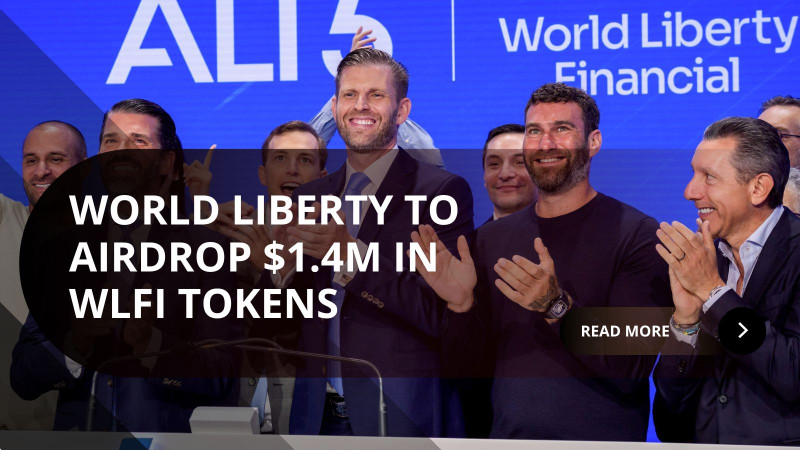
World Liberty Financial to Airdrop $1.4M in WLFI Tokens
Trump-Backed World Liberty Financial to Distribute Tokens in USD1 Stablecoin Initiative
World Liberty Financial (WLFI), the crypto venture affiliated with U.S. President Donald Trump, has announced plans to distribute 8.4 million WLFI tokens, valued at roughly 1.2 million dollars, to early participants in its USD1 stablecoin loyalty program.
This airdrop is tied to the USD1 Points Program, which launched approximately two months ago to promote adoption of the company’s U.S.-dollar backed stablecoin, USD1. Participants earn points by trading USD1 pairs across partner exchanges and maintaining qualifying balances.
According to WLFI, distribution criteria will vary by exchange: “The criteria and eligibility for earning points and rewards and distribution details may vary based on each exchange’s rules,” the company said in a post on X.
The token distribution is scheduled to take place on six platforms, including Gate.io, KuCoin, LBank, HTX Global, Flipster and MEXC, with each exchange determining eligibility and award amounts under the terms agreed with WLFI.
Strategic Context
The initiative serves several purposes. First, it acts as both a reward for early ecosystem supporters and a mechanism to stimulate USD1-stablecoin usage. Second, it tests the underlying infrastructure for token and stablecoin distribution in a real-world environment. Recognizing the scale, the governance vote preceding the proposal registered overwhelming support from holders.
For WLFI the move is also a visibility play. In a stablecoin market dominated by other major issuers, offering a loyalty-driven token distribution tied to a dollar-backed coin helps position USD1 as more than just another entry. It underscores WLFI’s ambition of building a full Web3 payments ecosystem around USD1, with WLFI governance tokens acting as connective tissue.
The company said the loyalty campaign has driven over $500 million in trading activity since its introduction two months ago, positioning USD1 as the sixth-largest stablecoin by market value, according to CoinGecko data.
Operational and Market Considerations
From a technical standpoint the execution is noteworthy. Eligible wallets do not need to claim their drop; the tokens are sent automatically once eligibility is confirmed. That reduces friction and enhances user experience, which is crucial for adoption at scale.
However several factors warrant attention. While the WLFI airdrop rewards early adopters, the eventual utility of the WLFI token remains tied to governance rights and ecosystem participation. Trading status for the token is still subject to internal decision-making and regulatory alignment. Market watchers also note the importance of transparency around USD1 reserves—its backing by U.S. dollar deposits, Treasury securities and equivalents is central to trust.
Regulatory scrutiny is a further dimension. Given WLFI’s connection to high-profile political figures, the project sits at the intersection of innovation and public interest. Lawmakers and watchdogs have flagged potential conflicts of interest in cases where stablecoins are linked to politically exposed persons. That context raises the importance of governance and disclosure for WLFI and USD1 alike.
What to Watch Next
Key metrics and upcoming milestones will influence perception and adoption of the program:
-
Ecosystem Integration: Monitoring how USD1 becomes usable in real payments, treasury functions or DeFi contexts will matter.
-
Token Tradability: The transition of WLFI tokens from governance-only to tradable status could unlock liquidity and broader market participation.
-
Reserve Audits and Transparency: Regular reports confirming USD1 backing, asset custody and redemption mechanisms will build confidence.
-
Regulatory Progress: U.S. stablecoin legislation and oversight developments will affect how projects like WLFI position themselves globally.
-
Exchange Listings and Adoption: The number and quality of partner exchanges supporting USD1 and WLFI will drive network effects and utility.
Conclusion
The forthcoming airdrop by World Liberty Financial signals a strategic push: leveraging token rewards tied to a stablecoin launch to drive engagement and adoption. It reflects an evolving model in crypto where loyalty programs and token economics interplay with payments infrastructure.
If executed well, this program could strengthen USD1’s role in the stablecoin landscape and reinforce WLFI’s ecosystem narrative. If not, trust issues around reserves, governance or politicised affiliations may overshadow potential gains. For now, the project stands as a significant experiment at the nexus of finance, blockchain and public-figure influence.
Stay Connected
You can stay up to date on all News, Events, and Marketing of Rare Network, including Rare Evo: America’s Premier Blockchain Conference, happening July 28th-31st, 2026 at The ARIA Resort & Casino, by following our socials on X, LinkedIn, and YouTube.
Polymarket Confirms Major Native Token Launch and Airdrop Plans
Polymarket Confirms Major Native Token Launch and Airdrop Plans
Prediction market platform Polymarket has officially revealed plans to launch a native token, tentatively referenced by the ticker “POLY,” and to conduct an airdrop targeting its active user base. This is the latest in a string of strategic moves that signal Polymarket is entering a new phase of growth and community-driven value creation.
In a recent communication, Chief Marketing Officer of Polymarket confirmed the intention to distribute POLY tokens as part of the platform’s next chapter. Although precise details such as the snapshot date or token economics have not yet been published, the announcement has already sparked significant interest and speculation across the crypto ecosystem.
What We Know So Far
Token Introduction
Polymarket founder Shayne Coplan sparked the token discussion earlier when he posted the string “$BTC $ETH $BNB $SOL $POLY” on X, placing POLY alongside well-established crypto assets. This implied a serious ambition for the token to operate at scale. Bitcoinist.com+1
Airdrop Framework
Although the project has not yet revealed final criteria, airdrop hunters and active users are already positioning themselves. Some analyst commentary suggests that metrics under consideration could include trading volume, market participation, profits, liquidity provision and platform loyalty. CoinMarketCap+1
Institutional Momentum
Polymarket recently secured a strategic investment of up to $2 billion from the Intercontinental Exchange (ICE), parent company of the New York Stock Exchange. This backing strengthens the token narrative and supports institutional credibility for the upcoming POLY rollout. Traders Union
Why This Development Matters
1. Platform Maturation
Polymarket moving to a native token model signals evolution from a purely transactional prediction-market platform into a deeper ecosystem with governance and economic incentives. A token could introduce staking, rewards, user governance and richer incentive structures.
2. Airdrop Culture Reset
The planned POLY airdrop has the potential to be one of the largest in crypto history given Polymarket’s scale and liquidity. That shifts the playing field for early-stage users and raises the bar for how platforms reward participation and loyalty. CoinSpot
3. Prediction Markets in the Spotlight
By aligning token issuance with prediction markets, Polymarket elevates an under-explored segment of crypto. With institutional investments and tokenization in view, prediction markets may gain broader utility and recognition in finance.
Key Metrics and Signals to Watch
-
Snapshot Date Announcement: When Polymarket defines the cut-off for eligibility.
-
Token Distribution Rules: Details on allocation size, tiering, user eligibility, lock-up periods.
-
Trading and Liquidity Dynamics: How volumes behave in the lead-up and post-launch.
-
Institutional Engagement: How ICE and other backers integrate token use cases or platform expansion.
-
Regulatory Alignment: How Polymarket addresses compliance, Sybil-resistance and user fairness.
Final Thoughts
Polymarket’s confirmation of a native token and airdrop marks a pivotal moment not just for its own roadmap but for the broader Web3 ecosystem. The shift reflects growing sophistication in how platforms incentivize users, reward engagement and build sustainable networks.
For participants, this development offers a chance to engage early and potentially earn meaningful value. For observers and institutions, it signals that prediction markets are stepping into the mainstream. And for the industry at large, it reinforces that tokenization remains a powerful lever for growth—and that well-executed airdrops can serve as catalysts rather than gimmicks.
Polymarket’s next steps—snapshot criteria, token economics and launch timing—will be closely watched. If executed thoughtfully, POLY could become a model for how crypto projects reward users, scale platforms and bridge to institutional finance.