#Base
Coinbase Reverses Base App Strategy, Brings Back Coinbase Wallet

Coinbase is reversing its Base App strategy and bringing back Coinbase Wallet after falling short of the “everything app” vision it initially had for the platform.
This reversal comes just a year after the exchange rebranded Coinbase Wallet as the Base App during its “A New Day One” event, held in Los Angeles on July 26 last year. The goal of the rebrand was to create an on-chain “everything app” or “super app” for users.

To create the “everything app” platform, Coinbase combined the self custodial wallet features of Coinbase Wallet with social networking, messaging, payments, trading, and creator features, all within the Base App. This created a complete on chain experience where users could trade, create, interact, and discover new apps.
Amid all of this, the Base App strategy failed to gain traction. According to Coinbase CEO Brian Armstrong, it was an experiment that did not quite work, stating that the exchange will focus more on trading while bringing back the self custodial features of Coinbase Wallet.
Remember that Jesse Pollak, the creator of Base, also recently resigned from his leadership role at Base after admitting that his bet on-chain social products this year had failed. According to Pollak, the social side of the on-chain market had completely disintegrated.
The Plan Going Forward
Following the rebrand, Coinbase Wallet will serve as a “test kitchen” for features that are not readily available on the Coinbase cryptocurrency exchange. According to Ryan Kass, Head of Coinbase Wallet Product, Coinbase Wallet will give users access to on chain finance.
Among the first set of asset offerings to be made available to users are perpetual futures powered by Hyperliquid, including more than 290 derivative markets spanning cryptocurrency, equity, and commodity markets.
Wasabi Protocol Hack Drains $5M Across Chains

Wasabi Protocol, a multichain decentralized perpetual futures trading platform, was hit by an exploit that led to the loss of more than $5 million across several chains.
The exploit, according to blockchain security company PeckShield, was carried out across multiple chains, including Base, Berachain, Blast, and Ethereum, which is its main deployment chain.
The incident was also flagged by blockchain security firms CertiK and Blockaid, with both firms attributing the cause of the hack to a compromise of the Wasabi deployer wallet, which allowed the attacker to gain privileged admin access and subsequently drain funds from the protocol.
“The Wasabi deployer externally owned account was used to grant admin role access to an attacker-controlled helper contract, which then upgraded the perpetual vaults and LongPool to a malicious implementation that drained balances,” Blockaid wrote in a post on X.
“All Wasabi and Spicy liquidity provider share tokens minted by these vaults should be treated as compromised. The underlying assets backing them have been drained or are at risk while the Wasabi deployer key remains active. End users holding these tokens are showing book value, but the redemption value is zero,” the firm added, while recommending the immediate flagging and revocation of these tokens.
Blockchain security firm Cyvers also provided further details on how the incident occurred. According to Cyvers, a crypto wallet funded through Tornado Cash was used to deploy a malicious contract on Wasabi Protocol across the Base and Ethereum chains.
As a result of this malicious contract deployment, about $4.5 million in various crypto assets, including WETH, USDC, BTC, VIRTUAL, and cbBTC, as well as memecoins such as PEPE, MOG, and REKT, were stolen. The funds were later consolidated into Ether and distributed across multiple wallet addresses outside the protocol.
Wasabi Protocol Responds
Following the disclosure of the exploit by security teams, the Wasabi team, in a post on X, stated that they were aware of the breach and were actively investigating the incident alongside security experts, notably Security Alliance and Blockaid.
The team also warned against interacting with a list of compromised vaults and EVM positions across Base, Blast, and Berachain, while stating that users whose vaults were not among the compromised list could proceed with withdrawals at any time.
The Wasabi exploit closed the month of April, which recorded some of the largest crypto exploits, including those involving Drift Protocol and KelpDAO, which led to losses of $285 million and $293 million, respectively.
Coinbase Launches Crypto-Backed Loans in the UK

Cryptocurrency exchange Coinbase has rolled out crypto-backed loans for users in the United Kingdom, allowing users to borrow USDC against Bitcoin (BTC), Ether (ETH), and Coinbase Wrapped Staked Ether (cbETH) holdings.
The launch, announced this Monday, is part of Coinbase’s overall efforts to build a leading financial app in the UK that allows users to invest, manage, and grow their money.

The loans will be issued through Morpho, a decentralized finance lending protocol on Base, and according to Coinbase, users will be able to borrow up to $5 million in USDC, depending on the amount of Bitcoin and other eligible assets they hold as collateral. Coinbase says the interest rates will vary, depending on market conditions on Base, and that these rates will be set by Morpho.
It is also important to note that while there is no fixed repayment schedule for the borrowed loans, borrowers face liquidation risk if the loan-to-value ratio exceeds specific thresholds that will be set by Coinbase.
The crypto-backed loans can be accessed through the Coinbase app, where users can choose the amount of USDC they want to borrow and their preferred collateral asset. Once this is done, the pledged collateral will be transferred on-chain to a Morpho smart contract, and the USDC loans will be automatically disbursed to the user’s Coinbase account, which can then be converted to British pounds (GBP).
Coinbase Expands Its Crypto Efforts
Coinbase is one of the cryptocurrency exchanges leading development at the intersection of blockchain technology and artificial intelligence (AI).
In an X post last weekend, Coinbase CEO Brian Armstrong announced that the exchange was testing and integrating two AI agents into Slack and email. These AI agents will serve as virtual workers, able to perform on-chain actions such as holding funds, spending and sending money, trading, and earning yield.
This recent development comes shortly after Coinbase launched the x402 Foundation, designed to enhance the use of its x402 protocol as a standard payment protocol for internet native payments.
To achieve its “Everything Exchange” goal, Coinbase made a number of significant acquisitions last year, including the acquisition of the Deribit exchange and Echo. The exchange has also rolled out stock and ETF trading in-app for all eligible users, with its most recent rollout in Canada.

Coinbase Launches Agentic Wallets on Base

Coinbase is not introducing AI agents to crypto. Those have been here for years.
What Coinbase is doing now is different. It is trying to formalize and secure that reality.
With the release of what it calls Agentic Wallets, Coinbase is offering wallet infrastructure built specifically for autonomous AI agents. Not dashboards with AI features. Not analytics copilots. Actual wallets engineered so software agents can hold and move funds in a way that is safer, cleaner, and more production ready than the duct taped setups many teams rely on today.
Agentic Infrastructure
Erik Reppel, who leads engineering on the Coinbase Developer Platform, has been fairly direct about the problem they are solving.
Today, when developers say an agent “has a wallet,” that often means a private key is sitting somewhere it probably should not be. Maybe in a config file. Maybe in memory. Maybe loosely protected. If that agent gets manipulated, exploited, or simply misbehaves, the blast radius can be severe.
Reppel’s argument is that key isolation needs to be non negotiable. With Agentic Wallets, private keys are stored in secure execution environments, separated from the agent’s reasoning layer. The agent never directly touches raw key material. Instead, it interacts through controlled sessions with predefined permissions and limits.
He has described this architecture as orders of magnitude safer than letting an AI system operate with exposed keys.
That framing is important. Coinbase is not claiming to invent autonomous agents. It is trying to make them viable in production environments where security and compliance actually matter.
Built on Base and Wired Through x402
Two technical components sit at the core of this release: Base and x402.
Agentic Wallets are designed to run natively on Base, Coinbase’s Ethereum layer 2 network. Base offers lower fees and faster settlement compared to mainnet Ethereum, which makes it more practical for continuous automated activity. Bots and agents do not sleep. They monitor, adjust, and transact around the clock. Running that on a cheaper, faster chain is not a luxury, it is a necessity.
Then there is x402, Coinbase’s machine-to-machine payments protocol.
If that name sounds obscure, the idea is straightforward. x402 is built to allow services to pay other services directly onchain. It has already processed tens of millions of transactions in scenarios where APIs, compute layers, or other digital services require automated payment.
In the context of Agentic Wallets, x402 becomes the settlement layer for autonomous systems. An agent can pay for API access, purchase data feeds, cover inference costs, or settle fees with other services without a human approving every transaction. It is programmable, onchain, and designed for machines transacting with machines.
Put differently, Base provides the execution environment. x402 provides the payment rails. Agentic Wallets sit on top as the secure container that ties everything together.
Agents Already Trade. This Makes It Cleaner.
It is worth saying clearly: AI driven trading is not new.
Quant desks, DeFi vaults, MEV bots, and arbitrage engines have been programmatically making trades for years. In many cases those systems are highly sophisticated. But the wallet layer underneath them has often been an afterthought. Keys get managed in inconsistent ways. Access control is custom built. Security depends heavily on the engineering discipline of each individual team.
What Coinbase is offering is a standardized wallet layer designed for autonomous operation from day one.
With Agentic Wallets, developers can:
- - Set configurable spend caps per transaction or per session
- - Limit what contracts or addresses an agent can interact with
- - Isolate keys from the model or decision engine
- - Monitor transactions through built in compliance tooling
That does not suddenly give agents new superpowers. They were already capable of executing trades, reallocating liquidity, and managing positions. What this does is reduce the fragility in how those systems are wired into capital.
For teams building serious onchain automation, that difference matters.
Guardrails Are the Product
The safety architecture is arguably the most important part of this launch.
Prompt injection attacks, model manipulation, and logic exploits are not theoretical. If an agent is given broad financial authority and can be tricked into executing malicious instructions, the damage can be immediate and irreversible.
Coinbase’s model is to narrow the surface area.
Private keys live in secure enclaves. Agents operate through session credentials rather than raw key access. Developers can define how much value an agent can move and under what conditions. Transaction monitoring tools screen for high risk interactions before they are finalized.
None of this eliminates risk. Autonomous systems interacting with open financial networks will always carry some degree of unpredictability. But compared to the common practice of handing a bot a hot wallet and hoping for the best, this is a structural upgrade.
The Bottom Line
Zooming out, this fits into Coinbase’s broader strategy.
The company has been expanding its developer platform, pushing Base as a default settlement layer, and experimenting with tools that make onchain activity easier to embed into applications. Agentic Wallets extend that logic into the AI domain.
If AI systems continue to mediate financial activity, whether that is portfolio management, payments, or automated strategy execution, they will need infrastructure. Wallets are the choke point. Whoever controls that layer controls a meaningful slice of the stack.
Coinbase clearly wants to be that provider.
There are still regulatory and philosophical questions hanging over all of this. When an autonomous agent executes a trade or interacts with a protocol, who ultimately bears responsibility? The developer? The operator? The infrastructure provider? Those debates are just beginning.
But in practical terms, agents are already here. They are already trading. They are already moving markets.
Autonomous systems are currently participating in crypto. The wallet layer just needs to catch up.
Agentic Wallets are an attempt to do exactly that.
Aerodrome Finance Front End Attack, Users Should Avoid Domains
Aerodrome Finance Front End Attack, Users Should Avoid Domains
On November 22, 2025, Aerodrome Finance publicly alerted its community that its front-end system had been compromised. Users were urged to avoid interacting with the official domain until further notice. The incident shines a light on not only the specific risks for Aerodrome but the evolving threat landscape that decentralized finance (DeFi) platforms face as they attract more assets and users.
Here is a detailed breakdown of the event, the immediate impact, the underlying vulnerabilities, and what users should do now.
What Happened at Aerodrome
Aerodrome, a prominent decentralized exchange (DEX) built on the Base network, discovered a malicious actor had gained control of elements of its front-end infrastructure. The team’s announcement stated that the system was under attack and users should avoid transactions until the issue is resolved.
Investigations and on-chain data suggest the following sequence:
-
The attacker exploited the front-end system, possibly via a Domain Name System redirection or DNS hijack, leading users to a fake interface.
-
Users connecting wallets and signing transactions through the compromised domain exposed themselves to malicious contract interactions, which allowed the attacker to drain wallets.
-
On-chain sleuths identified two wallet addresses receiving stolen funds, with estimates of approximately $40,000 to $70,000 diverted from Aerodrome and related domains.
-
Although the core smart contracts reportedly remained secure, the front-end compromise posed serious risk because users interacted with an interface that could initiate unauthorized transactions.
Analysts have pointed out that front-end attacks, while less dramatic than contract exploits, remain one of the most under-appreciated vectors in DeFi. This incident places Aerodrome in the spotlight and raises critical questions about user safety, domain management, and the trust model of DeFi.
What Aerodrome and the Community Are Doing
In response to the incident, Aerodrome has taken the following steps:
-
Issued urgent advisories to users not to connect wallets or sign transactions on the affected domain.
-
Provided a secure, decentralized interface alternative while full remediation is underway.
-
Encouraged users to revoke all permissions granted within recent hours and monitor their wallet activity for unauthorized transactions.
-
Launched an investigation with bug bounty and intelligence firms to trace the attacker and recover stolen assets.
-
Secured its domain provider, locked the domain at the top-level domain (TLD), and initiated provider migration to avoid recurrence.
While the smart contracts remain uncompromised, the front-end risk highlights that all layers—the UI, domain infrastructure, wallet connection flow—must be protected.
What Users Should Do Now
If you used Aerodrome recently, please take these actions immediately:
-
Revoke Wallet Permissions
Use your wallet or permissions dashboard (such as Etherscan’s token approvals) to remove any recently granted approvals for the Aerodrome front-end domain. -
Avoid the Official Domain Until Verified
Use only mirror or verified alternative interfaces provided directly by the team. Do not trust links in social media bios unless officially confirmed. -
Monitor Transactions
Check your wallet transaction history for suspicious outgoing transfers, token approvals or swap interactions you did not initiate. -
Use a Hardware Wallet
For any future DeFi interaction, especially involving large amounts, consider using wallets with hardware signing to reduce risk of rogue UI prompts. -
Stay Updated
Follow official Aerodrome channels for remediation updates and wait for confirmation that the front-end is secure before interacting again.
Stay Connected
You can stay up to date on all News, Events, and Marketing of Rare Network, including Rare Evo: America’s Premier Blockchain Conference, happening July 28th-31st, 2026 at The ARIA Resort & Casino, by following our socials on X, LinkedIn, and YouTube.
Coinbase and Morpho Launch Up to $1 Million Crypto-Backed Loans
Coinbase and Morpho Team Up: Borrow Up to $1 Million Against ETH
Coinbase has launched a major upgrade to its crypto-lending services, enabling U.S. users (excluding New York residents) to borrow up to $1 million in USDC using their Ethereum as collateral. This capability is powered by Morpho Labs’ on-chain lending infrastructure, and it represents an important step toward mainstream access to decentralized finance (DeFi) via a trusted exchange.
The initiative ties together four critical trends: demand for liquidity without selling crypto, institutional-grade DeFi infrastructure, user-friendly platforms, and evolving regulatory comfort around crypto-backed loans.
How the Offering Works
-
Borrowers pledge Etherum (ETH) which is converted into Coinbase Wrapped Ethereum (cbETH) on Base, Coinbase’s layer-2 blockchain. The cbETH is then deposited into a Morpho smart contract as collateral.
-
In exchange, users receive USDC in their Coinbase account almost instantly. The loan product is integrated directly into the Coinbase mobile app, removing the user-experience friction common in traditional DeFi protocols.
-
The maximum borrowing amount stands at $1 million USDC per user, depending on collateral value and eligibility.
-
There are no fixed repayment schedules or deadlines—borrowers can repay any time. The key constraint is maintaining a healthy loan-to-value (LTV) ratio. If the outstanding loan amount including interest reaches approximately 86% of the collateral’s value, the position can be liquidated.
-
Rates are variable and determined by the open lending market on Morpho, and as part of Coinbase’s interface the process is designed to feel familiar to users of mainstream financial apps.
Strategic Significance
Unlocking Liquidity Without Selling
A major advantage of this offering is that users retain exposure to their underlying crypto holdings while accessing cash liquidity. This can help avoid tax-triggering events that might come from selling crypto assets, while still unlocking value for things like down payments, major purchases, or diversifying other investments.
DeFi Infrastructure Meets Mainstream Exchange
Coinbase is leveraging Morpho’s protocol layer so that the decentralized lending infrastructure handles execution and risk, while Coinbase manages the user interface, onboarding, and regulatory overlay. This model blends DeFi innovation with the user experience and brand trust of a regulated exchange.
Regulatory Evolution and Risk Management
Crypto-backed loans have a checkered history, with industry failures in recent years (for example, centralized lenders filing for bankruptcy). This time, Coinbase and Morpho appear to be building with lessons learned: a trusted exchange interface, modern risk controls, transparent collateral mechanics, and clear liquidation thresholds. The exclusion of New York is a nod to continuing regulatory variations across jurisdictions but demonstrates broader U.S. availability.
What the Data and Context Reveal
-
Morpho reports that its protocol supports billions in locked liquidity and has enabled institutions and exchanges to offer lending services in a modular, compliant way.
-
One source places the collective crypto-backed loan market at over $1 billion already in a short period, driven by this Coinbase-Morpho product and similar initiatives.
-
Earlier versions of Coinbase’s lending offering were closed suddenly amid regulatory issues, so this relaunch signals renewed confidence in design, oversight, and market timing.
-
The Base blockchain integration gives the service lower cost, faster transactions and more seamless experience compared to older DeFi on-ramps, improving accessibility for mainstream users.
Risks and Considerations
-
Volatility risk: If Ethereum’s price drops significantly, borrowers may face liquidation if the collateral value falls and the loan-to-value ratio breaches thresholds.
-
Liquidity and contract risk: While Morpho is audited and established, smart contract protocols always carry some risk of bugs, hacks or operational failure.
-
Regulatory change: Although the product is live, evolving regulation in the U.S. could alter lending terms, disclosure obligations or tax treatments tied to crypto-backed loans.
-
Cost of borrowing: Rates are variable and market-driven; high demand or collateral stress could increase borrowing costs unexpectedly.
-
User experience vs. risk exposure: The seamless interface may mask underlying complexity; users still need to monitor LTV, collateral status and market conditions.
Implications for Crypto and Finance
-
The introduction of high-limit crypto-backed loans via a mainstream exchange opens the door for wealthy and institutional crypto holders to access large liquidity without asset sales, blurring lines between traditional finance and DeFi.
-
This offering may accelerate use cases where holding crypto is strategic (for tax or value appreciation reasons) while accessing fiat liquidity for spending, investing or diversification.
-
If this model succeeds, more exchanges may follow, and lending protocols may become core infrastructure rather than niche DeFi tools—potentially reshaping the financial profile of crypto markets.
Final Thoughts
Coinbase’s collaboration with Morpho to offer up to $1 million in USDC loans backed by Ethereum is more than a product launch. It is a signal that crypto infrastructure is maturing from experimental protocols to user-friendly, high-scale financial services.
For crypto holders, it offers a new pathway to liquidity without sacrificing exposure. For the broader market, it shows that DeFi protocols and mainstream exchanges can integrate to deliver real-world services.
The key will be execution, risk control, user adoption and regulatory acceptance. If all elements align, this could mark a pivotal moment where crypto-native finance moves into mainstream modes and the borrowing-against-assets model becomes widely accessible.
Stay tuned as this space evolves, products like this may become standard components in how we finance, borrow and invest in the crypto age.
Stay Connected
You can stay up to date on all News, Events, and Marketing of Rare Network, including Rare Evo: America’s Premier Blockchain Conference, happening July 28th-31st, 2026 at The ARIA Resort & Casino, by following our socials on X, LinkedIn, and YouTube.
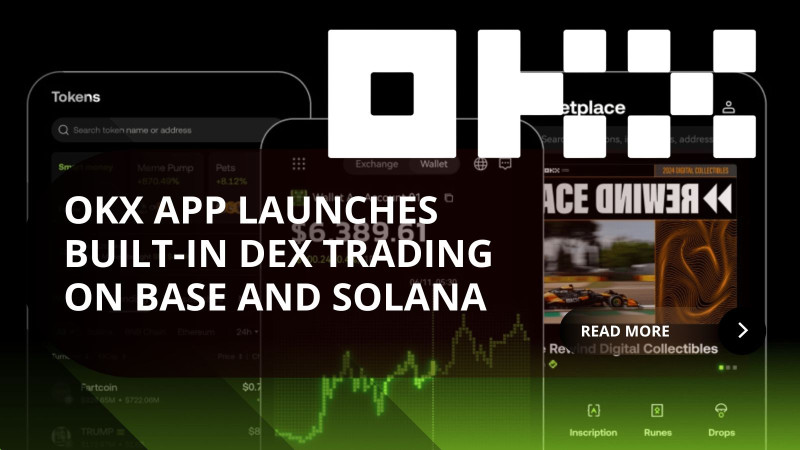
OKX Launches Built-In DEX Trading Across Base, Solana and X Layer
OKX Launches Unified DEX Trading for Base, Solana and X Layer
The global crypto exchange OKX has introduced a major upgrade to its app that integrates decentralized exchange (DEX) trading across multiple chains: Base, Solana and its own X Layer network. Users can now execute decentralized trades inside the OKX mobile application, enabling both centralized and decentralized trading from a single interface.
This move signals a new phase of centralized exchanges embracing DeFi liquidity rather than competing against it.
Unified interface for CEX and DEX
OKX’s update allows users to shift seamlessly between centralized order-books and on-chain markets. The wallet automatically sets up a self-custody passkey wallet when DEX mode is activated, ensuring users retain control of private keys while trading decentralized liquidity.
Liquidity is aggregated from more than 100 pools across supported chains, enabling the app to route orders toward the best available price.
Multi-chain support: Base, Solana and X Layer
-
On Base the integration taps into the growing ecosystem of Web3 apps building on its Ethereum-compatible roll-up.
-
On Solana the feature connects to high-performance on-chain DEXs that specialize in ultra-low fees and high throughput.
-
On X Layer OKX’s own modular Layer-2 supports EVM equivalence, throughput of several thousand transactions per second and is positioned to be a key part of OKX’s future modular infrastructure.
Self-custody meets exchange convenience
OKX emphasizes that users retain full self-custody of the DEX trades while benefiting from the liquidity and user-experience of a large exchange. For many retail users this removes the friction of switching between wallet apps, bridges and trading venues.
Lowering friction between CEX and DeFi
Historically traders faced two worlds: centralized exchanges (fast, liquid, custodial) and decentralized exchanges (non-custodial, self-sovereign, often clunkier). OKX’s integration helps bridge that divide. By offering both modes in one app it reduces switching cost and increases accessibility to on-chain markets.
Supporting multi-chain adoption
By including Base, Solana and X Layer networks OKX is betting that multi-chain strategies will dominate Web3. Users can access tokens, swaps and liquidity beyond a single network and participate in ecosystems that specialize in performance, low cost and innovation.
Strategic advantage for OKX
For OKX this feature furthers differentiation. Many exchanges now support wallet-apps, but fewer integrate full DEX trading across major chains inside their main app. OKX’s move could drive retention, user growth and stronger positioning in both CEX and DeFi sectors.
The broader context in DeFi evolution
Decentralized exchange volumes recently reached record highs with monthly totals exceeding $600 billion. The early DeFi wave emphasized pure open protocols while the current phase is more about unified UX, interoperability and ease of on-chain access from mass-market portals. OKX’s upgrade is consistent with this maturation trend.
At the same time, other major platforms are pursuing similar strategies. For example Coinbase recently added DEX access for Base network tokens and Binance has integrated wallet-native DEX routing on its app. OKX’s multi-chain DEX rollout therefore represents an escalation.
Potential risks and challenges
-
Liquidity fragmentation: Even though OKX aggregates over 100 pools, liquidity on some chains and tokens may still be shallow, increasing slippage for large trades.
-
Smart-contract and chain risk: Trading on-chain introduces protocol risks like bridge failures, network downtime or contract exploits which are less common on centralized markets.
-
Centralization criticism: While the feature offers non-custodial trading, critics may argue that routing via a centralized app reintroduces centralization trade-offs under the guise of decentralization.
-
User education: Retail users may assume the same protections apply across CEX and DEX modes; mismatches in custody, recovery or regulation awareness could lead to errors.
What to watch next
-
Adoption metrics: How many users enable the DEX mode and how much trading volume flows through the integrated system on each of the three chains.
-
Token listings: Will OKX prioritize new token launches or cross-chain assets via DEX mode, and how quickly will additional chains be added?
-
Development of X Layer: As OKX’s proprietary roll-up matures, liquidity and user activity on that network will be a key strategic indicator.
-
User experience and security feedback: Reports of slippage, wallet setup issues or custody concerns could influence how successful the rollout is.
-
Competitive responses: How other major exchanges respond with similar features, and whether this becomes standard across the industry.
Final thoughts
OKX’s rollout of built-in DEX trading across Base, Solana and X Layer marks a meaningful evolution in the convergence of centralized exchanges and decentralized finance. By enabling users to access on-chain liquidity from within a trusted exchange app, OKX is making DeFi more accessible, multi-chain, and user-friendly.
For traders and DeFi enthusiasts this is a powerful tool: multi-chain access, self-custody trading and deep-liquidity routing in a single environment. For OKX it is a strategic differentiation as the industry moves into its next phase of scale and adoption.
That said, execution will matter: how smoothly the feature works, how security is upheld and how users adopt it will determine whether this raises the bar for exchange-DeFi integration or remains a headline feature.
If OKX nails it, the result could be a clearer path for the average user to interact with DeFi fully, from wallet to swap to multi-chain strategy...all inside one seamless interface.
Stay Connected
You can stay up to date on all News, Events, and Marketing of Rare Network, including Rare Evo: America’s Premier Blockchain Conference, happening July 28th-31st, 2026 at The ARIA Resort & Casino, by following our socials on X, LinkedIn, and YouTube.