#Franklin Templeton
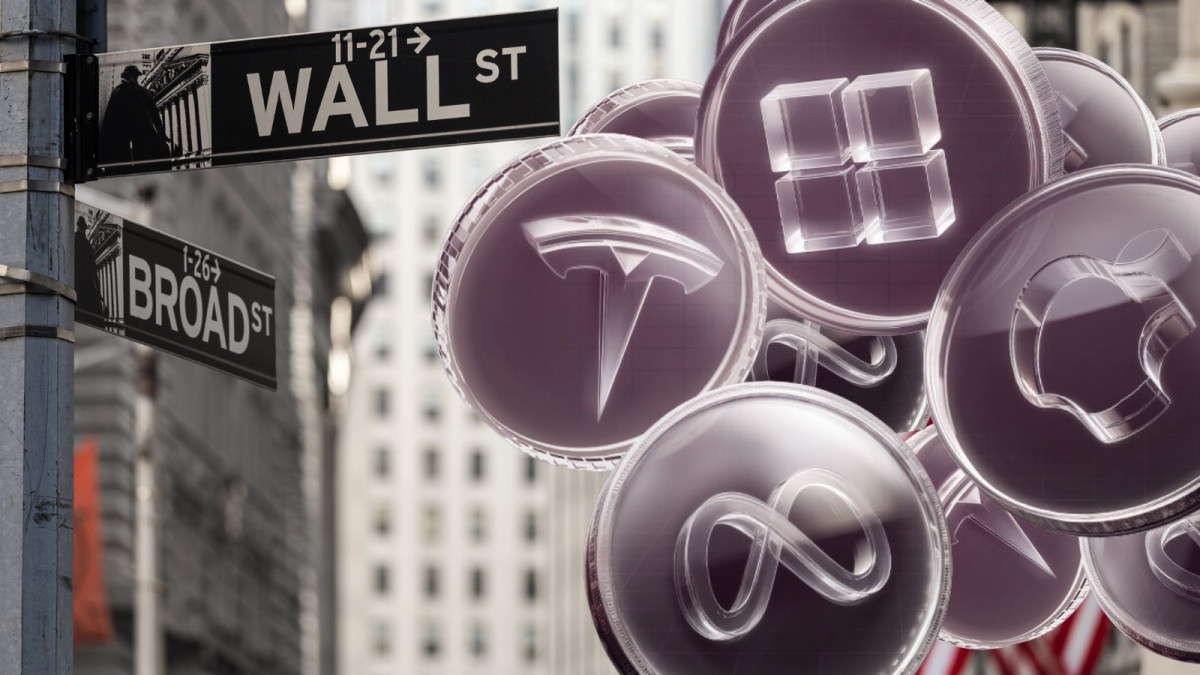
Wall Street Is Going To Tokenize Everything

There was a version of this story...told many moons ago that gets told as a prediction. Some future moment when the old guard of finance finally meets crypto on equal footing, when the suits and the degens find common ground, when a BlackRock executive and a DeFi protocol share the same balance sheet. Well that story is now pretty outdated...it's no longer some vision of an oracle peering into a crystal ball. We are already living in it. The future is here.
What we are seeing happen in global finance with tokenization is not some pilot program or a hedge. It is a structural transformation, and it is accelerating faster than most people outside of these two worlds seem to understand. Wall Street is no longer on the outside looking in, just dipping their toes in, to test the water. They have taken the plunge.
The Old System Was Always Broken
Here is something traditional finance never really wanted to say out loud: the infrastructure holding it together is ancient, slow, and held up largely by institutional inertia. Settlements that take days. Liquidity locked to six-and-a-half-hour trading windows. Layers of intermediaries, each one clipping a fee, each one adding time. For the largest players, those inefficiencies were baked into the cost of doing business. For everyone else, especially retail investors in markets outside the U.S., they were just walls.
Blockchain does not fix all of this overnight. But it offers something that legacy systems fundamentally cannot: a shared, programmable, real-time record of ownership that does not require three middlemen to reconcile. The World Economic Forum, in its 2025 report on asset tokenization, described the transition as potentially the next major phase in the development of financial market architecture, drawing a comparison to the shift away from paper certificates in the 1960s. That is not a crypto inside touting to his followers on X. That is the WEF stating how tokenization could transform finance.
When even the most establishment-facing institutions are framing this as a generational infrastructure shift, it's probably worth paying attention to.
The Institutions Are Not Coming. They Are Here.
BlackRock has a tokenized fund on Ethereum. JPMorgan launched a second tokenized money market product backed by U.S. Treasuries. Fidelity brought its own Digital Interest Token on-chain. Franklin Templeton has been quietly building its tokenized money market fund, BENJI, across multiple blockchains for years. These are live products managing real capital.
The total market for tokenized real-world assets crossed $75 billion in 2025. Projections from market analysts put the long-term ceiling at $18.9 trillion by 2033, and some estimates, citing the total addressable market of traditional finance, go much higher. Larry Fink has publicly stated, more than once, that he believes every financial asset can eventually be tokenized. When the CEO of the world's largest asset manager says that with conviction, the rest of the industry listens.The total crypto market sits at just shy of $2.6 trillion right now, to add some perspective to the type of volume tokenization can bring to the space.
And the whole idea behind this is not ideological. It is practical. Blockchain cuts settlement time, removes redundant intermediaries, enables fractional ownership, and allows assets to be composable across different financial products. For institutions moving hundreds of billions, those efficiency gains compound into something very significant, very quickly.
xStocks and the Part Where It Gets Really Interesting
Tokenized treasuries and money market funds are the institutional on-ramp. But the development that best captures where all of this is truly heading is xStocks, and it is worth understanding why it matters as much as it does.
Launched in June 2025 by Backed Finance, a Swiss RWA issuer, xStocks put more than 60 fully collateralized U.S. equities on Solana as SPL tokens. Apple. Tesla. Nvidia. Amazon. Each one backed 1:1 by real shares held under regulated custody. Not synthetic. Not a derivative. The actual stock, on-chain. Available the same day on Kraken and Bybit to users in over 185 countries, and within hours, live across Solana's DeFi ecosystem on Raydium, Jupiter, and Kamino.
The numbers since launch have been hard to argue with. Over $25 billion in total transaction volume. More than 80,000 unique on-chain holders. The platform has since expanded to 100 fully backed listings, and xStocks recently launched xChange, a unified execution layer for tokenized equities running 24/5 across Ethereum and Solana with atomic settlement built in. And we'll go back to the numbers. xStocks is amazing. It's done over $25 billion in volume. But daily stock market volume just in the U.S. is roughly $500-700 billion. Daily. Just in the U.S. Starting to get the big picture here? The much, much bigger picture?
What makes this genuinely different from everything that came before it is composability. With a brokerage account, you own a stock and that is more or less the end of the story. With xStocks inside Solana's DeFi ecosystem, you can use Nvidia as collateral in a lending protocol, provide liquidity with Apple against a stablecoin, or swap Tesla for SOL without touching a broker, a clearinghouse, or a trading window. That kind of programmable financial infrastructure does not exist in traditional markets. It simply never has.
Who This Actually Opens the Door For
For investors in the U.S., this is interesting. For investors everywhere else, it is potentially transformative. Access to U.S. equity markets has historically required meeting regulatory hurdles, working through licensed brokers, and navigating banking infrastructure that many parts of the world simply do not have. xStocks changes that math entirely. Trading starts at one euro. Dividends reinvest automatically. No broker required. No minimum account size. Just a wallet and a connection.
Franklin Templeton's partnership with Kraken, announced in early 2026, is another data point worth noting here. The two are exploring on-chain versions of Franklin's financial products, including tokenized stocks, yield instruments, and compliant custody solutions. A legacy asset manager and a crypto exchange building joint infrastructure is the kind of thing that a few years ago would have sounded like a very optimistic projection. Now it is a press release.
The Narrative Has Shifted. Permanently.
Crypto spent a long time fighting to be taken seriously by traditional finance. That fight is over, and crypto won it on the merits. What is replacing it is something more interesting: a negotiation over what the merged system actually looks like, who controls it, and how fast it scales.
The regulatory environment is improving. Interoperability between chains is being worked out. Liquidity in tokenized asset markets is growing month over month. The WEF framed the barriers as real but solvable, pointing to legacy infrastructure integration, inconsistent global standards, and cross-chain friction as the remaining friction points. None of those are permanent problems. They are engineering and coordination challenges, and the talent and capital now focused on solving them is enormous.
The General Manager of xStocks said it about as cleanly as it can be said: the question is no longer whether equities belong on-chain, but how fast they can be scaled. With 100 listings and $25 billion in volume already behind the platform, the model is proven. The next stage is expansion to every major U.S. equity and, eventually, global equities across international markets.
That is not a roadmap for some distant future version of crypto. That is the roadmap for the next few years. And if the last twelve months are any indication, it will probably move faster than anyone is currently projecting, including myself. As bullish as I am on all of this, I have a feeling that the transition to tokenize the world will be bigger than anything I could ever imagine.
Payward and Franklin Templeton Expand Tokenized Asset Market

Payward, the parent company of the cryptocurrency exchange Kraken, has partnered with Franklin Templeton, the leading global investment management company, bringing traditional financial products on-chain.
The partnership, which aims to converge traditional finance and digital asset markets and expand the utility of tokenized assets, leverages Franklin Templeton’s decades of experience as a global investment manager and leader in the tokenization space, alongside Payward’s crypto-native trading, custodial, and on-chain infrastructure.
Since tokenization is at the center of the partnership, the companies will explore launching several new actively managed investment strategies on xStocks, Payward’s tokenized asset platform. As a result, the two companies are expected to introduce tokenized yield-focused products and equities available to institutional clients through Kraken’s Prime and over-the-counter services. To offer the best investment experience, these tokenized products will be transparent, flexible, and programmable.
“Payward and Franklin Templeton are building toward a model of finance where the distinction between traditional assets and digital infrastructure no longer holds,” said Arjun Sethi, Co CEO of Payward and Kraken.
“The convergence between these two worlds is only going to deepen, and what collaborations like this one unlock is a new class of products that would not have been possible even three years ago: assets that carry the credibility of multi-decade managers and the programmability of digital infrastructure.”
BENJI Integration to Follow
Part of the partnership plans will involve integrating BENJI into Kraken's infrastructure. BENJI is a digital token created by Franklin Templeton that represents ownership of, or shares held by, an investor in a regulated money market fund. It is what investors actually hold and trade on-chain.
By integrating BENJI into Kraken, Franklin Templeton makes it easier for institutions to access and use the BENJI money market fund within its trading and custody systems, increasing capital efficiency and the fund's utility.
“The focus should be on making on-chain assets more functional for the full range of market participants once they are there,” said Sandy Kaul, Head of Digital Assets and Innovation at Franklin Templeton.
“By expanding the utility of BENJI and exploring new tokenized products, our work with Payward reflects the growing need to serve both digital native and institutional customers with solutions built for how capital increasingly moves on-chain.”
Franklin Templeton and Ondo Bring 24/7 Stocks Onchain

Franklin Templeton, one of the largest asset managers on the planet, has formally partnered with Ondo Finance to bring tokenized versions of its exchange-traded funds to blockchain networks, allowing investors to hold and trade exposure to traditional financial products directly through crypto wallets, at any hour of the day or night. The announcement, made Wednesday, marks a meaningful escalation in the firm's already aggressive push into digital asset infrastructure.
Under the arrangement, Ondo will purchase shares of five Franklin Templeton ETFs, including FFOG, FLQL, FDGL, FLHY, and INCE, then issue blockchain-based tokens through a special purpose vehicle. Those tokens pass along the economic exposure, so holders receive the return stream of the underlying fund but do not technically own the underlying shares directly. Liquidity will be supported by Ondo's network of market makers, including during windows when traditional exchanges are closed.
The platform powering this is Ondo Global Markets, which launched in September 2025 and has already reported more than $620 million in total value locked and north of $12 billion in cumulative trading volume across roughly 60,000 users. That kind of traction, relatively early in its life, helps explain why Franklin Templeton was willing to put its name on this deal.
Sandy Kaul, Franklin Templeton's head of innovation, framed the initial ETF lineup in straightforward terms: the chosen funds offer a broad mix of exposures and a useful test case to see what actually resonates with a new audience. The products will initially be available in Europe, Asia-Pacific, the Middle East, and Latin America. U.S. availability, the firm said, hinges on further regulatory clarity around how third parties can distribute registered funds on-chain.
Making Moves
For those tracking Franklin Templeton's blockchain strategy, this is less a sudden pivot and more the next logical chapter. The firm launched its Benji Technology Platform back in 2021 and with it the first U.S.-registered money market fund to run on a public blockchain, the Franklin OnChain U.S. Government Money Fund. That fund has since grown to $557 million in assets as of February 2026, not a trivial number for a product built on infrastructure that most institutional investors were still treating with skepticism just a few years ago.
Kaul also made waves at the Ondo Summit in New York in February, where she argued that the next evolution of asset management would be what she called "wallet-native": a world where stocks, bonds, private funds, and more are all held and managed through tokenized digital wallets rather than fragmented across brokerage accounts, banks, and paper records. The Franklin Templeton-Ondo partnership is a direct expression of that vision, and it is now live.
The Race Is On
Franklin Templeton is not operating in a vacuum. BlackRock's BUIDL fund has surpassed $2 billion in assets under management. JPMorgan rolled out its My OnChain Net Yield Fund on Ethereum late last year, crossing $100 million in short order. WisdomTree and Fidelity have both signaled similar intentions. And just this week, the New York Stock Exchange announced a partnership with Securitize to enable tokenized securities trading on its platform. The momentum is real and it is accelerating.
For Ondo, landing Franklin Templeton as a partner is a significant credibility stamp. The firm's ONDO token carries a market cap above $1.2 billion, and the broader real-world asset tokenization market has grown to over $15 billion in total assets according to RWA data, up sharply over the past year. The question now is whether tokenized fund structures can attract meaningful adoption beyond the crypto-native crowd that already lives in wallets.
What This All Means
None of this is without complication. Tokenized ETFs do not immunize investors from market volatility. Bitcoin hit an all-time high near $126,000 in October 2025 and was trading around $70,500 by late March 2026. Easy access to assets at any hour cuts both ways. Regulatory uncertainty in the U.S. remains a genuine constraint, with questions around compliance, investor identification, and how registered funds interact with decentralized infrastructure still unsettled.
Franklin Templeton has also partnered with Binance to allow tokenized fund shares to serve as collateral for institutional trades, which introduces new connections between regulated finance and crypto exchange infrastructure. That might be efficient under normal conditions, but critics will rightly note that interconnected systems have a history of amplifying stress in bad times. The 2022 crypto collapse left lessons that the industry has not fully metabolized.
Still, when a firm managing $1.7 trillion commits to blockchain as a primary distribution channel rather than a side experiment, competitors pay attention. The walls between traditional finance and crypto markets are getting thinner fast, and the Franklin Templeton-Ondo deal may end up being one of the more consequential ones to watch as this story unfolds.
Franklin Templeton Launches XRPZ ETF as Institutional Demand for XRP Accelerates
Franklin Templeton Debuts XRPZ ETF, Signaling a Major Shift for XRP and Institutional Crypto
Franklin Templeton has officially launched its spot XRP exchange-traded fund, the XRPZ, marking a watershed moment for the tokenized asset ecosystem. The debut of this ETF puts XRP in the spotlight as institutional capital flows begin to align with altcoins beyond Bitcoin and Ethereum.
With the backing of a $1.5 trillion asset manager, the XRPZ ETF offers regulated exposure to XRP via familiar equity channels, dramatically reducing operational, custody and regulatory friction for large allocators. It is a major validation of XRP’s role in what is evolving from retail crypto trading to long-term institutional infrastructure.
What the XRPZ ETF Involves
The IRA filings, S-1 amendments and DTCC listings confirm that Franklin Templeton is serious about launching the ETF under the ticker XRPZ. Among the structural details:
-
The fund is designed to hold XRP tokens as its primary asset, tracking the spot price of XRP rather than derivatives exposure.
-
Franklin used a shortened “8(a)” clause in its amended S-1 filing, enabling automatic effectiveness after 20 days unless the U.S. Securities and Exchange Commission intervenes, mirroring strategies used for altcoin ETFs earlier in the year.
-
The fund appeared on the Depository Trust & Clearing Corporation (DTCC) database ahead of trading, an early signal that the operational infrastructure (fund registration, clearing, custody) is in place.
-
The ETF carries a low management fee (notably 0.19 %) and in some reports the sponsor fee is waived for the first USD 5 billion in assets under management, enhancing appeal for large institutions.
-
Analysts estimate that XRP spot ETFs, including XRPZ, could attract billions of dollars in inflows over the coming months, materially altering supply-demand dynamics for XRP.
The significance lies in the nature of the issuer. Franklin Templeton is a deeply established financier, trusted by pension funds, retirement plans and advisory networks. Its entry into XRP means the asset is now accessible through mainstream legacy finance rather than purely crypto-native channels.
Institutional Implications: Opening the Floodgates for XRP
1. Institutional On-Ramp
Large financial advisory firms, traditional asset managers and pension portfolios previously avoided exposure to altcoins due to custody, regulatory and operational challenges. With XRPZ, they can gain XRP exposure through a familiar wrapper, potentially unlocking large amounts of capital.
2. Shift in Narrative
XRP has long been viewed as a remittance or settlement token rather than a broad investment asset. The ETF elevates XRP into the asset allocation conversation. The narrative now becomes about yield, infrastructure, tokenized finance and institutional adoption.
3. Supply Pressure Relief
Spot ETFs create demand that pulls tokens off open markets and into long-term holders. As XRP becomes part of ETF-held assets, fewer tokens circulate, tightening supply. At the same time, inflows from new investors broaden the holder base beyond short-term traders.
4. Regulatory Maturation
The fact that prime asset managers are being approved to list spot XRP ETFs signals institutional-grade regulatory comfort with what was once considered controversial. This legitimacy is critical for large scale adoption and asset allocation.
Market & Price Impact: What to Watch
While the broader crypto market remains volatile, the launch of the XRPZ ETF offers several catalysts for XRP’s next phase:
-
Analysts suggest that first-day volumes for XRP ETFs could approach or exceed $200 million, rivaling other major altcoin ETF launches earlier in 2025.
-
XRP price behavior may respond to the ETF wave rather than purely market sentiment. Analysts now forecast higher endpoints for XRP, ranging USD 3.50 to USD 4.50 or more, if institutional flows continue.
-
Supply metrics such as tokens on exchanges, large-wallet accumulation and daily active holders will become increasingly relevant. Any sustained reduction in exchange reserves supports upward pressure.
-
The token unlock schedule for XRP and the ETF’s holdings will influence whether the move becomes a sustained trend or a short-term spike.
-
ETF adoption is likely to materialize gradually, peppered through advisory firm allocations, retirement plan inclusions and wealth-management flows rather than a single instant tsunami.
Key Considerations and Possible Risks
Even with the positive outlook, several factors remain uncertain:
-
Regulatory risk persists. Although the filing uses “automatic-effect” language, the ETF still depends on the SEC not blocking the listing within the timeframe.
-
Market timing. If broader crypto sentiment remains weak, the ETF launch may be delayed, muted or overshadowed by macro factors.
-
Supply-side pressure. If a large number of XRP tokens come off lock-ups or distributions coincide with the launch, price impact may be dampened.
-
Competition. Other digital asset products and ETFs are launching across altcoins. XRP must deliver utility, not just access, to maintain momentum.
-
Implementation risk. Even with an ETF wrapper, custody, audit, tracking and infrastructure must work faultlessly to satisfy institutional standards.
Why XRPZ Could Mark a Turning Point
Franklin Templeton has chosen a moment where regulatory, market and institutional conditions align. The ETF is not merely a product, it is a signal that crypto infrastructure is entering the mainstream. XRP’s upgrade from speculative token to a major asset allocation tool is underway.
For investors evaluating crypto beyond Bitcoin and Ethereum, XRP offers a new frontier. Its lineage in settlement, its emerging ETF access, and the institutional backing now assembling make it uniquely positioned. Provided adoption continues, the tailwinds may significantly favor XRP in 2026.
The debut of the XRPZ ETF by Franklin Templeton represents a milestone in the evolution of digital assets. It paves the way for institutional capital to flow into XRP via conventional investment vehicles and sets a precedent for other altcoins. The long-term outlook for XRP may now shift from speculative volatility toward infrastructure-driven growth.
If institutions commit, supply tightens and adoption accelerates, XRP could quietly become one of the most important digital assets in the next phase of blockchain evolution. Its moment has arrived—and the system is ready to scale.
Stay Connected
You can stay up to date on all News, Events, and Marketing of Rare Network, including Rare Evo: America’s Premier Blockchain Conference, happening July 28th-31st, 2026 at The ARIA Resort & Casino, by following our socials on X, LinkedIn, and YouTube.