#Michael Saylor

Saylor Signals Bitcoin Buy as Strategy Pushes STRC Vote

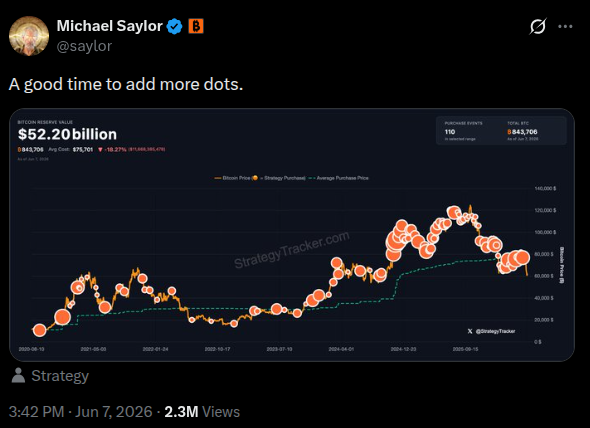
Michael Saylor did what he always does before Strategy opens its wallet. On Sunday morning, the executive chairman of the world's largest corporate Bitcoin holder posted a bubble chart to X.com, this one captioned "A good time to add more dots". For anyone who has followed Strategy long enough, the move reads like clockwork: Saylor posts the orange-dot chart, and a purchase filing with the SEC follows within days.
The post landed alongside a more pressing piece of company business. Strategy is asking its retail shareholders to approve a change to dividend payment frequency on its STRC perpetual preferred stock, shifting from monthly to semi-monthly payouts. The proxy vote deadline is June 8, and as of Sunday, the company was still scrambling to drive participation from a base that has historically been slow to engage.
The Orange Dot Chart and What It Means
Strategy's orange-dot chart has become one of the more recognizable signals in digital asset markets. Each bubble represents a Bitcoin purchase, with larger circles tied to larger acquisitions. The clustering of oversized dots across late 2024 and into 2025 visually narrates what has become an aggressive, almost relentless accumulation campaign.
At the time of Saylor's Sunday post, Strategy held 818,869 BTC, with a total reserve value of roughly $64 billion based on dashboard figures. Bitcoin was trading near $78,262 at the time, putting the company's per-share BTC equivalent at 213,391 satoshis. MSTR stock had closed Friday at $177.42, down 5.11% on the week, with a market cap of $62.31 billion and an enterprise value of $81.85 billion.
By mid-afternoon on Sunday, the post had racked up 2.3 million views. CEO Phong Le added his own endorsement, writing that the company's goal remains to "increase net Bitcoin and Bitcoin per share over time." The confirmation from two senior executives in one afternoon removed any ambiguity about the direction of travel.
The signal proved accurate. Strategy subsequently filed an 8-K confirming it had purchased 24,869 BTC for approximately $2.01 billion between May 11 and May 17, at an average price of $80,985 per coin. That brought total holdings to 843,738 BTC, funded in part through at-the-market sales of MSTR shares and proceeds from STRC preferred stock issuances.
The STRC Dividend Vote: A Harder Sell
The buy signal was the easy part. The proxy vote has been a different story.
Strategy wants to change how it pays dividends on STRC, its Variable Rate Series A Perpetual Stretch Preferred Stock. The proposal would move payments from monthly to twice monthly. The company argues the shift would reduce reinvestment lag, improve liquidity, and cut volatility in the stock's price. Saylor put it plainly in prior remarks: going semi-monthly would provide more entry and exit points for investors, and with only 176 companies in the entire market paying monthly dividends, Strategy would distinguish itself further by going even more frequent.
The challenge is getting retail investors to actually vote. Strategy says 80% of outstanding STRC shares are held by retail investors, not institutions. That is a problem because, according to a November 2024 research note from the Harvard Law School Forum on Corporate Governance, retail holders have voted only around 29% of their shares across the last five proxy seasons. Institutional holders, by contrast, vote roughly 77% of their shares.
Ahead of the June 8 deadline, both Saylor's personal account and Strategy's official social media channels were actively nudging holders to submit their ballots. The company had already scheduled a live Q&A with Saylor and CEO Phong Le on May 20 in an effort to build awareness. Strategy also engaged proxy solicitor Alliance Advisors to help drive participation, though the firm had not disclosed a vote count as of Sunday.
Context: Financing, Volatility, and a Quarterly Loss
The dual push comes at a complicated moment for Strategy. The company reported a quarterly net loss of roughly $12.5 billion earlier in the year, a figure driven largely by unrealized BTC valuation swings rather than operational trouble. Still, the headline spooked some corners of the market and briefly renewed debate over the sustainability of the company's treasury model.
Adding to the noise, Strategy had on May 15 announced an agreement to repurchase approximately $1.5 billion of its 0% convertible senior notes due 2029. The filing noted that sources of funds for the repurchase could include cash reserves, securities-sale proceeds, and Bitcoin-sale proceeds. That last option rattled traders briefly, given that any hint of BTC liquidation from the world's largest corporate holder tends to move markets.
Options activity around MSTR reflected the heightened attention. Open interest in MSTR-linked options stood at $49.49 billion heading into the weekend, with implied volatility at 60% and historical 30-day volatility at 71%. For a company that is, at its core, a leveraged Bitcoin position wrapped in a corporate structure, those figures are not out of the ordinary. But they do underscore how closely the market tracks Saylor's every post.
What Comes Next
The STRC dividend vote wrapped June 8, with results to be disclosed by the company in the following days. Whether the proxy measure passed likely hinges on how many retail holders bothered to log in and click a button, a notoriously difficult outcome to engineer without institutional guardrails.
As for the Bitcoin buying, the confirmed $2 billion purchase puts Strategy's total cost basis at roughly $63.9 billion, with an average acquisition price of $75,700 per coin. At current levels, that implies a paper gain in the low billions, and a holdings base now equivalent to more than 4% of Bitcoin's fixed 21 million supply cap. For Saylor, the orange dots keep getting bigger. The question for everyone else is whether the strategy holds if the market really turns and we see much much lower prices.

Strategy Buys Back $1.5B Bonds, May Sell Bitcoin
Strategy Inc. dropped a notable filing on Friday, announcing it has agreed to repurchase approximately $1.5 billion of its 0% Convertible Senior Notes due 2029 in a series of privately negotiated transactions with select noteholders. The buyback price comes in at roughly $1.38 billion in cash, meaning the company is retiring the debt at around 92 cents on the dollar. It is a discount, and that matters.
The notes in question were originally issued back in November 2024 with a $3 billion notional size and a 0% coupon rate. They carry a conversion price of $672.40 per share and mature December 2, 2029. With MSTR shares currently sitting around $183, that conversion price is a long way off. The decision to buy these back now, below face value, reflects what appears to be an active effort to tighten up the balance sheet while the opportunity exists.
Bitcoin Sales Back on the Table
Here is where it gets interesting. Strategy listed three possible funding sources for the repurchase: available cash reserves, proceeds from its at-the-market equity offering programs, and potentially the sale of bitcoin. That last part is drawing attention.
Executive Chairman Michael Saylor has long positioned the firm as a relentless accumulator of BTC, not a seller. At the Bitcoin 2026 conference, he stated that even if Strategy were to sell one bitcoin, it would be buying 10 to 20 more. That framing is still technically intact, but the formal inclusion of bitcoin sales as a stated funding mechanism in an SEC filing is a different kind of signal than a conference soundbite.
Strategy currently holds 818,869 BTC, acquired at a total cost of roughly $61.81 billion, or an average price around $75,537 per coin. At current prices near $80,400, the company is sitting on unrealized gains. Whether it actually taps those holdings remains to be seen, but the option is now formally on the table in a public document.
STRC Momentum and JPMorgan Projections Add Context
The announcement comes just one day after Strategy's Variable Rate Series A Perpetual Stretch Preferred Stock, known as STRC, hit a record single-day trading volume of $1.53 billion on Thursday. That beat the prior record of $1.1 billion set on April 13. Saylor flagged the milestone on X, calling it a sign of growing institutional confidence in the instrument.
The STRC instrument has become a key capital-raising tool for Strategy, helping fund a significant portion of its bitcoin accumulation over recent months. The company has added more than 101,000 BTC since March alone, with over 56,770 of those purchases occurring after April. JPMorgan analysts have projected Strategy's total bitcoin purchases for 2026 could reach $30 billion, citing the capital efficiency of its preferred equity programs.
Settlement Expected Around May 19
The final repurchase price is still subject to adjustment based on the volume-weighted average price of Strategy's Class A common stock over a designated measurement period, so the $1.38 billion figure could shift modestly before everything closes. Once settlement occurs, expected on or around May 19, the repurchased notes will be cancelled. That leaves approximately $1.5 billion of the 2029 notes still outstanding, implying the company held close to $3 billion in the instrument before this transaction.
MSTR shares were down roughly 2% in pre-market trading Friday, moving in line with a broader overnight dip in bitcoin. Analysts note that retiring the notes at a discount reduces future dilution risk, given the gap between the conversion price and current share levels, while also signaling that management is actively managing liabilities rather than simply letting them ride to maturity.
For a company that has built its entire identity around bitcoin accumulation, even the possibility of selling BTC to service debt is a nuance worth watching. Whether it stays hypothetical or not will likely depend on how bitcoin trades in the weeks ahead.

Strategy Buys Another $1 Billion in Bitcoin, Holdings Cross 780,000 BTC

Michael Saylor is not slowing down. Strategy disclosed on Monday that it bought another 13,927 BTC last week, spending roughly $1 billion at an average price of $71,902 per coin. The purchase brings total holdings to 780,897 BTC, acquired for a cumulative $59.02 billion at an average cost basis of $75,577.
The announcement came just hours after Saylor posted his now-familiar "Think Bigger" message on X alongside the company's orange-dot BTC purchase history chart. For anyone who has followed Strategy closely, the post was less of a hint and more of a countdown. He has used the same signal before every major acquisition since 2020, and this time was no different.
Strategy raised $1 billion through sales of its STRC preferred stock product, known internally as Stretch, to finance the buy entirely. The STRC instrument requires only about a 2.05% annual Bitcoin return to cover its dividend obligations. In other words, as long as Bitcoin does not flatline or fall steadily for years on end, the math works in Saylor's favor, at least in theory.
Still, the numbers are not exactly comfortable right now. Strategy disclosed $14.46 billion in unrealized losses on its digital assets for the first quarter of 2026 in a recent SEC filing. With Bitcoin trading near $71,000 and the company's average cost sitting above $75,500, the bulk of its position remains underwater. Saylor has not blinked. He declared earlier this month that "Bitcoin has won" and that the traditional four-year halving cycle is essentially dead, replaced by a market now driven primarily by institutional capital flows.
The scale of Strategy's accumulation in 2026 is hard to ignore. The company added 89,599 BTC year-to-date through late March, compared to roughly 8,484 BTC for BlackRock's IBIT over the same period. That pace puts Strategy more than 7x ahead of the world's largest asset manager in terms of 2026 Bitcoin accumulation. The gap between the two largest holders has narrowed to around 20,000 BTC, and at the current rate, Strategy could overtake IBIT as the single largest holder before summer.
To put the buying pace another way: in March alone, Strategy accumulated 46,233 BTC while the entire global Bitcoin mining network produced approximately 16,200 BTC. A single company absorbed nearly three times the newly minted supply in a single month. That kind of pressure should, theoretically, move markets. But it has not, at least not consistently.
The question of why Strategy's purchases fail to push the price higher has become something of a standing puzzle in crypto markets. CoinDesk analysts pointed to a few reasons: Strategy accounts for only about 7% of gross inflows into Bitcoin, meaning its purchases are still relatively small against the total market. More importantly, capital has been leaving the ecosystem. Bitcoin's realized cap saw a $29 billion drawdown since February, and BlackRock's IBIT open interest dropped over $4 billion in the same window. Those outflows have largely swamped the buying pressure Strategy generates.
U.S.-listed spot Bitcoin ETFs did manage $1.32 billion in net inflows during March, ending four consecutive months of outflows. But price action stayed flat for the month regardless, reinforcing the point that the link between inflows and price is neither direct nor immediate. Saylor's confident framing of Bitcoin as a new form of permanent institutional capital may be accurate in the long run. Whether it holds up in 2026's choppy macro environment, with geopolitical tensions running high and BTC sitting below his average cost, remains a much harder question to answer.
With 780,897 BTC now on its books, Strategy controls approximately 3.7% of Bitcoin's total circulating supply of about 20 million coins. MSTR shares were down roughly 2.5% in pre-market trading on Monday following the disclosure. The stock has become a proxy for leveraged Bitcoin exposure and tends to amplify both the upside and the pain. At the current pace, Strategy could push past 800,000 BTC before the end of April. Saylor, it seems, is just getting started.
Former UK PM Boris Johnson Calls Bitcoin a Ponzi Scheme
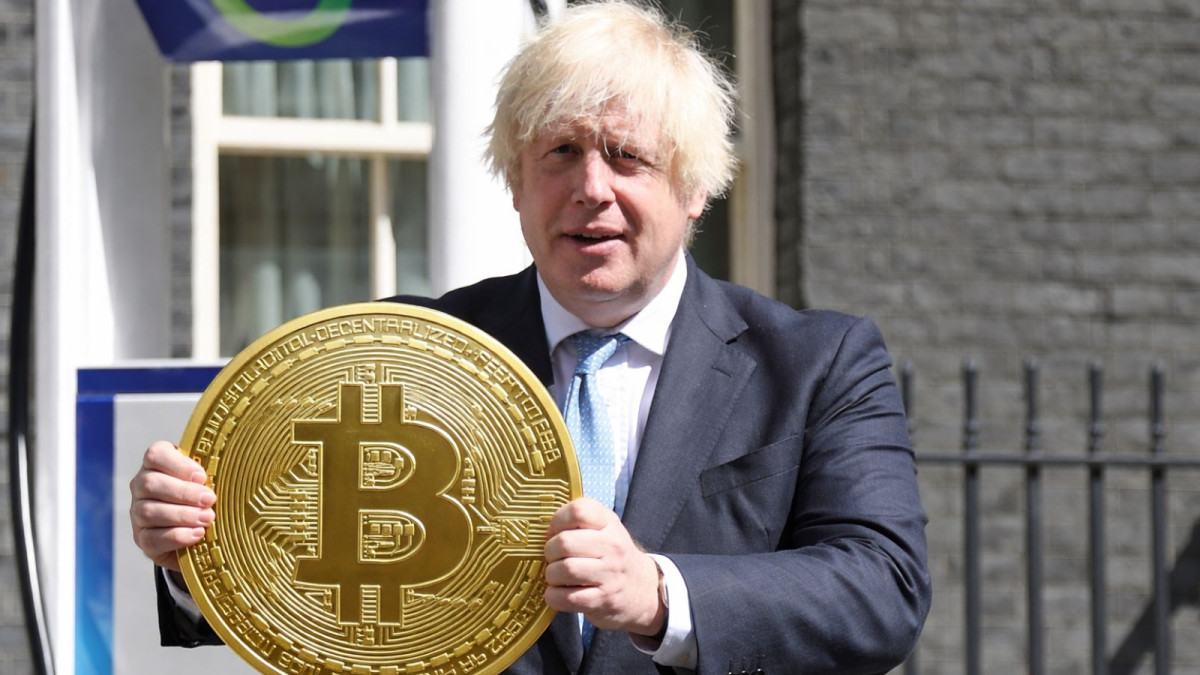
Former U.K. Prime Minister Boris Johnson has called Bitcoin a Ponzi scheme, claiming it has far less value than gold and even Pokémon cards, which he said are more widely recognized.

In a recent Daily Mail article, former UK Prime Minister Boris Johnson called Bitcoin a Ponzi scheme with no real value, saying it relied on a “supply of new and credulous investors.” He also shared the story of a friend who lost about $26,000 in a crypto investment scam.
Johnson shared a story about a retired man from a village in Oxfordshire who initially handed over £500 (about $661) to someone who promised to double the money through Bitcoin investments. Johnson said the man went on to invest £20,000 (around $26,450) over three and a half years but ultimately received nothing in return.
The former prime minister also questioned the credibility of Bitcoin, calling it “a string of numbers stored in a series of computers.” “Who can we turn to if someone decrypts the crypto?” Johnson asked. “There’s no one except Nakamoto, who might be nothing more than Pikachu or Charmander.”
Since the pseudonymous creator of Bitcoin, Satoshi Nakamoto, lacked institutional backing, Johnson questioned Bitcoin’s credibility as a tradable asset. According to Johnson, Pokémon cards, which fascinated children thirty years ago and still do today, are a more tradable asset than Bitcoin.
“These curious little Japanese cartoon beasties hold the same fascination for five-year-olds as they did 30 years ago. The kids are obsessed with them. They boast and squabble about them,” Boris said.
“Even if you remain pretty impervious to the charm of Pikachu, you can just about see why a decades-old Pikachu card is still a tradeable asset,” he added.
The Crypto Community Responded
While many social media users have ridiculed Boris’ understanding of cryptocurrency, some have offered clearer explanations of why Bitcoin cannot be called a Ponzi scheme.
Michael Saylor, founder of MicroStrategy, also sought to clarify the issue.
“Bitcoin is not a Ponzi scheme. A Ponzi requires a central operator promising returns and paying early investors with funds from later ones,” Saylor wrote on X.
“Bitcoin has no issuer, no promoter, and no guaranteed return—just an open, decentralized monetary network driven by code and market demand,” he added.
Michael Saylor’s Strategy Makes its 101st Bitcoin Purchase

Image credit: Binance.com
Strategy, the world's largest public holder of Bitcoin, has deepened its Bitcoin bet, completing its 101st Bitcoin purchase.
According to a filing made to the US Securities and Exchange Commission on Monday of this week, Strategy acquired 3,015 bitcoins for $204.1 million last week.
Based on information available on the US SEC website, the average purchase price for this transaction was $67,700 per BTC, below the company's average acquisition price of $75,985. With this latest purchase, Strategy now has total Bitcoin holdings of 720,737 BTC.

Image credit: sec.gov
Saylor’s Long-Term Bitcoin Strategy
Michael Saylor, often regarded as the Bitcoin bull, has long been one of the strongest advocates of Bitcoin's long-term value. His belief system was first made public in August 2020 when his company, Strategy, purchased 21,454 Bitcoins for about $250 million.
Rather than continue holding traditional assets in its treasury, Strategy announced it would be making Bitcoin a core part of its treasury reserve.
Regarding this 2020 purchase, Saylor himself said:
"This investment reflects our belief that bitcoin, as the world's most widely adopted cryptocurrency, is a dependable store of value and an attractive investment asset with more long-term appreciation potential than holding cash."
Since that day, Strategy has steadily accumulated Bitcoin, even during bearish market seasons.
To understand Strategy's stacking strategy, here is an overview of how it has accumulated Bitcoin over the last six years:
2020: Acquired 70,470 BTC (started Aug. 11 with the first purchase of 21,454 BTC; reached total holdings of 70,470 by Dec. 21)
2021: Acquired 53,921 BTC (total holdings reached 124,391 BTC by Dec. 30).
2022: Acquired 8,109 BTC (total holdings reached 132,500 BTC by year-end).
2023: Acquired 56,650 BTC (total holdings reached 189,150 BTC by Dec. 26).
2024: Acquired 257,250 BTC (total holdings reached 446,400 BTC by Dec. 30).
2025: Acquired 226,097 BTC (total holdings reached 672,497 BTC by Dec. 29).
2026: Has acquired 48,240 BTC, with total holdings reaching 720,737 BTC.
By steadily acquiring Bitcoin through open-market transactions, Strategy has cemented its position as the world's largest public holder of Bitcoin, making these purchases in a way that does not cause any short-term imbalance in the crypto market.
How the Market Reacted
Upon the announcement of this news, MicroStrategy's common stock (MSTR) experienced an uptick, jumping from $123 last Monday to $129 on Friday, a 4.7% increase.
The biggest gain for the MSTR stock, however, occurred on Wednesday, when it rose to $135. This increase suggests renewed investor confidence in Saylor's bitcoin purchase strategy. Even in bearish market conditions, Saylor's vision for Bitcoin remains unchanged.

Image credit: investing.com
Despite experiencing sharper selling pressure in February, with its price falling 14.8% to 15% from its January closing price of $78,621, Bitcoin experienced a slight uptick in its price, rising from $64,000 last Monday to $65,000 by Friday of last week.

Michael Saylor and MicroStrategy Buy Another 390 Bitcoin for $43 Million
MicroStrategy Doubles Down: Michael Saylor’s Relentless Bitcoin Accumulation Strategy
MicroStrategy keeps buying Bitcoin as conviction and adoption grow
Michael Saylor and MicroStrategy have once again captured the attention of the financial world by expanding their Bitcoin holdings, reinforcing their position as the largest corporate holder of the world’s leading digital asset.
While social media celebrated another symbolic “orange dot” from Saylor’s post, the message behind it was far more significant — MicroStrategy’s commitment to buying Bitcoin remains unwavering, even amid volatile markets and shifting macroeconomic conditions.
MicroStrategy’s Ongoing Bitcoin Accumulation
Since its first purchase in August 2020, MicroStrategy has consistently added Bitcoin to its corporate treasury, positioning itself as the model for institutional Bitcoin adoption. Under Saylor’s leadership, the company has built a reserve exceeding 640,000 BTC, valued at roughly $70 billion at current prices.
Each purchase reinforces Saylor’s long-term thesis: Bitcoin is the ultimate treasury reserve asset, superior to cash or gold in a world of currency debasement and inflation.
MicroStrategy has repeatedly used capital markets tools — including convertible notes, equity raises, and debt financing — to fund its purchases. The company’s strategy is clear and transparent: use the strength of its balance sheet to accumulate Bitcoin and hold indefinitely.
“Our strategy is simple,” Saylor has said. “Buy Bitcoin. Hold Bitcoin. Build shareholder value through Bitcoin.”
Why MicroStrategy Keeps Buying
1. Conviction in Bitcoin as Digital Gold
Saylor believes Bitcoin represents the most sound, scarce, and secure form of money ever created. By converting cash reserves into BTC, MicroStrategy is protecting its balance sheet from inflation while aligning itself with the long-term digital asset megatrend.
2. Institutional Leadership
MicroStrategy’s approach has transformed it from a business intelligence company into a hybrid enterprise and Bitcoin holding company. This bold pivot has made Saylor a respected voice in both corporate finance and the digital asset space.
His conviction has also inspired other institutional players — from family offices to public companies — to consider similar treasury strategies.
3. Strategic Use of Capital Markets
Instead of using operational cash flow alone, MicroStrategy has leveraged the capital markets to expand its Bitcoin holdings. By issuing stock and convertible debt, the company has found innovative ways to buy more BTC without relying solely on earnings.
4. Long-Term Thinking Over Short-Term Fluctuations
MicroStrategy has held firm through multiple Bitcoin market cycles. While short-term traders often react to volatility, Saylor views each price drop as an opportunity to buy more. The firm’s average cost basis remains well below Bitcoin’s current price, reinforcing the strength of its long-term positioning.
A Blueprint for Corporate Bitcoin Adoption
MicroStrategy’s consistent accumulation has set a precedent for how corporations can strategically integrate Bitcoin into their balance sheets. The approach has three key lessons for other businesses exploring digital assets:
-
Transparency: MicroStrategy publicly discloses every purchase, building trust with investors and regulators.
-
Strategic Financing: The company uses debt and equity issuance intelligently, preserving operational flexibility while expanding exposure.
-
Long-Term Vision: By treating Bitcoin as a core treasury asset rather than a speculative investment, MicroStrategy positions itself for long-term value creation.
This combination of innovation and conviction has made the firm a de facto ambassador for Bitcoin in corporate America.
The Bigger Picture: Institutional Bitcoin Momentum
MicroStrategy’s continued buying comes amid renewed institutional interest in Bitcoin. Exchange-traded funds (ETFs), payment platforms, and major banks are expanding access to crypto, signaling a maturing market.
While regulatory uncertainty still exists, the overall trend is clear — institutions are moving toward Bitcoin, and MicroStrategy’s approach is helping lead the way.
By maintaining its position through both bullish and bearish conditions, the company has proven that Bitcoin can serve as a reliable long-term store of value for corporate treasuries.
The Road Ahead
As MicroStrategy continues to buy Bitcoin, Saylor shows no signs of slowing down. Each acquisition sends a message of confidence not just to shareholders, but to the entire crypto industry.
The company’s transformation has sparked a global conversation about how businesses can leverage Bitcoin for financial resilience and strategic advantage. And with Saylor’s relentless optimism, it’s clear that MicroStrategy’s Bitcoin journey is far from over.
“Bitcoin is the future of money,” Saylor often says. “And we plan to be there every step of the way.”
Final Thoughts
MicroStrategy’s ongoing Bitcoin purchases represent more than just a corporate investment — they symbolize the growing alignment between traditional finance and decentralized money.
In an era where inflation erodes cash value and trust in centralized systems continues to wane, Saylor’s vision stands as both a hedge and a declaration of belief in digital freedom.
As MicroStrategy keeps adding to its Bitcoin treasury, it is not just holding an asset — it is helping build the foundation of a new financial era.
Stay Connected
You can stay up to date on all News, Events, and Marketing of Rare Network, including Rare Evo: America’s Premier Blockchain Conference, happening July 28th-31st, 2026 at The ARIA Resort & Casino, by following our socials on X, LinkedIn, and YouTube.