#Bitcoin Accumulation

Saylor Signals Bitcoin Buy as Strategy Pushes STRC Vote

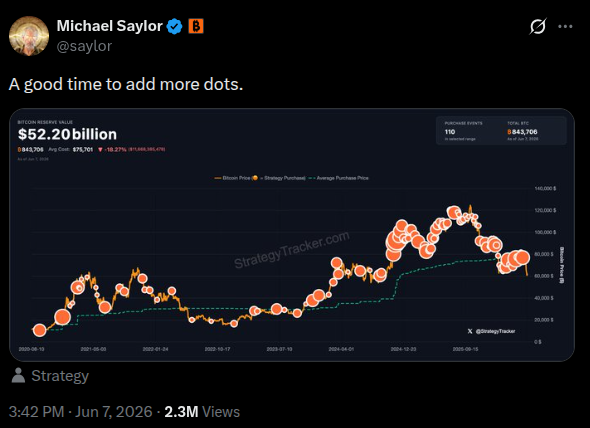
Michael Saylor did what he always does before Strategy opens its wallet. On Sunday morning, the executive chairman of the world's largest corporate Bitcoin holder posted a bubble chart to X.com, this one captioned "A good time to add more dots". For anyone who has followed Strategy long enough, the move reads like clockwork: Saylor posts the orange-dot chart, and a purchase filing with the SEC follows within days.
The post landed alongside a more pressing piece of company business. Strategy is asking its retail shareholders to approve a change to dividend payment frequency on its STRC perpetual preferred stock, shifting from monthly to semi-monthly payouts. The proxy vote deadline is June 8, and as of Sunday, the company was still scrambling to drive participation from a base that has historically been slow to engage.
The Orange Dot Chart and What It Means
Strategy's orange-dot chart has become one of the more recognizable signals in digital asset markets. Each bubble represents a Bitcoin purchase, with larger circles tied to larger acquisitions. The clustering of oversized dots across late 2024 and into 2025 visually narrates what has become an aggressive, almost relentless accumulation campaign.
At the time of Saylor's Sunday post, Strategy held 818,869 BTC, with a total reserve value of roughly $64 billion based on dashboard figures. Bitcoin was trading near $78,262 at the time, putting the company's per-share BTC equivalent at 213,391 satoshis. MSTR stock had closed Friday at $177.42, down 5.11% on the week, with a market cap of $62.31 billion and an enterprise value of $81.85 billion.
By mid-afternoon on Sunday, the post had racked up 2.3 million views. CEO Phong Le added his own endorsement, writing that the company's goal remains to "increase net Bitcoin and Bitcoin per share over time." The confirmation from two senior executives in one afternoon removed any ambiguity about the direction of travel.
The signal proved accurate. Strategy subsequently filed an 8-K confirming it had purchased 24,869 BTC for approximately $2.01 billion between May 11 and May 17, at an average price of $80,985 per coin. That brought total holdings to 843,738 BTC, funded in part through at-the-market sales of MSTR shares and proceeds from STRC preferred stock issuances.
The STRC Dividend Vote: A Harder Sell
The buy signal was the easy part. The proxy vote has been a different story.
Strategy wants to change how it pays dividends on STRC, its Variable Rate Series A Perpetual Stretch Preferred Stock. The proposal would move payments from monthly to twice monthly. The company argues the shift would reduce reinvestment lag, improve liquidity, and cut volatility in the stock's price. Saylor put it plainly in prior remarks: going semi-monthly would provide more entry and exit points for investors, and with only 176 companies in the entire market paying monthly dividends, Strategy would distinguish itself further by going even more frequent.
The challenge is getting retail investors to actually vote. Strategy says 80% of outstanding STRC shares are held by retail investors, not institutions. That is a problem because, according to a November 2024 research note from the Harvard Law School Forum on Corporate Governance, retail holders have voted only around 29% of their shares across the last five proxy seasons. Institutional holders, by contrast, vote roughly 77% of their shares.
Ahead of the June 8 deadline, both Saylor's personal account and Strategy's official social media channels were actively nudging holders to submit their ballots. The company had already scheduled a live Q&A with Saylor and CEO Phong Le on May 20 in an effort to build awareness. Strategy also engaged proxy solicitor Alliance Advisors to help drive participation, though the firm had not disclosed a vote count as of Sunday.
Context: Financing, Volatility, and a Quarterly Loss
The dual push comes at a complicated moment for Strategy. The company reported a quarterly net loss of roughly $12.5 billion earlier in the year, a figure driven largely by unrealized BTC valuation swings rather than operational trouble. Still, the headline spooked some corners of the market and briefly renewed debate over the sustainability of the company's treasury model.
Adding to the noise, Strategy had on May 15 announced an agreement to repurchase approximately $1.5 billion of its 0% convertible senior notes due 2029. The filing noted that sources of funds for the repurchase could include cash reserves, securities-sale proceeds, and Bitcoin-sale proceeds. That last option rattled traders briefly, given that any hint of BTC liquidation from the world's largest corporate holder tends to move markets.
Options activity around MSTR reflected the heightened attention. Open interest in MSTR-linked options stood at $49.49 billion heading into the weekend, with implied volatility at 60% and historical 30-day volatility at 71%. For a company that is, at its core, a leveraged Bitcoin position wrapped in a corporate structure, those figures are not out of the ordinary. But they do underscore how closely the market tracks Saylor's every post.
What Comes Next
The STRC dividend vote wrapped June 8, with results to be disclosed by the company in the following days. Whether the proxy measure passed likely hinges on how many retail holders bothered to log in and click a button, a notoriously difficult outcome to engineer without institutional guardrails.
As for the Bitcoin buying, the confirmed $2 billion purchase puts Strategy's total cost basis at roughly $63.9 billion, with an average acquisition price of $75,700 per coin. At current levels, that implies a paper gain in the low billions, and a holdings base now equivalent to more than 4% of Bitcoin's fixed 21 million supply cap. For Saylor, the orange dots keep getting bigger. The question for everyone else is whether the strategy holds if the market really turns and we see much much lower prices.

Strategy Buys Back $1.5B Bonds, May Sell Bitcoin
Strategy Inc. dropped a notable filing on Friday, announcing it has agreed to repurchase approximately $1.5 billion of its 0% Convertible Senior Notes due 2029 in a series of privately negotiated transactions with select noteholders. The buyback price comes in at roughly $1.38 billion in cash, meaning the company is retiring the debt at around 92 cents on the dollar. It is a discount, and that matters.
The notes in question were originally issued back in November 2024 with a $3 billion notional size and a 0% coupon rate. They carry a conversion price of $672.40 per share and mature December 2, 2029. With MSTR shares currently sitting around $183, that conversion price is a long way off. The decision to buy these back now, below face value, reflects what appears to be an active effort to tighten up the balance sheet while the opportunity exists.
Bitcoin Sales Back on the Table
Here is where it gets interesting. Strategy listed three possible funding sources for the repurchase: available cash reserves, proceeds from its at-the-market equity offering programs, and potentially the sale of bitcoin. That last part is drawing attention.
Executive Chairman Michael Saylor has long positioned the firm as a relentless accumulator of BTC, not a seller. At the Bitcoin 2026 conference, he stated that even if Strategy were to sell one bitcoin, it would be buying 10 to 20 more. That framing is still technically intact, but the formal inclusion of bitcoin sales as a stated funding mechanism in an SEC filing is a different kind of signal than a conference soundbite.
Strategy currently holds 818,869 BTC, acquired at a total cost of roughly $61.81 billion, or an average price around $75,537 per coin. At current prices near $80,400, the company is sitting on unrealized gains. Whether it actually taps those holdings remains to be seen, but the option is now formally on the table in a public document.
STRC Momentum and JPMorgan Projections Add Context
The announcement comes just one day after Strategy's Variable Rate Series A Perpetual Stretch Preferred Stock, known as STRC, hit a record single-day trading volume of $1.53 billion on Thursday. That beat the prior record of $1.1 billion set on April 13. Saylor flagged the milestone on X, calling it a sign of growing institutional confidence in the instrument.
The STRC instrument has become a key capital-raising tool for Strategy, helping fund a significant portion of its bitcoin accumulation over recent months. The company has added more than 101,000 BTC since March alone, with over 56,770 of those purchases occurring after April. JPMorgan analysts have projected Strategy's total bitcoin purchases for 2026 could reach $30 billion, citing the capital efficiency of its preferred equity programs.
Settlement Expected Around May 19
The final repurchase price is still subject to adjustment based on the volume-weighted average price of Strategy's Class A common stock over a designated measurement period, so the $1.38 billion figure could shift modestly before everything closes. Once settlement occurs, expected on or around May 19, the repurchased notes will be cancelled. That leaves approximately $1.5 billion of the 2029 notes still outstanding, implying the company held close to $3 billion in the instrument before this transaction.
MSTR shares were down roughly 2% in pre-market trading Friday, moving in line with a broader overnight dip in bitcoin. Analysts note that retiring the notes at a discount reduces future dilution risk, given the gap between the conversion price and current share levels, while also signaling that management is actively managing liabilities rather than simply letting them ride to maturity.
For a company that has built its entire identity around bitcoin accumulation, even the possibility of selling BTC to service debt is a nuance worth watching. Whether it stays hypothetical or not will likely depend on how bitcoin trades in the weeks ahead.
Strive Adds 317 BTC, Enters Top-10 Bitcoin Treasury Rankings

Strive Inc., the Columbus, Ohio-based Bitcoin treasury company co-founded by Ohio Gubernatorial Candidate, Vivek Ramaswamy, has crossed a threshold that would have seemed far-fetched. It now ranks among the ten largest publicly traded corporate holders of Bitcoin in the world.
In the days surrounding its earnings disclosure this week, Strive confirmed it had purchased 317 additional Bitcoin, pushing total holdings to 13,628 BTC as of March 17, 2026. At current prices hovering around $70,000 per coin, that stack carries a market value just shy of $1 billion, making Strive one of the more consequential new entrants to a leaderboard that has historically been dominated by the likes of Strategy, Marathon Digital, and a small cluster of Bitcoin miners.
Bitcoin has been under pressure in 2026, sliding more than 45% from its October 2025 peak near $126,000 down toward the low-to-mid $60,000s in early March before recovering recently. For a company whose entire model is built around accumulating the asset as cheaply as possible relative to the number of shares outstanding, a bear market is arguably an opportunity. Strive's management frames it precisely that way, pointing to a metric they call Bitcoin Yield, which measures how much Bitcoin the company has added per diluted share regardless of price. That figure came in at 22.2% for Q4 2025 alone.
What The Q4 Numbers Actually Mean
Digging into the earnings release filed with the SEC on March 19, the headline GAAP loss of $393.6 million looks alarming in isolation. The non-GAAP adjusted net loss attributable to common stockholders was a smaller but still substantial $208.2 million, with a diluted loss per share of $4.73 after accounting for the company's 1-for-20 reverse stock split.
The gap between those two figures reflects the particular accounting treatment of Bitcoin holdings under relatively recent FASB guidance. Unrealized losses on digital assets flow through the income statement, meaning that as Bitcoin fell from its October peak through December 31, those paper losses showed up in full on the P&L. The inverse would be true in a rising market, and indeed Strive reported a Bitcoin Dollar Gain of $114.3 million for Q4 and a further $78.2 million through mid-March.
On the balance sheet, the company held $668.5 million in digital assets at fair value as of December 31, 2025, with $67.5 million in cash. A follow-on offering of its Variable Rate Series A Perpetual Preferred Stock, marketed under the ticker SATA, added roughly $109.2 million in net proceeds in January 2026. The SATA instrument has become central to Strive's funding model: investors buy the preferred shares at around $100 apiece, collect a quarterly dividend currently yielding 12.75% annualized, and Strive takes that capital straight into the Bitcoin market.
Buying Strategy's Preferred Stock
Perhaps the most eyebrow-raising move in recent weeks was Strive's decision to deploy $50 million into Strategy Inc.'s perpetual preferred stock, known as STRC, which currently yields 11.5%. In other words, one Bitcoin treasury company is now using its balance sheet to buy the preferred equity of another Bitcoin treasury company. Both firms are simultaneously accumulating Bitcoin and investing in each other's capital structures.
Strategy, which holds 738,731 BTC and remains by far the largest corporate holder, is itself under pressure: MSTR shares have declined every month this year and are down more than 51% from their peak. The shared exposure to a single asset means that a sustained Bitcoin downturn would stress every link in this chain at roughly the same moment.
That said, for Strive, the STRC investment has a certain logic. At 11.5% yield on a $50 million position, it generates income that can be used to service SATA dividends or fund further BTC purchases without liquidating any actual Bitcoin. The company gets dollar-denominated cash flow from a security whose ultimate collateral is also Bitcoin. Whether that makes the trade elegant or doubly risky depends heavily on where Bitcoin goes next. Strive is betting that direction is up and to the right.
Wall Street Is Paying Attention
B. Riley launched coverage of Strive earlier this month with a Buy rating and a $12 price target, citing the company's dual-engine model as an underappreciated value driver. Analyst Fedor Shabalin made the case that the market has not yet assigned meaningful value to Strive's asset management business, which oversees roughly $2.5 billion in assets separately from the Bitcoin treasury. With shares trading around $8.51 at the time, that $12 target implies roughly 40% upside, but it also positions B. Riley as far more conservative than the stock's own 52-week high of $268 would suggest was once in play.
The initiation note also highlighted a key sensitivity: every $1,000 move in Bitcoin translates to approximately $13.1 million in treasury value for Strive. At 13,628 BTC, the company's fortunes are tightly tethered to a single price feed. That is, of course, the entire point. Strive is not trying to hedge Bitcoin; it is trying to accumulate as much of it as possible per share outstanding, and then let the market decide what that is worth.
BTC Treasury Race
Strive's entry into the top-10 comes against a backdrop of explosive growth in corporate Bitcoin adoption. According to data tracked by Bitcointreasuries.net, the number of publicly listed companies worldwide holding Bitcoin as a treasury asset crossed 200 in 2025, up from fewer than 30 before that year. The pace of adoption has outrun even optimistic projections made at the time of the first U.S. spot Bitcoin ETF approvals in January 2024.
Tesla sits on 11,509 BTC and has not meaningfully added to its position since late 2024, which allowed Strive, at 13,311 BTC following its March 11 purchase, to move past Elon Musk's automaker on the public company leaderboard. CleanSpark, Marathon Digital, and others in the mining space remain ahead, but the distinction between miner and pure-play treasury holder is blurring as more non-mining companies pursue the same accumulation strategy.
Fidelity Digital Assets has argued that Bitcoin can serve as a hedge against currency debasement and fiscal instability, a view that has gained traction among CFOs navigating an environment of persistent deficits and geopolitical uncertainty. Strive's pitch to shareholders is essentially that argument distilled into a public equity vehicle, one that offers exposure to Bitcoin's upside while layering in financial engineering designed to compound that exposure faster than holding the coin directly.
Vivek Ramaswamy founded Strive in 2022 alongside former Anheuser-Busch president Anson Frericks with backing from Peter Thiel, JD Vance, and Bill Ackman. The firm's original identity was aggressively anti-ESG and anti-DEI, positioning itself as the antidote to what Ramaswamy called the politicization of corporate America by the BlackRocks and Vanguards of the world. Ramaswamy stepped back from day-to-day involvement in early 2023 to run for president, and though he lost to Trump in the primaries, he ultimately endorsed him and parlayed the campaign into a political profile that kept him relevant.
The Bitcoin pivot came in September 2025 under CEO Matt Cole, who repositioned the entire enterprise around the treasury strategy. Ramaswamy has remained involved as a figurehead and public voice, even as the operational direction shifted substantially. The anti-ESG brand has receded; what remains is a company that pitches itself as the first publicly traded asset management firm to adopt Bitcoin as its primary treasury asset.
The SATA preferred stock has been described internally as a form of long-duration equity, and demand has at times surprised the company's own projections. Investor appetite reportedly exceeded $600 million at one point, allowing Strive to upsize its offering to $225 million. The instrument trades on Nasdaq and has generally held close to its $100 par value, though it was recently quoted around $96, reflecting some softness tied to broader crypto market conditions.
The End Game
Strive has been clear about its intentions. The company wants to monetize Clinivanta, raise additional capital through preferred equity issuances, and buy more Bitcoin. Whether the market awards it a premium over net asset value depends largely on Bitcoin's trajectory and investors' willingness to pay for the financial engineering on top of the underlying asset.
Right now, that premium is not there. With ASST shares trading at roughly 0.9 times modified NAV, the market is essentially saying the business operations and the leverage strategy add no value, or even detract from it. B. Riley disagrees, pointing to the asset management business as an overlooked driver. Prediction markets currently assign a 38.5% probability to Bitcoin hitting $100,000 by the end of 2026. If that happens, Strive's $1 billion treasury becomes a $1.4 billion treasury and the math starts looking a lot more attractive to equity holders.
For the moment, the company sits in a paradox familiar to anyone who has watched Strategy over the past few years: the asset is underperforming from its peak, the stock is down sharply, and yet the conviction that the trade is right has only deepened. Strive added 317 BTC this week. It will almost certainly add more.