#Institutional Bitcoin

Strategy Buys Another $1 Billion in Bitcoin, Holdings Cross 780,000 BTC

Michael Saylor is not slowing down. Strategy disclosed on Monday that it bought another 13,927 BTC last week, spending roughly $1 billion at an average price of $71,902 per coin. The purchase brings total holdings to 780,897 BTC, acquired for a cumulative $59.02 billion at an average cost basis of $75,577.
The announcement came just hours after Saylor posted his now-familiar "Think Bigger" message on X alongside the company's orange-dot BTC purchase history chart. For anyone who has followed Strategy closely, the post was less of a hint and more of a countdown. He has used the same signal before every major acquisition since 2020, and this time was no different.
Strategy raised $1 billion through sales of its STRC preferred stock product, known internally as Stretch, to finance the buy entirely. The STRC instrument requires only about a 2.05% annual Bitcoin return to cover its dividend obligations. In other words, as long as Bitcoin does not flatline or fall steadily for years on end, the math works in Saylor's favor, at least in theory.
Still, the numbers are not exactly comfortable right now. Strategy disclosed $14.46 billion in unrealized losses on its digital assets for the first quarter of 2026 in a recent SEC filing. With Bitcoin trading near $71,000 and the company's average cost sitting above $75,500, the bulk of its position remains underwater. Saylor has not blinked. He declared earlier this month that "Bitcoin has won" and that the traditional four-year halving cycle is essentially dead, replaced by a market now driven primarily by institutional capital flows.
The scale of Strategy's accumulation in 2026 is hard to ignore. The company added 89,599 BTC year-to-date through late March, compared to roughly 8,484 BTC for BlackRock's IBIT over the same period. That pace puts Strategy more than 7x ahead of the world's largest asset manager in terms of 2026 Bitcoin accumulation. The gap between the two largest holders has narrowed to around 20,000 BTC, and at the current rate, Strategy could overtake IBIT as the single largest holder before summer.
To put the buying pace another way: in March alone, Strategy accumulated 46,233 BTC while the entire global Bitcoin mining network produced approximately 16,200 BTC. A single company absorbed nearly three times the newly minted supply in a single month. That kind of pressure should, theoretically, move markets. But it has not, at least not consistently.
The question of why Strategy's purchases fail to push the price higher has become something of a standing puzzle in crypto markets. CoinDesk analysts pointed to a few reasons: Strategy accounts for only about 7% of gross inflows into Bitcoin, meaning its purchases are still relatively small against the total market. More importantly, capital has been leaving the ecosystem. Bitcoin's realized cap saw a $29 billion drawdown since February, and BlackRock's IBIT open interest dropped over $4 billion in the same window. Those outflows have largely swamped the buying pressure Strategy generates.
U.S.-listed spot Bitcoin ETFs did manage $1.32 billion in net inflows during March, ending four consecutive months of outflows. But price action stayed flat for the month regardless, reinforcing the point that the link between inflows and price is neither direct nor immediate. Saylor's confident framing of Bitcoin as a new form of permanent institutional capital may be accurate in the long run. Whether it holds up in 2026's choppy macro environment, with geopolitical tensions running high and BTC sitting below his average cost, remains a much harder question to answer.
With 780,897 BTC now on its books, Strategy controls approximately 3.7% of Bitcoin's total circulating supply of about 20 million coins. MSTR shares were down roughly 2.5% in pre-market trading on Monday following the disclosure. The stock has become a proxy for leveraged Bitcoin exposure and tends to amplify both the upside and the pain. At the current pace, Strategy could push past 800,000 BTC before the end of April. Saylor, it seems, is just getting started.
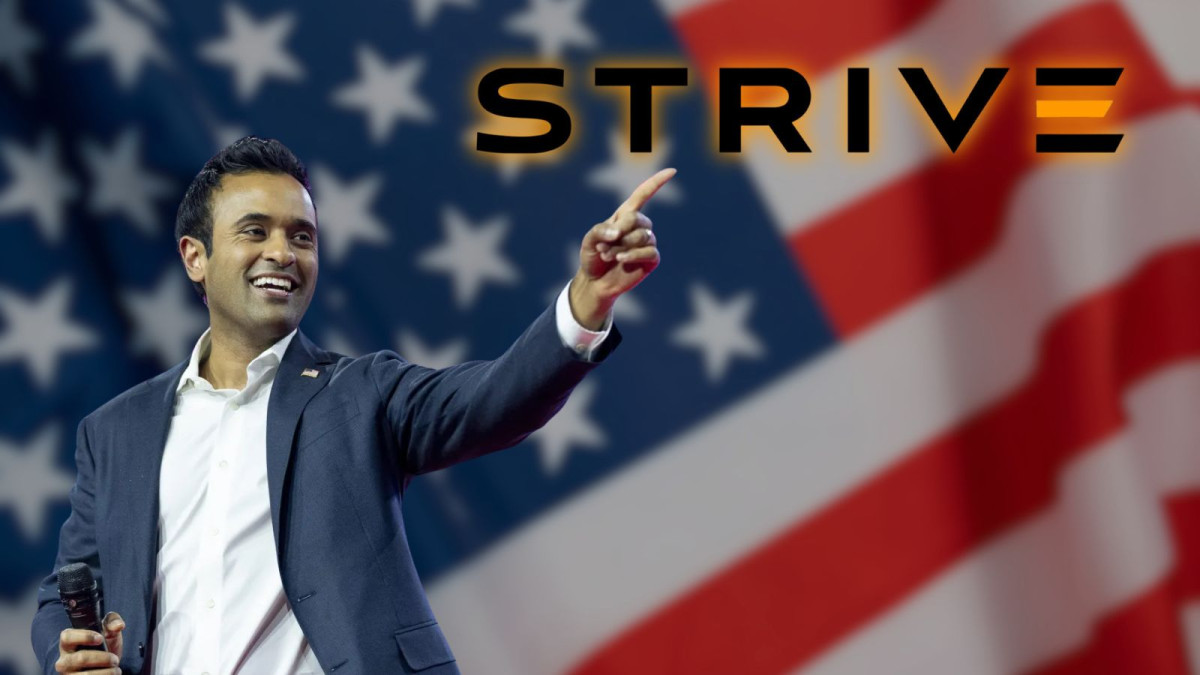
Strive Adds 317 BTC, Enters Top-10 Bitcoin Treasury Rankings

Strive Inc., the Columbus, Ohio-based Bitcoin treasury company co-founded by Ohio Gubernatorial Candidate, Vivek Ramaswamy, has crossed a threshold that would have seemed far-fetched. It now ranks among the ten largest publicly traded corporate holders of Bitcoin in the world.
In the days surrounding its earnings disclosure this week, Strive confirmed it had purchased 317 additional Bitcoin, pushing total holdings to 13,628 BTC as of March 17, 2026. At current prices hovering around $70,000 per coin, that stack carries a market value just shy of $1 billion, making Strive one of the more consequential new entrants to a leaderboard that has historically been dominated by the likes of Strategy, Marathon Digital, and a small cluster of Bitcoin miners.
Bitcoin has been under pressure in 2026, sliding more than 45% from its October 2025 peak near $126,000 down toward the low-to-mid $60,000s in early March before recovering recently. For a company whose entire model is built around accumulating the asset as cheaply as possible relative to the number of shares outstanding, a bear market is arguably an opportunity. Strive's management frames it precisely that way, pointing to a metric they call Bitcoin Yield, which measures how much Bitcoin the company has added per diluted share regardless of price. That figure came in at 22.2% for Q4 2025 alone.
What The Q4 Numbers Actually Mean
Digging into the earnings release filed with the SEC on March 19, the headline GAAP loss of $393.6 million looks alarming in isolation. The non-GAAP adjusted net loss attributable to common stockholders was a smaller but still substantial $208.2 million, with a diluted loss per share of $4.73 after accounting for the company's 1-for-20 reverse stock split.
The gap between those two figures reflects the particular accounting treatment of Bitcoin holdings under relatively recent FASB guidance. Unrealized losses on digital assets flow through the income statement, meaning that as Bitcoin fell from its October peak through December 31, those paper losses showed up in full on the P&L. The inverse would be true in a rising market, and indeed Strive reported a Bitcoin Dollar Gain of $114.3 million for Q4 and a further $78.2 million through mid-March.
On the balance sheet, the company held $668.5 million in digital assets at fair value as of December 31, 2025, with $67.5 million in cash. A follow-on offering of its Variable Rate Series A Perpetual Preferred Stock, marketed under the ticker SATA, added roughly $109.2 million in net proceeds in January 2026. The SATA instrument has become central to Strive's funding model: investors buy the preferred shares at around $100 apiece, collect a quarterly dividend currently yielding 12.75% annualized, and Strive takes that capital straight into the Bitcoin market.
Buying Strategy's Preferred Stock
Perhaps the most eyebrow-raising move in recent weeks was Strive's decision to deploy $50 million into Strategy Inc.'s perpetual preferred stock, known as STRC, which currently yields 11.5%. In other words, one Bitcoin treasury company is now using its balance sheet to buy the preferred equity of another Bitcoin treasury company. Both firms are simultaneously accumulating Bitcoin and investing in each other's capital structures.
Strategy, which holds 738,731 BTC and remains by far the largest corporate holder, is itself under pressure: MSTR shares have declined every month this year and are down more than 51% from their peak. The shared exposure to a single asset means that a sustained Bitcoin downturn would stress every link in this chain at roughly the same moment.
That said, for Strive, the STRC investment has a certain logic. At 11.5% yield on a $50 million position, it generates income that can be used to service SATA dividends or fund further BTC purchases without liquidating any actual Bitcoin. The company gets dollar-denominated cash flow from a security whose ultimate collateral is also Bitcoin. Whether that makes the trade elegant or doubly risky depends heavily on where Bitcoin goes next. Strive is betting that direction is up and to the right.
Wall Street Is Paying Attention
B. Riley launched coverage of Strive earlier this month with a Buy rating and a $12 price target, citing the company's dual-engine model as an underappreciated value driver. Analyst Fedor Shabalin made the case that the market has not yet assigned meaningful value to Strive's asset management business, which oversees roughly $2.5 billion in assets separately from the Bitcoin treasury. With shares trading around $8.51 at the time, that $12 target implies roughly 40% upside, but it also positions B. Riley as far more conservative than the stock's own 52-week high of $268 would suggest was once in play.
The initiation note also highlighted a key sensitivity: every $1,000 move in Bitcoin translates to approximately $13.1 million in treasury value for Strive. At 13,628 BTC, the company's fortunes are tightly tethered to a single price feed. That is, of course, the entire point. Strive is not trying to hedge Bitcoin; it is trying to accumulate as much of it as possible per share outstanding, and then let the market decide what that is worth.
BTC Treasury Race
Strive's entry into the top-10 comes against a backdrop of explosive growth in corporate Bitcoin adoption. According to data tracked by Bitcointreasuries.net, the number of publicly listed companies worldwide holding Bitcoin as a treasury asset crossed 200 in 2025, up from fewer than 30 before that year. The pace of adoption has outrun even optimistic projections made at the time of the first U.S. spot Bitcoin ETF approvals in January 2024.
Tesla sits on 11,509 BTC and has not meaningfully added to its position since late 2024, which allowed Strive, at 13,311 BTC following its March 11 purchase, to move past Elon Musk's automaker on the public company leaderboard. CleanSpark, Marathon Digital, and others in the mining space remain ahead, but the distinction between miner and pure-play treasury holder is blurring as more non-mining companies pursue the same accumulation strategy.
Fidelity Digital Assets has argued that Bitcoin can serve as a hedge against currency debasement and fiscal instability, a view that has gained traction among CFOs navigating an environment of persistent deficits and geopolitical uncertainty. Strive's pitch to shareholders is essentially that argument distilled into a public equity vehicle, one that offers exposure to Bitcoin's upside while layering in financial engineering designed to compound that exposure faster than holding the coin directly.
Vivek Ramaswamy founded Strive in 2022 alongside former Anheuser-Busch president Anson Frericks with backing from Peter Thiel, JD Vance, and Bill Ackman. The firm's original identity was aggressively anti-ESG and anti-DEI, positioning itself as the antidote to what Ramaswamy called the politicization of corporate America by the BlackRocks and Vanguards of the world. Ramaswamy stepped back from day-to-day involvement in early 2023 to run for president, and though he lost to Trump in the primaries, he ultimately endorsed him and parlayed the campaign into a political profile that kept him relevant.
The Bitcoin pivot came in September 2025 under CEO Matt Cole, who repositioned the entire enterprise around the treasury strategy. Ramaswamy has remained involved as a figurehead and public voice, even as the operational direction shifted substantially. The anti-ESG brand has receded; what remains is a company that pitches itself as the first publicly traded asset management firm to adopt Bitcoin as its primary treasury asset.
The SATA preferred stock has been described internally as a form of long-duration equity, and demand has at times surprised the company's own projections. Investor appetite reportedly exceeded $600 million at one point, allowing Strive to upsize its offering to $225 million. The instrument trades on Nasdaq and has generally held close to its $100 par value, though it was recently quoted around $96, reflecting some softness tied to broader crypto market conditions.
The End Game
Strive has been clear about its intentions. The company wants to monetize Clinivanta, raise additional capital through preferred equity issuances, and buy more Bitcoin. Whether the market awards it a premium over net asset value depends largely on Bitcoin's trajectory and investors' willingness to pay for the financial engineering on top of the underlying asset.
Right now, that premium is not there. With ASST shares trading at roughly 0.9 times modified NAV, the market is essentially saying the business operations and the leverage strategy add no value, or even detract from it. B. Riley disagrees, pointing to the asset management business as an overlooked driver. Prediction markets currently assign a 38.5% probability to Bitcoin hitting $100,000 by the end of 2026. If that happens, Strive's $1 billion treasury becomes a $1.4 billion treasury and the math starts looking a lot more attractive to equity holders.
For the moment, the company sits in a paradox familiar to anyone who has watched Strategy over the past few years: the asset is underperforming from its peak, the stock is down sharply, and yet the conviction that the trade is right has only deepened. Strive added 317 BTC this week. It will almost certainly add more.