#Lightning Network
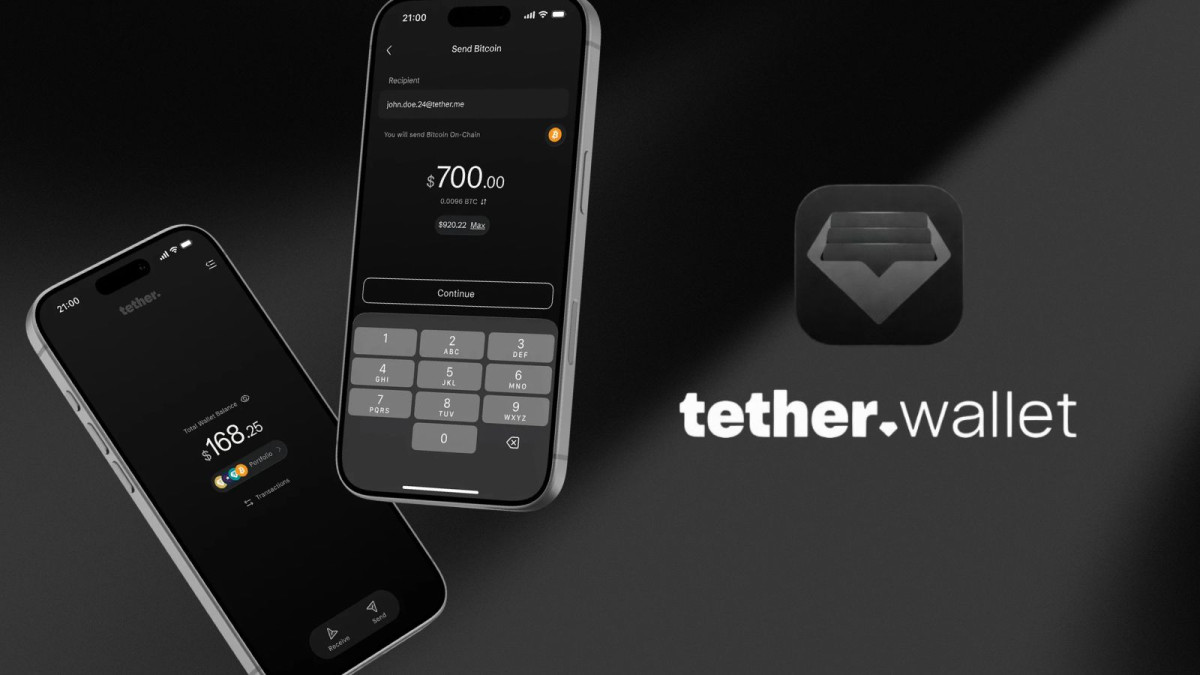
Tether Launches Self-Custodial Wallet for USDT, Bitcoin, and Gold Tokens

The world's largest stablecoin issuer is getting into the wallet game. Tether has officially launched tether.wallet, a self-custodial application that puts its payments infrastructure directly into the hands of end users for the first time.
For more than a decade, Tether's USDT stablecoin quietly powers hundreds of billions in daily trading volume, settlement, and cross-border payments across dozens of blockchains. But, most users never interact with Tether directly. That is about to change
The new app, simply called tether.wallet, supports four assets at launch: USDT, the company's U.S.-market stablecoin USAT, its gold-backed token XAUT, and Bitcoin, available both on-chain and through the Lightning Network. USDT and XAUT run on Ethereum, Polygon, Plasma, and Arbitrum at launch, while USAT is limited to Ethereum for now, with more networks reportedly in the pipeline.
No More Long Wallet Addresses
One of the more practical features is the use of human-readable identifiers, think something like [email protected], instead of the standard hexadecimal wallet strings that have caused users to accidentally send funds to the wrong address for years. Transactions also settle without requiring users to hold separate gas tokens; fees are paid directly in the asset being transferred. For anyone who has fumbled through a failed transaction because they did not have enough ETH to cover gas, that is a genuinely meaningful improvement.
Private keys remain fully under user control. All transactions are signed locally on the device, and Tether says it never holds user funds or keys at any point. It is a fully self-custodial model, which distinguishes it from the exchange-hosted wallets that have drawn scrutiny after a string of high-profile custodial failures in recent years.
570 Million Users, and Counting
Tether says its technology already reaches more than 570 million people across over 160 countries as of March 2026, with tens of millions of new wallets being added each quarter. The company is pitching tether.wallet as the next logical step in that growth, designed for mainstream users who have never touched a crypto wallet before, not just the crypto-native crowd who already know what a seed phrase is.
CEO Paolo Ardoino has been making the rounds with this one. He described the product as "the People's Wallet," framing it as a natural evolution of Tether's role from building the foundation of the digital asset economy to making it directly usable by anyone. His pitch goes further than stablecoins, though. Ardoino has long argued that AI agents will need native, self-custodial wallets for machine-to-machine payments, and the Wallet Development Kit (WDK) that underpins tether.wallet is designed with that kind of future in mind.
tether.wallet is built on Tether's open-source Wallet Development Kit, which the company has been quietly developing for a while now. The WDK had its first significant public deployment in January 2026, when video platform Rumble launched a non-custodial wallet built on the same infrastructure, enabling creator tipping in Bitcoin and USDT across Rumble's 80 million users. That earlier rollout effectively served as a real-world stress test before today's broader consumer launch.
The open source nature means third-party developers, businesses, and potentially AI systems can all build self-custodial wallet products on the same foundation. Tether is positioning this less as a single app and more as the beginning of a distribution layer.
Tether's Big Year...So Far
Tether has had a busy year on multiple fronts. In January, the company launched USAT, a GENIUS Act-compliant U.S.-regulated stablecoin issued through Anchorage Digital Bank, a direct challenge to Circle's USDC in the institutional and regulated segment of the market. In March, Tether engaged KPMG for what it described as the first-ever full financial audit of its $185 billion USDT reserves, a significant departure from the periodic attestations the company has historically relied on. PwC was also brought in to assist with internal systems preparation.
By moving into consumer-facing wallet infrastructure, Tether is entering territory already occupied by MetaMask, Phantom, Trust Wallet, and others. Those players have years of user experience, broad network support, and established reputations. Whether Tether's brand recognition among non-crypto users, combined with the built-in familiarity of USDT, translates into meaningful adoption is the real question. The stablecoin market itself crossed $315 billion in March 2026, an all-time high, and analysts expect this number to grow dramatically over the next few years.
Square Makes Bitcoin Default for Millions of U.S. Small Businesses

Jack Dorsey's Square has rolled out Bitcoin payments for millions in the United States. Starting March 30, Bitcoin payments are now switched on by default for millions of eligible U.S. sellers on the platform, no opt-in, no lengthy setup, no technical expertise required. For a lot of small business owners, they may not even notice it happened until a customer tries to pay with BTC at checkout.
Block, Square's parent company, confirmed the rollout through a post on X, telling merchants they can now "start accepting bitcoin that instantly converts to cash at checkout, with no additional setup." The shift builds directly on the Square Bitcoin initiative the company announced in late 2025, but this time it is not optional infrastructure sitting in the background. Bitcoin acceptance is now baked into the payment stack that millions of American businesses already use daily for point-of-sale, inventory and payroll.
Zero Fees, Instant Settlement, No Volatility Risk
Square is making it as easy as possible for businesses to integrate Bticoin payments. When a customer pays in Bitcoin, the transaction settles near-instantly via the Lightning Network and converts to U.S. dollars at the moment of sale. The merchant never holds BTC, never worries about the price dropping overnight and does not need to make any changes to their accounting. They just receive dollars, same as always.
On top of that, Square is waiving processing fees on Bitcoin payments through the end of 2026. Starting January 1, 2027, the fee becomes 1% per transaction, which is still well below what most card networks charge. For small businesses watching margins closely, that gap is not nothing. It is a real financial incentive to keep the feature on, or at minimum to not bother turning it off.
Miles Suter, Block's head of Bitcoin product, framed the goal plainly: making it easier for millions of businesses to accept bitcoin at scale. What he left unsaid is how unusual the default-on design actually is. Most payment processors that support crypto, including PayPal, Stripe and Coinbase Commerce, require merchants to actively enable cryptocurrency in their settings. Square has flipped that logic entirely.
The Default-On Model Could Be the Whole Story
Industry observers have zeroed in on the opt-out structure as the most consequential design choice here. Merchants who do not want to accept BTC can disable the feature through their Square dashboard. But it is on. For everyone. By default. The expectation is that most won't bother. Inertia is a powerful force in business software. If even a small fraction of Square's millions of active sellers leave Bitcoin payments on, the practical footprint of BTC in everyday commerce expands in a way that years of crypto advocacy has failed to achieve.
Lightspark CEO David Marcus, the former president of PayPal, was quick to call the move transformative. He compared it to the early standardization of TCP/IP, the protocol that allowed disparate computer networks to communicate through a shared standard. "Enabling Bitcoin payments at scale could mirror how TCP/IP became the foundational protocol of the internet," Marcus said. It is a big claim. But the underlying logic, that Bitcoin could become a neutral, interoperable layer for value transfer the way TCP/IP became one for data, is not a new idea. Dorsey himself has argued something similar for years.
Part of a Bigger Block Ecosystem Push
This rollout did not come out of nowhere. Block has been building toward it for a while. Through Cash App, the company already serves consumers who can buy, sell and transfer Bitcoin. Bitkey gives users a self-custody hardware wallet option. Spiral funds open-source Bitcoin development. Proto is building out mining infrastructure. Square's auto-enabled payments are the commercial layer on top of all that, the piece that ties the ecosystem to Main Street.
This move also arrives in a regulatory environment that, while still messy in places, is more favorable than it has ever been. The SEC has clarified guidelines for payment processors handling cryptocurrency conversions, giving companies like Square more legal certainty to act. States including Texas and Florida have moved to pass crypto-friendly legislation. Treasury Department officials have signaled support for mainstream payment integration, even as federal frameworks around transaction reporting remain a work in progress.
Square's feature is not available to sellers in New York State, where the regulatory picture remains more complicated. The company has not commented on a timeline for expansion there.
What Comes Next Is the Real Question
There are real unknowns here. Building the infrastructure is one thing. Getting consumers to actually choose Bitcoin at checkout, when they could just tap a card, is another. Merchant adoption, in the sense of sellers actively keeping the feature on and promoting it to customers, is not guaranteed either. And competitive dynamics are shifting. PayPal's PYUSD stablecoin is expanding across 70 markets, representing a different bet on which form of digital money wins out in everyday commerce.
Dorsey's position, and Block's broader strategy, is that Bitcoin's long-term infrastructure potential outweighs the short-term predictability of dollar-pegged stablecoins. The company is absorbing the volatility risk so merchants don't have to, which is essentially a sustained institutional bet on Bitcoin's direction. Whether that bet pays off will depend on whether consumers follow the infrastructure that has now been built for them. That part, nobody fully controls, but it will be interesting to watch the numbers and who is actually using this.