#Preferred Stock

Saylor Signals Bitcoin Buy as Strategy Pushes STRC Vote

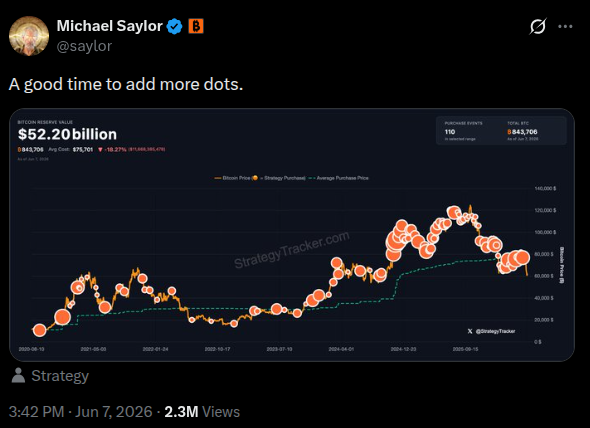
Michael Saylor did what he always does before Strategy opens its wallet. On Sunday morning, the executive chairman of the world's largest corporate Bitcoin holder posted a bubble chart to X.com, this one captioned "A good time to add more dots". For anyone who has followed Strategy long enough, the move reads like clockwork: Saylor posts the orange-dot chart, and a purchase filing with the SEC follows within days.
The post landed alongside a more pressing piece of company business. Strategy is asking its retail shareholders to approve a change to dividend payment frequency on its STRC perpetual preferred stock, shifting from monthly to semi-monthly payouts. The proxy vote deadline is June 8, and as of Sunday, the company was still scrambling to drive participation from a base that has historically been slow to engage.
The Orange Dot Chart and What It Means
Strategy's orange-dot chart has become one of the more recognizable signals in digital asset markets. Each bubble represents a Bitcoin purchase, with larger circles tied to larger acquisitions. The clustering of oversized dots across late 2024 and into 2025 visually narrates what has become an aggressive, almost relentless accumulation campaign.
At the time of Saylor's Sunday post, Strategy held 818,869 BTC, with a total reserve value of roughly $64 billion based on dashboard figures. Bitcoin was trading near $78,262 at the time, putting the company's per-share BTC equivalent at 213,391 satoshis. MSTR stock had closed Friday at $177.42, down 5.11% on the week, with a market cap of $62.31 billion and an enterprise value of $81.85 billion.
By mid-afternoon on Sunday, the post had racked up 2.3 million views. CEO Phong Le added his own endorsement, writing that the company's goal remains to "increase net Bitcoin and Bitcoin per share over time." The confirmation from two senior executives in one afternoon removed any ambiguity about the direction of travel.
The signal proved accurate. Strategy subsequently filed an 8-K confirming it had purchased 24,869 BTC for approximately $2.01 billion between May 11 and May 17, at an average price of $80,985 per coin. That brought total holdings to 843,738 BTC, funded in part through at-the-market sales of MSTR shares and proceeds from STRC preferred stock issuances.
The STRC Dividend Vote: A Harder Sell
The buy signal was the easy part. The proxy vote has been a different story.
Strategy wants to change how it pays dividends on STRC, its Variable Rate Series A Perpetual Stretch Preferred Stock. The proposal would move payments from monthly to twice monthly. The company argues the shift would reduce reinvestment lag, improve liquidity, and cut volatility in the stock's price. Saylor put it plainly in prior remarks: going semi-monthly would provide more entry and exit points for investors, and with only 176 companies in the entire market paying monthly dividends, Strategy would distinguish itself further by going even more frequent.
The challenge is getting retail investors to actually vote. Strategy says 80% of outstanding STRC shares are held by retail investors, not institutions. That is a problem because, according to a November 2024 research note from the Harvard Law School Forum on Corporate Governance, retail holders have voted only around 29% of their shares across the last five proxy seasons. Institutional holders, by contrast, vote roughly 77% of their shares.
Ahead of the June 8 deadline, both Saylor's personal account and Strategy's official social media channels were actively nudging holders to submit their ballots. The company had already scheduled a live Q&A with Saylor and CEO Phong Le on May 20 in an effort to build awareness. Strategy also engaged proxy solicitor Alliance Advisors to help drive participation, though the firm had not disclosed a vote count as of Sunday.
Context: Financing, Volatility, and a Quarterly Loss
The dual push comes at a complicated moment for Strategy. The company reported a quarterly net loss of roughly $12.5 billion earlier in the year, a figure driven largely by unrealized BTC valuation swings rather than operational trouble. Still, the headline spooked some corners of the market and briefly renewed debate over the sustainability of the company's treasury model.
Adding to the noise, Strategy had on May 15 announced an agreement to repurchase approximately $1.5 billion of its 0% convertible senior notes due 2029. The filing noted that sources of funds for the repurchase could include cash reserves, securities-sale proceeds, and Bitcoin-sale proceeds. That last option rattled traders briefly, given that any hint of BTC liquidation from the world's largest corporate holder tends to move markets.
Options activity around MSTR reflected the heightened attention. Open interest in MSTR-linked options stood at $49.49 billion heading into the weekend, with implied volatility at 60% and historical 30-day volatility at 71%. For a company that is, at its core, a leveraged Bitcoin position wrapped in a corporate structure, those figures are not out of the ordinary. But they do underscore how closely the market tracks Saylor's every post.
What Comes Next
The STRC dividend vote wrapped June 8, with results to be disclosed by the company in the following days. Whether the proxy measure passed likely hinges on how many retail holders bothered to log in and click a button, a notoriously difficult outcome to engineer without institutional guardrails.
As for the Bitcoin buying, the confirmed $2 billion purchase puts Strategy's total cost basis at roughly $63.9 billion, with an average acquisition price of $75,700 per coin. At current levels, that implies a paper gain in the low billions, and a holdings base now equivalent to more than 4% of Bitcoin's fixed 21 million supply cap. For Saylor, the orange dots keep getting bigger. The question for everyone else is whether the strategy holds if the market really turns and we see much much lower prices.