#AVAX
Bitwise Launches BAVA Avalanche AVAX ETF

Global crypto asset manager Bitwise Asset Management has launched BAVA, a spot Avalanche Exchange-Traded Product (ETP) that provides investors with exposure to the Avalanche (AVAX) token, allowing them to earn yield without directly holding it.

Since the Avalanche network allows investors to earn rewards of up to 5.4% per year for staking AVAX, Bitwise, through its in-house staking division, Bitwise Onchain Solutions, will stake 70% of its AVAX holdings in the BAVA ETP, while the remaining 30% will be kept as a liquidity reserve to meet redemptions and operational needs.
Although BAVA allows investors to gain exposure to Avalanche’s AVAX, it is important to note that this exchange-traded product is not suitable for all investors. It is subject to a high degree of risk, is highly volatile, and could result in significant losses. Investors, therefore, need to exercise caution when investing in BAVA.
How BAVA Performed
Starting with initial assets under management of $2.5 million and a net asset value of approximately $25 per share, the BAVA crypto ETP recorded a trading volume of over $400,000 within the first 90 minutes of its launch.
Within its first day of trading, BAVA closed at $25.50, marking a 2 percent increase from its launch price and reaching $26. According to TradingView, BAVA is currently trading on the New York Stock Exchange at $26.30. Its assets under management have also grown from the initial $2.5 million to approximately $13 million to $19 million within days of its launch, while AVAX, the native cryptocurrency of the Avalanche network, is currently trading at $9.19, according to CoinGecko.
The launch of the spot AVAX ETP comes a few days after Bitwise launched the Hyperliquid Staking Exchange-Traded Product, BHYP, on Deutsche Börse Xetra in Europe. In January, the asset manager launched CLNK, a Chainlink exchange-traded fund that provides exposure to LINK, the native cryptocurrency of the Chainlink oracle network.
The Bitwise Proficio Currency Debasement fund, an exchange-traded fund that provides exposure to Bitcoin, gold, miners, and precious metals, was also launched by the asset manager earlier this year.
About the Avalanche Network
The Avalanche network is a high-performance Layer-1 blockchain designed for speed, scalability, and customization. It uses its own Avalanche, also known as Snow, consensus mechanism that allows a validator to select a small random subset of other validators to validate blockchain transactions.
Due to its high performance, several top-tier blockchain protocols have built on the Avalanche network, including the decentralized finance lending protocol Aave and the decentralized exchange WOOFi. Other tokenization institutions, such as Franklin Templeton, VanEck, and Securitize, have also built tokenized products on the Avalanche blockchain.
CME to Launch AVAX and SUI Futures

The Chicago Mercantile Exchange (CME), the world’s largest financial derivatives marketplace, has announced plans to launch Avalanche (AVAX) and Sui (SUI) futures contracts on May 4, pending regulatory review by the Commodity Futures Trading Commission (CFTC).
The launch of these contracts, the company says, will allow market participants and traders the option to choose between micro-sized and larger-sized futures contracts, including AVAX futures sized at 5,000 AVAX and micro AVAX futures sized at 500 AVAX, as well as SUI futures contracts sized at 50,000 SUI and micro SUI futures contracts sized at 5,000 SUI.
According to Giovanni Vicioso, CME Group Global Head of Cryptocurrency Products, the launch of this new set of futures contracts is aimed at providing clients and market participants with greater flexibility and more market options, as well as improved capital efficiency across the deeply liquid CME derivatives market.
"We continue to see strong volumes as market participants turn to our markets to manage risk and pursue opportunities, with March average daily volume up 19 percent year over year and nearly $8 billion in average notional value traded daily,” Vicioso said.
The nearly $8 billion in average notional value traded is not insignificant, as CME is one of the most liquid derivatives exchanges. According to a February trading report, the CME derivatives trading platform recorded an all-time daily trading peak of 29.6 million futures contracts in January of this year, a 15 percent year over year increase compared with January of the previous year.
The launch of the Avalanche and Sui contracts comes shortly after CME Group launched Cardano (ADA) futures, Chainlink (LINK) futures, and Stellar (XLM) futures contracts on February 9 of this year, as part of the firm’s ongoing strategy of providing trusted, regulated crypto products to all kinds of market participants.
Crypto Derivatives Market Continues to Boom
The crypto derivatives trading market, primarily the futures and options market, has continued to boom. In the first quarter of this year, crypto derivatives trading accounted for almost 90 percent of the total $20.57 trillion traded in that period, reaching $18.63 trillion, while spot trading accounted for $1.94 trillion.
There has also been an increase in the number of large institutions in recent times, including traditional finance institutions that have moved to tap into this vast section of the crypto market.
In October 2025, the global investment bank Goldman Sachs, in collaboration with DBS Bank, launched the first-ever over-the-counter interbank cryptocurrency options trade. In December last year, JPMorgan Chase, America’s largest bank, also began exploring the launch of crypto spot and derivatives trading services for its institutional clients.

VanEck Launches First U.S. Spot Avalanche ETF for AVAX Investors
VanEck has officially launched the first spot Avalanche ETF in the United States, giving investors regulated exposure to AVAX AVAX and pushing crypto ETFs further beyond Bitcoin and Ethereum.
The new product, trading under the ticker VAVX, tracks the spot price of Avalanche’s native token while also incorporating staking rewards. It is a notable step for both VanEck and the broader crypto market, where asset managers are increasingly testing how far regulators will allow ETF expansion into large but still volatile altcoins.
For Avalanche, it is easily the most significant institutional milestone the network has seen to date.
What VanEck Is Offering
At its core, the VanEck Avalanche ETF is straightforward. It holds AVAX directly and aims to reflect the token’s real time market price. Where it gets more interesting is staking. Portions of the fund’s AVAX holdings are delegated for staking, with rewards flowing back into the ETF’s net asset value.
That structure gives investors exposure not just to price movements but also to the yield mechanics that are native to proof of stake networks. In traditional markets, that kind of blended price and yield exposure is familiar. In crypto ETFs, it is still relatively new.
VanEck has also leaned on aggressive pricing to attract early interest. The firm waived fees on the first $500 million in assets until late February 2026. After that, the sponsor fee settles at 0.20 percent, putting it on the cheaper end of crypto ETF offerings.
The fund is designed for investors who want exposure to Avalanche without dealing with wallets, private keys, or staking infrastructure. That includes registered investment advisors, family offices, and institutions that operate under strict compliance frameworks.
A Long Road Through Regulation
VanEck’s Avalanche ETF did not appear overnight. The firm first filed for the product in early 2025, at a time when U.S. regulators were still digesting the approval of spot Bitcoin ETFs and cautiously opening the door to Ethereum products.
As with most crypto ETF applications, the process involved multiple amendments, extended review periods, and detailed disclosures around custody, liquidity, and staking mechanics. At several points, regulatory delays weighed on market sentiment around AVAX, highlighting how closely traders now watch ETF headlines.
The final structure reflects compromises shaped by that process. Custody is handled by regulated providers, staking policies are clearly defined, and the fund operates within existing exchange listing standards rather than relying on a bespoke rule change.
In short, this ETF exists because the regulatory climate, while still cautious, is no longer outright hostile to spot crypto products beyond Bitcoin.
Why Avalanche, and Why Now
Avalanche sits in an interesting position in the crypto market. It is large enough to matter, consistently ranking among the top smart contract platforms by market capitalization. At the same time, it has not enjoyed the same institutional mindshare as Ethereum or even Solana.
Launching a spot ETF changes that perception. ETFs tend to function as a kind of legitimacy signal, especially for traditional investors who rely on familiar wrappers to access new asset classes.
The timing also matters. AVAX is well off its previous highs, reflecting both broader crypto market cycles and intense competition among layer one blockchains. For long term allocators, that weakness can look less like a deterrent and more like an entry point.
VanEck’s move suggests it sees Avalanche not as a speculative outlier, but as a network with enough maturity, liquidity, and ecosystem depth to justify a regulated investment product.
How This ETF Stands Apart
Compared with earlier crypto ETFs, VAVX introduces a few meaningful differences.
First, staking is part of the value proposition. Many Bitcoin ETFs are purely directional bets on price. This fund acknowledges that proof of stake assets generate yield and attempts to reflect that reality in a regulated format.
Second, the launch underscores a shift in regulatory tolerance. Bitcoin and Ethereum were once viewed as exceptional cases. The approval of an Avalanche ETF suggests that, under certain conditions, other major networks can now meet regulatory standards as well.
Finally, the ETF expands the menu for investors building diversified crypto exposure through traditional portfolios. Avalanche offers a different risk profile and technological narrative than Bitcoin’s digital gold thesis or Ethereum’s dominant smart contract role.
What It Means for the Market
In the near term, the ETF could improve liquidity and visibility for AVAX, particularly among institutional investors who have been watching crypto ETFs from the sidelines. Even modest allocations from wealth managers can have an outsized impact on altcoin markets.
More broadly, the launch raises the stakes for other issuers. Firms like Grayscale and Bitwise have already signaled interest in Avalanche related products. If VAVX attracts meaningful assets, it strengthens the case for a wider wave of altcoin ETFs.
That does not mean the path forward is risk free. AVAX remains volatile, regulatory standards can shift quickly, and investor appetite for crypto exposure is still sensitive to macro conditions. But the direction of travel is clear.
What This Means
VanEck’s Avalanche ETF is not just about one token or one fund. It reflects a crypto market that is slowly, unevenly, but undeniably integrating into traditional financial infrastructure.
For years, the question was whether spot crypto ETFs would ever exist in the U.S. Now the question is how many, and how far down the market cap rankings regulators are willing to go.
With VAVX, Avalanche has an answer. It is officially part of the ETF conversation.

Stars Arena Hack: Road to Recovery

In a recent turn of events, Stars Arena, the social platform backed by Avalanche's Contract Chain, found itself at the center of a major security breach. Launched last month, this platform had been gaining popularity, following the success of Friend.tech. Stars Arena allowed users to create and monetize online communities, offering influencers, content creators, and public figures a way to profit from their fan base. Users could link their Twitter accounts and trade profile tokens using Avalanche's AVAX, making it an enticing platform for those looking to capitalize on their online presence. However, a late Friday night revelation shook the platform and its users to their core.
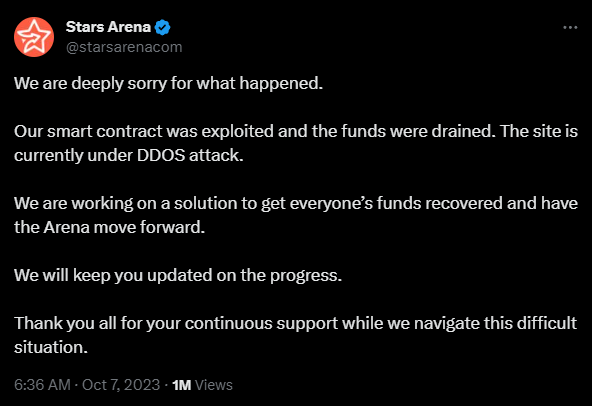
The official Stars Arena Twitter account posted a dire warning, confirming that the platform's smart contract had fallen victim to a cyberattack. The message explicitly stated: "We're actively checking the issue. DO NOT deposit any funds."
The breach was first noticed by Redline, a self-proclaimed crypto expert. Hackers had exploited the platform, siphoning off 266,103 AVAX, equivalent to roughly $2.85 million, via the FixedFloat exchange service. The repercussions of the attack rippled through the AVAX ecosystem, causing a drop in the token's price from $11.56 to $10.78. Users, in a bid to protect their assets, urged each other to remove Stars Arena from their Twitter accounts.
Hours later, Stars Arena issued an apology for the smart contract exploit. They also confirmed that they were facing a Distributed Denial of Service (DDOS) attack. The team assured users that they were actively working on a solution to recover the lost funds and allow the platform to move forward.
To address the situation, Stars Arena hosted a live Twitter Spaces session on Saturday, during which they announced, "A special white hat development team is coming in to rapidly review the security of the platform. We will re-open the contract with all the funds in full after a full security audit. This will happen very soon."
The breach occurred on the heels of a surge in transactions on Stars Arena, with the platform's volume spiking by 248% in the 24-hour period leading up to the attack. Earlier that week, the platform had also suffered an exploit that allowed hackers to make off with $2,000. Although the exploit was promptly rectified, Stars Arena made it clear they were in a battle against "malicious actors in the space who want to steal your money."
However, there is a glimmer of hope amid the turmoil. In a recent update, Stars Arena announced that they had successfully recovered approximately 90% of the lost funds. An agreement was reached with the individual responsible for the security breach. In exchange for the return of the funds, the responsible party received a 10% bounty fee plus 1,000 AVAX, which had been lost in a bridge.
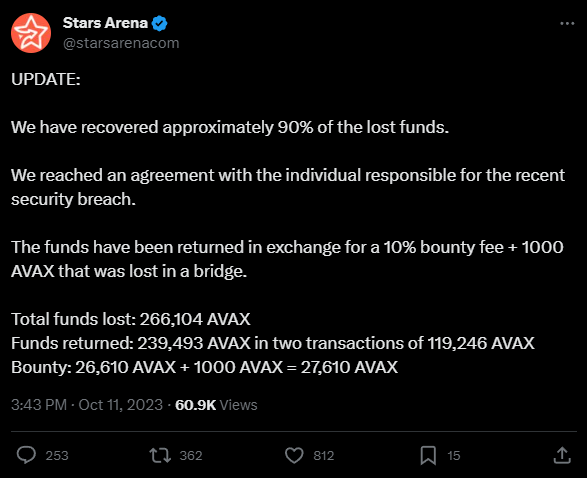
Here are the key figures: Total funds lost: 266,104 AVAX Funds returned: 239,493 AVAX in two transactions of 119,246 AVAX https://twitter.com/starsarenacomBounty: 26,610 AVAX + 1,000 AVAX = 27,610 AVAX
This turn of events marks a significant step towards recovery and redemption for Stars Arena. The platform is determined to learn from its experiences and continue its mission to provide a safe and innovative space for online communities and content creators.
Grab your early bird tickets to Rare Evo 2024!
General Admission - $100
VIP - $400
These early bird prices will go up October 24th.
VIP tickets will be airdropped our Rare Perks NFT!
Purchase Tickets Here