

Trust Wallet Chrome Extension Hack Turns a Quiet Holiday Into a $7 Million Crypto Mess 
Crypto has a way of ruining the calendar. Just when things slow down, markets calm, and people log off for the holidays, something breaks. This time it was Trust Wallet, and for some users, it broke badly.
More than $7 million in cryptocurrency was stolen after a compromised version of Trust Wallet’s Chrome browser extension made its way into circulation late last week. The losses came fast, right around December 24, when many users were updating software, traveling, or simply not paying close attention. By the time some noticed something was wrong, their wallets had already been drained.
The issue centered on a specific update to the Trust Wallet Chrome extension. On the surface, it looked like a normal release. No flashing red flags, no obvious warnings. Users installed it the same way they always do, clicking update and moving on. Somewhere along the line, though, malicious code ended up inside that release. Once active, it gave attackers a way to move funds out of users’ wallets quietly and efficiently.
What followed was a familiar pattern for anyone who has watched crypto hacks play out. Wallets that had been untouched for weeks suddenly sent out large transactions. Bitcoin, ether, BNB, and stablecoins flowed into unfamiliar addresses. Analysts tracking the blockchain could see the money moving, hopping between wallets, splitting up, recombining. It was all very visible and completely irreversible.
Trust Wallet confirmed that the breach was limited to one version of the Chrome extension. According to the company, mobile users were not affected, and neither were users who had not installed the compromised update. The company urged anyone using that version to disable it immediately and install the patched release from the official store.
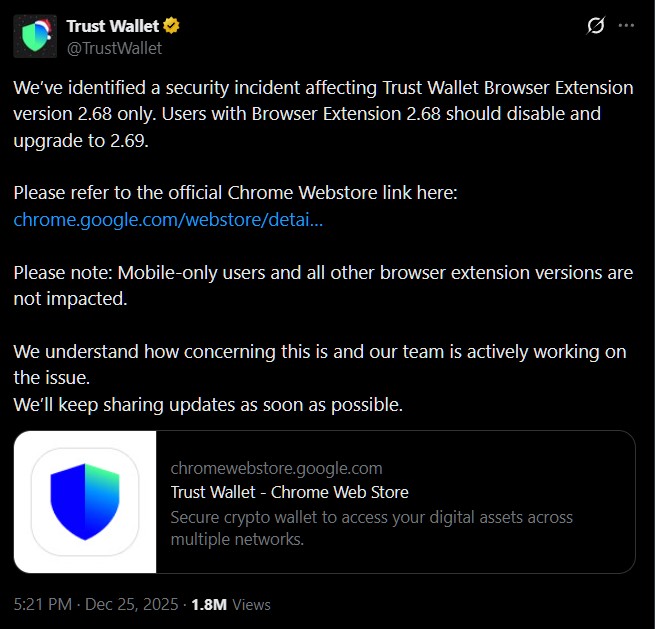
That response helped contain the damage, but it did not undo what had already happened. In crypto, there is no undo button. Once assets leave your wallet, they are gone unless the attacker decides to give them back, which is not something people tend to count on.
Adding to the response, Changpeng Zhao, the Binance co-founder whose company owns Trust Wallet, said affected users would be reimbursed while an internal investigation continues. That promise brought some relief, especially for users who lost significant sums. Still, reimbursement does not erase the bigger concern. People want to know how a malicious update made it through in the first place.
Security researchers were already digging in by the time official statements came out. Some noticed odd wallet activity tied to recent extension updates. Others began pulling apart the extension code, looking for scripts that could leak private data or trigger unauthorized transactions. Warnings spread quickly across social platforms, security channels, and group chats. In crypto, news like this moves faster than press releases.
The episode once again highlighted a long standing weakness in crypto infrastructure. Browser wallet extensions are incredibly popular because they are easy. They connect seamlessly to decentralized exchanges, NFT platforms, and Web3 apps. For many users, they are the default way to interact with crypto on a daily basis. But that convenience comes with risk. Extensions live inside browsers that were never designed to protect private keys holding real money.
A single compromised update can affect thousands of users at once. Unlike phishing attacks that rely on tricking individuals one by one, an extension issue scales instantly. If the update is trusted, users trust it too.
This is why security experts keep repeating the same advice, even if it sounds boring. Large balances should not live in hot wallets. Browser wallets are tools for interaction, not vaults. Hardware wallets and cold storage are slower and less convenient, but they dramatically reduce the risk of exactly this kind of event.
In the aftermath, users have been urged to take several steps. Disable the affected extension. Review transaction histories carefully. Revoke token approvals that might still be active. In some cases, move remaining funds to an entirely new wallet with a fresh seed phrase that was never exposed to the compromised environment. None of this is fun, but waiting is usually worse.
There is also a broader reputational cost. Trust Wallet is one of the most widely used non-custodial wallets in the world. Incidents like this shake confidence, even if the company responds quickly and makes users whole. For newer users especially, it reinforces the idea that crypto is complicated, risky, and unforgiving.
The investigation into how the compromised extension was approved and distributed is still ongoing. Questions remain about whether this was a supply chain issue, a submission process failure, or something else entirely. Those answers will matter, not just for Trust Wallet, but for the wider ecosystem that relies heavily on browser extensions.
For now, the lesson is an old one, repeated yet again. In crypto, trust is fragile. Convenience is expensive. And even during the quietest week of the year, something can go wrong fast.
Stay Connected
You can stay up to date on all News, Events, and Marketing of Rare Network, including Rare Evo: America’s Premier Blockchain Conference, happening July 28th-31st, 2026 at The ARIA Resort & Casino, by following our socials on X, LinkedIn, and YouTube. Tickets are available here.