
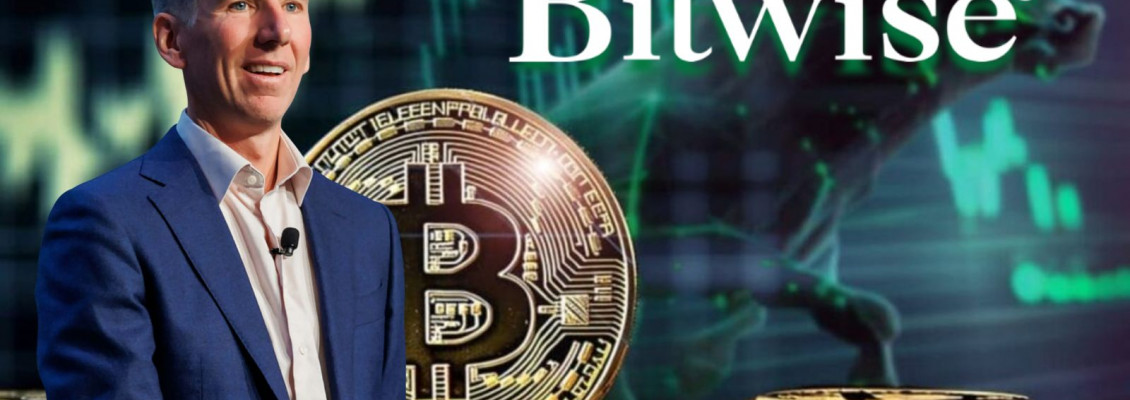
Why Bitwise Is Thinking Bigger About Crypto, and Why the Timing Matters
The crypto industry is moving into a new phase, and Bitwise Chief Investment Officer Matt Hougan believes the shift is much larger than the market realizes. His view is that the combination of regulatory changes, institutional interest, and the rise of on chain financial infrastructure is creating an environment that could redefine how global markets function.
What is striking is not just his optimism, but the level of detail behind it. Hougan is not talking about the next bull run or a temporary upswing. He is talking about a structural change that could reshape how assets move and how financial services are delivered.
A Regulatory Turn That Few Saw Coming
For years, regulation has been the main obstacle standing between crypto and traditional finance. That has started to change in a very real way. In a recent address, Securities and Exchange Commission Chair Paul Atkins presented a plan known informally as Project Crypto. Instead of focusing primarily on enforcement, the initiative outlines a path for integrating traditional markets with public blockchains.
Hougan called this the most optimistic regulatory stance he has ever seen and said it forced him to revise not just the scale of crypto’s potential, but the timeline as well. His point is straightforward. The market has not fully absorbed what a cooperative regulatory regime could unlock. Investors have priced in caution for so long that they have not adjusted to the possibility of acceleration.
Three Areas Where the Biggest Winners May Emerge
Hougan identifies three categories where he sees the strongest potential.
1. Layer 1 blockchains and core crypto networks.
If financial activity continues to move on chain, the blockchains that support settlement, tokenization, stablecoins, and decentralized financial rails could see massive growth. Hougan mentions networks like Ethereum, Solana, Cardano, Avalanche, Aptos, Sui, NEAR and others. His view is that the right approach is not to pick a single winner, but to build a diversified basket of networks that are gaining real world usage.
2. Decentralized finance protocols.
With clearer regulatory treatment, DeFi could move from a niche set of applications to the backbone of a new financial system. Protocols that automate trading, lending, borrowing, derivatives, and stablecoin issuance could scale far beyond their current user base. Hougan believes that once regulatory friction drops, institutional participation could flow in rapidly.
3. Financial super apps.
This is one of the most ambitious parts of the projection. Hougan believes new platforms will combine traditional finance and crypto into a single interface. Instead of having brokerage accounts in one place, bank accounts in another, and crypto apps somewhere else, users could interact with all financial assets through one unified system. He thinks a company in this category could become the largest financial services firm in the world, potentially passing a one trillion dollar valuation.
Why a Ten to Twenty Times Expansion Does Not Sound Unrealistic
Hougan has consistently argued that crypto could deliver ten to twenty times growth over the next decade. His reasoning is not based on hype. It is based on the idea that crypto is entering a period where cycles driven by halving events or speculative trading matter less than structural factors. He believes the “four year cycle” narrative has lost relevance. What now matters is the maturation of the asset class and the integration of crypto with global finance.
In his view, the size of the market today reflects years of hesitation driven by legal uncertainty. Once that uncertainty lifts, capital could move faster than analysts expect. Institutions that have been watching from the sidelines may feel more comfortable allocating real budget to crypto infrastructure, tokens, or tokenized assets.
What Could Go Right, and What Could Still Undermine This Vision
There is no guarantee that the optimistic scenario plays out. Hougan acknowledges both sides.
What could go right:
-
Regulatory clarity could remove the largest barrier to institutional adoption.
-
Layer 1 networks with real usage could become the settlement layers of a digital financial system.
-
Super apps could reduce friction for everyday users, pulling millions more into on chain ecosystems.
-
The industry could attract capital at a scale closer to major traditional asset classes.
What could go wrong:
-
Regulatory implementation may move slower than expected, or shift again under new political leadership.
-
Some networks or protocols may fail to scale, or may lose out to competitors.
-
Macroeconomic conditions could suppress risk assets even if fundamentals improve.
-
Volatility could remain a psychological barrier for mainstream investors.
What This Means for Investors, Builders, and Policymakers
If Hougan is right, the industry is not just entering a new market cycle. It is entering the early stages of a long transformation in how financial markets operate. Investors who once tried to time cycles may need to rethink their approach and focus more on diversified exposure to infrastructure. Builders may find themselves working in an environment that is more supportive than anything they have experienced so far. Policymakers may influence the shape of global finance for decades based on decisions they make in the next few years.
It is possible that crypto still has years of volatility ahead. It is also possible that the industry is standing on the edge of the most meaningful phase of its development. Hougan’s message is that the market may be thinking too small. He believes the shift underway is not incremental. It is transformative.
Stay Connected
You can stay up to date on all News, Events, and Marketing of Rare Network, including Rare Evo: America’s Premier Blockchain Conference, happening July 28th-31st, 2026 at The ARIA Resort & Casino, by following our socials on X, LinkedIn, and YouTube.
Leave a Comment