#Bitcoin
Deutsche Bank Set to Launch Crypto Custody Service for Institutions

Deutsche Bank has just announced its plan to launch its digital asset custody solution this year, depending on how soon it completes the necessary regulatory requirements.
Making the announcement in a press release this Wednesday, the bank said the new custody solution will provide its institutional and corporate clients with secure and regulated custody services for their digital assets, with Deutsche Bank managing the clients’ wallets and private keys.
“Digital assets are not a replacement for the traditional financial system but an important complement to it. We see them as new rails that can coexist with existing market infrastructures while benefiting from the trust, security and safeguards that regulated financial institutions provide. Our aim is to offer clients a secure and regulated gateway to this evolving market,” said Gerald Podobnik, Co-Head of Corporate Bank at Deutsche Bank.
At launch, the custody solution will support only a selected range of digital assets, including Bitcoin and Ether, as well as a few stablecoin assets such as USDC, EURC and EURAU, with possible expansion to support more assets depending on clients’ demand and regulatory processes. Tokenized financial instruments are also included in the bank’s roadmap.
Security Measures to Protect Clients' Assets
To enhance the safety and security of clients’ assets under its custody, Deutsche Bank will implement multiple layers of security for the custodial solution, with the bank stating that these security mechanisms will operate under strict governance.
Among the various security measures that will be implemented to safeguard clients’ assets are secure key generation and hardware-based protection, segregation of duties, multi-person approval processes, separate warm and cold storage environments, and controlled backup and recovery arrangements.
As its initial focus, the custodial solution will be made available first to qualified Deutsche Bank institutional clients across Europe, including corporates, asset managers, hedge funds, custodians, brokers and sovereign institutions.
Block Files OCC Charter to Establish Crypto Custody Bank

Financial technology company Block Inc. has formally submitted an application to the Office of the Comptroller of the Currency (OCC) to establish Builders Bank & Trust, N.A. (“Builders Bank”), an uninsured national trust bank.
If approved, the charter will enable Block to operate as a federally regulated national trust bank under the supervision of the OCC, allowing it to provide fiduciary and custody services for digital assets such as Bitcoin and stablecoins.
“Combining Block’s digital asset expertise, our experience with Square Financial Services, and the deep banking expertise of our team, we believe Builders Bank is well positioned to support Block’s broader vision of economic empowerment,” said Lee Woolley, who is expected to serve as president and CEO of Builders Bank.
Although the charter will not allow Builders Bank to accept customer deposits or make loans like traditional banks, if approved, it will enable the bank to operate as an uninsured, non-deposit taking national trust bank under the OCC’s regulatory framework.
Block’s application comes at a time when several financial institutions have made similar filings with the OCC to establish national trust banks.
Just last month, digital asset infrastructure provider Zero Hash applied to establish a national trust bank focused exclusively on digital assets. The application followed similar filings by fintech firm Dakota, Catena, and Payward in preceding months.
President Trump-backed World Liberty Financial and Sony Bank also recently received conditional trust charters from the OCC to establish national trust banks, while stablecoin issuer Circle was granted a New York trust charter.

UK’s Largest Investment Platform Begins Offering Crypto ETNs

Hargreaves Lansdown, the UK’s largest retail investment platform, has begun listing Bitcoin and Ether exchange traded notes (ETNs) for its roughly 2 million clients.
The listing, which comprises nine crypto ETNs from major issuers, including BlackRock’s iShares, WisdomTree, 21Shares, Invesco, CoinShares, and Bitwise, comes shortly after the Financial Conduct Authority lifted its four year ban on UK investors buying crypto ETNs in October 2025.
Eligible clients will now be able to buy, hold, and sell regulated Bitcoin and Ether exchange traded notes (ETNs), which track the prices of Bitcoin and Ether. Since the crypto ETNs only directly track the prices of the underlying cryptocurrencies, clients do not own the underlying assets.
Regarding the launch, Doug Abbott, Hargreaves Lansdown’s chief product officer, told the Financial Times, “We want clients to … understand what they are investing in,” adding that there would be the “right level of friction” involved in the buying process, given that highly volatile cryptocurrencies are not suitable for everyone.
According to Abbott, the launch of the ETNs followed consistent inquiries about the products from its sophisticated user base. The firm also said that the necessary security measures were already in place to ensure that the platform was safe and ready to support the ETNs.
About Hargreaves Lansdown
Hargreaves Lansdown is the UK’s largest direct to consumer retail investment platform, allowing private investors to save, invest, and manage their pensions. Through its app and platform, Hargreaves offers a wide range of products, including Stocks and Shares ISAs, SIPPs (self invested personal pensions), Fund and Share dealing accounts, cash savings, and ETFs.
Although Hargreaves had long held a cautious and skeptical view of cryptocurrencies and had frequently downplayed the economic relevance and potential of Bitcoin, it has had to adjust its position, particularly amid the rapid mainstream adoption of cryptocurrencies. This shift is evident in the launch of its crypto ETN offering.
Standard Chartered Launches Institutional Spot Trading in the UAE

Standard Chartered, the British multinational banking and financial services group, has expanded its presence in the UAE by launching institutional spot trading for Bitcoin and Ether.
While this is not the first time institutional BTC and ETH spot trading has been launched in the UAE, Standard Chartered’s launch is unique, as it is the first Global Systemically Important Bank (G-SIB) to offer institutional Bitcoin and Ether deliverable spot trading in the region and is currently the only global bank offering such capabilities in the Emirates.
By launching these institutional grade spot trading services, Standard Chartered enables eligible institutional clients to access deliverable Bitcoin and Ether spot trading through its electronic trading channels.
“The UAE has developed a clear digital assets regulatory framework that supports institutional participation and innovation,” Rola Abu Manneh, Chief Executive Officer, UAE, Middle East and Pakistan at Standard Chartered, said.
“Extending our Bitcoin and Ether spot trading capability to institutional clients is a significant step in broadening our regulated digital asset proposition in the market. By combining execution with secure custody, governance and the connectivity of a global bank, we are providing clients with a more integrated way to participate in digital asset markets.”
The launch of Standard Chartered’s institutional spot trading service came just a few days after the bank became the first authorized bank distributor of the HKD-backed stablecoin developed by Anchorpoint Financial Limited.
Standard Chartered has also been involved in several pro crypto and tokenization friendly moves, launches and partnerships. Notable among these was its acquisition of Zodia Custody in May, a move designed to support institutional clients.

Coinbase Launches Derivatives Contracts in Canada

Global cryptocurrency exchange Coinbase has launched derivatives contracts for eligible Canadian investors seeking to trade and speculate on a trusted platform.

The derivatives contracts, which will be offered through Coinbase Financial Markets, are the first of their kind from a crypto native platform in Canada, giving investors access to highly liquid and regulated contracts, including 23 perpetual and dated futures covering assets such as Bitcoin, ETH, and SOL; five commodity futures covering gold, silver, and oil; and index futures.
Regarding the features of the newly launched derivatives contracts, Coinbase said in a blog post that the contracts are regulated by its financial markets arm, an entity registered with the U.S. Commodity Futures Trading Commission (CFTC). The contracts will also be flexible, with nano sized contracts designed for investors with lower upfront capital requirements.
Coinbase’s derivatives contract launch comes at a time when the exchange has rolled out more customizable charting and interface features on Coinbase Advanced.
Rather than forcing every trader to use the same chart setup, the rollout is aimed at making it easier for traders to customize their trading screens. Traders can switch between candlestick and line charts, change time frames, adjust chart settings and technical indicators, and use drawing tools.
The benefits of these features are that traders can spot market trends faster, identify potential entry and exit points, and analyze market movements more effectively.

BlackRock & Fidelity Taking Over Bitcoin ETF Market

When U.S. spot bitcoin exchange-traded funds launched in January 2024, the thinking was pretty straightforward: a dozen or so competing products, a level playing field, and investors picking winners over time. Eighteen months in, that vision has not quite held up. What has emerged instead looks a lot more like a two-firm market, and it is getting more concentrated by the month.
BlackRock's iShares Bitcoin Trust (IBIT) and Fidelity's Wise Origin Bitcoin Fund (FBTC) are now pulling in the overwhelming majority of new institutional capital flowing into the space. The data tells the story plainly. On January 14 of this year, total bitcoin ETF inflows hit $840.6 million, according to Farside Investors. IBIT alone captured $648.4 million of that. FBTC added another $125.4 million. Between them, the two funds accounted for more than 90 cents of every dollar that entered the market that day.
That was not a fluke. On April 17, when total inflows reached $663.9 million, IBIT and FBTC again represented roughly two-thirds of the total. By May 1, the same pattern repeated: combined flows from the pair neared $500 million out of a $629.8 million total. Day after day, the numbers point in the same direction.
Scale Is the Whole Game
The dominance comes down to a few structural advantages that are basically impossible for smaller players to replicate in the short term. BlackRock manages over $10 trillion in assets globally. It has deep, pre-existing relationships with thousands of wealth management platforms, financial advisors, family offices, and institutional allocators. Fidelity brings similar firepower through its massive retail brokerage network and deep roots in retirement savings. Both funds also benefit from the kind of liquidity and trading depth that large institutions need when moving big positions without significant slippage.
IBIT currently commands roughly $54 to $67 billion in assets under management depending on the reporting date, representing close to half of the entire U.S. spot bitcoin ETF market by AUM. FBTC sits in a distant second at around $17 to $18 billion. Together, the pair controls the vast majority of the institutional bitcoin allocation pie, leaving Grayscale's GBTC, Ark's ARKB, Bitwise's BITB, and others fighting over what's left.
For professional allocators, the decision often comes down to factors that have nothing to do with bitcoin itself. Liquidity, bid-ask spreads, trading volume, and issuer reputation weigh heavily. On those metrics, IBIT and FBTC clear the bar for most institutional risk frameworks. Many of the other funds, frankly, do not even come close.
Smaller Funds Are Getting Squeezed Out
The casualty list is getting longer. Funds from Franklin Templeton, VanEck, WisdomTree, and Valkyrie are now regularly posting daily flows measured in single-digit millions, or occasionally not appearing in the inflow tallies at all. Their presence in the market is becoming more of a footnote than a force. Earlier this year, Trump Media and Technology Group scrapped plans for its own spot bitcoin ETF entirely, an early sign that new entrants have correctly sized up what they would be walking into.
This consolidation has been particularly visible during the more turbulent stretches of 2026. Bitcoin is down roughly 29% year-to-date, and the broader ETF complex has lived through several waves of heavy redemptions, including a rough patch between mid-May and early June. During those selloffs, outflows have hit all the major funds, but IBIT has consistently absorbed smaller losses relative to its peers, and in some cases remained net positive on days when rivals saw significant withdrawals.
The Grayscale Factor and What It Tells Us
Worth remembering: when Grayscale converted its GBTC from a closed-end trust to a spot ETF in January 2024, the fund bled roughly $17.5 billion in cumulative outflows as investors rotated away from its 1.5% fee toward cheaper alternatives. The primary beneficiaries of that rotation were IBIT and FBTC, both at 0.25%. That rotation was arguably the founding event that cemented today's hierarchy, and it has proven remarkably sticky.
Both products hold physical bitcoin. Both carry similar expense ratios. Both have comparable tracking records. The difference is distribution, pure and simple. BlackRock and Fidelity had the pipes already built when spot approval came through. Everyone else was starting from scratch.
A Winner-Take-Most Market Takes Shape
What is unfolding in the bitcoin ETF market looks less like a competitive landscape and more like the dynamics you see in index fund or money market businesses, where scale and distribution create a self-reinforcing advantage. The bigger IBIT gets, the more liquid it becomes. The more liquid it becomes, the more institutions gravitate toward it. And the more institutions hold it, the harder it becomes for smaller products to pull capital away.
The implications for smaller issuers are not great. They are not going to disappear overnight, but their ability to influence market direction or attract meaningful institutional allocations looks increasingly limited. Barring a significant product innovation or fee shock, the bitcoin ETF market appears to be settling into a structure where BlackRock and Fidelity call the shots, and everyone else fills out the margins.
For the wide market, that concentration cuts both ways. It means greater stability and predictability from two well-capitalized, highly visible issuers. It also means that sentiment at BlackRock and Fidelity, more than anywhere else, will determine the direction of institutional bitcoin flows for the near future.

Saylor Signals Bitcoin Buy as Strategy Pushes STRC Vote

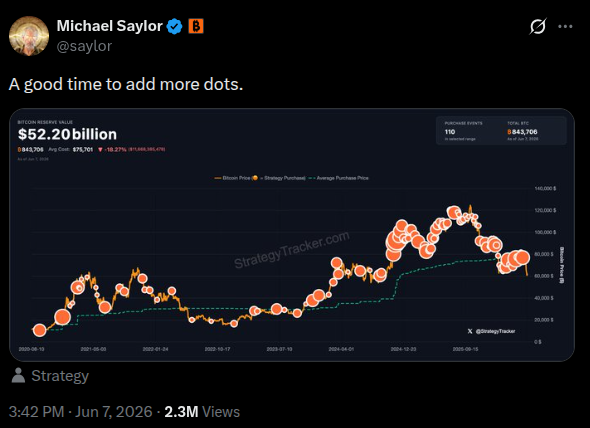
Michael Saylor did what he always does before Strategy opens its wallet. On Sunday morning, the executive chairman of the world's largest corporate Bitcoin holder posted a bubble chart to X.com, this one captioned "A good time to add more dots". For anyone who has followed Strategy long enough, the move reads like clockwork: Saylor posts the orange-dot chart, and a purchase filing with the SEC follows within days.
The post landed alongside a more pressing piece of company business. Strategy is asking its retail shareholders to approve a change to dividend payment frequency on its STRC perpetual preferred stock, shifting from monthly to semi-monthly payouts. The proxy vote deadline is June 8, and as of Sunday, the company was still scrambling to drive participation from a base that has historically been slow to engage.
The Orange Dot Chart and What It Means
Strategy's orange-dot chart has become one of the more recognizable signals in digital asset markets. Each bubble represents a Bitcoin purchase, with larger circles tied to larger acquisitions. The clustering of oversized dots across late 2024 and into 2025 visually narrates what has become an aggressive, almost relentless accumulation campaign.
At the time of Saylor's Sunday post, Strategy held 818,869 BTC, with a total reserve value of roughly $64 billion based on dashboard figures. Bitcoin was trading near $78,262 at the time, putting the company's per-share BTC equivalent at 213,391 satoshis. MSTR stock had closed Friday at $177.42, down 5.11% on the week, with a market cap of $62.31 billion and an enterprise value of $81.85 billion.
By mid-afternoon on Sunday, the post had racked up 2.3 million views. CEO Phong Le added his own endorsement, writing that the company's goal remains to "increase net Bitcoin and Bitcoin per share over time." The confirmation from two senior executives in one afternoon removed any ambiguity about the direction of travel.
The signal proved accurate. Strategy subsequently filed an 8-K confirming it had purchased 24,869 BTC for approximately $2.01 billion between May 11 and May 17, at an average price of $80,985 per coin. That brought total holdings to 843,738 BTC, funded in part through at-the-market sales of MSTR shares and proceeds from STRC preferred stock issuances.
The STRC Dividend Vote: A Harder Sell
The buy signal was the easy part. The proxy vote has been a different story.
Strategy wants to change how it pays dividends on STRC, its Variable Rate Series A Perpetual Stretch Preferred Stock. The proposal would move payments from monthly to twice monthly. The company argues the shift would reduce reinvestment lag, improve liquidity, and cut volatility in the stock's price. Saylor put it plainly in prior remarks: going semi-monthly would provide more entry and exit points for investors, and with only 176 companies in the entire market paying monthly dividends, Strategy would distinguish itself further by going even more frequent.
The challenge is getting retail investors to actually vote. Strategy says 80% of outstanding STRC shares are held by retail investors, not institutions. That is a problem because, according to a November 2024 research note from the Harvard Law School Forum on Corporate Governance, retail holders have voted only around 29% of their shares across the last five proxy seasons. Institutional holders, by contrast, vote roughly 77% of their shares.
Ahead of the June 8 deadline, both Saylor's personal account and Strategy's official social media channels were actively nudging holders to submit their ballots. The company had already scheduled a live Q&A with Saylor and CEO Phong Le on May 20 in an effort to build awareness. Strategy also engaged proxy solicitor Alliance Advisors to help drive participation, though the firm had not disclosed a vote count as of Sunday.
Context: Financing, Volatility, and a Quarterly Loss
The dual push comes at a complicated moment for Strategy. The company reported a quarterly net loss of roughly $12.5 billion earlier in the year, a figure driven largely by unrealized BTC valuation swings rather than operational trouble. Still, the headline spooked some corners of the market and briefly renewed debate over the sustainability of the company's treasury model.
Adding to the noise, Strategy had on May 15 announced an agreement to repurchase approximately $1.5 billion of its 0% convertible senior notes due 2029. The filing noted that sources of funds for the repurchase could include cash reserves, securities-sale proceeds, and Bitcoin-sale proceeds. That last option rattled traders briefly, given that any hint of BTC liquidation from the world's largest corporate holder tends to move markets.
Options activity around MSTR reflected the heightened attention. Open interest in MSTR-linked options stood at $49.49 billion heading into the weekend, with implied volatility at 60% and historical 30-day volatility at 71%. For a company that is, at its core, a leveraged Bitcoin position wrapped in a corporate structure, those figures are not out of the ordinary. But they do underscore how closely the market tracks Saylor's every post.
What Comes Next
The STRC dividend vote wrapped June 8, with results to be disclosed by the company in the following days. Whether the proxy measure passed likely hinges on how many retail holders bothered to log in and click a button, a notoriously difficult outcome to engineer without institutional guardrails.
As for the Bitcoin buying, the confirmed $2 billion purchase puts Strategy's total cost basis at roughly $63.9 billion, with an average acquisition price of $75,700 per coin. At current levels, that implies a paper gain in the low billions, and a holdings base now equivalent to more than 4% of Bitcoin's fixed 21 million supply cap. For Saylor, the orange dots keep getting bigger. The question for everyone else is whether the strategy holds if the market really turns and we see much much lower prices.

Kalshi Wins Approval for US Bitcoin Perpetual Futures

For years, perpetual futures have been crypto's most traded instrument and almost none of that volume has touched U.S.-regulated infrastructure. Until now. The Commodity Futures Trading Commission (CFTC) formally approved KalshiEX to list BTCPERP, a no-expiry Bitcoin perpetual futures contract tied to spot BTC prices. On the same day, the agency's Market Participants Division issued a staff-level interpretation clearing Coinbase Financial Markets to route U.S. customers to certain derivatives on Deribit, its offshore affiliate. Two very different regulatory moves, made on the same morning, pointed at the same underlying problem: American traders have been effectively locked out of the largest segment of global crypto markets.
CFTC Chairman Mike Selig framed the Kalshi order as delivery on a specific commitment to onshore crypto perpetuals, describing the move as a path for one of the most liquid segments of the crypto asset markets to exist inside the U.S. regulatory framework. Coinbase CEO Brian Armstrong put a number to the problem his company says it is solving: until now, U.S. users have been locked out of roughly 80% of global crypto markets, which includes perpetual futures and options. Coinbase cited Deribit's more than $185 billion in July 2025 trading volume and approximately $60 billion in open interest at the time of acquisition to illustrate the scale of what domestic traders could not legally access through regulated channels.
What the CFTC Actually Approved
BTCPERP is a cash-settled contract referencing the U.S. dollar spot price of one Bitcoin, as tracked by the CF Benchmarks Bitcoin Real Time Index. It trades in units of one ten-thousandth of a BTC, runs 24 hours a day, seven days a week, and has no fixed expiry date. Traditional futures converge toward their underlying asset at expiration because physical delivery or final cash settlement pulls the contract to spot. A perpetual has no such date, so the convergence mechanism operates continuously through periodic funding payments between long and short holders. If the contract trades above spot, longs pay shorts. If it trades below, shorts pay longs. The economic pressure keeps the perpetual price tracking Bitcoin in real time.
The CFTC's approval leans heavily on Bitcoin's specific market structure as its justification. The order notes Bitcoin's deep, active, and continuous spot trading across broadly distributed venues, with pricing observable around the clock. That depth is what makes the funding rate mechanism credible: arbitrageurs can act while the perpetual is live, since the underlying spot market never closes. The agency was explicit that this reasoning applies to Bitcoin and to similarly structured digital commodities with comparable market depth. Other assets will need to go through a separate review. Bitnomial had previously received certification for a product labeled a perpetual futures contract, but that contract carried a 25-year term limit and is considered a different structure. BTCPERP is the first true no-expiry perpetual to receive a Commission-level order.
Two Paths, Very Different Weight
The distinction between the Kalshi approval and the Coinbase staff letter matters more than it might look at first glance. Kalshi's BTCPERP is a Commission-issued order under Section 5c(c)(4) of the Commodity Exchange Act and Regulation 40.3. That is formal product approval, with binding legal weight and a clear compliance framework. Coinbase's route is different in kind. The Market Participants Division issued an interpretation and a no-action position in response to Coinbase Financial Markets. Staff confirmed that certain Deribit digital commodity derivatives may be categorized as foreign futures under Regulation 30.1, and said it would not recommend enforcement action under specified conditions tied to how customer digital assets and stablecoins are handled as margin through Coinbase affiliates.
Staff letters are conditional by design. The CFTC was clear: these positions represent the Market Participants Division only, are not binding on the Commission, and can be modified, suspended, or terminated. The Coinbase path is useful for reaching scale quickly because it connects U.S. clients directly to Deribit's existing liquidity pool, which is among the largest in global crypto derivatives. But it carries a thinner precedential footprint. Coinbase said institutional onboarding to Deribit options has already begun, with perpetual futures access and broader retail availability described as coming later, without a hard timeline. Retail access is expected to carry additional eligibility criteria and risk disclosure requirements.
The Liquidity Question Nobody Can Answer Yet
Regulatory clearance is the easy part. Getting traders to use a U.S. regulated perpetual when Binance, Bybit, and OKX offer the same exposure with deeper order books and, in most cases, higher leverage, is the actual test. Offshore exchanges process billions of dollars in Bitcoin perp volume on a slow day. The CFTC has been working toward this moment for over a year, issuing a formal request for comment in April 2025 on perpetual derivatives, their benefits, risks, market integrity implications, and customer protection questions. The approvals are, in that sense, the policy answer to the RFI. The market answer comes when Kalshi's BTCPERP goes live and traders decide whether regulated access at U.S. leverage limits is a compelling enough trade-off.
The CFTC's case-by-case stance on future perpetual approvals means the template is now set, but the runway is not yet cleared. Ethereum perps, Solana perps, and other digital assets with sufficient spot market depth could follow, but each application needs to clear the same review process independently. Kalshi separately indicated it plans to launch perpetual contracts on more than a dozen currencies pending additional regulatory reviews. CME's parallel push toward 24/7 crypto futures and options trading adds another dimension to the picture: traditional derivatives infrastructure is adapting to match crypto's always-on market structure, while crypto-native exchanges now have a formal path to operate inside U.S. regulatory boundaries. Whether the liquidity follows is a question of product quality, margin efficiency, and distribution reach, and none of that gets answered in an approval order.
The next signals are practical: Kalshi's launch terms and funding rate performance, Coinbase's timeline for rolling out perpetual futures through CFM, how retail access gets structured, and whether formal rulemaking eventually hardens the current agency posture into something more durable. For now, U.S.-regulated Bitcoin perps exist. Whether they can actually compete is the harder question, and the market will answer it faster than any regulator. It usually does.
U.S. Seizes $1B in Crypto From Iran

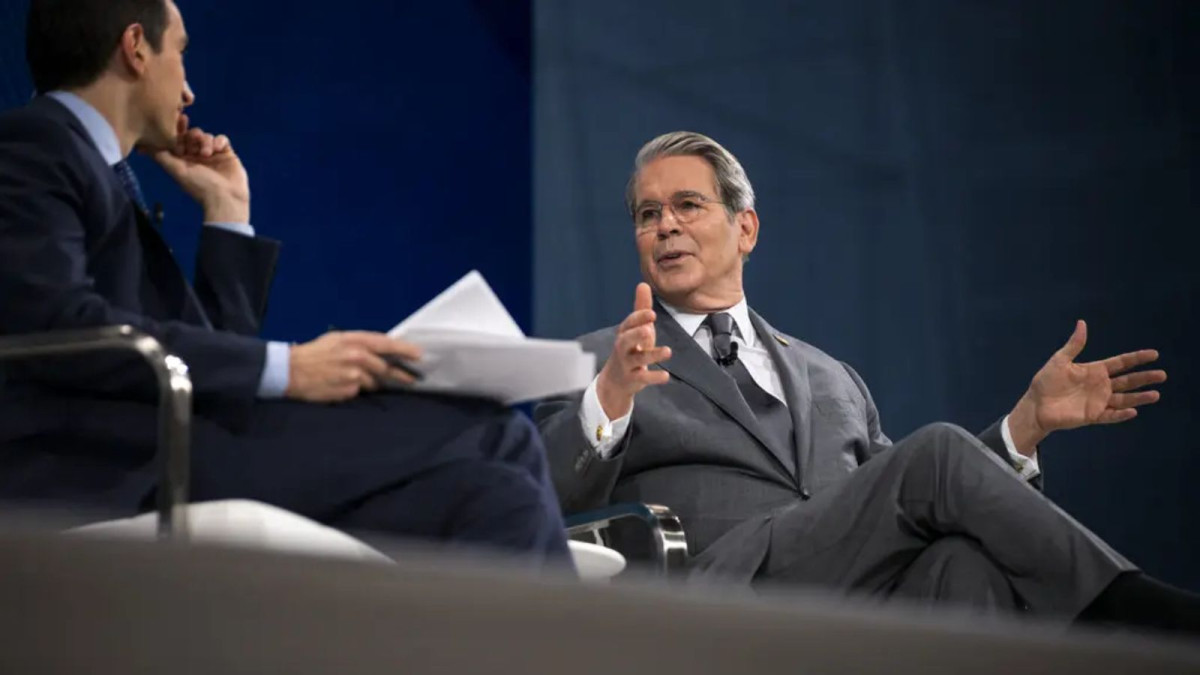
Speaking at the 2026 Reagan National Economic Forum in Simi Valley, California, Treasury Secretary Scott Bessent told Fox Business host Larry Kudlow that the United States has seized roughly $1 billion worth of cryptocurrency from entities linked to Iran's military since conflict broke out in February.
"We just outright grabbed the wallets," Bessent said. "Some of them may be typing in right now, and they might not have realized that their wallet had been grabbed."
Operation Economic Fury
The seizures Bessent referenced didn't happen overnight. They are the product of a campaign called Operation Economic Fury, a Treasury-led financial pressure initiative that kicked off around March 2025 under the Trump administration's direction. The goal, broadly, has been to cut off Iran's ability to move money internationally by targeting its revenue streams, weapons funding infrastructure, and sanctions evasion networks.
Before this campaign intensified, Iran had reportedly been routing $400 million to $500 million per month through crypto, primarily USDT on the Tron blockchain, to fund oil sales and Islamic Revolutionary Guard Corps operations. It's a shadow banking pipeline built on a stablecoin that, for various reasons, became the preferred dollar substitute in sanctioned economies around the world.
The Treasury's Office of Foreign Assets Control has since sanctioned more than 1,000 Iran-linked entities and wallet addresses. It has also gotten some notable help from the private sector.
Tether as a Sanctions Tool
On April 24, 2026, Tether froze $344 million in USDT across two Tron blockchain addresses tied to Iran's IRGC and the Central Bank of Iran. One wallet held approximately $213 million; the other, $131 million. Blockchain analytics firm Chainalysis had flagged the addresses based on on-chain patterns consistent with known Iranian military wallets, and the freeze was coordinated directly with U.S. law enforcement and updated OFAC designations published the same day.
USDT circulates heavily on Tron precisely because it became a preferred rail for cross-border transfers in regions where traditional dollar-based banking is unavailable or restricted. By working with Tether to freeze those wallets, the Treasury effectively turned the world's largest stablecoin into a live sanctions enforcement mechanism. That's a significant shift in how financial pressure campaigns work in the digital asset era.
The implications go beyond Iran. Tether's cooperation confirms, in practice, that USDT is not a neutral financial instrument. It is subject to the same policy levers as the dollar-based correspondent banking system it was often pitched as an alternative to.
Bitcoin, Hormuz, and the Limits of "Untraceable" Crypto
The IRGC's crypto ambitions have not been limited to stablecoins. In April, the Financial Times reported that Iran was planning to require oil tankers passing through the Strait of Hormuz to pay transit fees in Bitcoin. An Iranian official quoted at the time said the fees "can't be traced or confiscated due to sanctions." That quote aged poorly.
This month, Iran's state-affiliated Fars news agency reported that the IRGC promoted a Bitcoin-settled maritime insurance platform called Hormuz Safe. The scheme is a direct response to the ongoing blockade of the waterway, through which roughly 20% of the world's oil flows. With oil revenues choked and the regime under mounting financial pressure, digital assets have become one of the few remaining channels to keep funds moving.
Bessent did not directly link the $1 billion in seizures to the Bitcoin toll scheme. He also did not confirm whether Bitcoin itself was among the seized assets. Those details remain unspecified. What he did confirm is that the campaign is ongoing, that the seizures are substantial, and that some of those holding the funds may still be unaware.
Legal Fallout and Frozen Funds
The frozen Tether tranche is already the subject of a legal battle. A group of American terrorism victims, families connected to a 1997 Hamas bombing in Jerusalem, filed a motion in Manhattan federal court in mid-May seeking to have the $344 million transferred directly to their attorneys. Their unpaid court judgments against Iran total more than $2.4 billion across multiple terrorism-related cases. The plaintiffs served restraining notices on Tether just three days after the original freeze.
It is a legally complex situation. Tether froze the wallets by blacklisting the addresses at the smart contract level. Whether those funds can be redirected to private plaintiffs rather than held by the government is an open question, and one that federal courts will likely spend considerable time untangling.
Where This Leaves Iran, and Crypto
Bessent's comments Friday came as negotiations over a potential ceasefire deal were apparently inching forward. Reports citing Axios indicated that negotiators had reached a preliminary agreement pending Trump's approval. Whether that changes the pace of seizures is unclear.
What is clear is that Iran's crypto holdings are larger than the seized amount. Estimates put total Iranian digital asset holdings at roughly $7.7 billion, with about half attributed to the IRGC. The billion seized so far is meaningful pressure but not a knockout blow.
For the broader crypto market, the episode lands as a reminder that the "permissionless" framing of digital assets has always had limits. When the asset is a dollar-pegged stablecoin issued by a centralized company, and that company cooperates with the U.S. Treasury, the network rails may be decentralized but the kill switch is not. That reality is going to shape how governments, firms, and bad actors all think about crypto infrastructure for years to come.

South Carolina Passes Pro-Crypto Law and Rejects CBDCs

South Carolina Governor Henry McMaster has signed a new pro-crypto bill into law that establishes a comprehensive regulatory framework for the use of cryptocurrencies.
The bill, known as Senate Bill S.163, was passed this week and creates a crypto-friendly environment for crypto use. According to the new law, individuals and businesses are no longer prohibited from accepting digital assets as payment or from using self-hosted or hardware wallets to store their crypto holdings.
By passing this pro-crypto law, the South Carolina government enhances the real-world utility of cryptocurrencies, especially in payment finance, and removes regulatory uncertainty associated with their use in commercial activities.
Since the newly enacted law exempts cryptocurrencies used for payment from any additional tax or government-imposed charges, it prevents merchants and businesses from discriminating against crypto transactions or against converting crypto into a tax-disadvantaged payment method. The result is that crypto moves further into the mainstream and its adoption increases.
The Anti-CBDC Portion of the Bill
Another important aspect of the newly enacted law is the anti-CBDC provision, which rejects the use of a government-controlled digital asset.
Under the new legislation, no state-level government parastatal, including agencies, boards, commissions, and departments, may accept or require payments in central bank digital currency (CBDC). The law also prevents these state-level entities from participating in any “digital asset” test conducted by the Federal Reserve.
The law also strongly supports crypto mining, prohibiting local governments from restricting mining in industrial zones or imposing any additional limits on mining companies beyond general noise pollution regulations.
South Carolina Becomes Latest Crypto-Friendly State
With these pro-crypto bills passed, South Carolina has joined other crypto-friendly states, such as Kentucky, Oklahoma, Arkansas, Florida, Mississippi, Montana, North Dakota, Louisiana, and Arizona, that have enacted similar laws.
In March of last year, Kentucky passed a pro-crypto bill, HB 701, into law. Just like South Carolina's new laws, the law allowed users to hold and use digital assets in self-hosted wallets or hardware wallets. The law also exempted digital asset mining companies from the requirement to obtain a money transmitter license or comply with securities regulations before operating in the state.

Congress Introduces ARMA Bill for U.S. Bitcoin Reserve

President Donald Trump's campaign promise of a Stretegic Bitcoin Reserve just took another step to being a reality today. A new piece of legislation making its way through Washington aims to permanently anchor the United States government's bitcoin holdings inside federal law, and adds in a mandatory two-decade lockup attached.
Representative Nick Begich (R-AK), joined by Democratic co-lead Representative Jared Golden (ME), introduced the American Reserve Modernization Act of 2026 on Thursday. Known as ARMA, the bill arrived in Congress with 17 original co-sponsors spanning both parties, a fact that backers have been quick to point out, given how often digital asset legislation...well almost all legislation lately, seems to stalls along partisan lines.
A Tighter Legal Framework Than an Executive Order
ARMA is essentially a legislative upgrade to the strategic Bitcoin reserve President Donald Trump established through executive order back in March 2025. That order told federal agencies to hold their seized crypto and stop the "fire sale" liquidations that characterized the prior administration's approach. But executive orders can be reversed. Statutes are a lot harder to undo, and that difference is at the heart of why Begich and his co-sponsors pushed for the bill.
"Administrations have auctioned crypto off or held it in reserve, according to the whims of the executive branch," Golden said in a statement. Under ARMA, that kind of discretion would be gone. The stockpile would carry "the weight of law."
The 20-Year Hold and the 1 Million BTC Target
Under the bill, the Treasury Department would be authorized to acquire up to 200,000 BTC per year over five years, targeting a total reserve of 1 million bitcoin, or roughly 5% of the asset's fixed supply. All holdings, including the approximately 198,000 to 328,000 BTC the government already controls from years of criminal forfeitures, would be subject to a hard 20-year minimum holding period. During that window, no bitcoin could be sold, swapped, auctioned, or otherwise disposed of, with one very narrow exception: if doing so would help reduce the national debt.
The government's existing stash came primarily from high-profile seizures including the Silk Road takedown and the 2022 Bitfinex hack recovery, in which the DOJ clawed back 94,636 BTC. A White House official, Patrick Witt of the President's Council of Advisors for Digital Assets, acknowledged at a recent conference that managing those holdings has been messy. "We've heard stories and confirmed some of them of cold wallets that were being stored in drawers of desks in various agencies," he said. ARMA would consolidate all federally held digital assets under Treasury oversight and require proof-of-reserve reporting to bring transparency to what is currently a very scattered procedure.
Budget-Neutral by Design, But Skeptics Remain
The bill's drafters say new bitcoin purchases would be funded through Federal Reserve remittances and other budget-neutral financial mechanisms, sidestepping the politically charged question of whether taxpayer money would foot the bill. That type of framing was important for bipartisan appeal, and it seemed to work, for the most part. There will always be skeptics when it comes to this bug of a shift in tradition U.S. monetary policy. Treasury Secretary Scott Bessent already threw cold water on agency-level purchases earlier this year, a signal that the White House and Congress may not be entirely aligned on the mechanics.
Begich drew a parallel to gold when defending the reserve concept to Fox Business. "When you look at gold, it is the dominant precious metal reserve," he said, making the case that bitcoin occupies an analogous role in the digital asset class. Strive CEO Matt Cole went further, calling ARMA "the single most important crypto legislation" that could emerge from Washington. A very dramatic statement, given the GENIUS and CLARITY Bills.
A Long Road Ahead
For all the bullish hype, ARMA is still just a bill. It needs committee action, alignment with a parallel Senate effort backed by Senator Cynthia Lummis, and floor votes in both chambers before it becomes law. The Senate Banking Committee recently passed the separate CLARITY Act with a 15-9 bipartisan vote, sending it to the Senate floor and setting a somewhat hopeful tone for crypto legislation broadly. We'll see whether that positive momentum carries over to a bill asking the federal government to buy and hold a trillion-dollar's worth of bitcoin for two decades.
At current prices, the U.S. already holds more than $25 billion in bitcoin, making it the largest national holder of the asset in the world. ARMA would formalize that position and potentially expand it dramatically. If Congress is ready to make this bet, in statute and for the long haul, is debatable. But even the discussion of doing something like this is extremely positive in my opinion.
Poland Passes MiCA Bill Amid Zondacrypto Collapse

Lawmakers in the lower house of the Polish parliament, the Sejm, have passed a bill implementing the European Union Markets in Crypto Assets Regulation (MiCA), amid a probe into the collapse of Zondacrypto, the country’s largest cryptocurrency exchange.
The passage of the bill marks a third attempt after the president vetoed earlier versions proposed by lawmakers. Following the latest parliamentary approval, the bill now awaits the president’s decision before it can become law.
The Polish government has until July 1, 2026, the end of the transitional period, to implement the MiCA framework. If the deadline is missed, virtual asset service providers risk having their licenses expire. Without valid authorization, crypto firms in Poland would no longer be permitted to provide crypto asset services to clients in Poland or across the European Union.
As a result, affected companies may be forced to shut down their operations in Poland or relocate to another EU member state in order to obtain a crypto asset service provider license, which is generally more costly and time-consuming. This requirement applies primarily to domestic crypto entities, while foreign crypto companies operating in Poland are expected to remain unaffected by this policy.
Zondacrypto Collapse
The passage of the bill adopting MiCA comes as Polish prosecutors have launched an investigation into the collapse of Zondacrypto, the country’s largest cryptocurrency exchange.
Zondacrypto has halted withdrawals for thousands of users since December 2025, leaving many unable to access their funds. According to Polish authorities, about 30,000 users have been affected, with estimated losses exceeding 350 million zlotys ($95.93 million).
Amid Zondacrypto’s financial struggles and its admission that it lost access to a cold wallet holding about 4,500 BTC, allegedly linked to its former CEO, who has been missing since 2022, Polish Prime Minister Donald Tusk has alleged that the exchange’s collapse is linked to fraud and its existing ties with Russian mafia groups.
According to Tusk, Zondacrypto’s success comes from “Russian money linked to the so-called Bratva Mafia group and Russian intelligence agencies.” Describing its roots as sinister, Tusk accused Zondacrypto of sponsoring right-wing opposition politicians. By advancing the bill supporting MiCA, Tusk aims to reduce the ease with which cryptocurrencies are used to finance sabotage activities in the country.